
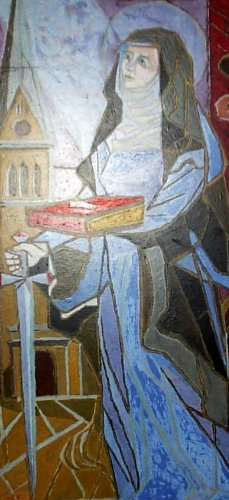
Helena of Sköfde (d. 1164, also called Helen or Elin)[1] was a Swedish saint and patron to what is now Västergötland, in southwest Sweden, where she was born. Her father might have been a duke (or jarl) named Guthorm.[2][3] Helena was widowed at a young age, but instead of remarrying, she “devoted herself to works of charity and piety, keeping her gates open to the poor, and clothing them”.[2] She also built, at her expense, most of the church in Sköfde in southcentral Sweden.[3] According to hagiographer Agnes B. C. Dunbar, she built a portico between the church and its tower, and when asked about its purpose, replied, “God will give us some saint whose body and relics can be suitably placed there”.[2] Eventually, she was interned there. The church, which was named for her since the Middle Ages, was burned down during the city’s fire in 1759, was rebuilt on its original foundations, and is still used today. Helena’s burial chamber is located in the oldest part of the church.[1]
Helena had a dream, while visiting Götene in western Sweden, that the village’s church, with her in it, flew away to Sköfde. She interpreted the dream as a prediction that she would die in Gotene and be buried at Sköfde, which, as Dunbar reported, “eventually happened”.[2] In about 1164, her daughter’s husband, while Helena was on a pilgrimage to Jerusalem, was killed by his servants, who admitted to it but claimed that Helena had incited them to do it.[2][3] His family became her enemies and persecutors; one of them, while she was visiting Gotene “for indulgences to the consecration of the church of Gotone”,[2] stabbed and killed her.
Go here to read the rest.

