
“As there is a multiplicity of creatures on earth, so there may be other beings, intelligent, created by God. This does not conflict with our faith, because we cannot put limits on the creative freedom of God…How can we rule out that life may have developed elsewhere? Just as we consider earthly creatures as ‘a brother,’ and ‘sister,’ why should we not talk about an ‘extraterrestrial brother’? It would still be part of creation.” Rev. Jose Funes (2008, then Director of the Vatican Observatory), “The Extraterrestrial is My Brother“
INTRODUCTION—”THE GOD OF THE GAPS” ARGUMENTS
If I judge correctly from comments on the previous two articles in this series (see here and here), some faithful Catholics will strongly disagree with Fr. Funes. And, as I’ll explain below, I myself have reservations about the existence of “ET brothers.” In this third article, I’ll present some theological considerations, taken from the 2021 SCS Conference and from my own reflections.
Before discussing theology, let me summarize some of the information from the previous articles on the likelihood of life outside the earth. In arguing questions like this, materialists tell us not to invoke a “God of the Gaps.” That is to say, if there is no apparent “natural” mechanism to explain some phenomenon, we should not, therefore, ascribe it to a miracle wrought by God. In general, I agree with this limitation. Nevertheless, the gaps are there. So, I’ll start by listing some of these apparent gaps, bottlenecks in our understanding of where life (and intelligence) comes from.
ORIGIN OF LIFE BOTTLENECKS
As several of the SCS talks showed, simple molecules are present in interstellar space. Prof. Shingledecker termed these (see figure below) “pre-biotic molecules.”
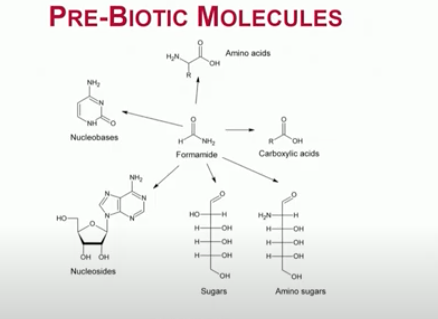
from Shingledecker, SCS 2021
These simple molecules are the biotic building blocks—amino acids, sugars, nucleotides—which form the larger molecules, biopolymers: proteins, DNA, RNA, lipids, that are molecular biology. How this step might occur is still a mystery at this time.
The next step is assembling these biopolymers into a cell, biopolymers enclosed by a wall, a membrane of phospholipids, and protein channels. The mechanism for this step is also a mystery, and in my opinion, likely to remain one. Are there other bottlenecks? In her talk, Prof. Karin Oberg suggested there might be one more, the formation of animals from single cells. Here’s the reasoning: it took only about 700 million years for the first life to be formed after earth became a planet (from about 4.5 billion to 3.8 billion years ago). On the other hand, several billion years elapsed before that first life developed into the wealth of animal forms arising in the Cambrian explosion (approximately 520 million years ago).
And there is, I suggest, another bottleneck: a rational being capable of wondering about origins and purpose in life. Let’s discuss that below.
THE GAP BETWEEN ANIMALS AND HUMANS
“Speak, and I will baptize thee.” The Bishop of Polignac on seeing a live chimpanzee (early 17th century); from “The Gap,” by Thomas Suddendorf.
Even though we classify humans as animals, there are still gaps between them, of a kind, not degree. Language is one such. And by “language,” I do not mean simply communication. Rather, there is grammar, syntax, and semantics. One speaker at the SCS conference put the difference succinctly: animals communicate by imperatives, humans by declaratives. Moreover, in language, humans use reference elements, recursive modes, and abstractions. For a clear and complete description of the differences between animal communication and human language, see “Do Dolphins have a language?” Also, there is a genetic marker for the language gap, the FOXP2 gene.. Family disorders in talking and understanding speech are correlated with genetic mutations of this gene. FOXP2 genes similar to those for homo sapiens have been found in Neanderthal DNA, but not in that of other humanoids or primates.
Besides language, there is art. Prof Oberg pointed out that during the 200,000 years when several homo (humanoid) species were present when tools were used and very possibly a primitive language existed, there was no art. The first art, the pictorial reference of reality, came about 40,000 years ago. In children, the ability to picture and represent develops in the first two or three years, a little later than language. Animals do not have this capability, despite publicity about abstract paintings by chimpanzees.
And with the capacity for art, what other particularly human traits arise? The ability to raise questions about existence and meaning? Why am I here? What will happen to me and those I love when I die? Who made all this? We can only say, I believe, that these are the questions God gave to man, with the gift of a soul. So this leads then to the meat of this piece, the theology of ETR life.
ETR THEOLOGY 1: ARE THERE MANY ETRS?
In a general way, we can imagine two schemes which God might choose to create:
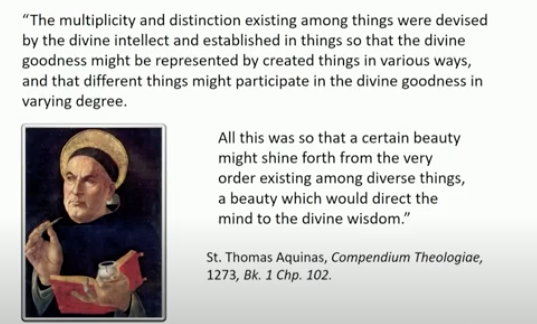
- God yields a plenitude (as in the featured quote) or, as St. Thomas Aquinas would say;
- Or, God focuses on man as His image. as the creation story in Genesis says:
“So God created man in his own image, in the image of God created he him; male and female created he them.” Gen. 1:27 (KJV)
Now this “image” of God need not be a physical one. Indeed, since the Trinitarian God exists in all His attributes and infinite qualities, He does not have a reproducible physical image. Accordingly, a cephalopod “human” would be as much an image of God as a primate “human.” So, this line in Genesis does not really exclude ETRs.
What mode does our Trinitarian Creator use? Does He set a frame of universal laws such that life and intelligence occur by a so-called natural process? Or does He, every now and then, give a nudge, a push to squeeze through the bottlenecks: life, animal forms, rationality? If the former, one would expect life and intelligence to be abundant. If the latter, probably not. Which of these ways we credit will be a matter of personal bent; neither dogma nor fact give a definitive answer. If the many-worlds QM theorists have it correctly, it might even be that in some universes there is only one rational species, in others many. Let’s leave this as an open question, then, and turn to another.
ETR THEOLOGY 2: THE FALL AND SALVATION OF ETRS?
Assume for the sake of argument, that in this universe there are many ETRs. Will each of these or some of these undergo a Fall, as did Adam and Eve? And will the Son of God come to save them, in the form of their kind? In the first of his science-fiction trilogy, “Out of the Silent Planet,” C.S. Lewis dealt with these questions. Only on earth did the Fall occur, with a consequent crucified Savior. On Mars, three sentient species exist in synergistic cooperation, not fallen. Each member of the three species anticipates a heavenly hereafter.
In thinking about these two theological questions, I myself wonder: is the Fall an inevitable consequence of free will and of the presence of the Tempter, the Evil One? If so, then it would be the case, if there be other ETRs in our universe, that they would Fall. And it would also be the case that God the Father in His infinite mercy would send His son, in the form of that ETR, for its salvation. But that’s an opinion, not backed up by theology or dogma, to my knowledge.
So this is still one more question for which, I believe, there is not a definite answer. But to build on my own reflections on this, let me discourse on what I perceive to be our unique and favored situation, our privileged place in a universe governed by the so-called Anthropic Principle.
AREN’T WE SPECIAL!!¹ THOUGHTS ON THE ANTHROPIC PRINCIPLE
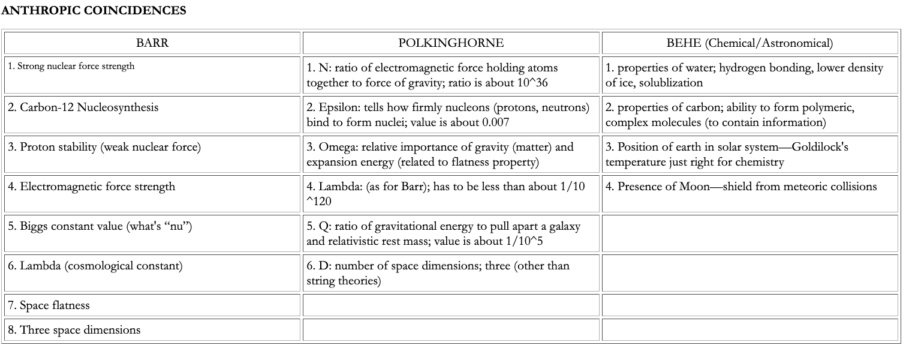
The fundamental laws of physics, the parameters that set their operation, in sum, the nature of the universe, seem to be designed to make it hospitable to carbon-based life. This favoritism, the Anthropic Principle, should be familiar to the reader, so I won’t expound on it at length in this piece. See footnote 2 below for a brief account, and these articles for more details (here and here). However, I do want to remark on one particular aspect of God’s creation: the vastness of the universe and our insignificance. For me, this is an occasion of wonder and marvel.
For I will behold thy heavens, the works of thy fingers: the moon and the stars which thou hast founded. What is man that thou art mindful of him? or the son of man that thou visitest him? Psalm 8:4,5
But this isolation, the smallness, and bigness³, also has a purpose. From the smallest (quarks) to the biggest (the universe) there are 40 powers of ten on the scale, and a human’s size is more or less in the middle. But to God, size is irrelevant. If there are vast distances to the nearest stars, that serves to isolate us from harmful radiation, such as would be present in the center of our galaxy, where there is a black hole and stars are denser. If we are 15 powers of ten bigger than quarks, that enables particle physics and chemistry to be the bricks of life.
All these coincidences lead me to believe that we are unique, that humankind is God’s special creation. Perhaps in other universes, He created many species in His image, some fallen, some not. But in this universe, we are, I believe, His sole creation.
Finally, I again urge the reader to go to the videos of the Conference (here and here) to hear other (and probably wiser) discourses on this matter.
*Published first on Catholic Stand
NOTES
¹ You old-timers might remember the Church Lady on Saturday Night Live, and her expression, “Now, isn’t that special…!!!”
² The unlikely conditions (Anthropic Coincidences) that enable the universe to exist and to be a place for carbon-based life.
Possible Reasons for Unlikely Anthropic Coincidences:
- That’s just the way it is—we wouldn’t be here if the coincidences weren’t there (not a satisfying explanation).
- An infinity of universes—if there are an infinite number of universes, even a highly improbable universe will occur, including duplicates (this is an act of faith even more demanding than a belief in God).
- A basic “Theory of Everything” requires the values of the constants and force laws to be as they are—the universe is not a contingent entity but a necessary entity (and Who created such a “Theory of Everything”?)
- The Fine-Tuning set by a loving, all-powerful Creator.
³ The scale of man in the universe and with respect to smallest particles is given in the classic film, Powers of Ten (Eames, 1977) and in a more recent version (1997). One comment to the latter video is pertinent: “Damn no wonder aliens haven’t found us yet or vise versa.”


Thinking about this ahead of time does give us time to consider various alternatives. We need to keep in mind that to a large extent that ETRs is more of a Rorschach inkblot test until we encounter real world ETRs. Currently we only have the single data point of our own planet and the life on it to go by. The primary focus of the Bible is on God’s relationship with we humans. We know that the human race is a fallen race, but whether this is the case with ETRs has yet to be determined. It is all speculation.
*
There is the passage in the Bible in John 10:16 where Jesus says: “And I have other sheep, that are not of this fold; I must bring them also, and they will heed my voice. So there shall be one flock, one shepherd.” Perhaps this might cover ETRs. We will have to see what the future brings.
*
In terms of physical image and likeness to God, Eve was made from a rib of Adam. Adam and Eve were of one substance, one flesh. They were physically consubstantial. This points to and anticipates the Nicene Creed.
Back in my days in the trenches of science, I had a director – a brilliant man – who tried very hard to be an atheist and was really bad at it. He once made an off hand comment to the effect that, eventually, the existence or non-existence of God would fall out of the equations. My reflection was that God falls out of the fact that there are equations.
That was an absolutely delightful read!! It’s been a while since I enjoyed reading something on line as much as I enjoyed that. Thank you.
Greg, Mike, David: thank you for your insightful comments.
God falls out of the fact that there are equations. EXACTLY!
Let us also not to invoke the “NOTHING of the Gaps.” That is to say, if there is no apparent “natural” mechanism to explain some phenomenon, we should not, therefore, ascribe it to “mindlessness”.
Besides language and art, what about religion? Why do we not see at least some primitive type of worship in apes and other intelligent animals? What about cloths? Why don’t some intelligent animals make some attempt to cover their privates? Even humans in the warmest climates cover certain things.
Great set of articles; thanks for posting these.
I think a metaphysical bottleneck would be the origination of the rational soul. It’s de fide (AFAIK) in respect to the creation of the angels and at least of the first humans that their souls were directly created (and sententia certa for their progeny), and thus the direct creation of the rational soul would seem to be a requisite for any rational being, which would preclude determining the likelihood of ETRs by natural processes. I suppose in that respect it would be less of a bottleneck and more of an impossibility save for divine intervention.
That being said, since there are non-human rational souls (i.e., angels), there doesn’t seem to me to be anything which would necessarily preclude other body-rational soul composites, although the question might be if to be “man” is just to be a body-soul composite, as opposed to just an intelligence like the angels. Or is “to be man” to be a body-soul composite on this particular planet? St. Augustine perhaps indirectly treats this question in City of God 16 in his discussion of those who are born “monstrously.”
In respect to the Fall, I don’t think that free-will inevitably implies a fall. If presumably more than a majority of the angels didn’t fall, then an inevitable fall for man would seem to imply that something about the body provides for that inevitability, which would be problematic for the Incarnation. The fall or non-fall of any body-soul composite ETR would then hinge on whether being a body-soul composite is just what it is to be “man” and thus descended from Adam, and if it makes sense theologically for any “men” not of direct physical lineage 50,000 light-years away to be implicated in Original Sin. The general theological consensus against traducianism and generationism would perhaps leave open that possibility, which would of course open up many more theological cans of worms.
I think another interesting question would be if there can be another mode of created rationality besides pure intellect as in the angels or body-soul composite as in man. A further question might be if there can be body-soul composites in which the body is something other than biological/animal and what bearing that might have on things like the appetites, passions, etc., and then further what (for example) a crystalline incarnation might look like in respect to a Fall.
Thanks again for these posts; it’s sparked some deeper reflection on my part at least.
The FOXP2 gene has a fascinating story, the Wiki article on it is quite a read, see https://en.wikipedia.org/wiki/FOXP2
In arguing questions like this, materialists tell us not to invoke a “God of the Gaps.” That is to say, if there is no apparent “natural” mechanism to explain some phenomenon, we should not, therefore, ascribe it to a miracle wrought by God. In general, I agree with this limitation.
I agree as well, but mainly because the ‘we can find God in the Gaps’ argument is really bad theology. As we fill in the gaps we no longer see God, which arguably describes the last 250 years rather well. Christianity would be better off if we kept our ignorance to ourselves and left God out of it.
Bottleneck #1: These simple molecules are the biotic building blocks—amino acids, sugars, nucleotides—which form the larger molecules, biopolymers: proteins, DNA, RNA, lipids, that are molecular biology.
The thing to remember here is the Rare Earth Hypothesis: The Moon was much closer, perhaps half the land area of the planet were tidal pools due to the massive tides. The earth rotated much faster as well, so there were several tides per day, not just one or two as we see in most places today. As a hypothetical cause it doesn’t seem to be out of the question. However the fact is that the Earth-Moon system must have very few other examples in the universe. Few Brother ET
Bottleneck #2: The next step is assembling these biopolymers into a cell, biopolymers enclosed by a wall, a membrane of phospholipids, and protein channels.
This is the real bottleneck, the hypothetical naturalistic causes invented so far are very weak. Yet science has to assume naturalistic causes, and they must work along the line of the tidal pool hypothesis. It should be pointed out that if half the earth’s land surface (perhaps 25 x10^10 square meters) had 7×10^8 years of tidal flows before life appeared, then a lab replication experiment with a test cell of 1 square meter will require a run time of 175×10^18 years, or about a billion times more than the current age of the universe. Not happening.
Bottleneck #3: On the other hand, several billion years elapsed before that first life developed into the wealth of animal forms arising in the Cambrian explosion (approximately 520 million years ago).
Given the rather tight correlation of the Cambrian explosion with the peak of the oxygenation of the earth’s atmosphere, we can likely conclude this is not a real bottleneck. The rise of oxygen was not linear, there were setbacks, and there are fossils of of earlier failed explosions, see https://en.wikipedia.org/wiki/Francevillian_biota
Bottleneck #4: the human brain
This is a very real bottleneck. History tells us that when a biological feature is needed for survival, it evolves rather quickly. For example, vision has evolved about 40 times on earth, and 5 times to photographic imaging quality. We know that no one with our brains was here before us, no one split atoms before us, for example. So despite the survival advantages our brains give us, we have no reason to think that natural selection was involved . This is probably the nearest we come to a miracle in natural history. Again, science has to suppose otherwise, but while the suppositions are plausible they fail to explain why it didn’t happen earlier.
This is not good evidence for Brother ET either.
Possible Reasons for Unlikely Anthropic Coincidences:
1) That’s just the way it is—we wouldn’t be here if the coincidences weren’t there (not a satisfying explanation).
Yep, not satisfying, science is never satisfied
2) An infinity of universes—if there are an infinite number of universes, even a highly improbable universe will occur, including duplicates (this is an act of faith even more demanding than a belief in God).
Remember, if there is a multiverse then it has no time, including infinite time, and so infinity might not apply to it. Furthermore, there is evidence to infer that it does exist, and one such piece (the net zero energy of our universe, which has a quantum mechanical implication) is very unlikely to be a common duplication.
Tom D, thanks for those insightful comments. Some biologists (Lewontin & Gould) argue that intelligence is a “spandrel” (an architectural feature that is produced accidentally). That’s stretching it, I believe.
Also, you’ve said some things I would have said had the article been longer.
And Bob, you haven’t even brought up the Fermi Paradox yet.
Poor Brother ET, he hasn’t much of a chance at all. In my lectures I used to say “We basically have four arguments without evidence, so there is no way to weight them. One says ET is there, three say no. I weight them equally, so I say ET has a 25% of being there, 75% not.” Oh did some people get mad!
BTW, though I wrote “the hypothetical naturalistic causes invented so far [to explain the primordial cell’s origin] are very weak”, I have to say today they are still more plausible and testable than what I saw just a couple of years ago. I was impressed with how specific they were – for example, that the cell’s nucleus membrane evolved from DNA’s self-repair mechanisms. Progress is being made, slow as it is.
Tom, thanks again for the dialog. The paradox attributed to Fermi (some doubt whether he actually said it) is, like the Anthropic Principle, a crutch for belief, but not probative. Here’s my take on proposals for biopolymer formation and cell assembly. They may seem reasonable or (like string theory) elegant, but until they’re tested empirically (to be falsifiable) then they’re not science.
Thanks for the informative posts and comments, guys. Very interesting.
Sabine Hossenfelder has a recent video on YouTube titled: “Can Physics Be Too Speculative? An Honest Opinion.” She covers Dark Matter, Fifth Forces, String Theory, Multiverses, and Alien Technology.
*
https://www.youtube.com/watch?v=f23eWOquFQ0
GregB, …thanks for the link…I’ll look into it. In general, I agree with sentiment expressed in the title of the video
Excellent post and comments! Thank you all!
Sabine Hossenfelder also has another recent video on YouTube titled: “Are we made of math?”
*
https://www.youtube.com/watch?v=CTpp0EChDbI
Bob, sorry for the late erply, I’ve been away from the internet since you posted this:
The paradox attributed to Fermi (some doubt whether he actually said it) is, like the Anthropic Principle, a crutch for belief, but not probative.
How so? The purpose of a paradox in science is to open lines of inquiry. Why are these two any different than Olbers’ Paradox [“Why is the night sky dark, an infinite universe should have stars everywhere with no dark in between”]? As far as I can see the answer is that Olbers’ has been resolved [via the Big bang], while the others are not
Here’s my take on proposals for biopolymer formation and cell assembly. They may seem reasonable or (like string theory) elegant, but until they’re tested empirically (to be falsifiable) then they’re not science.
Of course they are science. As I mentioned earlier, proposals for biopolymer formation and cell assembly cannot be replicated, not because it is inherently impossible (in the way long range weather forecasting is impossible, and in the way string theory might be), but because there are significant time limitations on such an attempt. The fact that a scientific hypothesis can’t lead to a strong theory is evidence only that it is weak science, and so we have to tentatively accept it until something better comes along.
TomD, thanks again for thoughtful comments. It’s clear you and I disagree on what constitutes science. For my view see “Essay 2, Truth Cannot Contradict Truth.
http://catholicscientist.com/2018/06/06/essay-2-how-we-believe-how-science-works/
TomD, which is to say the 17 interpretations of QM listed in the Wikipedia article aren’t science, Feynman’s phd thesis on advanced and retarded waves isn’t science, etc….Although all these are, as you say, food for thought. They are “METAphysics,” “after-physics,” or “above-physics.”
Bob, thanks for the link. I agree with 99% of what you wrote there.
The main problem I had was with Imre Lakatos. It appears that his ideas were invented to bridge the conflict between Thomas Kuhn and Karl Popper. I deny that there is a conflict between Kuhn and Popper, on the grounds that Kuhn failed to create a philosophy of science, he created a sociology of science. If Kuhn is correct then a scientist who is cut off from the human community (a sole shipwreck survivor, or the fictional Dr. David Bowman at the end of the novel 2001: A Space Odyssey) could no longer ‘do science’. This is absurd, therefore Kuhn’s ideas are wrong as an objective philosophy, therefore there is much less need for Lakatos’ model. His model strikes me as overly complex and maybe limited: his explanation of how Newtonian physics was supplanted by Einstein to me seems to attenuate both the intellectual inevitability of Popper’s philosophy and the social dynamics of Kuhn’s ideas. It’s neither fish nor fowl.