
INTRODUCTION
Does life, intelligent or not, exist anywhere other than on earth? And if such extraterrestial life be intelligent, how does Catholic teaching take it into account? Speakers at the 2021 Conference of the Society of Catholic Scientists addressed these questions, along the following lines:
- What kind of chemistry does life (as we know it) require in order to exist?
- Outside the earth, either in our solar system or in planets of other stars (exoplanets), are conditions for such chemistry present?
- If intelligent extraterrestial life exists, could we detect its presence by radio or other signals?
- Should such life exist, what are the implications for Catholic theology?
Rather than summarizing each of the SCS talks, I’ve decided to give an overall summary. I urge the reader to go to the talks themselves (I’ve provided Youtube links at the end of this article¹) In this article I’ll focus on the first question. In a second piece. I’ll cover the second and third, and in a third, the fourth question.
Let’s look first at Question 1.
CHEMISTRY OF LIFE (AS WE KNOW IT)
If we restrict our discussion to life based on molecular biology and chemistry as we know it on earth, then we’ll be talking about life based on molecules containing carbon.² These biological building blocks, the molecular constituents of carbon based life, reside in liquid water. In order that complex biological molecules not break up, the water temperature shouldn’t be too high. Also, it should not be so low that chemical reactions occur too slowly. Thus there is a so-called “Goldilocks” temperature zone in which extraterrestial life must reside.
In other articles I’ve speculated about how life might have begun (see here). Because of God’s marvelous gift to molecular biology, the hydrogen bond, biological molecules can undergo weak interactions. The zipper-like action of such hydrogen bonding enables DNA molecules to form helices and to unfold and to be copied. It facilitates the folding and unfolding of proteins. Because the hydrogen bonded association of protein and substrate molecule is not too strong, enzyme catalyzed reactions can proceed readily.
CHEMICAL EVOLUTION
We can imagine a sequence of chemical evolution as illustrated in the diagram below:
elements (H,C,N,O,P,S)→ small molecules (H2O,HCN,CO2,CH4,NH3…)→ building blocks (amino acids, sugars, nucleic acids, phosphates,…) → biopolymers (RNA, DNA, proteins, lipids)
The final step, the assembly of these biopolymers into a cell with the formation of a cell wall is, at this time, a mystery.
how the first cell came into being are matters of speculation, since these events cannot be reproduced in the laboratory. The Cell: A Molecular Approach (2nd Ed.)
How the changes from one stage to the other might occur is known only in part or not at all (The arrows hide a lot that is not known). Nevertheless there is evidence from astronomical observations that some conditions in early stages might obtain for earth-like exoplanets and for some satellites of giant planets in our solar system.
Let’s look at the first transition, from elements to simple molecules. Is there evidence that such molecules exist outside the earth?
SIMPLE MOLECULES IN EXTRA-STELLAR DUST CLOUDS
According to Prof. Karin Oberg (Harvard), there is strong evidence from astronomical spectra that H2O, HCN, CH4, and other simple molecules are present in exoplanets and dust clouds in which such planets form. Exoplanet spectra show the presence of such molecules:
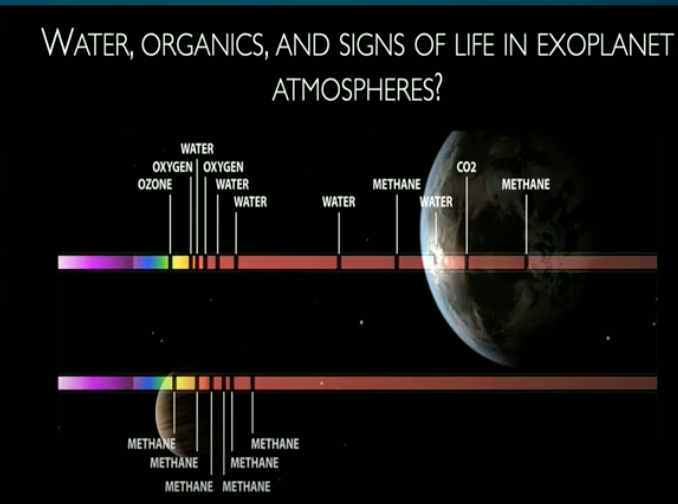
From SCS 2021 talk, Prof Karin Oberg
As shown in the image below, the spectra of HCN (cyanic acid) is present in dust clouds surrounding stars. Planets are formed in such dust clouds.
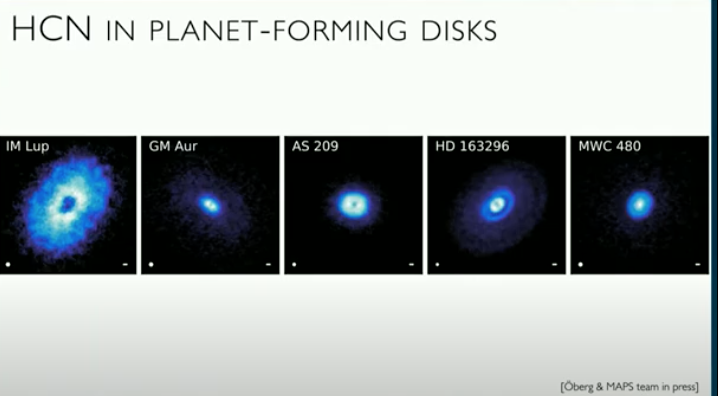
From SCS 2021, Prof. Karin Oberg
Besides the simple molecules listed above, astronomical microwave spectra provide evidence for many other simple molecules that combine to form biological building blocks. (See here and here for examples.²) Such molecules form by the action of interstellar radiation (UV and higher energies) and through short-lived intermediates. Although their concentration is low, the volume of space dust clouds is large enough that the total amount is not negligible. Even though the reaction schemes that scientists propose to yield biological building blocks are reasonable (see here and here for examples), papers do not always give the laboratory experiments that would replicate these schemes.
SIMPLE MOLECULES IN METEORITES, COMETS
In his talk, Prof. Christopher Shingledecker gave a clear account of how prebiotic molecule and biotic building blocks might form on cosmic dust. Meteorites give evidence of this. And what is the most interesting feature of such evidence? Biotic building blocks are chiral, that is to say, they have a symmetry difference like that between left and right hands, as the figure below shows:
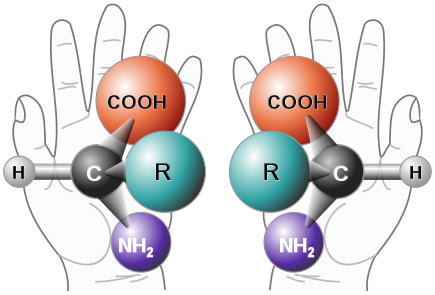
(from Wikimedia Commons)
Since all naturally occurring proteins have a left-handed symmetry, one might expect the same handedness or chirality for the amino acid building blocks. And in fact, the amino acids found in meteorites do show a slight excess of such L-handed amino acids. Where does this natural chirality come from? One possible mechanism is polarized radiation acting on only right—handed molecules, leaving an excess of left-handed, but this explanation is speculative. It’s one of the mysteries in how such molecules are formed.
Professor Shingledecker proposed a reaction scheme for the formation of prebiotic and biotic molecules shown in the diagram below:
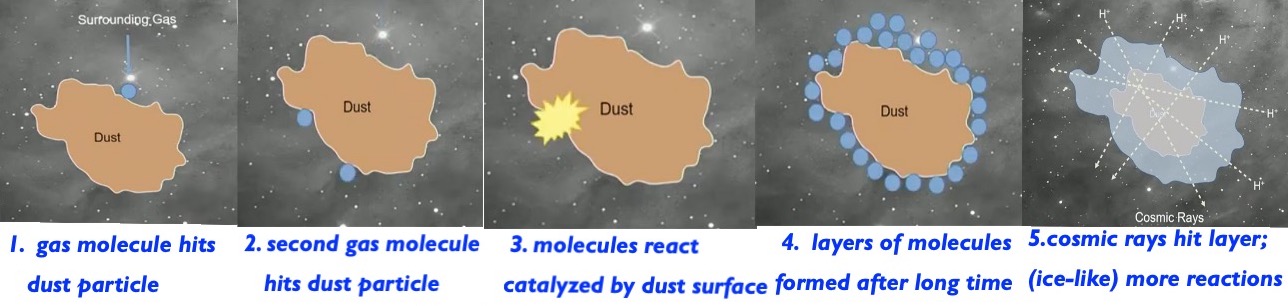
from SCS 2021, Prof. Shingledecker
Laboratory work replicating interstellar space conditions supports the scheme in the picture above.
IS THE PROBLEM OF CHEMICAL EVOLUTION SOLVED?
So then, how much do we know then about the formation of biotic molecules? As Prof. Shingledecker pointed out, we know a lot about the first step in evolution of life’s chemistry:
- pre-biotic molecules and biotic building blocks form from the elements;
- large molecules, polymers (proteins, polynucleotides, phospholipid chains), form from the building blocks;
- self-replicating molecules (RNA, DNA) are among such polymers;
- cell walls (phospholipid assemblies) form to enclose these self-replication molecules.
But at this time, steps 2-4 are still a mystery, a matter of speculation, according to John Sutherland, a prominent researcher in the chemistry of life:
Demonstrating such a process [the steps above] in the laboratory would show how life can start from the inanimate. If the starting materials were irrefutably primordial and the end result happened to bear an uncanny resemblance to extant biology.. .We are not yet close to achieving this end, but recent results suggest that we may have nearly finished the first phase: the beginning. [Emphasis added. ]ohn D. Sutherland, “Studies on the origin of life — the end of the beginning,” Nature Reviews Chemistry, Vol. 1:12 (2017))
Accordingly, since the scientific genesis of life chemistry is, to a major degree, still a mystery, let’s turn to theological implications.
THE THEOLOGY OF CHEMICAL EVOLUTION—PRELIMINARY REMARKS
Before discussing this topic at greater length in a future article, let me remark on a few pertinent observations made by Prof. Karin Oberg. She mentioned two possible Scriptural arguments against the possibility of extraterrestial life:
- Scripture does not mention extraterrestial life;
- God’s reveals His governance through miraculous acts; one such is the creation of life.
Answering the first objection, Prof. Oberg noted that dinosaurs (among other species) were not mentioned in Scripture, so this cannot be a valid objections. With respect to the second, Catholic teaching generally points to God as setting an ordered universe through His laws. It is the order of His creation that is the occasion for glory. As Psalm 19A has it: “The Heavens declare the glory of God and the Firmament shows forth the work of His hands.”
And here’s one other question posed by Prof. Oberg: should we choose a God who makes us unique in the universe or a God who fills the universe with a plenitude of life, life that as in the last chapter of C.S. Lewis’s Perelandra, is ecstatic in a dance of adoration?
In a second article I’ll discuss technology: how do scientists search for evidence of extraterrestial life and (if they’re there) ETR’s—ExtraTerrestial Rational beings. And in the third, I’ll give my own views and those of the Conference speakers on the theological implications of all this.
*This article was originally published on Catholic Stand.
NOTES
¹ Go here for SCS Conference Program. Go here for the Youtube recordings of the Saturday lectures and here for those of the Sunday lectures.
² Being a science fiction fan, I’ve read about life based on electric plasmas, ammonia seas, and silicate rocks. In fact, the last was my first encounter with alien life (fictional, that is). In Stanley Weinbaum’s “A Martian Odyssey,” (1937? 1938?) the silicon based life-form excretes bricks, builds them into a pyramid, and when one pyramid is finished moves on to the next.


Fascinating! Thanks Bob for bringing hard science to an area too often dominated by baseless speculation.
I think was Chesterton who I saw Mike Flynn quote but the core idea was: Don’t all Christians believe in intelligent extraterrestrial life?
After all, angels and demons are hardly terrestrial.
Bob mentions a good point. There are four steps in the rise of life from inanimate matter (copied below). We can do step 1 in a laboratory setting. But steps 2 through 4 are still much of a mystery. I recently watched a YouTube video (whose link escapes me right now) explaining the same.
pre-biotic molecules and biotic building blocks form from the elements;
large molecules, polymers (proteins, polynucleotides, phospholipid chains), form from the building blocks;
self-replicating molecules (RNA, DNA) are among such polymers;
cell walls (phospholipid assemblies) form to enclose these self-replication molecules.
Here is a different YouTube video about why we could be alone in the Universe:
https://www.youtube.com/watch?v=PqEmYU8Y_rI
It is done by Dr. David Kipling. When he sticks to science, he’s really great and I watch his videos all the time (my wife hates it when I do that inasmuch as she has zero interest in science). But politically he is a flaming liberal progressive feminist Democrat, for which reason I abandoned him on that cesspool known as Twitter. In any event, the one thing he mentions in the video that I think is key is this:
What is relationship between the probability of abiogenesis and the number of habitable worlds in the universe?
There is a graph at about the three minute and 50 second point in the video which depicts this. If the smallness of the probability of abiogenesis “outweighs” (counteracts, nullifies) the multitude of possible habitable worlds in the universe, then the fine tuning required for life will by itself will make its appearance on Earth the only one. Of course, just one microbe discovered in the oceans of a Jovian moon (e.g., Europa) would make all this speculation a moot point. In fact, if we find that life has risen independently in two different places in our solar system, then that makes a good case for life being ubiquitous throughout the universe because then we will know that the probability of abiogenesis is rather high (relatively speaking) and NOT very small as we currently think.
BTW, since God is life itself, it would come as no surprise to discover that Dr. David Kipling’s considerations in his video are wrong. Again, to repeat myself like a broken record, it all depends on the relationship between the likelihood of abiogenesis and the number of possible habitable worlds in the universe (regardless of whether or not we can currently reproduce abiogenesis in a laboratory setting).
Dr. David Kipping. Argh!
http://www.davidkipping.co.uk/#:~:text=WHO%20IS%20DAVID%20KIPPING%3F,the%20Cool%20Worlds%20Lab%20website.
Bob writes above in his article about homochirality being necessary for life. This is a very important point that makes abiogenesis very unlikely. Dr. Hugh Ross provides the following essay:
https://reasons.org/explore/blogs/todays-new-reason-to-believe/homochirality-a-big-challenge-for-the-naturalistic-origin-of-life
Dr. Ross’s conclusion: “Thirteen years ago, I described in chapter 9 of the book I cowrote with Fazale Rana, Origins of Life,17 how the lack of a reasonable natural hypothesis, or even a scenario, to explain an abiotic origin of reservoirs of 100% left-handed bioactive amino acids and 100% right-handed ribose posed an intractable problem for naturalistic/materialistic origin-of-life models. Thirteen years later, the homochirality problem for researchers intent on a naturalistic/materialistic origin of life has become even more intractable. Is it not now well past time to consider a supernatural, super-intelligent Originator of Earth’s life?”
LCQ, you make a good point about chirality being hard to explain by f abiogenesis. (Plus other stuff: polymer formation, RNA formation, cell wall formation). However, one has to beware of “God of the Gaps” type arguments. Because we don’t know how something came to be or operates does not necessarily mean there is a particular supernatural mechanism for it, rather than it being part of God’s great design, which, at present, we do not fully comprehend. To paraphrase a quote by (I forget who), I much prefer a God who has an overall design, rather than a Lego-like piece by piece creation.
The notion that embodied consciousness could come to be, much less be repeated, defies what we know about the universe– that it is virulently anti-life. Alfred Noyes once wrote “This universe exists, and by that fact declares itself to be a miracle” states well why an alien extra terrestrial life form emerges as a statistical improbability. Identification of what consciousness requires for its emergence makes “alien life” a hypothesis similar to the one arguing for a universe that is infinite in all directions.
I remember the Drake equation. At the time it was first presented it was mostly a SWAG. With the advanced space telescopes, improved Earth based adaptive optics telescopes, and other space-based and Earth-based radio telescopes, we are now starting to be able to put actual numbers into this equation. It will be interesting to see what future astronomical observations and solar system space probes come up with.