
https://www.youtube.com/watch?v=v5CckE3bxWM
[6] But Pilate hearing Galilee, asked if the man were of Galilee? [7] And when he understood that he was of Herod’s jurisdiction, he sent him away to Herod, who was also himself at Jerusalem, in those days. [8] And Herod, seeing Jesus, was very glad; for he was desirous of a long time to see him, because he had heard many things of him; and he hoped to see some sign wrought by him. [9] And he questioned him in many words. But he answered him nothing. [10] And the chief priests and the scribes stood by, earnestly accusing him.
[11] And Herod with his army set him at nought, and mocked him, putting on him a white garment, and sent him back to Pilate. [12] And Herod and Pilate were made friends, that same day; for before they were enemies one to another. [13] And Pilate, calling together the chief priests, and the magistrates, and the people, [14] Said to them: You have presented unto me this man, as one that perverteth the people; and behold I, having examined him before you, find no cause in this man, in those things wherein you accuse him. [15] No, nor Herod neither. For I sent you to him, and behold, nothing worthy of death is done to him.
Luke 23: 6-13
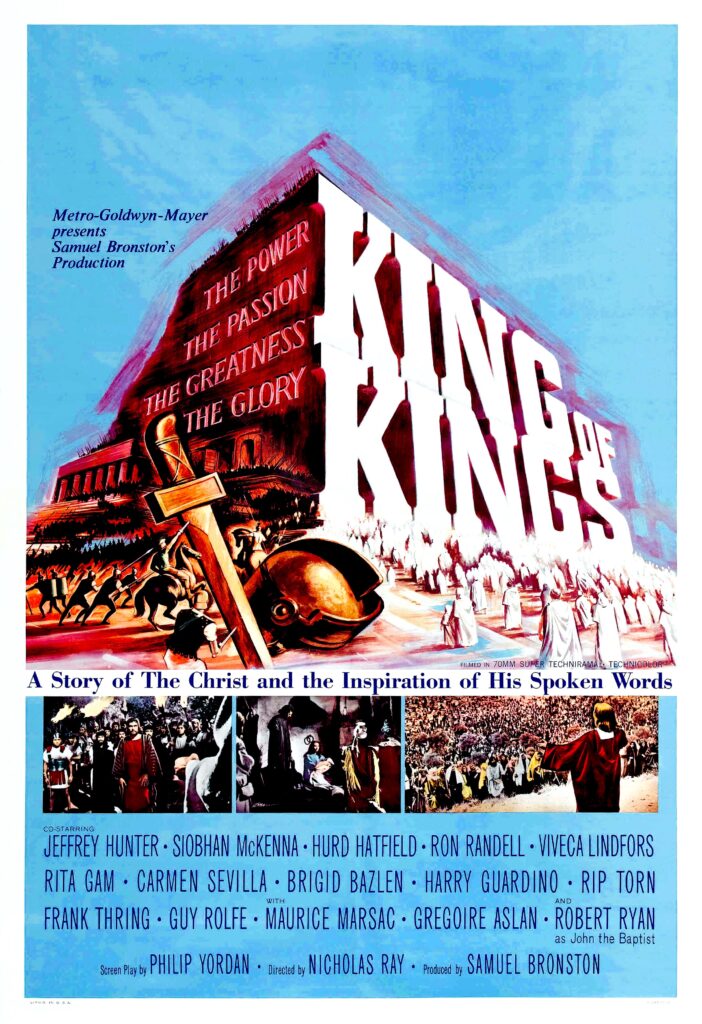
The late Frank Thring, an Australian actor, had the distinction of playing both Pilate and Herod Antipas in major films, Pilate in Ben Hur (1959) and Herod Antipas in King of Kings (1961).
Of all the big budget Biblical epics of Hollywood, King of Kings (1961) gets the least respect and perhaps deservedly so. The film is notable for being the first big budget Hollywood movie to depict Christ directly, with Jeffrey Hunter in the title role. Although Hunter was the correct age, 33, he looked far younger and the film has sometimes been nicknamed “I Was A Teenage Christ”.
The film took a fair amount of liberties with the Gospels, appending annoying historical fictions. The scene involving Herod Antipas and Christ however is played pretty straight with Herod wondering is Jesus John the Baptist come back to life, seeking to have Christ perform a miracle, mocking Christ, arraying Christ in a rich cloak and sending him back to Pilate. Thring however depicts Herod as a very driven man, perhaps on the doorway to madness.
Herod had lived through a time when Augustus Caesar was laying the ground for the Principate, the basis for the Roman Empire. The Mediterranean world had been in turmoil for a century, primarily through Roman civil wars, and Augustus was beginning to usher in a period of peace, perhaps without parallel before or since, in the recorded history of Man. Herod Antipas would have been quite aware of this since doubtless he studied the Romans with the same keen interest that a dog observes its master or mistress. However, Herod also knew that there would be little enough of peace for him. It was obvious to all intelligent observers that a rebellion would eventually occur in Judea as the Jews rose against Roman rule. Herod was sitting on, to use an anachronism, a powder keg, and that alone would disturb any ruler. However that was not the most serious problem that Herod confronted. John and Jesus reminded him that many Jews believed that the Messiah had come or was coming shortly. This increased the precariousness of the earthly situation of Herod, and reminded him of the bleak afterlife that was drawing closer for him each day. Well might Herod have regarded madness as a refuge considering the puzzles that fate had cast in his way.


One thing almost all the films got right about Herod is that he was the typical venal aparachik of the times. Almost no local administrator of a territory in the Roman empire ever achieved a reputation as competent or skillful. Most relied on the presence of the Roman legions to keep order and almost none could be said to have increased the prosperity or efficiency of the operations of the empire. Herod was no exception. Fearful of his position and incapable of serving Rome and keeping the populace in check, he would have to be regarded as a failure on all counts. The rebellion of 70 AD can be laid largely at the policies of Rome and of Herod that failed to take into consideration the political and religious concerns of the people. Even the presence of Pilate was not enough keep order and prevent various levels of unrest from time to time. All of this is reflected not just in the bible but also in the writings of the historian Flavius Josephus.