
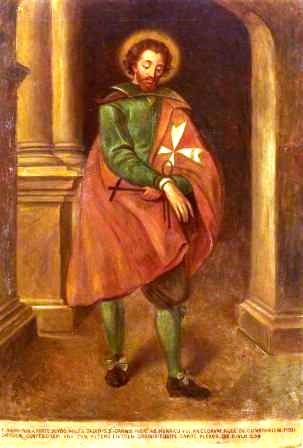
Born probably in 1476, he was a descendant of Richard the Strong, shield bearer of William the Conqueror, who gave to his family his surname – le Fort-Escu: “the Strong Shield” – and his devise: “Forte scutum salus ducum”. Our holy man’s ancestors were both soldiers and jurists. They participated in all the great struggles of the crusades, in the battles of Agincourt and Bosworth Field. His father, who had followed Richmond to Paris and had landed and fought with him, became the king’s major-domo when Henry VII succeeded to the throne. The father of our Knight had married Alice Boleyn, whose niece Anne, was to become the second wife of Henry VIII.
When Henry VIII, then still Prince of Wales, was made a Knight in 1503, a few young gentlemen shared that honour with him; Adrian Fortescue was one of them. But he had never desired worldly distinctions. He therefore spent most of his time in the country, busy with his lands and with county affairs. Yet he always answered the call of the Prince. Adrian Fortescue followed Henry VIII to Calais, in June 1513, in the enterprise against Louis XII of France concerning the region of Milan. He was present at the meeting of the Field of the Cloth of Gold, in l520; he was charged with guarding Queen Catherine of Aragon. In 1522, he fought under the Earl of Surrey in Picardy. In 1523, he took part in the capture of Bray and of Montdidier, under the command of the Duke of Suffolk. These activities had not kept him from marrying Anne Stener (1499) and from becoming a widower (1518). It does seem that he had finished his military career when, though no longer young, he married Anne Rede (1530). At that time he was in high favour with the court. His first cousin, Anne Boleyn, lady-in-waiting of the Queen’s, had been noticed by the King, who repudiated his wife and “married” his favourite in spite of the opposition of Clement VII, a former Knight of Rhodes: this pope had refused to annul the union of Henry VIII and Catherine of Aragon. That same year Sir Adrian received a messenger from the Tower of London bearing him the news of the joyful birth of his cousin Elizabeth, the future queen of England and daughter of Anne Boleyn. Any ambition seemed permissible for him. It was then that, faithful to the decisions of Rome, he proved his faith in a striking fashion by entering the Order of Saint John of Jerusalem which opposed the religious errors of the king of England, That was in 1532.
Adrian Fortescue thus drew the lightning. All the property that the Order had in England had just been seized. Without considering the military services rendered by the pacification and policing of the Mediterranean Sea, Henry VlII destroyed as much as he could of a maritime power which dared to condemn his fancies. As a consequence, the members of the Order were not welcome at court. Although he had no office, Adrian was asked to take the Oath of Succession. Had this demand been dictated by some attitude of the Knight’s who may have approved of John Fisher and Thomas Moore, who had been imprisoned for having refused to take that oath? Whatever may be the case, Sir Adrian was taken to Woodstock where he was questioned. Then he was removed by boat as far as Southwark here he was lodged in the prison of Marshalsea.
The King gave the castle of Stener, a part of the inheritance of Lady Anne Stener, to her brother, Sir Walter Stener. Sir Adrian’s imprisonment grew long. No doubt Thomas Cromwell wished to take time to strengthen his power; he was keeping in check a possible leader of the opposition and of the resistance. We have seen these tactics used in more modern times. Then, for no apparent reason, our Knight was released.
The execution of the martyrs of the English Reformation began on May 4, 1535. Carthusians and priests poured out their blood. And the blood-letting continued. Sir Adrian, however, was still free.
In the following year, three events concern Sir Adrian closely: on January 7, his good lady, the repudiated queen, Catherine of Aragon, died; on May 19, his cousin, Queen Anne, was decapitated for adultery and treason; and on the same day, the King married his new flame, Jane Seymour. Yet, all these events changed nothing in the life of our Knight, who awaited his fate.
Finally, on February 14, 1539, he was again arrested and locked up in the Tower of London. There his fate was clear. On the 18th, an inventory was drawn up of all his real and personal possessions, in London and in the country, and they were declared seized by the Crown.
There was no trial, or at least no traces of it are to be found. To condemn with certainty those whom he wanted to eliminate, Cromwell had revived the Bill of Attainder of 1459 and applied it to the Catholics, “enemies of the throne”; their property was confiscated to “pay for the insult”. On the same day and under the accusation of having incited the people against the King, we find with our holy man the Countess of Salisbury, first cousin of the mother of Henry VIII and mother of Reginald Cardinal Pole, the Marchioness of Exeter, Sir Thomas Dingly, a Knight of Malta, and 12 other persons, priests and laymen.
And on July 8 (or 9, or 10), 1539, Sir Adrian Fortescue and Sir Thomas Dingly were beheaded, by special favour, for having preferred “to obey God”. The place of their burial is not known.
Go here to read the rest of the biography.

