“Towards Reforming the International Financial and Monetary Systems in the Context of Global Public Authority” – a roundup of reactions
On Monday, the Vatican’s Pontifical Council for Justice and Peace published a statement on the global economic crisis: “Towards Reforming the International Financial and Monetary Systems in the Context of Global Public Authority” [click link for full text]
Suffice to say, reactions were spirited (and in many cases, predictable), reflecting “a tired pattern”, to quote Zach (Civics Geeks)
Everyone once and a while there is a news story about “the Vatican”. “The Vatican” issues a document of some sort. The document says something about current affairs. Immediately there are two very predictable reactions, depending on whether the person is inclined to agree with the Church or not.
- “Look! The Church teaches that Catholics have to think like I think! My opinions have acquired divine authority. The world would be a better place, and the Church would be a better Church, if every Catholic just obeyed Church teaching like I do.”
- “I don’t have to obey the Church – I can think for myself. It’s fine if some old white men in Rome think that, but I don’t have to and I am still a good Catholic.”
These are, of course, caricatures, but I think they express two attitudes that are quite common. They are alike in that they are both dogmatic and reactionary.
What follows then are some mostly thoughtful responses — fodder for a discussion here at American Catholic).
- “The Pope, Chaplain to OWS? Rubbish!” – George Weigel in a characteristic clarification from National Review‘s The Corner, on those who would imbue the document with too much authority:
The truth of the matter is that “the Vatican” — whether that phrase is intended to mean the Pope, the Holy See, the Church’s teaching authority, or the Church’s central structures of governance — called for precisely nothing in this document. The document is a “Note” from a rather small office in the Roman Curia. The document’s specific recommendations do not necessarily reflect the settled views of the senior authorities of the Holy See; indeed, Fr. Federico Lombardi, the press spokesman for the Vatican, was noticeably circumspect in his comments on the document and its weight. As indeed he ought to have been. The document doesn’t speak for the Pope, it doesn’t speak for “the Vatican,” and it doesn’t speak for the Catholic Church.
- Pope Benedict Calls For “Central World Bank” … Only He Didn’t. Here’s Why – Thomas Peters (American Papist) counters the spin of Fr. Tom Reese, who “seems perfectly happy to help the mainstream media fundamentally misunderstand the authority of teaching this document enjoys, [claiming] that the pope has “more in common with the people at occupy wallstreet” than the tea party.”
- “while economists are learning from the Vatican, perhaps the Vatican might learn a few lessons from economic analysts” muses Phil Lawler (Catholic Culture): “If you want to promote Catholic social teaching, don’t wander beyond your expertise. Stick to moral principles, and leave economic analysis to the economists.”
- Also weighing in from “The Corner”, Dr. Samuel Gregg with Catholics, Finance, and the Perils of Conventional Wisdom:
Plenty of other critiques could — and no doubt will — be made of some of the economic claims advanced in this PCJP document. As if in anticipation of this criticism, the document states, “We should not be afraid to propose new ideas.” That is most certainly true. Unfortunately, many of its authors’ ideas reflect an uncritical assimilation of the views of many of the very same individuals and institutions that helped generate the world’s most serious economic crisis since the Great Depression. For a church with a long tradition of thinking seriously about finance centuries before anyone had ever heard of John Maynard Keynes or Friedrich Hayek, we can surely do better.
(Samuel Gregg is research director at the Acton Institute. He has authored several books including On Ordered Liberty: A Treatise on the Free Society, his prize-winning The Commercial Society, Wilhelm Röpke’s Political Economy, and his 2012 forthcoming Becoming Europe: Economic Decline, Culture, and America’s Future).
- Mark Brumley, President and CEO of Ignatius Press, on “Going the way of World Government” (Catholic World Report):
If the Pontifical Council for Justice and Peace is trying to make the Catholic Church sound as if she’s living in a fantasy world or trying to portray Catholic social teaching as completely irrelevant to real world problems, I’d say, “Mission accomplished.” If, on the other hand, the council wants people seriously to think about the problems of globalization, it’s going to have to demonstrate a much better grasp of political and economic practicalities, as well as the limits and dangers of international solutions. At the risk of sounding like an End of the World visionary, I suggest we should temper our enthusiasm for world-authority solutions by re-reading the Catechism of the Catholic Church, paragraphs 675-677, and by consulting the Book of Revelation, chapter 13.
By all means, let’s discuss global problems and possible solutions. Let’s recognize the dangers of nationalism and the imbalances that exist between rich and poor nations. Let’s not overlook the weakness of international capitalism or pretend the free market has all the solutions. Let’s have a good philosophical discussion about world government, and its long-term prospects, if the world endures for a few more centuries. But let’s remember that, historically speaking, those who have tried to act on their talk about a world political order have wound up being tyrants.
- Jeffrey Tucker, editorial vice president of the Mises Institute, author of Sing Like a Catholic
(2009) and Bourbon for Breakfast
(2010), and (familiar to many readers) as a daily contributor to The New Liturgical Movement — “Right Diagnosis, Deadly Cure”:
… the document’s identification of loose credit with market liberty is the beginning of the end of the good sense here. From this point, we plunge straight away into a full endorsement of a world central bank, a world political authority, taxes on financial trading, and heavy regulations. The document doesn’t actually call for an end to the free market. On the contrary, it imagines that enlightened world planners will protect, guard, and even “create” what it calls “free and stable markets.”
This is beyond naive. It seems to illustrate a near total absence of clear thinking. Centralization of money and credit caused this problem. Centralization of political authority caused this problem. Why would anyone imagine that more centralization is therefore the answer? This approach takes a terrible situation and makes it much worse.
- Over at Commonweal, “unagidon” asks “do we need a Global Public Authority to fix the economy?” — and answers in the negative.
- “The Vatican Renders Unto Caesar”, by Nicholas G. Hahn III (Real Clear Religion) 10/25/11:
Any sane person can recognize that the notion of another global civil authority flies in the face of subsidiarity. Simply because the Council says subsidiarity should regulate the relationships of authority, doesn’t mean it actually will.
In fact, global institutions do not often respect autonomy or individual freedom of their memberships. Perhaps even Pius XI, for all his griping against the “greed” of financial systems, might consider the creation of a new “supranational Institution” a “grave evil and disturbance of right order.”
And so, a question that must be asked is: does Rome want a king?
Dr. Robert Moynihan (editor, Inside the Vatican):
The positive thing: this document, in keeping with all of the Church’s social teaching, wishes to defend honesty, transparency, truthfulness and justice in financial dealings over against dishonesty, opacity false representations and injustice.
In this, the document is to be praised, and praised highly. We need honesty and truth-telling in a global economy that is seemingly careening toward a train wreck which will inevitably hurt the poor and weak most of all.
The negative thing: the global economy, and especially the global derivatives market, is big, enormous, in fact, so big, so opaque, so complex, that literally no one knows what the situation really is, or what measures to take to undo the financial detonator that seems ready soon to go off.
In this sense, the Vatican office’s policy recommendations are inevitably insufficient.
- John Allen Jr. (National Catholic Reporter), counters the critics by calling attention to “a southern consensus”:
Focusing on how much papal muscle the note can flex, however, risks ignoring what is at least an equally revealing question: Whatever you make of it, does the note seem to reflect important currents in Catholic social and political thought anywhere in the world?
The answer is yes, and it happens to be where two-thirds of the Catholics on the planet today live: the southern hemisphere, also known as the developing world.
It’s fitting that the Vatican official responsible for the document is an African, Cardinal Peter Turkson of Ghana, because it articulates key elements of what almost might be called a “southern consensus.” One way of sizing up the note’s significance, therefore, is as an indication that the demographic transition long under way in Catholicism, with the center of gravity shifting from north to south, is being felt in Rome.
- Disputations reflects on lessons of the Tower of Babel in the concluding paragraphs of the document:
… the story of Babel not only warns us that we are bound to lack concord if we don’t speak the same language, but — reading it in parallel with the story of Pentecost — that the concord upon which any global authority must be founded to thrive in virtue is nothing less than the peace of Jesus Christ.
As a practical matter, the world is some way away from establishing that foundation. Whether Christians possess the peace of Jesus Christ in sufficient fullness to serve as the cement which, when mixed with the world’s crushed stone, can form a concrete of sufficient strength to bear the weight of the Pontifical Council for Justice and Peace’s proposals is, I suppose, open to question.
- Notes on the Vatican Statement on Global Financial Reform – solid, section-by-section analysis by DarwinCatholic (American Catholic 10/26/11), revealing points that are congenial to both ends of the political spectrum (“There’s much in here that American conservatives and libertarians are not going to like, but there’s just as much that leftist Catholics (particularly populist ones) aren’t going to like either (if they read it.)”).
See additional responses from Rick Garnett @ Mirror of Justice (“many are (perhaps strategically and tactically) mis- and over-reading the Note in order to overstate the consonance between its vision and the current policies of the Democratic Party in the United States and its special-interest constituencies”); Michael Brendan Dougherty @ Business Insider (“WHOOPS! Vatican Lets Slip Plans For One World Government”); Fr. John Zuhlsdorf; Sean P. Daily of Gilbert magazine (“if there is one institution that could unite us, even if it unites [distributists and followers of the 'Austrian' school] only in opposition, it is the Pontifical Council on Justice and Peace”) — and, now blogging for The American Conservative, Rod Dreher hosts a vigorous discussion on his blog here; here; here and here.
War and the Eclipse of Moral Reason
This post was prompted by Kyle Cupp’s recent reflections on the “inviolability of human life” (Vox Nova October 6, 2011). Insofar as it concerns a republication of an essay pertinent to the topic of Kyle’s post, I will confine my own introduction to three responses that came to my mind during the course of reading.
First, with regards to the assertion that “any direct killing is not only an attack on the creature but an attack on God, which is always and everywhere evil” — I have often wondered how do advocates of this line of thought address God’s summary execution of Ananias and Sapphira in the New Testament (Acts Chapter 5)?
Secondly, it seems to me that the adoption of a stance of absolute pacifism in some Christian circles flirts dangerously with the heresy of Marcionism — in that its adherents seem all too willing to draw a sharp divide between the God if the Israelites in the Old Testament (who was not above ordering Israel’s kings, prophets and judges to use lethal force, to say nothing of His own actions) and the by-and-large peaceful and nonviolent God of the New Testament (to which, again, the story of Ananias and Saphira might constitute an unsightly and conflicting blemish). This is exemplified in one reader’s comment:
More proof, if any were needed, that the so-called “Old Testament” should be consigned to the literature shelf, along with Homer and the rest of the primitive, pre-Christian texts. The “O.T.” can be cited to justify virtually any kind of homicide one should want to commit, including genocide. All one needs do is think that he’s channeling God’s will and he can kill with guilt-free abandon. Some call it piety; some call it pathology.
Cardinal Dulles once observed that the Old Testament the Mosaic Law specifies no less than thirty-six capital offenses calling for execution, and that while Jesus refrained from using force in most cases (a notable exeption being driving the money-changers from the temple with a whip), “at no point, however, does Jesus deny that the State has authority to exact capital punishment.” While he argued in opposition to the death penalty, he wisely saw that one could not do so in ignorance of, or opposition to, Catholic tradition. His example is worth emulating.
My third and final point has to do with the “dirty hands” perspective — the assertion that even in situations where killing is warranted (as a defensive measure), the mere act of taking human life itself is intrinsically immoral, the equasion of armed force with violance, and lethal force to murder, such that any resort to such is deemed necessarily sinful. Or as Kyle says: “Killing is always wrong, even when it’s right.” Curiously, I find this stance indicative of a distinctly Protestant mentality that dispenses with centuries of Catholic thought and tradition. (That said, we are in an age now where it seems that Protestant and Catholic voices have become indistinguishable on this very subject, with multiple fronts voicing indiscriminate condemnation of armed force without qualification).
This last and final point is best argued in the following essay, “War and the Eclipse of Moral Reasoning”, by Dr. Philip Blosser. (Republished here by kind permission of the author) — a discussion of which I hope will bear much fruit.
– Christopher Blosser Continue reading
Occupy America!!!
Certainly some of the issues raises by the ongoing protests at Wall Street and various cities across America are worthy of serious discussion and debate: the disparity between economic classes, the government bailouts to the financial industry and cushy severance packages to failed CEO’s vs the majority of those who can barely scrape by month-to-month, or might have lost their jobs (and homes, and savings) with no such financial safety net (a discussion of such here with Rod Dreher).
If you want serious analysis of the events, I recommend this excellent coverage by Robert David Graham (Errata Security), providing the quality coverage lacking in the mainstream media.

At the same time, it’s hard not to see the whole gamut of political-ideological factions — anarchist, marxist, libertarian, “tea party” (although the latter are branded as infiltrators wishing to “co-opt” the demonstration) — assemble to voice to their righteous indignation, and observe the moments of unintentional comedy and occasional irony that result . . . if not for which we might take their message just a little more seriously: Continue reading
Jesus vs. the Department for Health and Human Services
Proposed HHS regulations for “Required Health Plan Coverage” to be implemented next year will compel every employer to provide insurance coverage for sterilization and abortifacients, which Catholics (and perhaps other religious organizations) will judge as morally-reprehensible.
The Obama administration in their graciousness has provided some form of “conscience-exemption”:
Group health plans sponsored by certain religious employers, and group health insurance coverage in connection with such plans, are exempt from the requirement to cover contraceptive services. A religious employer is one that: (1) has the inculcation of religious values as its purpose; (2) primarily employs persons who share its religious tenets; (3) primarily serves persons who share its religious tenets; and (4) is a non-profit organization under Internal Revenue Code section 6033(a)(1) and section 6033(a)(3)(A)(i) or (iii). 45 C.F.R. §147.130(a)(1)(iv)(B).
but the guidelines here are drawn so narrowly that few, if any, religious organizations will actually qualify for exemption.
As Sister Mary Ann Walsh of the USCCB notes, in framing the definition of “religious employer” thus “the HHS has plunked itself right in the middle of the sanctuary. It is trying to define what a religion does and does not do.”:
Catholic hospitals, charities and educational institutions provide about $30 billion worth of service annually in this country. No one presents a baptismal certificate at the emergency room. The hungry do not recite the Creed to get groceries at the food pantry. Students can pursue learning at The Catholic University of America, Villanova or any other Catholic college without passing a catechism admissions test. The commitment to serve those in need, the sick, the hungry, the uneducated, is intrinsic to Catholicism. No federal rule (except now HHS’s) says the church must limit its service to Catholics if it is to be true to its teaching. HHS doesn’t get the parable of the Good Samaritan, who helped the stranger simply because he was in need.Look at the numbers. Catholic hospitals admit about 5.6 million people annually. That’s one out of every six persons seeking hospital care in the United States. Catholic Charities serves more than 9 million people annually. Catholic colleges and universities teach 850,000 students annually. Among those served are Catholics, Protestants, Jews, Muslims, atheists, agnostics and members of any other religious or irreligious group you can name.
Indeed, it seems as though Jesus himself wouldn’t pass muster at the U.S. Department for Health and Human Services.
(HT: Wheat & Weeds).
Pope Benedict on the 10th Anniversary of 9/11

To my Venerable Brother
The Most Reverend Timothy M. Dolan
President, United States Conference of Catholic Bishops
Grace to you and peace from God our Father and the Lord Jesus Christ!
On this day my thoughts turn to the somber events of September 11, 2001, when so many innocent lives were lost in the brutal assault on the twin towers of the World Trade Center and the further attacks in Washington, D.C., and Pennsylvania. I join you in commending the thousands of victims to the infinite mercy of Almighty God and in asking our heavenly Father to continue to console those who mourn the loss of loved ones.
The tragedy of that day is compounded by the perpetrators’ claim to be acting in God’s name. Once again, it must be unequivocally stated that no circumstances can ever justify acts of terrorism. Every human life is precious in God’s sight and no effort should be spared in the attempt to promote throughout the world a genuine respect for the inalienable rights and dignity of individuals and peoples everywhere.
The American people are to be commended for the courage and generosity that they showed in the rescue operations and for their resilience in moving forward with hope and confidence. It is my fervent prayer that a firm commitment to justice and a global culture of solidarity will help rid the world of the grievances that so often give rise to acts of violence and will create the conditions for greater peace and prosperity, offering a brighter and more secure future.
With these sentiments, I extend my most affectionate greetings to you, your brother Bishops and all those entrusted to your pastoral care, and I gladly impart my Apostolic Blessing as a pledge of peace and serenity in the Lord,
From the Vatican, September 11, 2011

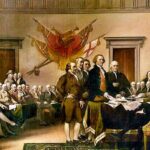
Happy Independence Day!
- Declaration of Independance – read the transcript and the history of the founding document of our nation (Library of Congress) | learn more about the battle for its preservation (PBS NOVA)
- Catholic Sources and the Declaration of Independence by Rev. John C. Rager. The Catholic Mind XXVIII, no. 13 (July 8, 1930), looks at synergies between the thought of Aquinas and Bellarmine and that expressed in the Declaration, asking: “Did Jefferson know of Bellarmine?”? (In How Catholic is the Declaration of Independence?, Commonweal takes a look at the “Scholastic-roots-of-democracy theory”; and CatholicHistory.net provides a bibliography on Catholics and the American Founding).
- Carl Olson interviews Dr. Bradley J. Birzer, author of American Cicero: The Life of Charles Carroll (Ignatius Insight) | Learn more about our Catholic founding father
- What do Pope John Paul II and Pope Benedict XVI think about the American Founding?.
- Discover the riches of The Federalist Papers – by way of a commentary by Paul Zummo (The Cranky Conservative), who maintains: “I absolutely believe that an understanding of the Federalist Papers is essential for understanding the U.S. Constitution and, therefore, understanding America.”
- Listen to Johnny Cash recite “I am the Nation”.
In anticipation of Corpus Christi
A stirring account from Archbishop Timothy Dolan of New York:
Last week, we bishops met for our annual Spring Meeting, this year in Seattle. We had a lot of business: liturgical matters, revision of the Charter to Protect Youth, approval of a defense of fragile human life against physician-assisted suicide, a decision to issue a document to help our priests, deacons, and ourselves preach better . . . plus a lot more.But the most productive session came on Friday morning. As usual, we began with the Holy Sacrifice of the Mass. But then we gathered as the Blessed Sacrament was placed in the monstrance on the altar. There we prayed: morning prayer from the Liturgy of the Hours; silence; an excellent conference by a brother bishop; silence; opportunity for confession; and closing Benediction.
It was, in my mind, the most productive part of our meeting. Nearly two hundred bishops, on their knees, in silent prayer, before Jesus, really and truly present in the Holy Eucharist.
As I tip-toed out of the room to stand in line for confession, I heard two of the young hotel workers chatting.
“It’s sure quiet in there,” whispered one of them. “What are they doing?”
“It’s weird,” replied the other. “They’re not doing nothing. They’re all just kneeling there quietly looking at this flat piece of bread in this fancy gold holder.”
He almost got it right . . . except that we believe, with all our heart and soul, that it’s not a “flat piece of bread,” but the second Person of the Blessed Trinity, Jesus Christ, really and truly present in the Sacrament of His Body and Blood.
SOLT Statement Regarding Fr. John Corapi
Official Statement of SOLT (Society of Our Lady of the Most Holy Trinity) regarding Fr. John Corapi:
As the Regional Priest Servant of the Society of Our Lady of the Most Holy Trinity (SOLT), I issue the following statement on behalf of the Society.On 16 March 2011, the Bishop of Corpus Christi, Texas, and the SOLT received a complaint against Fr. John Corapi, SOLT. As is normal procedure and due to the gravity of the accusation alleging conduct not in concert with the priestly state or his promises as a member of a society of apostolic life of diocesan right, Fr. Corapi was suspended from active ministry (put on administrative leave) until such a time that the complaint could be fully investigated and due process given to Fr. Corapi. In the midst of the investigation, the SOLT received a letter from Fr. Corapi, dated June 3, 2011, indicating that, because of the physical, emotional and spiritual distress he has endured over the past few years, he could no longer continue to function as a priest or a member of the SOLT. Although the investigation was in progress, the SOLT had not arrived at any conclusion as to the credibility of the allegations under investigation.
At the onset, the Bishop of Corpus Christi advised the SOLT to not only proceed with the policies outlined in their own constitutions, but also with the proper canonical procedures to determine the credibility of the allegations against Fr. Corapi. We reiterate that Fr. Corapi had not been determined guilty of any canonical or civil crimes. If the allegations had been found to be credible, the proper canonical due process would have been offered to Fr. Corapi, including his right to defense, to know his accuser and the complaint lodged, and a fair canonical trial with the right of recourse to the Holy See. On June 17, 2011, Fr. John Corapi issued a public statement indicating that he has chosen to cease functioning as a priest and a member of the SOLT.
The SOLT is deeply saddened that Fr. Corapi is suffering distress. The SOLT is further saddened by Fr. Corapi’s response to these allegations. The SOLT will do all within its power to assist Fr. Corapi if he desires to seek a dispensation from his rights and obligations as a priest and as a professed member of the SOLT. We request your prayers and the intercession of the Blessed Mother for the healing of Fr. Corapi and for any who have been negatively affected by Fr. Corapi’s decision to end his ministry as a priest and a member of the SOLT.
Fr Gerrard Sheehan, SOLT
Regional Priest Servant
Related
- Father Corapi’s Bombshell/a> by Joan Frawley Desmond. (National Catholic Register 6/19/11). Full coverage, including news that
“the order’s investigation faced complications created by a civil suit filed by Father Corapi against the former employee who had accused him of sexual misconduct.
“When she left the company, she signed a contract that she would not reveal anything that happened to her while she was at Santa Cruz Media. Father Corapi paid her for this. Father was suing her for a breach of contract.”
- “The Black Sheepdog is Unleashed” — against his unnamed accuser and the bishops. John Corapi responds.
6/20/11 - “God Love You, God Bless You, and Good Bye” – Initial message of John Corapi (“once called ‘father,’ now ‘The Black Sheep Dog’”)
Memorial Day 2011
Almighty God, our heavenly Father, let thy protection be upon all those who are in the service of our country; guard them from all harm and danger of body and soul; sustain and comfort those as home, especially in their hours of loneliness, anxiety, and sorrow; prepare the dying for death and the living for your service; give success to our arms on land and sea and in the air; and grant unto us and all nations a speedy, just and lasting peace. Amen.
– Prayer in Time of War
Waterboarding is for pansies.
‘You asked me once,’ said O’Brien, ‘what was in Room 101. I told you that you knew the answer already. Everyone knows it. The thing that is in Room 101 is the worst thing in the world.’
The door opened again. A guard came in, carrying something made of wire, a box or basket of some kind. He set it down on the further table. Because of the position in which O’Brien was standing. Winston could not see what the thing was.
‘The worst thing in the world,’ said O’Brien, ‘varies from individual to individual. It may be burial alive, or death by fire, or by drowning, or by impalement, or fifty other deaths. There are cases where it is some quite trivial thing, not even fatal.’
He had moved a little to one side, so that Winston had a better view of the thing on the table. It was an oblong wire cage with a handle on top for carrying it by. Fixed to the front of it was something that looked like a fencing mask, with the concave side outwards. Although it was three or four metres away from him, he could see that the cage was divided lengthways into two compartments, and that there was some kind of creature in each. They were rats.
‘In your case,’ said O’Brien, ‘the worst thing in the world happens to be rats.’ [George Orwell's 1984 Part III, Chapter 5.]
Those familiar with Orwell’s 1984 know what happens next. And if you haven’t, here’s the final scene of the movie adaptation (embedding disabled).
“What John McCain suffered actually was torture. His bones were broken, for example. Induced panic isn’t torture.”“I don’t base the definition of torture on subjective determinations. Clearly it’s an issue of prudential judgment and it is certainly clear to me, someone who has severe panic attacks, that panic is not torture.”
“If we cannot induce panic in our enemies with the intention of saving millions of lives, we can’t go to war at all. It’s as simple as that.”
Waterboarding is for pansies. If Abū Zubaydah could withstand being waterboarded 83 times during August 2002, we’re clearly not doing it right. Let’s turn up the panic a few notches. Let’s take it one step further. Let’s put the fear of God almighty in these pathetic excuses for humanity.
Let’s go Orwellian — “Room 101″ style.
“the Gaga-who-walks-among-us”
Blogging for the Jesuit national weekly America, Tom Beaudoin (associate professor of theology in the Graduate School of Religion at Fordham) indulges in speculation about the theological and cultural significance of … Lady Gaga, soliciting reflections from a new generation of budding scholars and theologians on Lady Gaga’s “ethos of ‘authenticity’” — as in the following, from a faculty member of Marymount School in NY:
“But to think about incarnation in another way, imagine Gaga performing unplugged and sans makeup as her natural-born self. She would then be not the Gaga sanctified and worshipped as “Mother Monster” on a (media) pedestal, but the Gaga-who-walks-among-us, the one who knows and understands the pain of being freak, outcast, and reject.“
Recall the furor back in 2005 when the Congregation for the Doctrine of the Faith, under the direction of then-Cardinal Ratzinger, gave the order to dismiss Fr. Thomas J. Reese, former editor of America. The CDF has been long concerned about the Jesuit publication’s promotion of positions on moral issues often in conflict with Catholic teaching. And insofar as the heterodox theological output of America was taken seriously, the Vatican’s concerns seemed warranted.
But in this case, I would encourage Mr. Beaudoin and company to keep up the good work.
Resurrection: The Rock Video
Robert Holmes “Rob” Bell Jr. is an American “megachurch” pastor and author of such trendy books as Velvet Elvis: Repainting the Christian Faith, and Sex God: Exploring the Endless Connections between Sexuality and Spirituality. His latest book, Love Wins, which from what I can tell is an exploration of Christian universalism, has caused quite a stir of late.
I don’t know a great deal about Rob Bell, save for my stumbling on this video this morning of Rob Bell preaching on the Resurrection.
Now — ordinarily, you might think the the resurrection of Jesus Christ from the dead would be sufficient enough to provoke some stirring of human wonder in the listener.
Not so.
Rather, the resurrection (or Rob Bell’s speculations on the meaning of such) has to be accompanied by a hip modern rock soundtrack and a streaming psychedelic light show such as I might have enjoyed — oh, perhaps two decades ago, at a Grateful Dead concert, “under the influence.” To such an extent that, at least from my perspective, the content of his message is repressed, obscured by the barrage of the senses.
What is it with these modern, megachurch televangelists?
What does this say about the attention span of the intended audience?
Has the gospel become so boring that we really have to be entertained by it?
He is Risen! ~ Happy Easter!
Yes, we believe in God, the Creator of heaven and earth. And we celebrate the God who was made man, who suffered, died, was buried and rose again.
We celebrate the definitive victory of the Creator and of his creation.
We celebrate this day as the origin and the goal of our existence.
We celebrate it because now, thanks to the risen Lord, it is definitively established that reason is stronger than unreason, truth stronger than lies, love stronger than death.
We celebrate the first day because we know that the black line drawn across creation does not last for ever.
We celebrate it because we know that those words from the end of the creation account have now been definitively fulfilled: “God saw everything that he had made, and behold, it was very good” (Gen 1:31). Amen.
Easter Vigil: Homily of His Holiness Benedict XVI
St. Peter’s Basilica. 23 April 2011.
Terror on the Ivory Coast
The blogger Gateway Pundit relays the news that Muslim Troops have slaughtered 1,000 Christians on the Ivory Coast:
Early reports suggested that more than 800 people, largely from the Gbagbo-supporting Gueré tribe, were killed in a single day at the sprawling Salesian Saint Teresa of the Child Jesus mission in Duekoue, 300 miles west of Abidjan towards the Liberian border. The attackers seem to have been largely soldiers descended from Burkina Faso immigrant Muslim families loyal to Ouattara.Late yesterday the Roman Catholic charity Caritas said more than 1000 people were massacred in Duekoue. A Caritas spokesman said Caritas workers visited the town and reported seeing a neighbourhood filled with bodies of people who had been shot and hacked to death with machetes.
The perpetrators of the massacre are troops loyal to the Muslim President Alassane Ouattara, rebels attempting to forcefully remove Laurent Gbagbo, the incumbent President refusing to step down after allegedly losing the vote in November 2010.
As Gateway Pundit notes, “the conflict has been brewing for years,” with a country divided between the Muslim North and Christian South and a disputed election of a Muslim president against a Christian incumbent who has remained in office since 2000.
Further reading is required to grasp the true horror (and nature) of the conflict: Continue reading
On the Muslim response to Terry Jones’ Qu’ran Burning (a reply to Rick Sanchez @ Huffington Post)
[A reply to "Burning the Quran Is No Childish Game", by Rick Sanchez (Huffington Post April 1, 2011; republished at Defend The Prophet) ~ Christopher]
With respect to Terry Jones’ burning of the Qu’ran, my position (as a Catholic) is to echo the statement of the Vatican: it is “an outrageous and grave gesture against a book considered sacred by a religious community,” and an unnecessary provocation (if even to make a point). A peaceful dialogue between communities is not advanced by such a direct attack on the other. Likewise, with respect to caricatures of Mohammed by the Western press:
In addition, coexistence calls for a climate of mutual respect to favor peace among men and nations. Moreover, these forms of exasperated criticism or derision of others manifest a lack of human sensitivity and may constitute in some cases an inadmissible provocation. A reading of history shows that wounds that exist in the life of peoples are not cured this way.
I said as much last year (“Lars Vilks, Gay Muhammad and Freedom of Expression” (American Catholic May 16, 2010) — Lars Vilks may endorse his right to depict a gay Mohammed or a paedophile Jesus. We might countenance his First Amendment “right” to sacrilege as Americans, but I believe as Catholics we should protest such offenses, not only to ourselves but to our fellow Muslims.
However, what I think also merits comment is exactly that which is noted by Rich Sanchez in his column: when a Qur’an happens to be vandalized, such an action is “not only offensive, but also dangerous — especially to our troops.” In fact, Terry Jones’ sacrilege “can have dire consequences for all of us.”
But why would it — why should it — be considered dangerous, even lethal, to our troops?
Surely this fact is a travesty as well?
In the past several days, a Muslim mob protesting the actions of Terry Jones in Mazar-e-Sharif, Afghanistan, culminated in an attack on the United Nations headquarters, the murder of six Nepalese guards and 3 foreign staff members, “hunted down and shot, some in the back, as they ran from a bunker where they had tried to hide. One person’s throat was also slit.” ["Koran Burning Prompts Third Day of Rage" Globe and Mail April 3, 2011.] Two US soldiers were shot dead by an Afghan border policeman in Maymana, northern Afghanistan (The Telegraph April 5, 2011).
By no means am I equating all Muslims with the mob in Afghanistan. We do not see this level of violent protest here in the United States by American Muslims. But surely those Muslims protesting the actions of Terry Jones, and Mr. Rick Sanchez as well, can agree that there is something seriously amiss when the vandalization of a religious icon — or cartoons published in a newspaper — result in a violent mob and the slaughter of innocents.
Christians, much to our dismay, suffer similar incidents of abuse and vandalization of that which we hold sacred here in America: the Holy Mother smeared with feces, the Crucifix dipped in urine, funded with taxpayer dollars and labled “art” to boot.
And yet, has the media ever reported mobs of Christians hunting down and killing the perpetrators of such sacrilege? — Speaking from personal experience, by and large when such incidents occur, the result is the congregation of Christians in prayer and silent, nonviolent protest.
What is it about Muslims in other nations that we see them react in this manner? Is this a religious thing? — Can it be so readily dismissed as a ethnic or cultural thing?
When critics of Islam depict it as a “violent religion”, why do so Muslim reactions have a tendency to lend credence to the very characterization they are protesting against?
I ask this with all respect, as a reader, as a Christian, and as a friend to the Muslim community.
Fr. Richard J. Neuhaus on Islam and Reform
Commenting on a prior post by Paul Zummo on “Religious Egalitarianism”, I had cited the provocative comment of the late Fr. James Neuhaus:
Yet more troubling is the message that Islam, in order to become less of a threat to the world, must relativize its claim to possess the truth. That plays directly into the hands of Muslim rigorists who pose as the defenders of the uncompromised and uncompromisible truth and who call for death to the infidels. If Islam is to become tolerant and respectful of other religions, it must be as the result of a development that comes from within the truth of Islam, not as a result of relativizing or abandoning that truth. Is Islam capable of such a religious development? Nobody knows. But, if the choice is between compromising Islamic truth or a war of civilizations, it is almost certain that the winner among Muslims will be the hard-core Islamism that [Bernard] Lewis rightly views as such a great threat.Christianity is more, not less, vibrantly Christian as a result of coming to understand more fully the mysterious and loving ways of God in His dealings also with non-Christians. Although the story of this development is complex, the important truth is that tolerance and mutual respect are religious, not secular, achievements. I will say it again: the reason we do not kill one another over our disagreements about the will of God is that we believe it is against the will of God to kill one another over our disagreements about the will of God. Christians have come to believe that. We must hope that more and more Muslims will come to believe that. That will not happen, however, if they are told that coming to believe that will make them less faithful Muslims.
I was asked by a reader to expand on Neuhaus’ remarks, and as I’ve no wish to hijack Paul’s post (particularly as it wasn’t about Islam per se), here’s some further food for thought.
What does Neuhaus mean? Continue reading
The Monk-Martyrs of Tibhirine
On the night of 26-27 March 1996, seven Trappist monks from the monastery of Tibhirine in Algeria — Dom Christian de Chergé, Brother Luc Dochier, Father Christophe Lebreton, Brother Michel Fleury, Father Bruno Lemarchand, Father Célestin Ringeard, and Brother Paul Favre-Miville — were kidnapped. They were held for two months, and were found dead on 21 May 1996.
The actual cause of their death remains in dispute. Their captors, the Armed Islamic Group, initially lay claim to the murders — but a French military attaché, retired General Francois Buchwalter, later reported that the deaths were accidental in a botched rescue attempt by the Algerian army. [Source: Wikipedia]
The fate of these monks was the subject of a book by John Kiser, The Monks of Tibhirine: Faith, Love, and Terror in Algeria (2003). A new film has been made — “Of Gods and Men” — recipient of many awards and glowing reviews. America‘s Fr. James Martin SJ has lauded it “the greatest film I’ve ever seen on faith.”
In 1996, First Things published an English translation of a letter by the superior of the monastery, Father Christian de Chergé, “to be opened in the event of my death”. In light of the movie it seems appropos to re-post it here, as food for thought: Continue reading
“Carlos” (2010)
Carlos, the film, chronicles the life, and often-bungled operations, of infamous Venezualan terrorist Illich Ramirez Sanchez, aka. ‘Carlos the Jackal’ in service to various Marxist and Islamicist fronts (bankrolled by Syria, Libya and oh, yes — Iraq).
For one so fervently committed to “anti-imperialism”, the end of the Cold War must have been quite disillusioning. The toppling of the Berlin Wall and unification of Germany, the downfall of the Soviet Union, the implosion of the Socialist bloc, the mass revolt sweeping across Europe — the culmination of these events left the once proud, once feared, once notorious “Carlos the Jackal” a relic of ages past, now bereft of support and shelter. You almost feel sorry for the guy: Continue reading
“Settle for Nothing Less.” (Walker Percy)
Q: What kind of Catholic are you?
A: Bad.
Q: No, I mean are you liberal or conservative?
A: I no longer know what those words mean.
Q: Are you a dogmatic Catholic or an open-minded Catholic?
A: I don’t know what that means, either. Do you mean I believe the dogma that the Catholic Church proposes for belief?
Q: Yes.
A: Yes.
Q: How is such a belief possible in this day and age?
A: What else is there?
Q: What do you mean, what else is there? There is humanism, atheism, agnosticism, Marxism, behavioralism, materialism, Buddhism, Muhammadanism, Sufism, astrology, occultism, theosophy.
A: That’s what I mean.
Q: To say nothing of Judaism or Protestantism.
A: Well, I would include them along with the Catholic Church in the whole peculiar Jewish-Christian thing.
Q: I don’t understand. Would you exclude, for example, scientific humanism as a rational and honorable alternative?
A: Yes.
Q: Why?
A: It’s not good enough.
Q: Why not?
A: This life is too much trouble, far too strange, to arrive at the end of it and then to be asked what you make of it and have to answer, “Scientific humanism.” That won’t do. A poor show. Life is a mystery, love is a delight. Therefore I take it as axiomatic that one should settle for nothing less than the infinite mystery and the infinite delight, i.e., God. In fact, I demand it. I refuse to settle for anything less.
Conversations with Walker Percy (1985)

Former Planned Parenthood director tells her story.
Next Tuesday, January 11th, Ignatius Press will launch a new book by former Planned Parenthood director and 2008 “employee of the year” Abby Johnson.
Unplanned is a behind-closed-doors expose of one of the biggest providers in the abortion industry, and a testimony of how Mrs. Johnson went from directing an abortion facility to working for the prolife cause. (And not just any abortion facility but the place at which the first 40 Days for Life campaign was launched in 2004).
As expected, Planned Parenthood isn’t taking this lightly. They filed a lawsuit to shut her up — but had their case dismissed.
Get all the details here, and purchase Unplanned from Ignatius Press at 35% off. You can also read the first chapter of Abby’s story in its entirety.
Abby also blogs at: http://www.abbyjohnson.org/.
Please join her prayer campaign for the conversion of Dr. LeRoy Carhart, one of the most experienced second & third trimester abortion providers.
Pope Benedict’s Christmas Address to the Roman Curia
On December 20, 2010, Pope Benedict gave his traditional annual speech and exchange of Christmas greetings to the Roman Curia in the Regia Hall of the Vatican. Here is the full text of the address.
Signs of despair (and hope) in Christian-Muslim relations
- “Where disagreement becomes a death sentence” – Zenit news interviews Shaheryar Gill, a Pakistani-born lawyer providing “an insider’s look” at Pakistan’s anti-blasphemy laws. On December 3rd, a hardline, pro-Taliban Pakistani Muslim cleric on Friday offered a reward for anyone who kills a Christian woman sentenced to death by a court on charges of insulting Islam.
- Meanwhile, in Iraq, an elderly Christian couple was killed in their home Sunday night in Baghdad, days before they were to finalize the transaction on their house and join an exodus of Christians fleeing to the safety of the North.
Earlier this month, a young Syrian Orthodox engineer was abducted from his shop and murdered, provoking the representatives of the Christian communities to withdraw in protest from the conference on Social Coexistence and Tolerance, organized by the Iraqi Ministry for Human Rights.
Muslim leaders are also sounding the alarm, calling on the Baghdad government and U.S. forces to provide safety for the Christian community.
- In Iran, Youcef Nadarkhani, a pastor of a church of about 400 people, was convicted of apostasy and has been sentenced to death for allegedly renouncing his Muslim faith. According to CNN, In the southern city of Shiraz, another Christian pastor, Behrouz Sadegh-Khanjani, 35, is facing a possible indictment for apostasy.
In his book-length interview Light of the World, Pope Benedict emphasized that, with respect to Muslims:
“The important thing here is to remain in close contact with all the current within Islam that are open to, and capable of dialogue, so as to give a change of mentality a chance to happen even where Islamism still couples a claim to truth with violence.”
Earlier in November, he renewed his call for religious freedom in Muslim countries Continue reading
So many books! So little time!
So many books! So little time! And, unfortunately, not enough to afford them all. Erasmus’ motto, “When I get a little money I buy books; and if any is left I buy food and clothes” worked during college, but is hard to get away with once you’re married with children and have a spouse to answer to. =)
We’ve heard much lately of Pope Benedict’s interview with Peter Seewald: Light of the World: The Pope, The Church and The Signs Of The Times, regarding which Ignatius Press’ Carl Olson has been doing a magnificent job rounding up reviews and discussion across the web; and George Weigel’s “sequel” to his reknowned autobiography of John Paul II: The End and the Beginning: Pope John Paul II — The Victory of Freedom, the Last Years, the Legacy, and Patrick W. Carey’s biography Avery Cardinal Dulles, SJ: A Model Theologian.
Here are a few more on the horizon that might be of interest to our readers (and which are definitely on my “to read” list from 2010). Continue reading


Recent Comments
(2 hours ago)
(3 hours ago)
(3 hours ago)
(3 hours ago)
(4 hours ago)
(4 hours ago)
(5 hours ago)
(5 hours ago)
(6 hours ago)
(6 hours ago)
(6 hours ago)
(6 hours ago)
(7 hours ago)
(7 hours ago)
(8 hours ago)
(9 hours ago)
(9 hours ago)
(9 hours ago)
(9 hours ago)
(9 hours ago)