Donald R. McClarey
Cradle Catholic. Active in the pro-life movement since 1973. Father of three, one in Heaven, and happily married for 43 years. Small town lawyer and amateur historian. Former president of the board of directors of the local crisis pregnancy center for a decade.
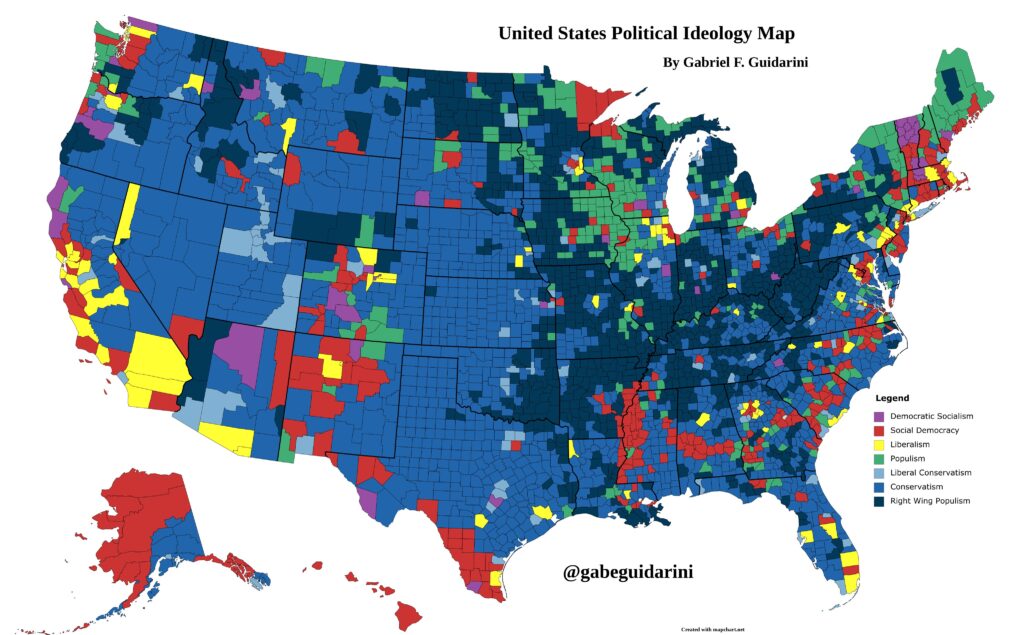



I don’t think much of his taxonomy. Our problem as a political society is that we’re broadly divided into two sectors. The rest is footnotes. Sector One (that’s us) adheres to the following propositions.
Life exists in spheres. In each sphere, there is an autonomous dynamic which incorporates value-scales specific to the sphere. There is family life, avocational life, the life of friendship, education, religion, work, philanthropy, and the civic sphere. The civic sphere encompasses politics, law, and formal philanthropy.
Society has formal rules. The rules are generally accessible to ordinary people. The rules are applied as impartially as flawed human beings can manage. Rules may change, but in any controversy, the rules are those that were in place at the time the controversy erupted.
Neither common and public institutions nor any occupation are the property of a particular political faction.
Accomplishment is, brass tacks, personal. Different people have different starting conditions and your observable accomplishment at the end may in the light of your initial circumstances say something about what you bring to the table now and in the future. Nevertheless, what you’ve done is what you’ve done and what you haven’t done is what you haven’t done.
Societies which seek to promote the common good encourage accomplishment and encourage accomplishments which do not derived from identifying rent-seeking opportunities.
Qualifications on the encouragement of accomplishment are found in the ethic of common provision and in republican principles of government. The one seeks to contain the effect of personal shortcomings on material well-being (while attempting as much as possible to avoid perverse incentives) while the latter seeks to contain the degree to which people who have acquired life’s rewards can exercise power over others with whom they have no business relationships.
We do not live in a society of orders (bar, in places like Britain, where orders are decorative). Distinctions in status are derived from the life-cycle, from national origin, from freely assumed obligations, and (here and there) from being men or being women. In odd circumstances, someone’s incapacities may be great enough to be placed under the guardianship of others consequent due process. These qualifications aside, we are all citizens.
As citizens, we are free men and free to associate and contract and also free to refuse to associate and contract. Contracts, of course, incorporate obligations, which the free man assumes. Such obligations are properly enforceable by public authorities.
Our freedom to contract is qualified by the following: that both sides of the transaction operate in a competitive market and that nothing to be done is in the service of vice and immorality.
That the function of the state is to formulate and enforce society’s rules (which shall incorporate all rubrics to delineate whose property is whom and to assist ordinary people in maintaining their property in their possession and shall incorporate the enforcement of contracts and shall resist the manipulation of markets), produce public goods, allocate usufruct over common property, contain the imposition of the costs of productive activity on third parties, and undertake acts to animate the ethic of common provision. Note, if production of a good or service can and does appear spontaneously on an open market, it is not a public good.
Norms apply equally to all of a given status. Norms are properly determined by officials chosen by those they live among and informed by convention and common sensibilities. Proper norms are learned by the experience of all previous generations and communicated to the living generations via culture. Norms are not something derived from experts. The norms of the experts are merely those ambient in certain occupational guilds.
Loyalties are properly concentric. Loyalty to the nation is one of the outer rings. One is loyal to one’s nation when one understands its history and adopts that history as one’s own and when one understands that the welfare of one’s countrymen takes precedence over the welfare of others.
The other sector denies all of these propositions (when they’re not lying).
Found the thread where he explains the methods– taking the jargon out, this is one guy’s impression of how he’d classify the politics of counties based on how they went in a couple of elections, with some change by primary votes and a big fudge factor that boils down to “somebody said.”
https://twitter.com/GabeGuidarini/status/1315414062629564420
And that’s the method. All of these requirements can be overruled by input from commenters that I received during my individual maps of each state during the series over the last four months.
On the upside, he does at least define his terms to try to get the idea of what he’s going for across.
Saw this earlier, but didn’t have the opportunity to comment.
I’d like to thank Art for taking the time to describe the propositions our side adheres to. I’d also like to expound on his description of the other side as “those [who]den[y] all of these propositions (when they’re not lying)[,]” by reminding everyone of the blogger Wretchard’s description of the other side as “Those Who Are No Longer Our Countrymen (TWANLOC).” Art has succinctly explained why: they don’t hold with what we hold dear. Hence the ever increasing intensity, bitterness and rancor that we experience with each passing election cycle.