
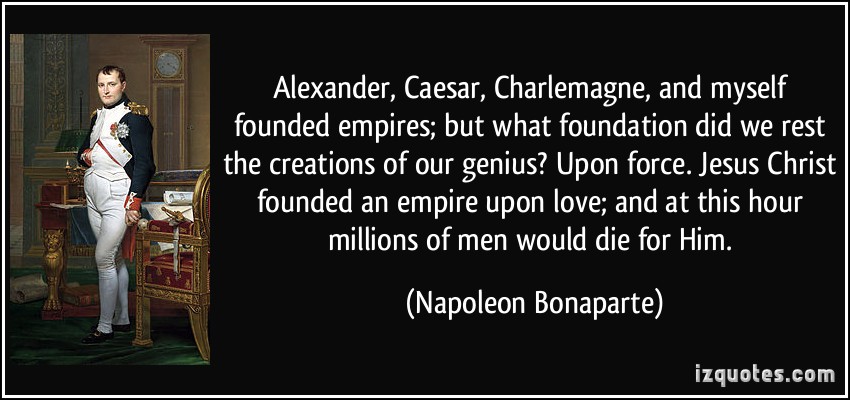
I am not as great an admirer of Napoleon as his biographer Andrew Roberts. I think how I feel about him is reflected in this excerpt from the screenplay Space Seed:
KIRK: Name, Khan, as we know him today. (Spock changes the picture) Name, Khan Noonien Singh.
SPOCK: From 1992 through 1996, absolute ruler of more than a quarter of your world. From Asia through the Middle East.
MCCOY: The last of the tyrants to be overthrown.
SCOTT: I must confess, gentlemen. I’ve always held a sneaking admiration for this one.
KIRK: He was the best of the tyrants and the most dangerous. They were supermen, in a sense. Stronger, braver, certainly more ambitious, more daring.
SPOCK: Gentlemen, this romanticism about a ruthless dictator is
KIRK: Mister Spock, we humans have a streak of barbarism in us. Appalling, but there, nevertheless.
SCOTT: There were no massacres under his rule.
SPOCK: And as little freedom.
MCCOY: No wars until he was attacked.
SPOCK: Gentlemen.
KIRK: Mister Spock, you misunderstand us. We can be against him and admire him all at the same time.
SPOCK: Illogical.
KIRK: Totally. This is the Captain. Put a twenty four hour security on Mister Khan’s quarters, effective immediately.
Historian Hendrik Van Loon nailed it in regard to Napoleon back in the first half of the last century:
Here I am sitting at a comfortable table loaded heavily with books, with one eye on my typewriter and the other on Licorice the cat, who has a great fondness for carbon paper, and I am telling you that the Emperor Napoleon was a most contemptible person. But should I happen to look out of the window, down upon Seventh Avenue, and should the endless procession of trucks and carts come to a sudden halt, and should I hear the sound of the heavy drums and see the little man on his white horse in his old and much-worn green uniform, then I don’t know, but I am afraid that I would leave my books and the kitten and my home and everything else to follow him wherever he cared to lead. My own grandfather did this and Heaven knows he was not born to be a hero. Millions of other people’s grandfathers did it. They received no reward, but they expected none. They cheerfully gave legs and arms and lives to serve this foreigner, who took them a thousand miles away from their homes and marched them into a barrage of Russian or English or Spanish or Italian or Austrian cannon and stared quietly into space while they were rolling in the agony of death.
If you ask me for an explanation, I must answer that I have none. I can only guess at one of the reasons. Napoleon was the greatest of actors and the whole European continent was his stage. At all times and under all circumstances he knew the precise attitude that would impress the spectators most and he understood what words would make the deepest impression. Whether he spoke in the Egyptian desert, before the backdrop of the Sphinx and the pyramids, or addressed his shivering men on the dew-soaked plains of Italy, made no difference. At all times he was master of the situation. Even at the end, an exile on a little rock in the middle of the Atlantic, a sick man at the mercy of a dull and intolerable British governor, he held the centre of the stage.
After the defeat of Waterloo, no one outside of a few trusted friends ever saw the great Emperor. The people of Europe knew that he was living on the island of St. Helena– they knew that a British garrison guarded him day and night –they knew that the British fleet guarded the garrison which guarded the Emperor on his farm at Longwood. But he was never out of the mind of either friend or enemy. When illness and despair had at last taken him away, his silent eyes continued to haunt the world. Even to-day he is as much of a force in the life of France as a hundred years ago when people fainted at the mere sight of this sallow-faced man who stabled his horses in the holiest temples of the Russian Kremlin, and who treated the Pope and the mighty ones of this earth as if they were his lackeys.
In his time Napoleon was sometimes thought of as the Anti-Christ by some of his more fervent opponents. He was not, as he demonstrated at the end of his life.
Napoleon purportedly made some remarkable statements about Christ while he was imprisoned on Saint Helena. This one was supposedly made to General Bertrand:
” Such is the fate of great men ! So it was with Caesar and Alexander. And I, too, am forgotten. And the name of a conqueror and an emperor is a college theme! Our exploits are tasks given to pupils by their tutor, who sit in judgment upon us, awarding censure or praise. And mark what is soon to become of me! Assassinated by the English oligarchy, I die before my time ; and my dead body, too, must return to the earth, to become food for worms. Behold the destiny, near at hand, of him who has been called the great Napoleon! What an abyss between my deep misery and the eternal reign of Christ, which is proclaimed, loved, adored, and which is extending over all the earth! Is this to die? Is it not rather to live? The death of Christ! It is the death of God.”
For a moment the Emperor was silent. As General Bertrand made no reply, he solemnly added, ” If you do not perceive that Jesus Christ is God, very well, then I did wrong to make you a general.”
And this statement, also to General Bertrand:
“The conversation at St. Helena very frequently turned upon the subject of religion. One day Napoleon was speaking of the divinity of Christ. General Bertrand said,
” I can not conceive, sire, how a great man like you can believe that the Supreme Being ever exhibited himself to men under a human form, with a body, a face, mouth, and eyes. Let Jesus be whatever you please—the highest intelligence, the purest heart, the most profound legislator, and, in all respects, the most singular being who has ever existed—I grant it. Still he was simply a man, who taught his disciples, and deluded credulous people, as did Orpheus, Confucius, Brama. Jesus caused himself to be adored because his predecessors Isis and Osiris, Jupiter and Juno, had proudly made themselves objects of worship. The ascendancy of Jesus over his time was like the ascendancy of the gods and the heroes of fable. If Jesus has impassioned and attached to his chariot the multitude, if he has revolutionized the world, I see in that only the power of genius and the action of a commanding spirit, which vanquishes the world as so many conquerors have done— Alexander, Caesar, you, sire, and Mohammed—with a sword.”
Napoleon promptly replied,
” I know men, and I tell you that Jesus Christ is not a man. Superficial minds see a resemblance between Christ and the founders of empires, and the gods of other religions. That resemblance does not exist. There is between Christianity and whatever other religion the distance of infinity.”
I say these statements were purportedly made by Napoleon because controversy surrounds these and similar statements allegedly made by Napoleon about Christ on Saint Helena. Go here for some background on the difficulty of confirming these quotes.
I believe some of the statements attributed to Napoleon about Christ were uttered by him. They have a Napoleonic ring to them in that they show his characteristic style: his use of classical allusions, his tendency to declaim rather than argue, his sense of history, etc. Napoleon had literary ambitions in his youth, and his overall style of speaking and writing stayed rather consistent throughout his career. Napoleon also loved to talk. When he had nothing else to occupy his attention he would burn off energy by talking. That he gave lengthy monologues about Christ and many other topics while in captivity is not to be doubted. That some “gilding the lilly” of the core statements went on as time passed is also not to be doubted, but I do believe that there is a hard core of accurate statements, including the two I have set forth above, regarding Napoleon’s views of Christ.
Although often portrayed as a Deist or an atheist, Napoleon was throughout most of his life a bad Catholic. Metternich, Napoleon’s greatest foe and shrewdest observer, summarized Napoleon’s religion as follows: “Napoleon was not irreligious in the ordinary sense of the word. He would not admit that there had ever existed a genuine atheist; he condemned Deism as the result of rash speculation. A Christian and a Catholic, he recognized in religion alone the right to govern human societies. He looked on Christianity as the basis of all real civilization; and considered Catholicism as the form of worship most favorable to the maintenance of order and the true tranquility of the moral world; Protestantism as a source of trouble and disagreements. Personally indifferent to religious practices, he respected them too much to permit the slightest ridicule of those who followed them. It is possible that religion was, with him, more the result of an enlightened policy than an affair of sentiment; but whatever might have been the secret of his heart, he took care never to betray it.”
That a bad Catholic might strive to become a good Catholic as he approaches his end is not to be marveled at. Here is the text of Napoleon’s will. Napoleon begins it: ” I DIE in the Apostolical Roman religion, in the bosom of which I was born more than fifty years since.” Perhaps more significant is this legacy to his son, whom he loved more than anyone else:
“1. The consecrated vessels which have been in use at my Chapel at Longwood.
2. I direct Abbé Vignali to preserve them, and to deliver them to my son when he shall reach the age of sixteen years.”
Is this only of antiquarian interest? Perhaps. However it is a testament to the power of Christ that a man who was frequently called the anti-Christ during his public career would end his days stating his belief in Him. Powers and principalities, and the men and women who lead them, come and go. Christ remains.


Don
Good or bd, mostly the latter, he is a classic example of the problem with a highly charismatic leader. People follow him without thinking, even going where they normally wouldn’t. Since his followers mostly follow; his thinking doesn’t get challenged, since he was something of genius the downfall came later, but harder.
I’m surprised you missed the History Teacher video.
The link
http://eclecticmeanderings.blogspot.com/2011/05/emperor-napoleon.html
Napoleon could accept advice, but he had a great difficulty in staying on good terms with men who could match him, or surpass him, in mental acuity. Hence his turbulent relationship with Talleyrand, admittedly something of a snake, his brother Lucien, who was an able monarch of Holland, and the list could go on at some length. Really able men tended to lose interest in being wielded like unthinking chessmen, and Napoleon lost a lot of talented subordinates as a result. It is of interest that few of his Marshals had a talent for independent command, too used to the Emperor looking over their shoulders. Napoleon was a micromanager, and as he aged he lost the energy to do so, and he had surrounded himself with too many men who were mediocre at best.
Great post Hank!
That he preferred to declaim rather than argue seems to square with a quote Paul Johnson attributed to Wellington: that Napoleon never learned how to fight a defensive war, which requires a different sort of grappling with one’s opponent than attack.
Fascinating. A final testament by a great and powerful emperor of this world to the King of Kings, Lord of Lords, and Lord of History—-so appropriate to this time of year.
[Would that we could have sat and talked with him during those long final months on St. Helena..]