
“By the will of God, prince Alexander was born from the charitable, people-loving, and meek the Great Prince Yaroslav, and his mother was Theodosia. As it was told by the prophet Isaiah: ‘Thus sayeth the Lord: I appoint the princes because they are sacred and I direct them.’
Second Pskovian Chronicle
Today is the feast day of Alexander Nevsky in the Russian Orthodox Church. Perhaps the most popular figure among Russians in Russian history, he was born on May 13, 1221 to Prince Yaroslav Vsevolodovich and Fedosia Igorevna of Ryazan. A second son, he had no chance of inheriting the throne of Valdimir. However German and Swedish encroachments caused the powers that be at Novgorod to acclaim him as their Prince. A victory over the Swedes at age 19 gave him the surname Nevsky as the battle was fought on the Neva river. Thus early in life Nevsky demonstrated a talent for war. However, he ran afoul of the Novgorod Boyars, aristocrats, always a turbulent lot at the best of times, and left Novgorod. He was called back quickly enough as Novgorod became the target of the Crusading Teutonic Order. This culminated in the famous battle on the ice of Lake Peipus on April 5, 1242. The Novgorodian forces had a two to one advantage and defeated the Teutonic Order. Casualties were relatively light, and contrary to the myth making of the film Alexander Nevsky, the ice did not break and none of the Teutonic Order army fell through the ice. It was a decisive victory however, and halted the medieval drang nach osten of the Germans along the Baltic coast.
With this victory Nevsky became the foremost Russian ruler of his day. He would rule the turbulent Novgorodians, with interruptions, throughout most of his life, and he would eventually be Grand Prince of Vladimir and Grand Prince of Kiev.
He would accept the Mongol Yoke of the Golden Horde, and he saw the Russians becoming tributary vassals of the Golden Horde. In this he had no choice as the Russians were clearly no match for the Mongols. A papal envoy reported on the destruction of Kiev by the Mongols in 1246:
They [the Mongols] attacked Rus’, where they made great havoc, destroying cities and fortresses and slaughtering men; and they laid siege to Kiev, the capital of Rus’; after they had besieged the city for a long time, they took it and put the inhabitants to death. When we were journeying through that land we came across countless skulls and bones of dead men lying about on the ground. Kiev had been a very large and thickly populated town, but now it has been reduced almost to nothing, for there are at the present time scarce two hundred houses there and the inhabitants are kept in complete slavery.
Nevsky has been blamed or praised for deciding that resistance to the Mongols was futile. The two centuries of Mongol domination left a severe stamp on the Russian character, but I do not think that Nevsky can be blamed for this. He made the correct military calculation that preserved the domestic autonomy of the Russians, their Church and reduced the Mongol Yoke, usually, to the payment of an annual tribute to the Golden Horde. It could have been far worse.
Prior to his death in 1263, Nevsky took monastic vows and received the religious name of Alexi.
After the Bolsheviks seized power in 1917 they initially had little use for Russian history or traditional Russian heroes like Nevsky. However, that would change under Stalin.
https://www.youtube.com/watch?v=AsOyI8_PQmI
Stalin shrewdly appreciated the utility of appropriating traditional Russian heroes, and hence he approved of the film Alexander Nevsky in 1938. A true work of genius by Sergei Eisenstein, who somehow pulled off the feat of making a film about an Orthodox Saint, an aristocratic Prince and pillar of the Church, and ladling it with Communist and anti-religious propaganda, and yet having the final result not be laughably absurd. The film was among the first efforts of Stalin to rally traditional Russian patriotism against the looming threat of Nazi Germany. Poor Eisenstein found himself in the doghouse soon after the release of the film due to the Nazi-Soviet pact. After the onset of Operation Barbarossa, the film was once again released and played to packed houses throughout the war. The Russian rallying song in the film was composed by Sergei Prokofiev. The lyrics roughly translated are :
Arise, ye Russian people,
to glorious battle, to a battle to the death:
arise, ye free people,
to defend our beloved country!
All honour to the warriors who live,
and eternal glory to those slain!
For our native home, our Russian land,
arise, ye Russian people!
Needless to say talking about a free people in Stalinist Russia must have struck many of the listeners as an example of black humor.
However, Stalin was onto something. Most Russians, not to mention Ukrainians and the other subject nationalities, were ready to greet as liberators virtually any invading army to free them from their Communist oppressors. In one of the great ironic tragedies of history, they were invaded by an army all too eager to slaughter them as untermensch, fit only to be killed or to be slaves. Appealing to traditional Russian patriotism, Stalin rallied the nation to fight. Stalin understood this. He remarked to a British diplomat while reviewing Russian troops marching off to the front. “We are not so fond as to think they perform these miracles for us, but for Holy Mother Russia.”
That of course is why Stalin also enlisted the aid of the Russian Orthodox Church which he had done his best to obliterate. He made a joint radio address with the Metropolitan of Moscow appealing for resistance to the invaders and reopened some of the churches the Communists had closed. The Orthodox responded with enthusiasm, preaching a crusade against Nazi Germany and raising funds to equip an armored division which fought under the Orthodox banner. Russian grandmothers and mothers, from the start of the war, sent off their sons and grandsons to serve in an atheist army with crosses around their necks, even if the crosses consisted of two nails twisted together. The irony of Stalin, a Communist Georgian atheist, being saved by traditional Russian patriotism and religious fervor is richly self-evident. Here is a rendition of the Arise Ye Russian People sans movie:
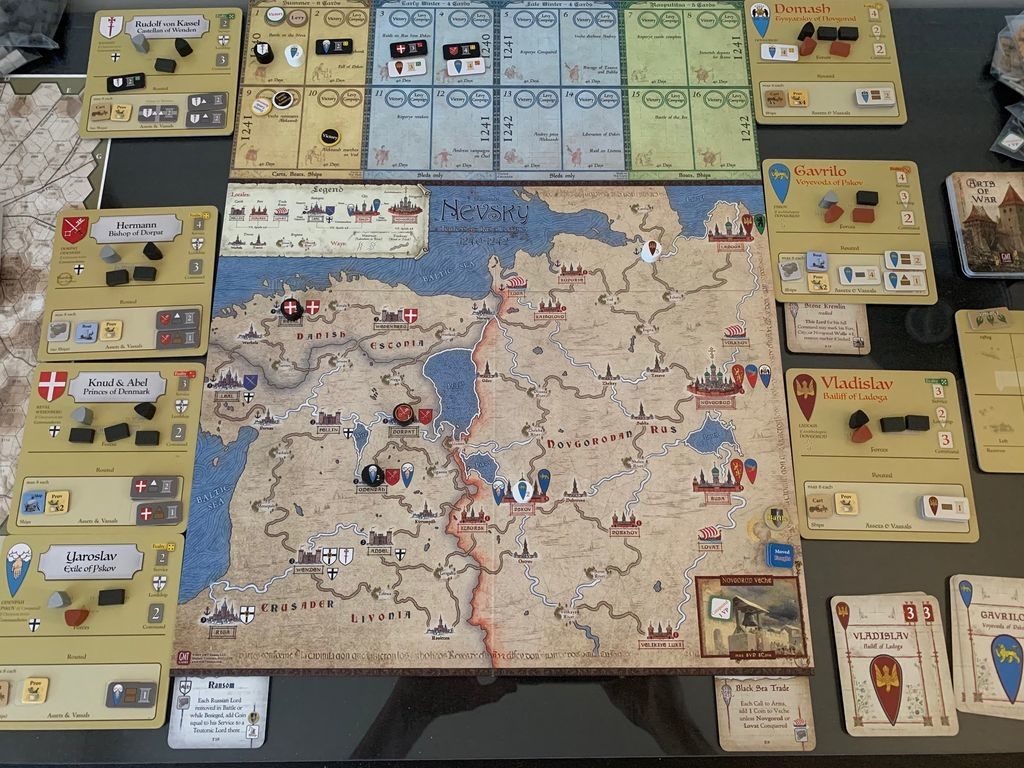
Nevsky is a fascinating character, and I am looking forward to the release of a new game about him by GMT Games. Go here to see it.


I read a similar thing about the Russian people during WW2 – there was no way they would fight for Stalin, but they would fight to the death for Mother Russia.
May the Most Holy Mother of God intercede for her long-suffering children in Russia and elsewhere.
Before Glasnost wasn’t the official Russian Orthodox Church suspect because many of the clergy were KGB informants ? At the same time there was an underground church true to the old religion? China thanks to Pope Francis may be using the same playbook.
The Russian Orthodox Church was riddled with agents and informants, although I think espionage between the ROC and the Soviet State was not a one way street.