“A victorious line of march had been prolonged above a thousand miles from the rock of Gibraltar in Spain to the banks of the Loire in France; the repetition of an equal space would have carried the Saracens to the confines of Poland and the Highlands of Scotland; the Rhine is not more impassable than the Nile or Euphrates, and the Arabian Fleet might have sailed without a naval combat into the mouth of the River Thames.
Perhaps the interpretation of the Qur’an would now be taught in the schools of Oxford, and her pulpits might demonstrate to a circumcised people the sanctity and truth of the revelation of Muhammed.”
Edward Gibbon, Decline and Fall of the Roman Empire
Charles Martel, “The Hammer”, led a life of conflict. An illegitimate son of Pepin of Herstal, Mayor of the Palace and the true power behind the Merovingian puppet kings, after the death of his father he had to fight his father’s legitimate offspring who sought to deprive him of any share in his father’s inheritance. Fortunately for Charles a streak of military genius ran through him, and he won battles against the odds, using force multiplying stratagems, including feigned retreats, and attacking in the middle of the day when armies of his time normally took a siesta. By 717 he was in control of Neustria, showing mercy unusual for his day in letting his defeated adversaries live and treating them with kindness.
The 28 year old ruler now entered a round of endless wars with neighboring kingdoms, gradually extending his power, and building up a professional force of infantry to supplement the peasant levies that made up the vast bulk of most Frankish armies.
A friend and patron of Saint Boniface, he also began the alliance between the rulers of the Franks and the Popes. He contributed much land to the Church, but roused ecclesiastical ire when he took some back to support his troops. He might have been excommunicated if both Church and State had not suddenly confronted a common foe.
In 711 the forces of Islam began the conquest of Spain, helped along by Christian traitors. Within a decade almost all of Spain had fallen, with small proto-kingdoms of Spaniards clinging to a precarious independence in the mountains of northern Spain. Mohammed had died less than a century before in 632, and in that intervening period Islam had conquered the Middle East, northern Africa and seemed poised to do the same in Europe against the petty Christian kingdoms that specialized in ceaseless internecine war, seemingly weakening themselves before their Islamic foes lifted a finger.
With Spain subdued, Muslim raids into what is now France became common. In 732 Abd-al-Raḥmân, governor of Muslim Spain, led a predominantly cavalry army of 25,000 men north on a great raid beyond the Pyrenees, perhaps the prelude to a war of conquest.
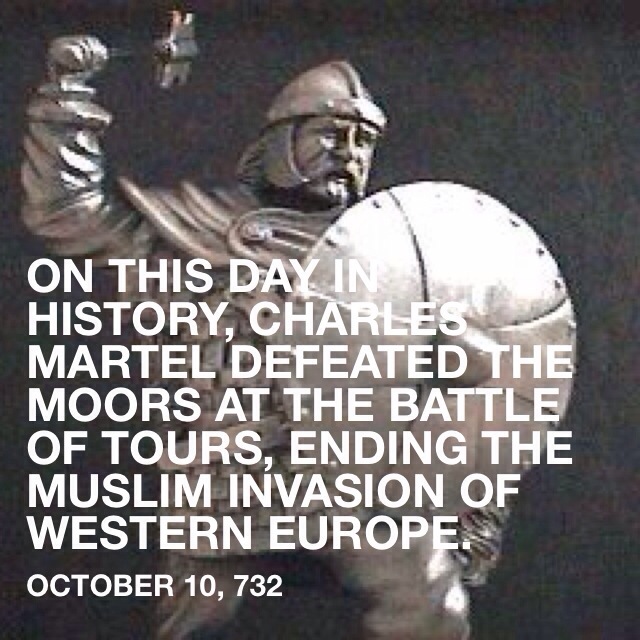
Charles Martel rallied together an infantry army of 15,000, and in early October 732 his army and that of Abd-al-Raḥmân confronted each other for seven days outside of Tours, Martel making certain to occupy the high ground. Martel had his army drawn up in a huge phalanx. Tiring of the stalemate, on October 10, 732 Abd-al-Raḥmân launched cavalry charge after cavalry charge against the Franks. A Muslim chronicler tells us what happened next:
And in the shock of the battle the men of the North seemed like a sea that cannot be moved. Firmly they stood, one close to another, forming as it were a bulwark of ice; and with great blows of their swords they hewed down the Arabs. Drawn up in a band around their chief, the people of the Austrasians carried all before them. Their tireless hands drove their swords down to the breasts [of the foe].
Martel launched an attack on the enemy camp, causing Abd-al-Raḥmân to order a retreat to his camp. The retreat became a rout after Abd-al-Raḥmân was killed in the fighting.
A Christian chronicle sums up the outcome of Tours:
Prince Charles boldly drew up his battle lines against them [the Arabs] and the warrior rushed in against them. With Christ’s help he overturned their tents, and hastened to battle to grind them small in slaughter. The king Abdirama having been killed, he destroyed [them], driving forth the army, he fought and won. Thus did the victor triumph over his enemies.
After Tours, Charles spent the rest of his life fighting off Islamic invasions from Spain. Much hard fighting remained ahead, but Tours was the turning point. The Franks would remain Christians and they ensured that Europe would remain Christian, thanks to God and the hard fighting Charles Martel and his Frankish infantry. His grandson, Charlemagne, would complete his work of building a strong Frankish state that helped ensure that Islam would not triumph in Europe and that the Reconquista would slowly drive Islam from Spain.


Loved the Blondie style video on Martel’s grandson. Oh for another Charles Martel today!
Well, ending the Muslim invasion of western Europe for 1300 years.
I named my youngest son Charles because of Charles Martel, The Hammer.
Never did a name more fit the man!
There were some other heroes in the fight against Islam in the West. Odo of Aquitaine (leading another province in SW France) fought as hard as Charles. In North Africa, the armies of Emperor Heraclius had stalled the Muslims at Carthage for 60 years, helped by a Berber princess (whose name I cannot recall), whose Fabian tactics delayed Caliph Omar’s forces so long that that fanatic celebrated when her head was brought to him at long last. Without that delay, Islam would have charged into a Spain and France with different and perhaps weaker leaders. (Imagine 9/11 under a Carter presidency.)
Louis, Louis, oh oh ooh, we gotta go!
Oui, oui, oui, je dis,
Louis, Louis, oh, oh, we gotta go!
Outremer lies across the sea;
Christians there, they call to thee
To fight the paynim, drive ’em home.
Thy duty as a faithful son of Rome.
Louis, Louis ….
It is said that power abhors a vacuum and that condition lasted for over two centuries after the fall of Rome. Had it gone on much longer before Charles came on the scene, it is likely the Muslims would have been successful in conquering central Europe. It is difficult to discount the importance of Tours to the establishment of Christian kingdoms and the beginning of Western Civilization that continues to this day despite its fits and starts.
Donald:
The emperors at Constantinople remained quite formidable opponents of Islam for several more centuries. There was a power vacuum in the West, but not in the Christian East. As a biographer of Diocletian noted, the Western Empire had never been as well populated as the East and had barely the manpower and resources needed to hold the limes under the reforms of the Late Empire, and after Honorius those were often wasted by contending generals.
At the time of Tours Byzantium had embarked upon a lengthy internal struggle over inconoclasm. A competent emperor would be cast up now and then, Basil II, the Bulgar slayer, for instance, but the Empire was on a downward slope that ended with losing Asia Minor to the Turks which led to the Crusades. I have long wondered if the Empire never fully recovered from the battle over images.
Don:
Reading various histories, the Empire did recover as an economic and military power, but its relations with the West and the Papacy were never the same. The Greek-speaking Emperors and their courts regarded even Italians as cultural inferiors, and the papacy’s opposition to iconoclasm was remembered with hostility, even after iconoclasm was itself forgotten, because the regard for Rome expressed by the Studite monks and many patriarchs through the time of St. Germanus was seen as compromising imperial control of the Church.
This hostility had consequences for Orthodox missionary activity, for (as one Soviet author noted), unlike Western monks, who introduced classical culture as well as the Faith to Celtic and Germanic pagans, the Eastern monks brought little classical learning to the Slavs, except some bits of Plato and the historians. Thus Western Christendom grew up with some sense of larger unity, while Eastern Christendom remains to this day very tribal and “national”, as Putin’s heavy hand on the Russian Church too obviously demonstrates.
Iconoclasm was replaced by Mother Angelica’s “Religious Reminders”.
Religious reminders help me and I thank God for the reminder.