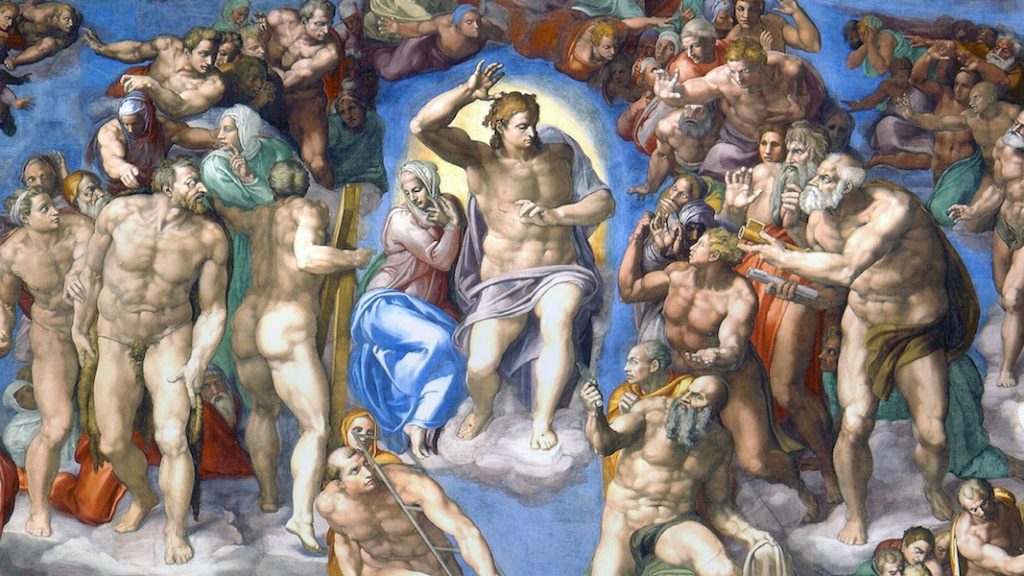
42 Watch ye therefore, because ye know not what hour your Lord will come. 43 But know this ye, that if the goodman of the house knew at what hour the thief would come, he would certainly watch, and would not suffer his house to be broken open. 44 Wherefore be you also ready, because at what hour you know not the Son of man will come.
Matthew 24: 42-44
We are at the end of the liturgical year and the readings from Scripture focus on the End Times.
Whether we are in the End Times is a subject that I am perpetually agnostic about. I tend to be a literalist on Christ’s statement that He will return “like a thief in the night” and as a result I have suspected that His Second Coming will be in a time of relative peace and prosperity, rather like the same conditions that prevailed during His First Coming, and that his His Second Coming will therefore come at a period when it would be least expected. Quien Sabe? My own personal take on how to live life each day is the same as contained in the poem Abraham Davenport, who, during the Great Darkness of May 19, 1780, gave us all an example, I think, to emulate:
Meanwhile in the old State House, dim as ghosts,
Sat the lawgivers of Connecticut,
Trembling beneath their legislative robes.
“It is the Lord’s Great Day! Let us adjourn,”
Some said; and then, as if with one accord,
All eyes were turned to Abraham Davenport.
He rose, slow cleaving with his steady voice
The intolerable hush.
“This well may be The Day of Judgment which the world awaits;
But be it so or not, I only know
My present duty, and my Lord’s command
To occupy till He come.
So at the post Where He hast set me in His providence,
I choose, for one, to meet Him face to face,
No faithless servant frightened from my task,
But ready when the Lord of the harvest calls;
And therefore, with all reverence, I would say,
Let God do His work, we will see to ours.
Bring in the candles.”
And they brought them in.
Then by the flaring lights the Speaker read,
Albeit with husky voice and shaking hands,
An act to amend an act to regulate The shad and alewive fisheries,
Whereupon Wisely and well spake Abraham Davenport,
Straight to the question, with no figures of speech
Save the ten Arab signs, yet not without
The shrewd dry humor natural to the man:
His awe-struck colleagues listening all the while,
Between the pauses of his argument,
To hear the thunder of the wrath of God
Break from the hollow trumpet of the cloud.
And there he stands in memory to this day,
Erect, self-poised, a rugged face, half seen
Against the background of unnatural dark,
A witness to the ages as they pass,
That simple duty hath no place for fear.