Donald R. McClarey
Cradle Catholic. Active in the pro-life movement since 1973. Father of three, one in Heaven, and happily married for 43 years. Small town lawyer and amateur historian. Former president of the board of directors of the local crisis pregnancy center for a decade.
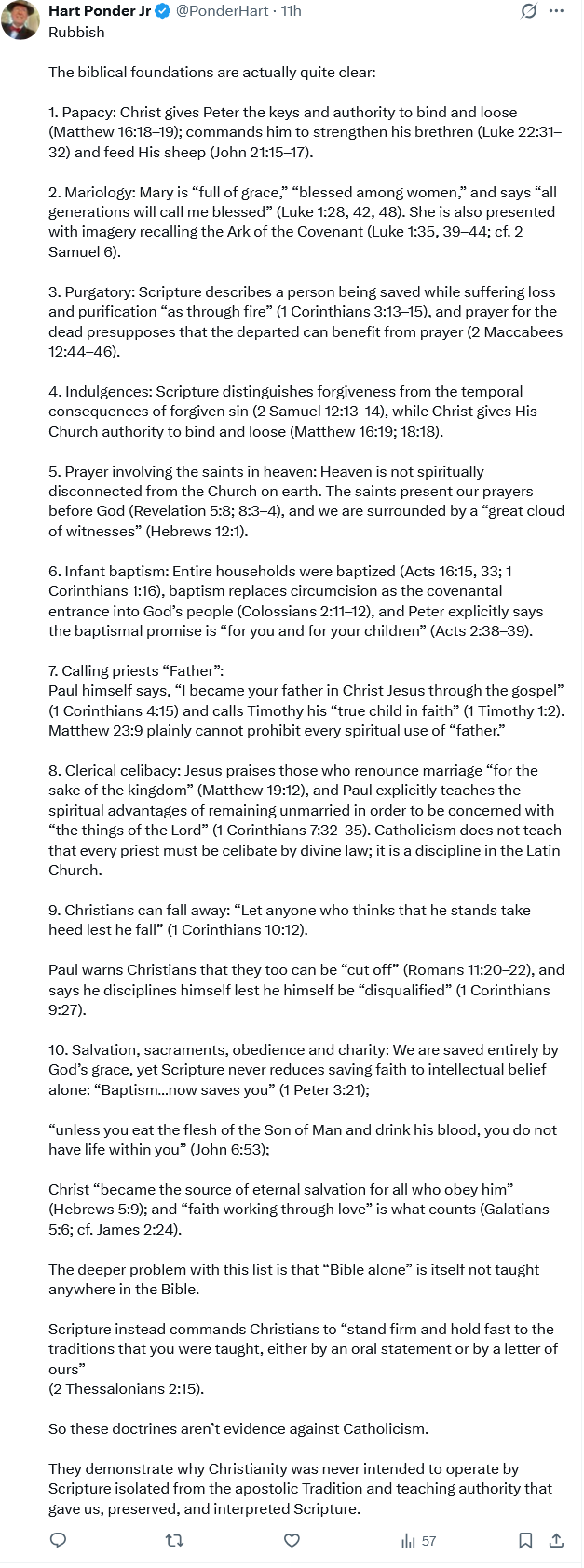

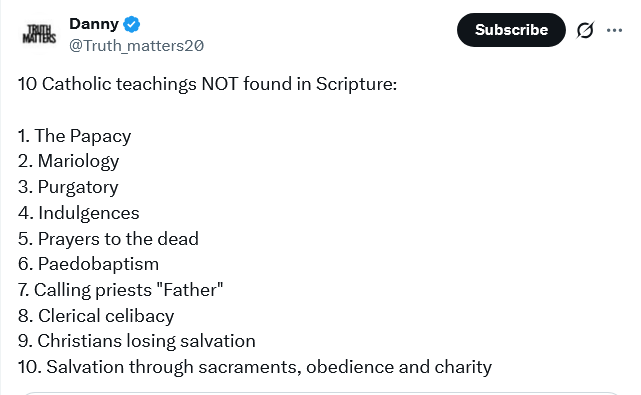


I am saving this for myself. Thank you.
One more thing that’s NOT in the Bible:
* What to include in the Bible.
Oops.
Protestants seem to trust the Holy Spirit just twice – to put together the Bible and to tell Luther what to take out of it.
(Oh, and when to split off from that split-off group, which split off that other split-off group. And to tell Lutherans to split in the first place.)
Re: the contents of the Bible, if I were currently a Protestant, I’d be kind of angry that the Deuterocanonical books (DCs) were wholly excised, even if I didn’t think they were inspired, largely because of how it was done.
Luther removed them from their traditional order and placed them in an appendix between the testaments, but still printed them. He even wrote glowing things about Tobit and Judith, if I remember correctly. Lutherans doctrinally are, AFAIK, ambivalent on the fixity of the canon. Calvin was NOT a fan, although he seems to have had a soft spot for Baruch, and later Calvinists did not have much regard for the DCs. Zwingli and later Anabaptists for some time held to the 73 book canon. Anglicans didn’t accept them as scriptural, but obviously had them in the Authorized Version, and even (if I recall correctly) use some DC readings in their version of the Office.
Fascinatingly, in almost all influential Bibles printed up until the mid to late 19th-century (e.g., Geneva Bible, KJV, etc., and non-English Bibles as well), the DCs were not only included but even had cross-references to the NT, and often even reciprocal cross-references from NT to DC. Again, one might not think they are inspired, but to have this ancient body of work and reference summarily removed is a travesty.
It wasn’t until the mid to late 19th century when English Bible Societies (many heavily influenced by Calvinism) began what I think amounts to pressure campaigns to have the DCs removed entirely, often only agreeing to print and/or distribute translations that did not include them. It was partially a financial motive, as it would save on printing costs, but also heavily theologically motivated.
Thus, it was ultimately not any ecclesial communion’s confession or doctrinal statements which led to their removal from physical Bibles, but rather para-church organizations who to some extent unilaterally made this decision. And after generations of Protestants receiving a Bible without the DCs, they aren’t even able to feel the loss of these decisions.
I am so glad for this! After reading Mr. Ponders reference to John 6:53, I went and read more from my Catholic study bibles that I have. Since my husband has wanted to attend a non-denominational church(really Baptist) where we live, I have had more than a few conversations with the pastor about their “communion”. When they do it, it is so devoid of holiness and importance that I feel is necessary when taking the Body and Blood. I now feel like I need to go to Saturday Mass at very least so that I can take in the consecrated and transubstantiated Body and Blood.
Whenever some primitivist Protestant tries to ensnare me on the “Christ says call no man ‘father’” (Matt. 23:9), this reader has been known to reply, “Are you carrying your sword? You’re not?”
“[ Now] anyone who does not have a sword should sell his cloak and buy one.” – Luke 22:36
For shame, not to carry your sword!
I’ve been seeing a lot of these “convert the Catholics” posts recently. I don’t know if it’s something I clicked on or some sudden evangelization effort from our separated brethren.