
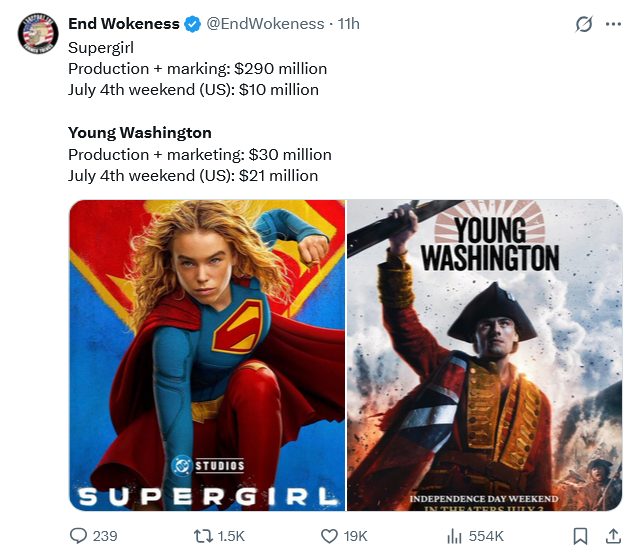
Any one seen this? My family had matters to attend to over the Fourth of July holidays so I haven’t seen it yet. Its box office numbers are miraculous considering it is a film on an historical topic from an independent studio.
Starting a war at 21 would be a notable fact in most bios, but for George Washington it was simply one more event in a life that ended up being one of the turning points in history.
At 21 Washington became the locus of events that led to a world war that saw fighting on every continent with the exceptions of Antarctica and the then undiscovered Australia. His brother Lawrence had held the post of adjutant of the Virginia militia with the rank of major. Upon his death Washington lobbied Lieutenant Governor Dinwiddie for the job. Dinwiddie, perhaps reluctant to entrust the job to a man so young, divided the duties of the office among four men, with Washington being one of them with the rank of Major. If Dinwiddie had any apprehensions about the youth of Washington, he soon overcame them as he granted to Washington an important commission. The French and the British disputed the Ohio valley and Dinwiddie sent Washington with a letter to the French commander in the Ohio asking them to remove themselves forthwith from the Ohio region.
The journey through what was then hundreds of miles of wilderness impressed Washington greatly with the future potential of this area for rapid expansion. Washington delivered Dinwiddie’s message to Captain Jacques Legardeur de Saint-Pierre, the French commander in the area, who received Washington courteously but who declined to withdraw.
Washington reported back to Dinwiddie. Washington kept a diary of his journey which Dinwiddie ordered to be printed, and fame came suddenly, and lastingly, to Washington throughout Virginia. Diplomacy having failed, Dinwiddie had Washington raise a force of Virginia militia to guard members of the Ohio company engaged in building a fort at present day Pittsburgh. The French beat the British to the punch, chased out the British traders and constructed Fort Duquesne at what is now Pittsburgh. In retaliation on May 28, 1754 Washington with his militia troops and Mingo allies attacked a French force of Canadiens under Joseph Coulon de Villiers, Sieur de Jumonville. Washington defeated them. Jumonville was captured, only to be murdered by one of Washington’s Indian allies, to the intense shock and horror of Washington.
“I heard the bullets whistle, and, believe me, there is something charming in the sound.”
George Washington, letter to his brother May 31, 1754, telling him about his victory . What might have been mere bragging by virtually any other man, King George II of Great Britain an old soldier himself supposedly heard about the remark and said that Washington must not have heard many bullets whistle by him yet if he found the sound pleasant, was not the case with Washington. As far as we can judge from outward evidence, Washington was absolutely fearless. Time after time in the French and Indian War and in the American Revolution he exposed himself to enemy fire. At Braddock’s Defeat in 1755 Washington had two horses shot out from beneath him, and four enemy musket balls were lodged in his clothes by the end of the fight. Washington believed that he could not be an effective leader unless he led from the front, and that is precisely what he did, often to the distress of his aides. His only emotional reaction to being under enemy fire was apparently complete contempt for the fire of the enemy. Men who observed him often wrote that they were amazed that anyone could be as fearless as he was.
The outraged French quickly turned the military tables. A huge force of 600 French, Canadiens and Indians besieged Washington at a badly sited stockade that Washington designated Fort Necessity. The military situation being hopeless, Washington surrendered, with his troops being allowed to march back to Virginia, the date being July 4, 1754. Washington and his French adversaries had fired the opening shots in the Seven Years War, known as the French and Indian War. English writer and member of Parliament Horace Walpole summed the situation up nicely: “The volley fired by a young Virginian in the backwoods of America set the world on fire.”
The British struck back with a column under Major General Edward Braddock. Washington served with the force as an unpaid volunteer. A British regular, Braddock had little fondness for Americans, although he made an exception for Washington who always had a knack for making friends.
At the battle of the Monongahela on July 9, 1755, the French and their Indian allies inflicted a humiliating defeat on the British expedition. Colonel George Washington, after the wounding of Braddock, although not being part of the chain of command since he was serving as an aide to Braddock and being technically outranked by every officer in Braddock’s force due to Washington only holding Virginia militia rank, effectively took command of the army, established a rear guard under himself, and allowed the army to stage an orderly retreat. This was an astounding performance for a man of only 23 with limited military experience. For years afterwards Washington would be known as the hero of the Monongahela until destiny allowed him the opportunity to earn much greater laurels.
On July 18, 1755 Washington wrote a report of the defeat to Dinwiddie. It is an early specimen of the type of reports that Washington would submit to Congress during the Revolutionary War two decades later, and it bears the features that Washington always displayed in his reports:
1. Concise: Washington had a talent for being able to render complex events into very few words. The brevity of his reports speak to his ability to sift the important from the superfluous.
2. Modesty: Although Washington was the hero of the day, no one could detect that from his report. Washington assumed that others would judge him from his actions, and wasted no words in self promotion or self-defense.
3. Warts and all: Washington was always blunt. In the report Washington does not attempt to mitigate the gravity of the defeat and notes that the frontier is now defenseless except for the shattered Virginia militia which were unequal to the task.
4. Honorable mentions: Washington always believed in reporting the courage and good performance of others, and he does so in his report, most notably for the Virginia military who carried the burden of the fight.
Here is the text of Washington’s report:
“To Governor Dinwiddie:
“Honbl. Sir – As I am favored with an opportunity, I should think myself inexcusable was I to omit giving you some account of our late Engagement with the French on the Monongahela, the 9th instant.
“We continued our march from Fort Cumberland to Frazier’s (which is within 7 miles of Duquesne) without meeting any extraordinary event, having only a straggler or two picked up by the French Indians. When we came to this place, we were attacked (very unexpectedly) by about three hundred French and Indians. Our numbers consisted of about thirteen hundred well-armed men, chiefly Regulars, who were immediately struck with such an inconceivable panic that nothing but confusion and disobedience of orders prevailed among them. The officers, in general, behaved with incomparable bravery, for which they greatly suffered, there being near sixty killed and wounded – a large proportion, out of the number we had!
“The Virginia companies behaved like men and died like soldiers; for I believe out of three companies that were on the ground that day scarce thirty were left alive. Capt. Peyroney and all his officers, down to a corporal, were killed; Captn. Polson had almost as hard a fate, for only one of his escaped. In short, the dastardly behavior of the Regular troops (so called)1 exposed those who were inclined to do their duty to almost certain death, and, at length, in despite of every effort to the contrary, broke and ran as sheep before hounds, leaving the artillery, ammunition, provisions, baggage, and, in short, everything a prey to the enemy. And when we endeavored to rally them, in hopes of regaining the ground and what we had left upon it, it was with as little success as if we had attempted to have stopped the wild bears of the mountains or rivulets with our feet; for they would break by, in despite of every effort that could be made to prevent it.
“The General was wounded in the shoulder and breast, of which he died three days after; his two aids-de-camp were both wounded, but are in a fair way of recovery; Colo. Burton and Sr. John St. Clair are also wounded and I hope will get over it; Sir Peter Halket, with many other brave officers, were killed in the field. It is supposed that we had three hundred or more killed; about that number we brought off wounded, and it is conjectured (I believe with much truth) that two-thirds of both received their shot from our own cowardly Regulars, who gathered themselves into a body, contrary to orders, ten or twelve deep, would then level, fire and shoot down the men before them.
“I tremble at the consequences that this defeat may have upon our back settlers, who, I suppose, will all leave their habitations unless there are proper measures taken for their security.
“Colo. Dunbar, who commands at present, intends, as soon as his men are recruited at this place, to continue his march to Philadelphia for winter quarters, consequently there will be no men left here, unless it is the shattered remains of the Virginia troops, who are totally inadequate to the protection of the frontiers.”
Celebrated as a hero, Washington was made commander of the Virginia regiment of a 1000 men and of all other colonial troops in Virginia. He and his men successfully guarded the Virginia frontier and its settlers, prevailing in some 20 engagements. Washington and his men participated in the Forbes Expedition of 1758 which culminated in the taking of Fort Duquesne. With a successful conclusion of the War in the Virginia and Ohio theaters, Washington resigned his commission and was promptly elected to the House of Burgesses.
Based upon the good box office numbers a sequel is apparently coming, 1776.
Full review after I have been able to see the film.


We saw it. Highly recommended. Looking forward to your review. It was well acted despite only two “name” actors; Ben Kingsley and Kelsey Grammar.