
If Zippy Catholic were still around I would expect him to show up in the comboxes to give us a jeremiad against usury. Usury has been understood in various ways through the life of the Church, some clerics condemning all interest on loans, to the usual understanding today that usury applies to unjust interest, which is rather like Justice Potter Stewart’s formulation that as to pornography, he knew it when he saw it.
I was once hired by a payday loan place to pursue collections. The first one I did, the debtor eventually skipped, had an annual interest rate of 420 percent. I then refused all other collections from this client, recognizing usury when it was before my eyes. I knew it when I saw it.
All economic systems have to have some form of interest in order to function. Islam bans interest, so what is functionally interest, is disguised in Islamic banking loans. Popes during the Middle Ages when interest on loans was usually condemned, would borrow from Jewish banking houses. (The clergy are often eager borrowers in general, less eager to pay back in general.) If an economic system much above a tightly organized community like the Amish, claims to be without interest or its equivalent, you have either landed in the Federation in Star Trek where they have “done away with money”, or you are among charlatans and their victims.
Myself, I wish a myriad of options to be open to potential borrowers, the more the merrier. I would not use a fifty year mortgage because I do not need to now. Starting out forty or so years ago on a first mortgage, a few hundred dollars off the monthly payment, compared to a 30 year, might have been attractive. People need to think these things out carefully, and if such strategic planning is beyond them, to get someone who is good at it to help them.


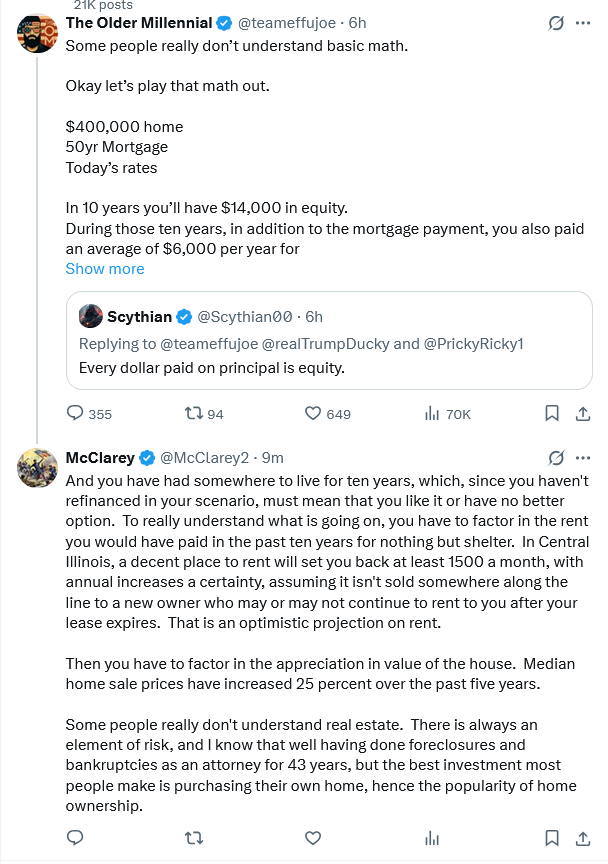
Rent is paying someone else’s mortgage off. I get that some have no choice.
Given the choice the choice should be: Marry young (if you can). Work, save and take out a mortgage on a house. Work hard and be consistent with your payments, beyond just paying the interest off on the mortgage.
The younger generation don’t seem to get it because they want to sip their matcha lattes and eat avocado toast at $20 a pop every weekend for brunch. Homes never depreciate. Cars, clothes, shoes and matcha lattes don’t hold (or increase) in value. Brick and mortar always does.
By the way, in my neck of the woods the way the property market has increased is beyond ridiculous. As in, insane and stupid tbh.
“… sip their matcha lattes and eat avocado toast at $20 a pop every weekend for brunch. “
Perhaps, but many believe owning their own home is out of their reach… so they “sip their…”
“Perhaps, but many believe owning their own home is out of their reach.”
I don’t think anything is out of anyone’s reach if they are willing to make sacrifices. If they don’t want to sacrifice lifestyle and comfort then it will be unattainable. Each to their own to choose.
I seem to recall Zippy also presented himself as someone who had at a young age founded a fantastically successful business. So, he relied entirely on equity capital and re-invested earnings, satisfied all invoices on presentation, and had no line of credit at a local bank. Do I have that right?
==
Interest is the price of credit. To say that credit should never have a price is to say that the lender is not providing you a service or that the service is a vice good.
==
I do recall hearing about 20 years ago a precis of the implications of lending at interest in a low-growth agricultural economy. that delineated the pitfalls of seeking and providing credit in that sort of environment. I’ve forgotten the content. That’s something to research.
==
See Hilaire Belloc: “There comes a point when you have to destroy the debt or destroy the debtor”. Hence we have bankruptcy laws. We also have the legal suppression of loan sharking and bookmaking.
==
In lower social strata, you have a collecting pool of people who are vulnerable to being blind-sided by events, who tend to overvalue current over future consumption, aren’t particularly disciplined, are often impetuous, cannot make sense of fine print, &c. They’re not investing in anything and providing them with consumer credit is rather like dumping rubbing alcohol on an open flame. Off-the-books help of various sorts from family and friends, title-loan dealers, pawn brokers, and bail bondsmen are about the best you can do to help them adjust to the vicissitudes of life without generating more trouble for themselves.
==
In the rest of society, you have the Alessandra Biaggis of this world, people who were offered government guaranteed credit which cannot be discharged, did not figure out the implications for themselves, were not properly counseled by others, and made several sets of ill-considered choices along the way. As a society, we’d have less of that if it were not official policy to generate it.
Zippy was quite wealthy Art, you are correct in your recollection.
Mortgage credit is a way for the middle class to accumulate wealth. None of us except perhaps trust fund babies have the ability to buy a house and pay cash. I’ve had three mortgages in my life. Having said that I hated having one. I made a point of paying them off as fast as I could after I got fairly upside down on credit card bills and was forced to pull a Dave Ramsey. My wife and I went scorched earth on debt. I can remember people telling me you should have as large a mortgage as possible because the interest on your primary home was tax deductible and rather than paying off your mortgage you could lower your taxes and invest in the stock market or other Investments. My response would be, yes, but that dollar you pay in interest is a real dollar. Having debt made me feel like a slave to the bank and there’s a considerable peace that comes from knowing that you own where you live and no one can throw you out of it.
Usury is charging interest on the use of money. Thus mortgages are not usury, as the lender gains the use not only of the money, but also the house. Similarly an investment in a business is not usury, if it is structured as buying a portion of the company and its profits rather than a loan for the money itself.
Now mortgages and business investments can be set up in an unjust fashion for other reasons, such as having extremely high rates of interest or extremely easy to violate payment conditions. But they aren’t inherently usurious.
Payday loans are inherently usurious. One of the most blatant examples of usury, along with student loans. It doesn’t matter if the interest is low (though it rarely is). These are unsecured loans, so the interest is merely a charge on the use of the money, hence usury.
A student loan is for investment in human capital. Your investment may be wasted, of course, but that can be true if you buy a building as well.
==
The purpose of consumer credit is to be able to redistribute one’s expenditures between time periods. You could argue people could forego much of this.
Rent is paying someone else’s mortgage off.
==
No, you’re paying for the use of the space. The landlord’s revenues may be allocated among a half-dozen different functions, not merely servicing his real estate loans.
Mortgage credit is a way for the middle class to accumulate wealth.
==
Purchasing real estate is an investment (among other things). Any accumulation of assets or reduction in debt arises from savings. Some assets you purchase prove more advisable than others.
If I wish to take out a loan for an investment, the loaner can review my plans beforehand, and I have an obligation to use the money for that investment. We need a similar setup for student loans.
“The landlord’s revenues may be allocated among a half-dozen different functions, not merely servicing his real estate loans.”
Unless the landlord owns the property outright he has to make mortgage payments on his property through rental income. Equity is built by paying off a mortgage. You cannot build equity renting someone else’s property. The landlord builds equity as the mortgage is paid off.
“Zippy was quite wealthy Art, you are correct in your recollection.”
I think he retired in his 50’s
A student loan is for investment in human capital. Your investment may be wasted, of course, but that can be true if you buy a building as well.
There’s two ways to interpret this:
1.) As a business venture. But these carry a risk of loss for the investor. For example, suppose that I agree to front start up money for a business in exchange for being a partner that receives 10% of the profits. If the business goes bust before it makes a profit, then I get nothing for my investment. But that is the risk that I took on, and I should have done better research so that I only invest when there is a good possibility of the long term profits offsetting my initial investment.
(Note too that I am not charging for the use of my money in this scenario, I am purchasing a share of the business.)
2.) As literal ownership of another person.
Interpretation 1.) doesn’t work for student loans because they can’t be discharged. Realistically speaking if they were a business venture the lender should investigate whether the student is likely to succeed in his future affairs before lending the money, and accept that he will get nothing if the student’s educational studies do not help out. But that’s not how these loans actually work.
Interpretation 2.) would justify getting money back from the student forever. But ownership of other people goes by another name: slavery. So this justification can’t work morally.
Student loans were at one time dischargeable. That changed in 2005 or thereabouts. Making them dischargeable and removing the government guarantee would mean higher service rates and more astringent underwriting.
==
The Church co-existed with slavery, serfdom, and indentured servitude. None of these are practices you’d want to revive.
==
Putting up collateral for a loan incorporates a risk of loss to the lender and borrower as well, The proceeds from foreclosures commonly fail to make the lender whole. Recall in 2003-09 how subprime and Alt-A loans were pushing lenders into insolvency though delinquency rates for such loans peaked at around 15% (IIRC). Pawn brokers are able to earn a living because the credit they extend is on average about 1/2 the resale value of the objects you pawn (if I understand correctly).
The idea that lenders always need to be “made whole” is wrong at the outset. If loans are investments, then they carry risk, like any other investment. The investor takes on the risk, and sometimes it doesn’t pan out.
If I buy a share in a company and it goes under before I get my money back, the owners aren’t obligated to pay me until I recoup my investment. If I buy a stock and it drops without any sign of picking up again, the company isn’t obligated to pay me back to equal the initial value of the stock.
The only reason that anyone believes differently for loans is because they believe that the lender should be guaranteed a profit for the mere use of his money… which is exactly what usury means. The argument is that money is “fruitful”, i.e. that it will grow in value over time, and that by being denied the possession of his money the lender must be compensate. But of course this isn’t literally true. If I dig a hole and put my money in it, it isn’t going to gain value (it actually loses value due to inflation.) It only gains value in fruitful investments… but all of those investments have a level of risk. The idea that the lender should be guaranteed a profit for a hypothetical profit on an imaginary investment that wouldn’t have be guaranteed even if it did exist is ridiculous. It is charging for a nonexistent good, which again is usury.
Unless you have interest on a loan, why in the world would a Bank ever make a loan to someone to buy a house? The risk in any such transaction is that the borrower will not make his payments and/or not maintain or damage the property. Then the Bank has to go through the foreclosure process which is often expensive and time consuming in most states. Unless the property is abandoned it takes about nine months to complete the foreclosure process, at a minimum, in Illinois. After that is done and the Bank now has title to the house, it often sells for less funds than the Bank is owed on the loan. If Bankers were free agents, which they are not due to state and federal regulation, they would make far fewer home loans and concentrate their efforts in far more lucrative, safer and less time consuming, segments of lending.
The idea that lenders always need to be “made whole” is wrong at the outset.
==
Something I neither stated nor implied. You drew a distinction between secured and unsecured loans. Both sorts of loans carry risks to the lender.
==
The only reason that anyone believes differently for loans is because they believe that the lender should be guaranteed a profit for the mere use of his money…
==
No, they believe that the terms of the contract should be fulfilled, which is that he’s repaid on a schedule and the outstanding balance is serviced at a given rate in the interim. The borrower can fall into delinquency and there can be unforeseen inflation making the service rate effectively negative. Anyone who entered the banking business in 1966 and retired in 2009 saw quite a bit of both. Any loan incorporates an actuarial calculation.
==
Aside from bank loans, you have bonds. Equities fluctuate in their nominal value, bonds do not. How you balance your portfolio between them is a function of your place in the life cycle and your risk profile.
==
The argument is that money is “fruitful”, i.e. that it will grow in value over time, and that by being denied the possession of his money the lender must be compensate. But of course this isn’t literally true.
==
Lending incorporates opportunity cost – i.e. other things he might have done with the funds. These include personal consumption, savings, equity investment, &c.
There are other factors that enter into the rent/buy decision. Things like property taxes, maintenance, HOA fees, homeowners insurance, etc. Insurance companies can require expensive items like a new roof to avoid policy cancellation. You also need to know if employment factors might result in moving to a new location. Local market conditions can influence ease of resale. Its not a one size fits all decision.
*
To me student loans are like a leveraged buyout in the corporate world except that the student loan has no cash surrender value, no equity position. The educational institutions stand to get a large share of the student loan funds from tuition and other charges levied on the students. It can end up looking like how the Wolves of Wall Street operate with many educational institutions sitting on fat endowments.
These conversations never go anywhere because the pro and anti usury sides never agree on terms. So everyone talks past everyone else.
For example, I said right at the outset that mortgages are not inherently usury, because the lender is charging for the use of the house (not just the use of the money.) And yet now the objection is brought up that if we do not oppose usurious loans, that mortgages will be impossible. Obviously that objection is irrelevant to everything that I am saying. But the usual way of thinking is to group all loans together (both usurious and non-usurious), so it’s easy to see where that mistake would come from.
Similarly I have already said that a lender is not justified in getting a guaranteed profit just because. It is true that if the lender is not able to get a profit he may decide to not give out a loan. But if the loans he was planning to give out were immoral in the first place, it doesn’t matter, because above all else we cannot do the immoral. You may as well say that loan sharks should be allowed to break the legs of people who are behind, since otherwise many of the people they loan to would never pay up and the loan sharks wouldn’t make the loan in the first place. It’s true that they wouldn’t make loans in many cases if they couldn’t back them up with threats of violence, but that doesn’t justify the tactics of loan sharks. Similarly if usurious loans are immoral than they can’t be morally given out by anyone, regardless of whether this is inconvenient for lenders.
It is a bit like talking to young people about porn. They have been so steeped in a culture of freely accessible pornography that they have trouble conceiving of a world without it, and usually assume that anyone who is against pornography is also a tyrant who wants to ban all forms of speech. This is ridiculous for anyone over the age of 30, but it’s easy to see why young people feel that way when you look at the world they live in. The trouble is that we’ve lived in a usurious society for centuries, and it’s only gotten worse, so everyone is in that position when it comes to usury.
And yet now the objection is brought up that if we do not oppose usurious loans, that mortgages will be impossible.
Any type of banking is impossible without interest, or something that is interest called by another name. That is not opinion but historical fact, as the history of the Holy See’s forays into banking would indicate.
Similarly if usurious loans are immoral than they can’t be morally given out by anyone, regardless of whether this is inconvenient for lenders.
All depends upon what is considered usury. The Catechism defines it as unjust interest, a subjective definition.
“with many educational institutions sitting on fat endowments.”
Some institutions, usually the more famous ones like Harvard and Yale. Most State institutions and most private colleges have next to nothing in endowments and are either wholly dependent upon state aid, or go under without students from abroad who pay the full charge, which most American students do not. The latter is true of most small liberal arts colleges.
To me student loans are like a leveraged buyout in the corporate world except that the student loan has no cash surrender value, no equity position. The educational institutions stand to get a large share of the student loan funds from tuition and other charges levied on the students. It can end up looking like how the Wolves of Wall Street operate with many educational institutions sitting on fat endowments.
==
A. Permit schools to charge for tuition and room-and-board, but require that ancillary charges be voluntary. The closest thing to a compelled ancillary charge might be parking fines (because you could have bought a sticker or parked in the right place) and the price of textbooks (because you could have bought used books or relied on reserve readings).
==
B. Permit only one sticker price for tuition and for room-and-board. Require schools to disclose the % of students receiving discounts on the sticker prices, the mean discount of the student body as a whole, the mean of the share receiving discounts, the school’s distribution of revenue sources, and the mean distribution of charges assessed on students fulfilled by family resources, 3d party patrons, intramural patrons, family assets and income, and student loans.
==
C. End government guarantees on new loans and liquidate Sallie Mae. Leave such lending to banks, credit unions, and finance companies. Allow lenders plenary discretion over to whom to lend. Place an upper limit on permissible real interest on such loans. Allow loans to be discharged in bankruptcy.
==
D. End federal grants to higher education (i.e. to the institution, its subsidiaries, and faculty members with an institutional address there) bar for disaster relief. The federal government might continue be a revenue source (intermediated or no) for an institution through the following avenues: federal contracts (one hopes awarded via sealed bids), as a patron of certain students (veterans’ benefits, ROTC, analogues to ROTC in civilian agencies, and staff development funds for federal employees), as a financier of medical services (for those institutions which have a university medical center or whose student clinic takes Medicaid patients), and through the payment of indemnities to a school for the loss of services of faculty who have been awarded temporary fellowships to work at federal agencies.
==
E. End state and local grants to private higher education bar disaster relief. States and localities might continue to be revenue sources through letting out contracts, as a financier of staff development programs for public employees, as a financier of medical services, and through the payment of indemnities for faculty on leave to work for the government.
==
F. Require that state and local finance of public higher education be through voucher redeemed via dedicated funds and through bond issues approved by referenda. The other revenue pathways noted above would be permissible as well. Patrons of students enrolling at public institutions would finance their payment of a recipient’s fee to the state treasury, which would then issue vouchers of and equal or greater redemption value to be presented to the school which in turn woold present them to a dedicated fund with a guaranteed and constitutionally–prescribed revenue source.
==
G. Have co-ordinate state and federal legislation to replace the current degree architecture with shorter and more focused programs. A preparatory certificate largely composed of an on-point set of academic courses (with some containing business or technology courses as well) followed by a tour in an occupational school would do for most constituents of higher education. The preparatory certificate would vary in length but average 25 credits and the occupational degree might vary in length but average 48 credits. Roughly 3.5% of the working population is in professions for which instruction and training programs would commonly or invariably exceed 60 credits. Maybe 12% of each cohort are satisfactory candidates for post-secondary liberal education (one, two, or three academic years studying a single subject).
==\
H. Require schools which wish to recruit foreigners as students or as teachers to purchase a visa for each (and for each dependent they wish to allow their recruit to bring with him). A limited ration of visas would be distributed semi-annually in multiple price auctions.
==
I. Require that institutional trustees of four-year institutions and stand-alone graduate schools be elected by a postal ballot of alumni validly registered to vote in the state wherein the institution has its HQ. Require also that trustees be elected for four year terms the same year of a quadrennial cycle and that they be of a manageable number (5-19).
==
J. Require that degree, concentration and certificate programs at state schools be limited to those in a glossary enacted by the state legislature.
A. Calculate mean revenue per student across the whole higher education sector.
==
B. Recall that interest and dividend income of a portfolio of securities averages about 2% of the principal each year.
==
C. Now locate a school which has an endowment large enough to produce an interest-and-dividend stream per student equal to (say) 38% of the mean revenue per student in the sector as a whole.
==
I believe there might be about two dozen such schools, but I’d have to find a more reliable source for the size of institutional endowments than Wokepidia. They include private research universities, fancy private colleges, stand-alone professional schools, and oddities like Rockefeller University and CalTech. You’ve got about 3,000 post-secondary institutions in this country.
because the lender is charging for the use of the house (not just the use of the money
==
The lender is charging you for the credit. The lender is not the property-owner and you’re not paying him rent.
==
We’re not talking past you. We’re taking exception to the distinction you’re trying to draw between home mortgages and other sorts of loans. We’re also taking exception to the notion that there is a worthwhile economic order which operates without the commercial provision of credit. There are command economies like the Soviet Union and there are societies based on subsistence agriculture and husbandry.
==
Now you’re telling that the provision of credit or the use of it is analogous to wanking in front of porn videos, something it would never have occurred to my grandfather to do.
What is overlooked is that the house can be refinanced at a lower rate and a shorter term as the homeowner’s economic situation improves. How many people buy a home, stay in it for the mortgage term at the rate it was originally financed?
About three percent.