
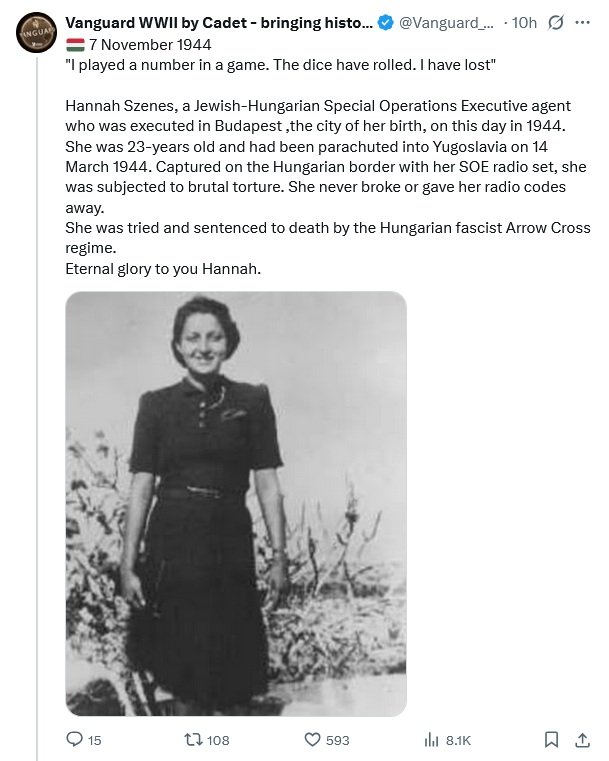
One of Churchill’s worst ideas, the Special Operations Executive was a product of his obsessive delusion that World War II could be won on the cheap with little British blood lost. Agents like the valiant woman above were sent on what amounted to suicide missions to attempt to fulfill Churchill’s fantasy that they could establish armed resistance that would set Nazi occupied Europe ablaze. The impact on the War of these missions were almost nil and cost many lives of courageous men and women. John Keegan, the late British military historian, summed up what a waste the whole operation was:
SOE was inefficient as an organization, unnecessarily dangerous to work for, ineffective in its pursuit of its aims, and counter-productive in the results achieved.


Churchill put Britain first and prioritised the preservation of British lives. He was skeptical of the a Jewish race. He was a great leader for Britain. He led the war effort but his ultimate goal was Britain first. Love him or hate him.
There was armed resistance in Yugoslavia and Albania. The wrong side succeeded.
. He was skeptical of the a Jewish race.
Churchill was a well known philo-Semite. For example, prior to the UN vote on partition, he called upon the Labour Government to “end their squalid war against the Jews”. During the War he revealed to the World the Nazi death camps and described the crime against the Jews as the one that had no name, genocide only being recently coined as a word.
Churchill was appalled by the losses on the Western Front in World War I and was determined to avoid them in World War II. These attempts to avoid the same losses in the Second World War usually ended in disaster. In order to forestall a 1943 invasion of France, Churchill insisted upon the completely useless and costly Italian campaign, and we still had to invade France in 1944.
“Britain waged a brilliant war. It was the only country to fight the first day of the war and the last day of the war.
They lost the fewest of all the major 425, less than half of what they lost in WWI.”
~ Victor Davis Hanson
Yes I don’t disagree Don. Churchill was a man of principle and denounced the Jewish holocaust undoubtedly and unreservedly. And obviously fought against it.
That did not stop his criticism of the Jews. He was reported to have written a paper which was never published “How the Jews can Combat Persecution” 1937. He said “they have been partly responsible for the antagonism from which they suffer.” And although praising them as “sober, industrious and law-abiding”, he had open criticism of the Jews: “there are times when one feels instinctively that all this is only another manifestation of the difference, the separateness of the Jew.” He argued that in order for them to not make themselves a target, they should integrate into society.
Britain only let in 10,000 Jewish during the war when Churchill was PM. As opposed to 75k pre-war (ironically under Chamberlain who made it known that he did not want Jewish immigration into Britain). Churchill was diplomatic to Jewish leaders and zionists and supportive but his policy’s (White Paper and Palestinian State) saw him restrict Jewish dominance in Palestine. Yet Churchill put pressure on countries such as Spain to allow Jewish refugees. Churchill was for Britain first. Do as I say not as I do.
Regardless, he was a formidable man who was governed by principle. Britain today needs a Churchill-type leader. It’s coming up Remembrance Day in commemoration of end of WW1 and it seems a sad waste that Britain is what it is today in spite of its men who died to protect its values. Maybe Churchill should have been less accomodating of the Arabs back then..
“They lost the fewest of all the major 425, less than half of what they lost in WWI.”
Largely due to France collapsing so swiftly in 1940 and having the US to shoulder much of the burden in 1944-45. The fighting in North Africa and the Mediterranean was not to be compared to the Western Front fighting in 1914-1918.
That’s certainly true, Donald, I was just making the point that if Churchill’s goal was to win the war with the fewest British casualties possible, he seemed to achieve his objective. Another thing I was impressed with in that Hanson clip was that Britain joined the war on day one out of principal … To aid an ally. They hadn’t been attacked yet they threw everything they had into that war and were pretty well broke as a country when it was over. I find that admirable.
And as far as trying to help organize partisan resistance in Nazi occupied Europe, I don’t think that’s a bad idea. If those efforts failed miserably, I guess the implementation was flawed … but the idea may still have been noble.
I dispute the idea that SOE was a terrible idea.
It seems such efforts did not succeed in Yugoslavia or Hungary. Yet such efforts did have a degree of success in other areas. If you watch The Longest Day, …a few scenes near the beginning depict 2-3 successes by the French Underground, leading into D-Day. One scene even depicts a Nazi official commenting on how the Underground cut his communication lines again.
Special Operations rarely expect to change the tide of a war. Instead, they focus on seeking to mitigate the degree of bloodshed that will inevitably occur.
Churchill was an inspirational leader but a military incompetent. (Note Marshall’s and Eisenhower’s struggle to get him to support an invasion of France in 1944.) More fatally, his opposition to Indian independence post WWIIand his genocidal opposition to the Kenyan independence struggle in the 1950s suggest a quasi-fascist racialism that must be emphatically rejected.
Churchill was an ideas man. Lots of ideas both good and bad. For instance he had the loony idea that an ice berg could be used as an unsinkable aircraft carrier. On the other hand he was the strongest advocate of the mulberries, the artificial harbors that proved essential to victory in Normandy. Once competent British field commanders came to the fore he backed them to the hilt, in spite of any personal irritation they caused him, Montgomery being the classic example.
In regard to India, Churchill was born in 1874. He was a man of his time and place in most ways. He got two points right: the Muslims and the Hindus did engage in a huge bloodletting once the Raj ended, and the ending of the Raj was the death knell of the British Empire. In regard to Kenya, there was plenty of murder on both sides.