
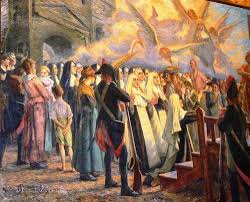
During the troubles of the French Revolution, 29 Sisters, expelled from their convents, found refuge in a house at Bollène. During their eighteen months there, they shared their life of prayer and total poverty. Arrested in April 1794 because they refused to swear the oath required by the city officials, an oath their conscience condemned, they were jailed on May 2 at Orange, in the Rectory’s prison, near the Cathedral, where 13 other Sisters were already imprisoned.
They organized themselves in a single community and consecrated the essential part of their time to prayer. Condemned to die by the Popular Commission, then commanding in the actual Chapel of Saint-Louis, they were transferred to the ancient Theater, where they awaited to climb the guillotine erected in Saint Martin’s Court. They all went up to the scaffold joyfully, singing and praying for their persecutors, who admired their courage : ” These bougresses are all dying with laughter”! Ten other jailed Sisters were saved by the fall of Robespierre on July 28, and liberated in 1795.
The bodies of the Martyrs were thrown in mass graves in the field of Lapolane (at Gabet), 4 kilometers from the town, on the edge of the Aygues River, and a Chapel was built there in 1832.
Go here to read the rest.


When the state becomes in their own minds more powerful than God.
The more I know about it, the more vile the French Revolution becomes.
It astonishes me how such godless secularity devoured a country so quickly.
A grave reminder of what is possible.
The documentation describing the martyrdom of the Carmelite nuns at Compeigne (11 professed nuns, 3 lay sisters, and 2 Third Order externs) notes what in effect was the unrealized and certainly fatal “public relations” error of the Committee of Public Safety:
The Mayor of Compeigne accompanied by Revolutionary soldiers, burst into their residence on July 12th to seize the women intending to immediately bring them to a show trial in Paris. However, they were dressed in their Carmelite habits because their lay clothes that they had been forced to wear were being washed.
So it was in their formal scapular and robes that they all went to trial, and then to execution, to the site at that time named the Place du Trône Renversé, now the very modest and usually quiet Place de la Nation.
So, on the 17th, the day of execution, they processed, youngest to oldest, to the guillotine in their religious habits. Arriving at the guillotine, the executioner refused to rush them and allowed them to finish singing the Divine Office (which they actually sang in the oxcart while being brought to execution), the Te Deum, the Veni Creator Spiritus, and the renewal of their religious vows, and finally the Laudate Dominum (Ps. 116). They were executed in the same age order, except for the prioress, Mother Therese, who died last.
The hitherto clamorous crowd, witnesses say, was reduced to a stunned silence, that according to historian John Wainwright (“The 16 Blessed Martyrs of Compeigne,” 1907, Catholic Encyclopedia).
After this, their bodies and severed heads were gathered, along with the 24 others executed that day, and tossed in a mass burial sand pit which is now part of the Picpus Cemetery. There is a monumental plaque at the back of the cemetery, listing the 17 names. It is a place of continual veneration and prayer should you ever visit there.