
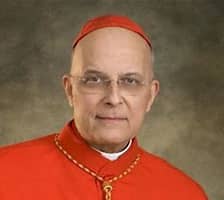
Francis George was born in Chicago in 1937. At the age of 13 he contracted polio which left him with a permanent limp. The limp caused him to be rejected by the Archbishop Quigley Preparatory Seminary in Chicago. Instead, he attended the Saint Henry Preparatory Seminary in Belleville, Illinois run by the Missionary Oblates of Mary Immaculate. He joined the Oblates in 1957 and was ordained to the priesthood in 1963. He earned a Master’s degree in Sacred Theology from the Catholic University of America in 1965. George taught philosophy at Creighton and Tulane until 1973 and earned a Doctorate in American Philosophy from Tulane in 1970 and a Master of Theology degree from the University of Ottawa in 1971.
From 1974-1986 he served as Vicar General of the Oblates. Stationed in Rome, he earned a Doctor of Sacred Theology from Pontifical Urbaniana University in 1988. Returning to the States he served as Coordinator of the Circle of Fellows at the Center for the Study of Faith and Culture in Cambridge, Massachusetts.
In 1990 he was made Bishop of Yakima. In 1996 he was made Archbishop of Portland. George returned home to the Windy City when he was made Archbishop of Chicago in 1997. He was elevated to the College of Cardinals in 1998.
For a man of mild temperament, George often found himself at odds with the Left leaning government of Illinois and Left leaning clergy in Chicago. His most famous remark was given to a group of priests worried about the secularization of the culture in 2010: “I expect to die in bed, my successor will die in prison and his successor will die a martyr in the public square. His successor will pick up the shards of a ruined society and slowly help rebuild civilization, as the church has done so often in human history.” He explained later that his remarks were not meant to be predictive, but a mental exercise to illustrate to the priests that even if the worst occurs, the Church would survive and prevail.
George participated in both the Conclaves of 2005 and 2013. Fighting cancer since 2006, he resigned in 2012 when he reached 75 and his resignation was accepted by the Pope in 2014. George passed away in 2015.
The Conclave of 2005 presented a challenge to the new Pope in that John Paul II was a very hard act to follow. There was not much drama at the Conclave. There were four ballots with the right hand man of John Paul II, Cardinal Joseph Ratzinger, leading on each ballot, and the future Pope Francis in second place. Ratzinger chose the name of Benedict XVI, and the choice of the Conclave pleased almost all the admirers of Pope John Paul II, who looked forward to a pontificate of continuity.
Joseph Ratzinger was born in 1927 on Holy Saturday in Marktl, Bavaria, Germany. At the age of 5, after seeing a Cardinal of the Church, he announced his ambition to one day be a Cardinal. At the age of 12 in 1939 he enrolled in the minor seminary in Traunstein. His studies were interrupted when the seminary was closed for military use in 1942.
Joseph’s father, a policeman, was an opponent of the Nazis, which led to demotions and persecution of his family. In 1939 a 14 year old cousin of Joseph, a boy with Down syndrome, was taken away and murdered pursuant to the Nazi T4 eugenics program. Joseph was forced to enroll in the Hitler Youth, but avoided meetings and was quite unenthusiastic.
In 1943 he was conscripted into the German anti-aircraft corps and later trained as an infantryman. In the chaos of 1945 he deserted and headed home. He was briefly held by the Allies as a POW, and was released on June 19, 1945.
Resuming his seminary studies with his brother Georg, they were both ordained in 1951 by Cardinal Michael von Faulhaber, the same Cardinal Joseph encountered when he was 5.
A brilliant student, Ratzinger earned advanced degrees and became a professor at Freising College in 1958, and would also be a professor at Bonn and Munster.
During Vatican II he was a peritus (theological expert) to Cardinal Frings of Cologne. Ratzinger was an advocate of the reforms of Vatican II and associated with members of the radical fringe, such as Hans Kung.
It is sometimes said that you should be careful what you wish for, because you may get it. This maxim may have occurred to Ratzinger after he was appointed to the chair of dogmatic theology at the University of Tubingen where one of his colleagues was Hans Kung. Professor Ratzinger was shocked by the excesses of Leftist students and gradually perceived that movement away from traditional Catholicism was one of the sources of the chaos around him.
Taking up a professorship at the University of Regensberg in 1969, he founded the journal Communio and was a frequent contributor until he was elected Pope. It is still being published in many languages and is a center of contemporary Catholic theological thought.
In 1977 Ratzinger was appointed Archbishop of Munich and Freising, and raised to the Cardinalate later that year.
In 1981 he was appointed by Pope John Paul II head of the Sacred Congregation for the Doctrine of the Faith, formerly known as the Holy Office. He became known as an enforcer of orthodoxy and a champion of traditional Catholicism. (A debate between young and old Ratzinger would have been edifying and perhaps, in parts, amusing.) In 1997 he asked Pope John Paul II for permission to go into semi-retirement as head of the Vatican Library and the Vatican Secret Archives. Permission was refused, the ailing Pontiff increasingly relying on the Cardinal.
Cardinal Ratzinger in 1997 made this interesting observation about the role of the Holy Spirit in choosing a Pope:
I would not say so, in the sense that the Holy Spirit picks out the Pope. … I would say that the Spirit does not exactly take control of the affair, but rather like a good educator, as it were, leaves us much space, much freedom, without entirely abandoning us. Thus the Spirit’s role should be understood in a much more elastic sense, not that he dictates the candidate for whom one must vote. Probably the only assurance he offers is that the thing cannot be totally ruined.
There are too many contrary instances of popes the Holy Spirit obviously would not have picked!
After his election as Pope, in his Urbi et Orbi blessing, Pope Benedict uttered words that somewhat foreshadowed his pontificate:
Dear brothers and sisters, after the great Pope John Paul II, the Cardinals have elected me, a simple, humble labourer in the vineyard of the Lord. The fact that the Lord knows how to work and to act even with insufficient instruments comforts me, and above all I entrust myself to your prayers. In the joy of the Risen Lord, confident of his unfailing help, let us move forward. The Lord will help us, and Mary, His Most Holy Mother, will be on our side. Thank you.
Like most great men, Pope John Paul II cast long shadows. Pope Benedict realized that he lacked the strength, the leadership and the raw charisma of his friend and predecessor, but he would do the best he could with the gifts that God granted him.
He did a lot in the almost eight years of his Pontificate. High points were the Pope’s Anglican Ordinariate, perhaps the most daring move made by a Pope in regard to Protestants since the Reformation. The steady increase since 2005 in ordinations worldwide to the priesthood demonstrated that the recovery initiated by John Paul II was continuing forward. Pope Benedict’s emphasis upon the growth of the Church in Africa and Asia bore much fruit. The reform of the reform was a hallmark of Pope Benedict in which he corrected the misuses of Vatican II. All in all he had a very successful Pontificate.
Then came his resignation on February 11, 2013. He claimed this resignation, unprecedented for many centuries, was due to ill health and the waning of his strength with advanced old age. Considering that he lived for close to ten years after his resignation, some skepticism about this explanation is perhaps warranted. The abruptness of the announcement has encouraged conspiracy theories as to why he resigned. I do not think we have the full story, and perhaps we may never have the full story. I suspect that one reason why he resigned was that he was sick of battling the considerable opposition he encountered among some cardinals.
As Pope Emeritus, Pope Benedict normally kept his lips sealed, although there were some minor signs of annoyance at some of the actions of his successor. He died on December 31, 2022 at the age of 95. If he had remained Pope and died on the same date, he would have been the oldest Pope at death in the history of the Church, beating Pope Leo XIII by two years.
With Benedict we had a Pope who knew what needed to be done to restore the Church from the travails of the last century, but who lacked the will to overcome the opposition, and who, perhaps, allowed himself to be bullied into an unwarranted resignation. An example of how a brilliant intellect without sufficient fortitude is often a blind alley.


[…] Information:Cardinal George & the Conclave of 2005 – Donald R. McClarey, J.D., at the American CatholicDuring Conclave! 8 May, Indulgence for […]