
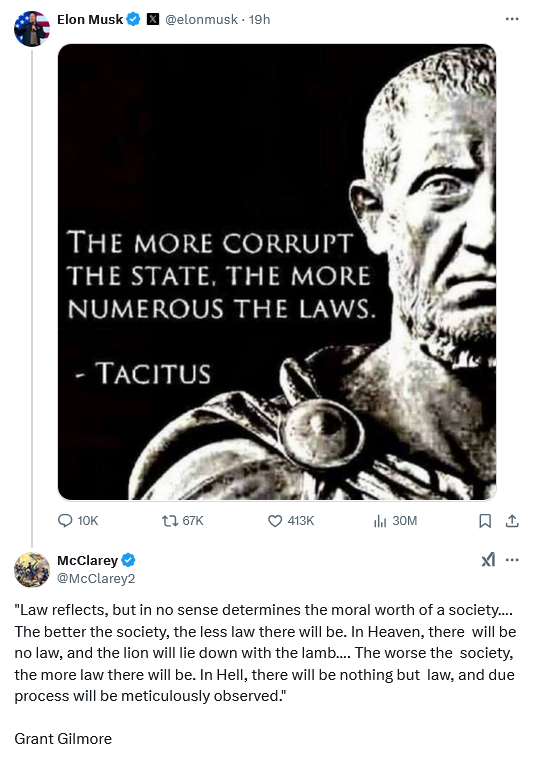
On the other hand:
More saw that ignoring or disobeying even unjust laws was “a short route to chaos”. As he succinctly put it: “I would uphold the law if for no other reason but to protect myself.”
The late Robert Bork, the man who would have given the deciding vote to overturn Roe long ago if had been confirmed by the Senate for the Supreme Court, wrote an essay here on Saint Thomas More and the law. This passage expresses what I believe:
“Individualism in the law, as in matters of faith, produces the substitution of private morality for public law and duty. This is precisely what More thought Luther was encouraging in his own day, and it is even more prominent in ours. That may be seen in the growth of legal nullification, the refusal to be bound by external rules, that is not only widespread among the American people but, more ominously, in the basic institutions of the law. More applied his injunction as much to the judge on the bench as to rioters in the street. We all recognize rioters as civil disobedients but we are less likely to recognize that the judge who ignores law or who creates constitutional law out of his own conscience is equally civilly disobedient. In 1975 Alexander Bickel, in The Morality of Consent, recounted the then recent American experience with disrupters in the streets, but added: “The assault upon the legal order by moral imperatives was not only or perhaps even most effectively an assault from the outside.” It came as well from a Court that cut through law to do what it considered “right” and “good.” Our law schools now construct theoretical justifications for that particularly corrosive form of civil disobedience, explaining that judges should create, and enforce as constitutional law, individual rights that are nowhere to be found in the Constitution.”
Against the backdrop of Justices disregarding the law, it is not surprising that jurors are refusing to be bound by either law or evidence if the results do not fit their personal views. Our representatives enact the laws but juries scattered across the country vote on them again, often overturning the democratic choice. This pernicious practice occurs not only sub silentio but is coming into the open. There is even a national organization, the “Fully Informed Jury Association,” to justify and encourage jury lawlessness. Some nullification occurs because black jurors think the law is arrayed against them or out of racial solidarity (the O. J. Simpson verdict), but other defiances reflect libertarian attitudes and personal disapproval of the law (the Jack Kevorkian acquittals). According to the Washington Post, a poll shows that three out of four Americans say they would disregard the judge’s instructions if the law contravened their own ideas of right and wrong.
People should act to change bad laws. If a law so seriously compromises a person’s conscience that obeying it would appear to that person to be active complicity in evil than disobedience of the law, with the willingness to be punished for the disobedience, may be called for by that individual. Otherwise, even bad or foolish laws should be obeyed until they can be changed, short of “a long train of abuses and usurpations, pursuing invariably the same object evinces a design to reduce them under absolute despotism” which justifies a rising in revolt by a people. To act otherwise is to reduce the law to mere opinion and to cause our civil society to descend to the rule of the strongest and/or the loudest.


From “Learn Latin” @Latinedisce on Twitter / X.
Corruptissima re publica plurimae leges.
> Notice the ablative absolute: corruptissimā rē publicā, “when the State is most corrupt.”
> Notice the implicit verb sunt (“there are”) with plurimae leges.
I worry that the quote Musk chose refers only to a corrupt state. When the people are also corrupt, removing laws will not necessarily lead to better behavior. And a great many people are corrupt.
I don’t fully trust Musk, though I acknowledge he is an ally. There is a certain security in a “country planted thick with law.” It tends to slow down innovations that seem good but are not.
That said, plenty of “nanny laws” could go to the dustbin with only positive effect.
The Bruised Optimist has a point. That said, the problem is the proliferation of regulations by unelected bureaucrats in agencies and commissions like the Environmental Protection Agency, the Nuclear Regulatory Commission, etc. Why can communist China build a Westinghouse AP-1000 pressurized water reactor in 3 years, but even after 10 years, we throw in the towel and quit –> VC Summer here in South Carolina? Jerry Pournelle’s iron law of bureaucracy applies:
In any bureaucracy, the people devoted to the benefit of the bureaucracy itself always get in control and those dedicated to the goals that the bureaucracy is supposed to accomplish have less and less influence, and sometimes are eliminated entirely.
He eventually rephrased it as follows:
LQC-
A) That’s because the all the second group does is bureaucracy. The first group is “distracted” by doing the work!
B) There shouldn’t BE laws made by unelected agency aparatchiks. (yes, I know they’re “rules” but call them what they are)
I would love to see the “rules” argued against based on the idea that Congress does not have the Constitutional power to select and authorize unelected legislators. I think it is a meritorious argument.
I unde stand the iron hand and iron heart of untouchable regulators. You have the NRC. I deal with the IRS. God willing, as infrequently as possible!
[…] News, Punditry, and Analysis:The Law – Donald R. McClarey, J.D., at The American CatholicJimmy Carter’s Favorite Song […]