
Home
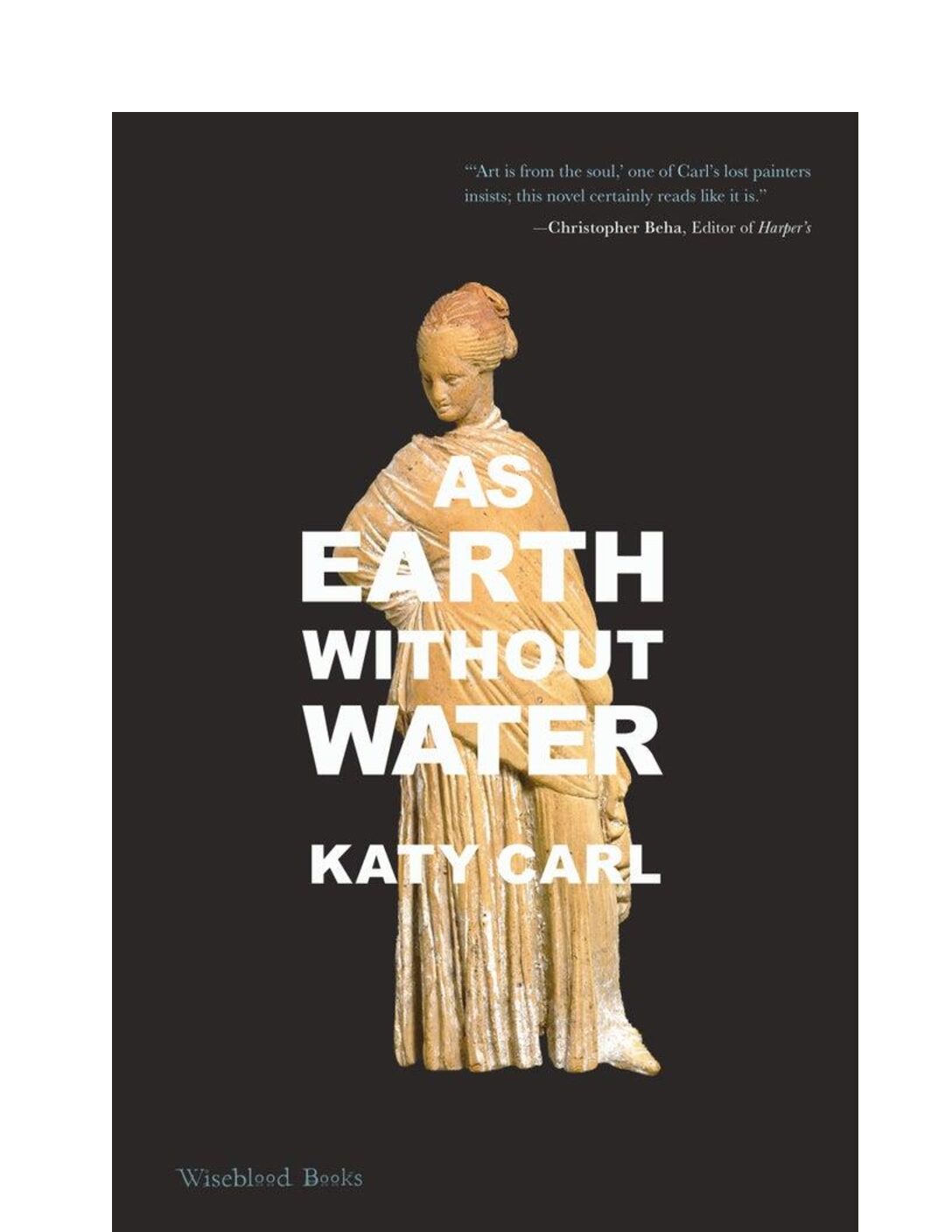
In the reality of As Earth Without Water (“AEWW”), Katy Carl, from her literary soul, births Angele and Dylan. Instead of completing their formation, bringing them to maturity, and telling us the end of these her literary children, she has Angele, now in the convent, stop the storytelling on page 220 with the words:
“There I rest, motionless, till the chime rings: exile from paradise, waiting for day.”
The words, THE END, do not appear on the page.
There is a certain sense of resolution when Leo T. throws his Anna K. in front of a train; but his readers had no say in the matter. J. Austen does not let anyone counter her choice to have Elizabeth become Mrs. Darcy. Julius G. Epstein, et al (authors of a screenplay originally titled: Everybody Comes To Rick’s) put Ilsa on a plane out of Lisbon with her freedom fighter husband, Victor Lazlo, at the end of the movie, Casablanca. Rick, who still loves Ilsa, is not on the plane and this was done without polling the audience about whom they would prefer to fly away with Ilsa.
Not so Katy Carl. Shunning literary tyranny, she lives literary generosity for her readers.
At first, her stoppage on page 220 may cause a reader to shake his or her head and blink. “Huh?” “Say what?” “No, no, no, no.” The reader might plead with KC:
Please tell us how it ends! Tell us whatever. Tell us Angele stays in the convent forever, never ever again ventures outside its walls, never has another cigarette, gives her life totally over in service to God, maybe never paints again, and becomes a living saint; or she leaves and becomes an art teacher at a Junior College in Kalamazoo where she ends her days as a hermit, unloved, worshipped by her students, a love letter from her old friend, Richard, tossed into her fireplace. KC, please fill in the blank. But don’t just stop. Whatever-just resolve everything-and don’t forget Dylan! Shoot, let him die of syphilis or become a missionary priest to Zambia, have him father 12 babies there, or becomes a living legend caring for victims of ebola who include the priest who assaulted him who is near death from leprosy, but just don’t leave us, ignorant, unknowing, unsatisfied.
KC has done so much more for her readers than ending the story. This sentence is on page 216: “If it is possible to say that I live now, not I, but Christ in me.” This “Christ in me,” the “exile from paradise,” and “waiting for day” words of Angele are the type of literary sledgehammer Mary Flannery O’Connor would have written – and this is where Mary Flannery would have ended the book.
All readers of AEWW can say, in chorus, “Deo Gratias! Thank God that KC is not MFO.”
[As an aside, if KC’s own maxim, declared to us by Angele – “Certain things can’t be known until they are lived” – holds true for author artists, Mary Flannery could not have gone beyond the cessation of Angele’s storytelling. To this commenter’s knowledge, Mary Flannery never had a real romance with a man.]
Although it may seem so, KC does not leave her readers stranded at the end of page 220. On the contrary, she entrusts her literary springoffs, Angele and Dylan, to the reader. In doing so, she says several things. One, she lets the reader know that she has an abiding respect for the reader. Two, she says, implicitly, that she trusts the reader to see and to know where the story goes from here, the reader now living in and believing in the world she has created
Finally she provides a flashing road sign so that the reader is sure to know that this work of love is about how Angele and Dylan have always been on their way home, to each other. This sign is given in the Acknowledgements section on the last page of AEWW. In the very last words of the book, KC says : “Brian Carl, thank you for being there. My home is wherever you are, always.” [EMPHASIS ADDED!].
The Katy Literary Paradigm of Home
T.S. Kuhn’s seminal work, The Structure of Scientific Revolutions (1962) has sold over 1.4 million copies. The book has been translated into sixteen languages and has been said to be the twentieth-century book most frequently cited in the humanities and in the arts between 1976 and 1983.
Kuhn studied what he called “paradigms,” both in general and, for the focus of his book, scientific paradigms in particular. (There is a brief discussion of paradigms in art at the end of the book. See, e.g., https://artfulscientist.home.blog/2019/06/04/thomas-kuhn-and-the-art-science-paradigm/).
For Kuhn, a “paradigm” is a conceptual framework for a theoretical orientation and view of reality based upon a particular epistemology which is reflective of a community at a specific time in history.
Similarly, a “literary paradigm” is a conceptualized reality matrix which is the product of the art of an author – a making of a world with words from one’s soul. One example is the “Jane Paradigm”:
“Just as every scientific fact depends for its reality upon the underlying theory that it supports, the scientific “paradigm” that gives it meaning, family is the overarching, meaning-invigorating paradigm of the work of Jane Austen, the “Jane Paradigm.” And her paradigm is a paradigm of goodness, of good news, of the family as gospel.” (“Jane Austen’s Paradigm: Family As Gospel;” G. McClung; Catholic Stand, 2016. https://catholicstand.com/jane-austens-paradigm-family-gospel/)
Eudora Welty, often referred to as the “Jane Austen of the South,” recognized the Jane paradigm (although she did not use those words):
“ . . . Jane Austen’s ardent belief that the unit of everything worth knowing in life is in the family, that family relationships are the natural basis of every other relationship.. . . .Jane Austen was born knowing a great deal – for one thing, that the interesting situations of life can, and notably do, take place at home.” (“Jane Austen;” Atlantic Brief Lives, Boston: Little. Brown, 1971 ed. Louis Kronenberger, 1971).
Angele’s and Dylan’s actions make sense and have meaning on the word canvas enlivened within the Katy Paradigm of Home. The key concept of the entire conceptual matrix is this: “Home” is wherever one is when one is with the person one loves. Conversely, when one is not with the person one loves, one is not at home. Correlatively, if one is in love, but apart from the one loved, searching, lost, adrift, trying to go on going somewhere, one is on the way home.
Other concepts of the Paradigm of Home [with the numerous quotations that give voice to the concepts omitted] include:
At home with the beloved, time is either not noticed or it is perceived as endless or non-existent.
Home feels real, it is for always, forever. There is permanence at home.
Those at home – with certainty – know themselves, know each other, and are bound to each other. The other is accepted and claimed despite any and all faults, failings, sins, and defects.
Looking for one’s self and being with the other for the search are being at home.
With the other, at home, there is glee, contented happiness, and joyous laughter.
A beloved other, no one else, is the way home.
More than a reader
Beyond the creation of a paradigmatic literary reality, both Jane Austen and Katy Carl elevate the reader and transform her or him from a mere bystander to an invested, concerned confidant and, sometimes, co-author. Both artists accomplish this first with and within their paradigms. Then they have the reader come to know their characters intimately, to befriend them, and to care for them. They do this in similar fashion by revealing the innermost thoughts of their characters.
Jane does this using the literary technique of “free indirect speech” by which a character’s thoughts are revealed and stated in the text without quotation marks.
KC does this by having Angele tell the story in the first person; by having her think out loud for the reader at length; by having her ask many, many poignant, revealing, on-point questions; and by having her make requests which are requests made to herself, bur are also directed to the reader. For example:
“ . . . with my forehead feeling for a cool that would not come and my eyes aching with what refused to fall, suspended there above the sink and asking myself: why did I agree to come here, why did I allow myself to be drawn back into this man’s orbit: why? Why didn’t I just stay home?”
“What is there to be done? Can you do the things that Therese says she does; how do you do them? How would you ever begin?”
“If not for Aunt Rachel, then – supposing it takes longer for me to find work than to live my way thorough my savings – where else would I go?”
“He will turn one way, I the other. What will it matter?”
“The things we tell ourselves about ourselves are true – aren’t they?”
“So tell me anything that makes sense or can be made to.”
Angele’s questions and requests invite the reader into a conversation, a two-way give and take. More than this, the reader is induced to ponder and to create in order to reply. The reader proceeds from a we’re-now-in-this-together place, a place which is the making of KC’s artistry. This is beyond storytelling. When Angele asks a question, the reader stops reading and considers the answer. When Angele makes a request, the reader stops reading and considers how to respond to the request. And all the reader’s answers and responses are done in accordance with the order, the reality, of the Paradigm of Home. They are done by the reader so that they not only embody a caring reply, but so that they are consistent and truthful in accord with the logic and concepts of the Paradigm.
This enlistment, nourishment, and elevation of the reader from reader to co-artist is a product of Katy Carl’s art-from-the-soul words, a making from her genius.
Conclusion
As Angele rides away on a bus from Dylan at the end of the story, she reads a note he has written in a book he has given her:
“The book in my lap is The Cloud of Unknowing, paperback: wrapped in the greyscale image of a thunderstorm, with Dylan’s number inscribed on the flyleaf. Dear Angele, he has written, and a fragment from a poem by Dunstan Thompson:
‘As for water,
We have our own wells here.
This ordered life is not for everyone.
Never, to their surprise, for those who run
Away from love.’ ”
Angele’s response to this shows that she fully understands that she is running away and that she knows that the “order” of the poem [for this story, the order generated by and within the Katy Paradigm of Home] is their love. She does not bring herself to admit this; but she does voice her wants that she assumes may at least be explained, if not satisfied, in the convent:
“I want peace. I want clarity. I want certainty. I want permanence.”
She knows, although she does not articulate it in words, that their love has the sought-after permanence and is the paradise from which she has exiled herself. She knows the day for which she is waiting is like the day she experienced when she got on the bus and looked back at Dylan: “Over him the sky hangs heavy with heat, blinding with white light.”
As Earth Without Water is an intense, beauty-full artistic making of hope, and, most of all, of love.
Angele never uses th ewrods “bride of Christ” whisa is the essence of being a nun.And what Angeletells us aobut Dylan-if she is intent on “finding self” and truly being bride of Crist-no reason to tlel us al that aobut himloving her and will wait for her and”
Few authors are as generous with their words from thei souls as KC is wih her readers-here are A and D, for you and with all that I have given you with the final “Thia way hoe” direction she says “let’s do this together, youi , me A and D.” Lete’s go home.”
Miss Welty sees that in the “familiar” of a family, Jane presents “the full presence of the world;” but Miss Welty’s insights about the Jane Paradigm also go further than simply seeing that it exists and its universal scope. Miss Welty realizes that we, the readers, are not only included in, but are welcomed by Jane into her family circles:
“The felicity they have for us must partly lie in the confidence they take for granted between the author and her readers.”


This type of literature makes me realize that very little of value —to me—-has been written since Dostoyevsky and Tolstoy.
[…] TFP10 Wardrobe Resolutions for the New Year – Meghan Ashley Styling, A Catholic StylistA Love Story: As Earth Without Water by Katy Carl Part II – Guy McClung, Ph.D., J.D., at […]