
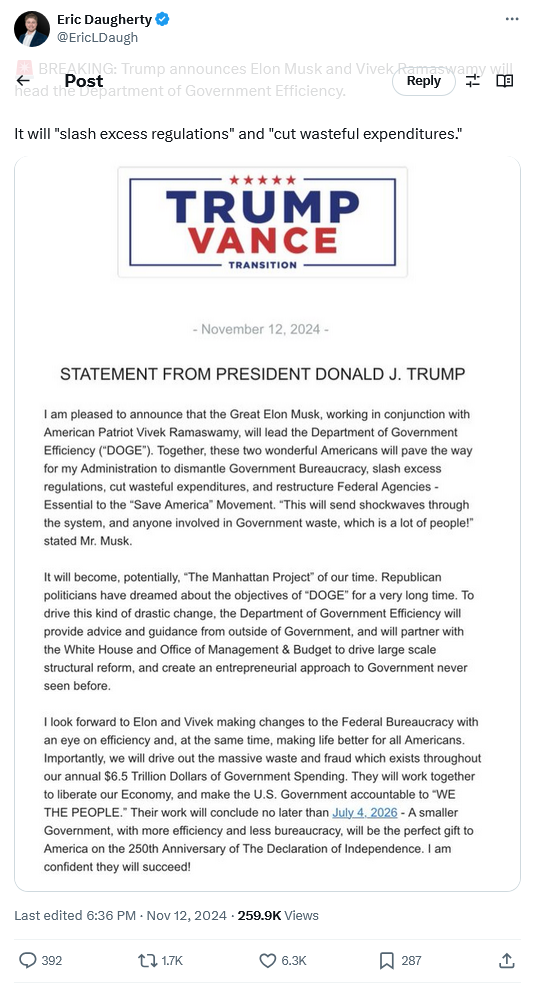
Trump didn’t go through the hell his adversaries put him through to warm a chair for the next four years. He plans systemic changes to Make America Great Again. We shall see how he does, but his goals are breathtaking, and as far from business as usual as it is possible to be.
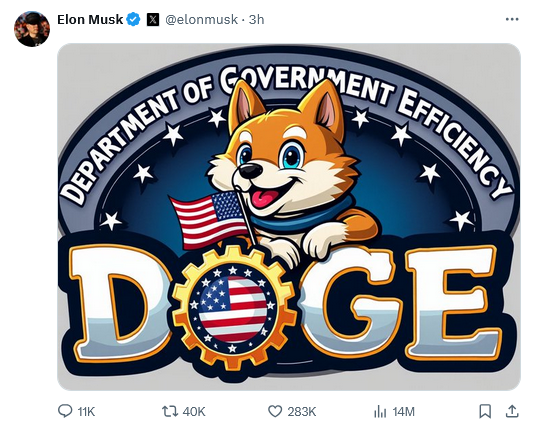
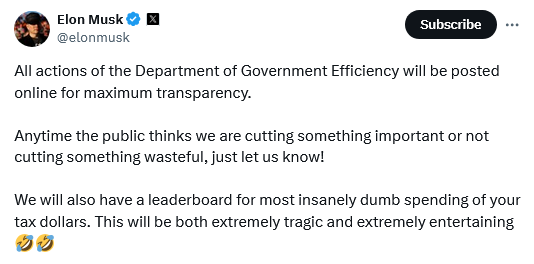



Great choice appointing Musk.
Logic tells you : Musk is wealthy. He essentially does not need the job. He wants the job. He has a chance to leave a lasting legacy here.
Our PM and Deputy PM (not who I voted for) just bought themselves multi-million dollar homes from salaries earned being public servants their entire careers. They have collectively spent their careers as union bosses/advisors or politicians. I think this story is common amongst leftist governments globally. And you wonder why the left always manages to keep the budget in the red.
Can we borrow Musk after you are finished with him?
😳
This is going to be fun.
For many a grifter this is going to be a “get the hell out of DOdGE” moment.
Popcorn?
We’re gonna need the industrial size.👀
If they are seriously going to take suggestions from the public itself, maybe even accept formal public comment on various regulations they propose to cut, that is a good sign. It is a better approach than simply dictating that an arbitrary percentage or number of regulations MUST be cut, without taking into consideration whether or not those regulations actually have a purpose.
This should be fun!
I’m disappointed Ron Paul isn’t involved though …
In principle, I love the idea of cutting government spending. Admittedly, there is a lot of fat to trim – like “obese guy they have to bury in the grand piano” fat.
BUT I do not like the idea of doing it on a business or entrepreneurial model.
Government has specific duties and must spend money to do them. Business seeks to make a saleable product and earn a profit. There are many things that are prudent in government that would be wasteful in a company because they do not sustain a marketable product or promote the brand or run at peak efficiency.
Musk is an exceptional businessman and promoter, but I do not see the self sacrifice in him that makes for the ideal (if atypical) public servant.
Musk needs to wear a Corno Ducale of he’s going to be the Doge
If they really want to eliminate government waste, they should get rid of the federal income tax. That’s where most of the money that finances all that waste comes from. And the Federal Reserve needs to be eliminated as well.
[…] News, Punditry, and Analysis:Release the D.O.G.E.! – Donald R. McClarey, J.D., at The American Catholic3 Steps To Build Your Fall Style – […]
Bill, should Musk ceremonially toss a ring into the Potomac,? Bruised, I heartily recommend that you acquire and read C. Northcote Parkinson’s “Parkinson’s Law”. It’s the best examination and expose of how bureaucracies of any stripe structure themselves, expand, and ensure their corporate survival well into the future, whether they are needed or not.I frequently thought about it over the three decades of my employment in a Major Municipality.
Southcoast-
I’ll take a look at that book.
Just so you know, I did eight years in federal bureaucracy, so I have both a sympathy and an antipathy for it. I saw them try to import “best practices” from corporate America. Most of those patches were not pretty. You could really tell who the sycophants were in the “lessons learned” sessions 🙄
That said, it was the corruption of federal service that drove me out. A housecleaning is loooooong overdue.
f they really want to eliminate government waste, they should get rid of the federal income tax. That’s where most of the money that finances all that waste comes from. And the Federal Reserve needs to be eliminated as well.
==
Neither of these ideas is the least bit advisable.
==
I’m pessimistic that Trump et al will accomplish much. Margins are close enough for the careerists and the corporate bagmen in the Republican caucus to sabotage just about anything and now they’ve put John Thune in charge of the Republican Senate caucus. Like Trent Lott and Kevin McCarthy and Paul Ryan, nearly his entire work history has consisted of time in political jobs.
==
IMO, the fattest target is grant distribution to corporate bodes and to persons with institutional addresses. You could make an exception for the following: intergovernmental agencies, foreign governments, state and territorial governments, local governments, and miscellaneous parties in regard to disaster relief. Otherwise, end ALL of it. Declare it a species of embezzlement. Most of this is crony philanthropy, but the farm sector is also a beneficiary; replacing farm subsidies with enhanced tariff protection would be agreeable.
==
In re the exceptions, we could withdraw from some intergovernmental organizations, e.g. the main body of the UN, UNESCO, UNRWA, etc. Another thing we could do is establish a preference for aiding foreign governments with services, equipment, and credits to buy equipment. In re state and territorial government, we might limit grants to the financing of Medicaid, unemployment compensation, maintenance of long-haul Interstates, indemnities for unintentional torts due to regulatory decisions, disaster relief, and a general revenue sharing grant. In re local governments, we could limit it to payment in lieu of taxes on federal property (which might go to some of the territorial governments as well), indemnities for regulatory decisions, and disaster relief. The grants would go to the government’s themselves, not to incorporated affiliates like state colleges. The revenue sharing grants might amount to about 2% of gross domestic product and be distributed according to a formula which would make a grant positively correlated to a state’s population, positively correlated with employee compensation per worker, but inversely correlated with per capita personal income.
==
In the course of the foregoing, a mess of federal agencies would merit dissolution as grant distribution is what they do. The National Science Foundation, the National Endowment for the Arts, the National Endowment for the Humanities, the Corporation for Public Broadcasting, the National Institute on Food and Agriculture are examples. Others would see radical reductions in their budgets, as they do undertake some in-house activity and let out contracts; the NIH would be an example of that.
==
Another thing you could do would be to limit federal welfare programs to (1) overseas development and relief, (2) domestic disaster relief, (3) veterans’ benefits, (4) the big five (Social Security, Medicare, Medicaid, unemployment compensation, and SSI), (5) the Job Corps, (6) small subsidies for niche clientele (e.g. residents of the low census insular dependencies, reservation Indians, military families, miscellaneous persons in itinerant occupations, persons facing actions in federal court, and persons living in remote areas), and (7) a program of tax credits and tax rebates structured to provide matching funds for earned income or to supplement the income of the elderly and disabled.
==
In doing this, you’d end subsidies for people’s mundane expenditures (groceries, housing, utility bills); end student aid apart from veteran’s benefits, benefits for the niche clientele, and training for federal employees and prospective federal employees (ROTC, for example). A number of federal agencies could be eliminated in so doing: the Food and Nutrition Service, HUD (bar a small regulatory agency), HRSA, SAMHSA, the Administration for Children and Families (fishing out the refugee resettlement component), the Administration for Community Living &c. In re the Department of Education, you could assign the National Assessment of Educational Progress and the statistical services to the Labor Department, assign any consumer protection function to the Federal Trade Commission, and assign the extant student aid programs to a temporary agency given the task of liquidating them. Ideally, HUD and the Education Department would disappear and the surviving components of HHS are sorted between extant departments and new departments, with one or another stand-alone agencies.
==
Plenty of targets for auction and liquidation: the government mortgage maws, other components of the Farm Credit System, Sallie Mae, federal grazing land, federal timberland, AmTrak, the Postal Service.
==
Of cardinal importance: scraping the sectoral preferences out of the federal tax code. You cannot do much about tariff schedules, but you can accomplish a great deal in re the personal income tax, corporation taxes, capital gains taxes, &c.
Very good. One proviso: Be sure to check why the fence was built in the first place, before pulling it down.
Otherwise, go for it.
[…] Most Viewed Prime Time Politics News Stories:1. Release the D.O.G.E.! – Donald R. McClarey, J.D., at The American Catholic2. More Schadenfreude – Donald R. […]
Bruised Optimist:
I have an MPA and half my classwork was with MBAs, so there’s a lot of overlap. To the extent that government does business-like things (hiring, meeting payroll, purchasing materials, maintaining buildings, etc.) it can be run efficiently like a good business.