Donald R. McClarey
Cradle Catholic. Active in the pro-life movement since 1973. Father of three, one in Heaven, and happily married for 43 years. Small town lawyer and amateur historian. Former president of the board of directors of the local crisis pregnancy center for a decade.



Watching SpaceX maneuver it’s reusable boosters is incredible to say the least. Buck Rogers silly toy rocket on a string with a flame dripping some sort of plastic at the end..do yoi remember those episodes? The rocket would come back into the atmosphere just as it had taken off. From that concept of “high” fiction to a SpaceX reality blows my mind.
There is one final frontier, however, that doesn’t require rocket fuel or super-computers to voyage deep into unchartered space.
It’s the journey into deeper love for neighbor.
Leaving the gravity of self behind and trusting the simplicity of a humble woman who journeyed further into the cosmos than any human could ever conceive. So deep that she was raised into the cosmos upon her mission being completed.
Not to diminish the extraordinary works of Elon and his team, but in relationship to deep space travel, the unending exploration of God in man and man in God is a venture worth all costs.
The preparations for this travel started when you were baptized.
btw…the colonization of other planets is moot if the heart of man isn’t in complete synchronization with it’s creator, imho.
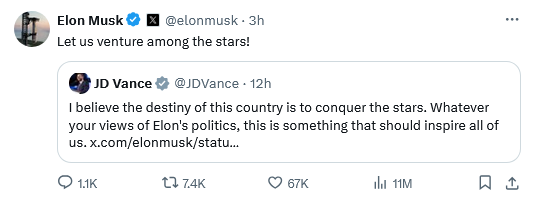
I appreciate all Mr. Musk has accomplished, but I don’t think it’s our destiny to conquer the stars, or that we will ever have the technology to do much more than have a closer look at them.
“ever” is a very long time Art. Mankind has endless problems, but the human brain, long term, is very clever at solving apparently unsolvable tech problems.
We will probably be able to colonize Mars and the moons of Jupiter and Saturn – eventually – using nuclear thermal rocket propulsion, technology well tested in the late 50s to early 70s.
https://www1.grc.nasa.gov/historic-facilities/rockets-systems-area/7911-2/
However, going faster than light speed to cover the vast distances between the stars is (I think) infeasible regardless of the possibility of space warps, wormholes, etc. Causality alone prohibits this:
https://www.youtube.com/watch?v=an0M-wcHw5A
Furthermore, even going at substantial fractions of light speed using matter-antimatter engines (beyond current technology) has its own hazards. Space is not truly empty. There are microscopic grains of dust everywhere. Hitting one such grain at 50% light speed – even 10% – would destroy one’s spacecraft.
Therefore, I agree with Art Deco.