
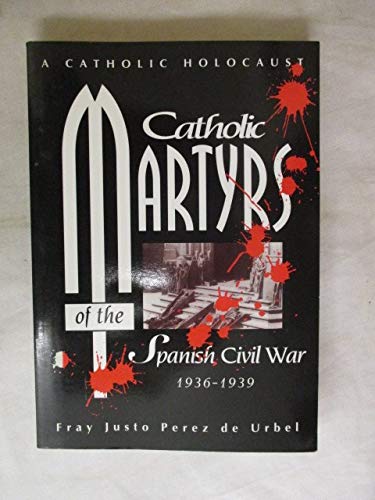
During the Spanish Civil War of 1936–1939, and especially in the early months of the conflict, individual clergymen were executed while entire religious communities were persecuted, leading to a death toll of 13 bishops, 4,172 diocesan priests and seminarians, 2,364 monks and friars and 283 nuns, for a total of 6,832 clerical victims, as part of what is referred to as Spain’s Red Terror.[4]
Pope John Paul II
Pope John Paul II beatified 473 martyrs in the years 1987, 1989, 1990, 1992, 1993, 1995, 1997 and 2001. Some 233 executed clergy were beatified by John Paul II on 11 March 2001.[5] In 1999 he also canonized a Christian Brother[6] and the nine Martyrs of Turon, the first group of Spanish Civil War martyrs to reach sainthood.[7] Regarding the selection of Candidates, Archbishop Edward Novack from the Congregation of Saints explained in an interview with L’Osservatore Romano: “Ideologies such as Nazism or Communism serve as a context of martyrdom, but in the foreground the person stands out with his conduct, and, case by case, it is important that the people among whom the person lived should affirm and recognize his fame as a martyr and then pray to him, obtaining graces. It is not so much ideologies that concern us, as the sense of faith of the People of God, who judge the person’s behavior.”[8]
Pope Benedict XVI
Benedict XVI beatified 530 martyrs in the years 2005, 2007, 2010 and 2011, with the biggest being the 498 Spanish martyrs in October 2007,[9] in the largest beatification ceremony in the history of the Catholic Church.[10] In this group of people, the Vatican has not included all Spanish martyrs, nor any of the 16 priests who were executed by the nationalist side in the first years of the war. This decision has caused numerous criticisms from surviving family members and several political organisations in Spain.[11]
The beatification recognized the extraordinary fate and often brutal death of the persons involved. Some have criticized the beatifications as dishonoring non-clergy who were also killed in the war, and as being an attempt to draw attention away from the church’s support of Franco (some quarters of the Church called the Nationalist cause a “crusade”).[12] Within Spain, the Civil War still raises high emotions. The act of beatification has also coincided in time with the debate on the Law of Historical Memory (about the treatment of the victims of the war and its aftermath) promoted by the Spanish Government.
Responding to the criticism, the Vatican has described the October 2007 beatifications as relating to personal virtues and holiness, not ideology. They are not about “resentment but … reconciliation”. The Spanish government has supported the beatifications, sending Foreign Minister Miguel Ángel Moratinos to attend the ceremony.[13] Among those present was Juan Andrés Torres Mora, a relative of one of the martyrs and the Spanish MP who had debated the memory law for PSOE.[14]
The October 2007 beatifications have brought the number of martyred persons beatified by the Church to 977, eleven of whom have been canonized as saints. Because of the extent of the persecution, many more cases could be proposed; as many as 10,000 according to Catholic Church sources. The process for beatification has already been initiated for about 2,000 people.[10]
At 28 October 2007 beatifications, Pope Benedict underscored the call to sanctity for all Christians, saying it was “realistic possibility for the entire Christian people”.[15] He also noted, “This martyrdom in ordinary life is an important witness in today’s secularized society.”[15]
Pope Francis
Pope Francis beatified 522 martyrs on 13 October 2013, at Tarragona, Spain; among them was Eugenio Sanz-Orozco Mortera from Manila, Philippines, who became the first Filipino martyr of the Spanish Civil War.[16] He also approved additional beatifications for Spanish martyrs that took place for a priest on 1 November 2014 as well as two sets of group martyrs on both 5 September 2015 and 3 October 2015. The pope also approved the beatification of 26 Capuchin martyrs, which took place on 21 November 2015. The beatification for Valentín Palencia Marquina and his four companions took place on 23 April 2016 in Burgos.[17]
The 114 Almerian martyrs were beatified on 25 March 2017, and Antonio Arribas Hortigüela and his six companions were beatified on 6 May 2017 in Girona.[18][19] The beatification of Mateo Casals Mas & 108 companions were beatified in Barcelona on 21 October 2017 and Vicenç Queralt Lloret & 20 companions as well as José Maria Fernández Sánchez & 38 companions were beatified in Madrid on 11 November 2017. The beatification of Teodoro Illera del Olmo & 15 Companions was held on 10 November 2018. The beatification of Ángel Cuartas Cristobal and his 8 companions was held in Oviedo on 9 March 2019 while María Isabel Lacaba Andia and her 13 companions were beatified in Madrid on 22 June 2019. María Pilar Gullón Yturriaga and 2 companions was beatified in Astorga on 29 May 2021. The beatification of Juan Elías Medina and 126 companions will be held in Córdoba on 16 October 2021, Francisco Cástor Sojo López and 3 companions in Tortosa on 30 October 2021 Benet Domènech Bonet & 2 companions in Barcelona on 6 November 2021 The beatifications of Cayetano Giménez Martín & 15 Companions in Granada on 26 February 2022, Angel Marina Álvarez & 19 Companions, Isabel Sánchez Romero, Juan Aguilar Donis & 5 Companions in Almería on 18 June 2022 and Vicente Nicasio Renuncio Toribio & 11 Companions in Madrid on 22 October 2022.
Go here to read the rest. We live in the true Age of Martyrs for the Church.


Unfortunately your headline is misleading. These martyrs were not combatants in the war and their executions had nothing to do with the waging of the war. The great majority of them were murdered BEFORE or soon after the war broke out, indeed the persecution of Catholics was the major reason for the revolt by the Army against the regime. All of the martyrs were completely a-political. Some were enclosed contemplatives who hardly even knew what was going on outside their convents. They were murdered for one reason only, that they were committed practising Catholics.
A correct title would be “Martyrs of the Spanish Stalinist regime”.