
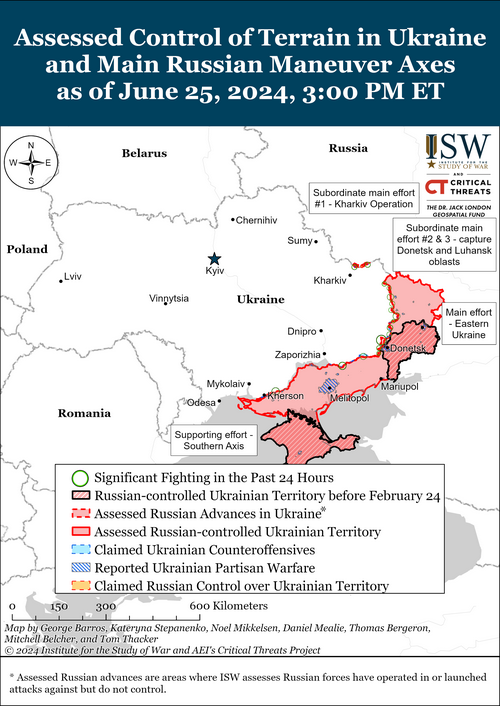
From The Institute for the Study of War:
Russian Offensive Campaign Assessment, June 25, 2024
Nicole Wolkov, Grace Mappes, Christina Harward, Karolina Hird, and Frederick W. Kagan
June 25, 2024, 7pm ET
Click here to see ISW’s interactive map of the Russian invasion of Ukraine. This map is updated daily alongside the static maps present in this report.
Click here to see ISW’s 3D control of terrain topographic map of Ukraine. Use of a computer (not a mobile device) is strongly recommended for using this data-heavy tool.
Click here to access ISW’s archive of interactive time-lapse maps of the Russian invasion of Ukraine. These maps complement the static control-of-terrain map that ISW produces daily by showing a dynamic frontline. ISW will update this time-lapse map archive monthly.
Note: The data cut-off for this product was 1:30pm ET on June 2. ISW will cover subsequent reports in the June 26 Russian Offensive Campaign Assessment.
Two major international bodies—the International Criminal Court (ICC) and the European Court of Human Rights (ECHR) — announced decisions on June 25 confirming Russia’s long-term perpetration of war crimes and human rights violations in Ukraine. The ICC’s Pre-Trial Chamber II (the chamber in charge of the ICC’s Ukraine-related investigations and prosecutions) announced on June 25 that it had issued arrest warrants for former Russian Defense Minister and current Security Council Secretary Sergei Shoigu and Chief of the Russian General Staff Army General Valery Gerasimov for “the war crime of directing attacks at civilian objects” in Ukraine.[1] The ICC noted that there is reasonable evidence to believe that both Shoigu and Gerasimov bear individual responsibility for the war crimes of causing incidental harm to civilians and damage to civilian objects and the crime of inhumane acts, both of which are violations of the Rome Statute. The ICC also emphasized that even in the case of Russian forces targeting “installations that may have qualified as military objectives at the relevant time,” the incidental civilian harm was excessively weighed against the expected military advantage—contrary to the international legal principle of proportionality.[2] The ICC concluded that there are reasonable grounds to believe that Shoigu’s and Gerasimov’s military decision-making intentionally inflicted serious bodily harm and suffering on Ukraine’s civilian population.
The ECHR’s Grand Chamber also ruled on June 25 that Russia has committed various human rights violations in Crimea since the beginning of its illegal occupation of the peninsula in February 2014.[3] The ECHR found that Russian officials and forces in Crimea committed numerous violations of the European Convention of Human Rights, including violations of the right to life, prohibition of inhumane or degrading treatment, right to liberty and security, right to no punishment without law, right to respect for private and family life, right to freedom of religion, right to freedom of expression, right to freedom of assembly, right to property, right to education, and right to freedom of movement, among other human rights violations. The ECHR’s ruling emphasized that the evidence that the Ukrainian government has provided to the court amounts to “a pattern or system of violations” perpetrated by Russia in Crimea. The decision is the first in which any international legal body has recognized Russia’s widescale and systemic violation of human rights spanning over a decade in occupied Crimea.[4]
Russia and Venezuela signed a memorandum of understanding (MOU) aimed at countering “coercive measures,” likely to demonstrate to the West that the Kremlin holds influence in the Western hemisphere. Russian Foreign Minister Sergey Lavrov and Venezuelan Foreign Minister Yvan Gil met on June 11 during the BRICS summit and signed the MOU, which the Russian Ministry of Foreign Affairs (MFA) described as an intent to develop a joint strategy combating “unilateral coercive measures” through informational channels and diplomatic means. Both Venezuela and Russia offered oddly limited details regarding the specifics of the MOU.[5] The Venezuelan MFA announced the MOU on its social media accounts on June 11 but deleted the announcement from its official website, and the Russian MFA reported on the original Lavrov-Gil meeting on June 11 but did not announce the MOU until June 25.[6] The MOU itself is also vague; the Russian MFA’s readout of the MOU does not define “unilateral coercive measures.”[7] This Russian-Venezuelan MOU and Russian posturing in South America follows a Russian naval port call to and military exercises near Havana, Cuba on June 12-17, after which the Russian navy was rumored to stop in Venezuela.[8] The Kremlin has recently indicated its interest in expanding cooperation with Venezuela, and the Kremlin likely intends for this new MOU to forward Russian narratives about a new multipolar world in a country that does not identify with the Russian World (Russkiy Mir) or alternative “Eurasian security architecture” rhetorical lines.[9]
Ukrainian forces conducted a drone strike on a Russian ammunition depot in Voronezh Oblast on June 25 and recently conducted strikes on Pantsir-S1 air defense systems in Belgorod Oblast with unspecified weapons. Ukraine’s Main Military Intelligence Directorate (GUR) reported on June 25 that it struck a field ammunition depot in Olkovatka, Voronezh Oblast, and geolocated footage published on June 25 shows a smoke plume near Olkovatka.[10] Russian opposition outlet Astra reported that an unspecified source stated that GUR conducted the strike with two drones and that the drones struck two ammunition warehouses that held over 3,000 shells.[11] Radio Liberty published satellite imagery from June 25 showing at least two fires at the Olkhovatka ammunition depot.[12] Voronezh Oblast Governor Alexander Gusev claimed that unspecified explosives detonated far from civilian buildings in Olkhovatsky Raion after Ukrainian forces conducted strikes on two unspecified cities.[13]
The Ukrainian National Guard reported on June 25 that Ukrainian forces struck two Pantsir-S1 anti-aircraft systems in the Kharkiv direction on unspecified dates.[14] The Ukrainian National Guard posted photos of the aftermath of the strikes, which were geolocated to near Dubovoe (just south of Belgorod City) and Borisovka (west of Belgorod City).[15] Ukrainian forces reportedly struck the Pantsir system in Dubovoe on June 22.[16] It is unclear what munitions Ukrainian forces used to strike the Pantsir systems, however. A Ukrainian OSINT Telegram account geolocated the position of the Pantsir system near Dubovoe in January 2024 after footage appeared of the air defense system repelling a Ukrainian missile strike — suggesting that Russian forces have not moved the Pantsir system in the past six months.[17]
Russia imposed countersanctions against 81 European Union (EU)-based news outlets on June 25 following EU sanctions against four Russian state-affiliated news outlets on June 24.[18] The Russian Ministry of Foreign Affairs (MFA) announced that it had blocked access to EU-based media outlets, including: Germany’s Der Spiegel and Die Welt; Denmark’s Berlingske; Spain’s El Mundo, El Pais, and EFE; Italy’s La Repubblica; Poland’s Belsat; France’s Le Monde, Radio France, and Agence France-Presse (AFP); Estonia’s EER and Delfi; and more general sites including Politico’s European service, Svoboda Satellite Package, and EU Observer.[19] The Russian MFA noted that these sanctions are specifically in response to the EU blocking Kremlin-affiliated news sites RIA Novosti, Rossiskaya Gazeta, and Izvestia, but did not mention the new EU sanctions against the Voice of Europe — the joint venture of Kremlin-affiliate Artem Marchevsky and former pro-Russian Ukrainian MP Viktor Medvedchuk.[20]
Dagestan Republic Head Sergei Melikov ordered investigations into the personal records of senior Dagestani officials following the June 23 likely Wilayat Kavkaz terrorist attacks in Dagestan, indicating that the Kremlin may be intensifying efforts to address Islamist extremist threats in the North Caucasus as it attempts to maintain a veneer of stability and normalcy. Melikov stated in a June 25 address to the People’s Assembly of Dagestan that he ordered an audit of the personal files of “everyone who holds leadership positions in Dagestan, including deputies of the People’s Assembly.”[21] Melikov dismissed Dagestan’s Sergokalinsky district head Magomed Omarov on June 24 after Russian sources reported that that two of his sons were identified as two of the Makhachkala attackers whom Russian law enforcement killed during the attack.[22] Russian security services reported on June 25 that they detained Omarov and Russian law enforcement reported that Omarov may face charges of aiding terrorists.[23] A Russian insider source claimed that the Kremlin is “reconsidering its approach” to preventing extremism in the North Caucasus and “raising more questions” about Melikov who has yet to curb the “growing radical sentiment among [Dagestan’s] youth” following the June 23 Dagestan terrorist attacks.[24] ISW assessed that the Kremlin is attempting to maintain a veneer of stability and normalcy in response to the Dagestan terror attack and posture Russia’s alleged multiethnic and multi-religious unity.[25] Russian milbloggers widely criticized local officials who they claimed are aware of rising extremism and also criticized Dagestani youth policy for its alleged endorsement of youth mixed martial arts fight clubs, which they claim breeds extremist ideology.[26] Russian milbloggers’ outrage at Dagestani authorities is a tacit admission that they are not interested in amplifying the Kremlin’s efforts to link the June 23 Dagestan terrorist attacks to external actors such as Ukraine or the West.
The European Union (EU) officially started accession negotiations for Ukraine and Moldova on June 25.[27] Belgian Foreign Minister Hadja Lahbib also noted that the EU Council has approved the draft for a joint EU-Ukraine security agreement in addition to opening accession negotiations.[28]
Armenian Foreign Minister Ararat Mirzoyan met with Lithuania-based Belarusian opposition leader Svitlana Tsikhanouskaya on June 20 in Vilnius amid deteriorating Armenian-Belarusian relations.[29] Armenian Foreign Ministry Spokesperson Ani Badalyan published images of the meeting on X (formerly Twitter) on June 20.[30] Tsikhanouskaya’s press service reported that she and Mirzoyan discussed cooperation between “Belarus’ democratic forces” and Armenia’s government, parliament and civil society.”[31] Tsikhanouskaya also stated that the people of Armenia and Belarus “deserve a free, democratic, and European future.”[32] The Armenian MFA’s decision to publicize Mirzoyan’s meeting with Tsikhanouskaya is a public indication of Armenian outrage at Belarusian actions. Armenian Prime Minister Nikol Pashinyan directly accused Belarus of helping Azerbaijan prepare for the 2020 Nagorno-Karabakh War on May 22 after Belarusian President Alexander Lukashenko stated during his May 2024 state visit to Azerbaijan that he and Azerbaijani President Ilham Aliyev conversed before the 2020 Nagorno-Karabakh War and concluded that Azerbaijan could be victorious.[33] Politico reported on June 13, citing leaked documents, that Belarus provided Azerbaijan with artillery equipment, electronic warfare (EW) systems, and drones between 2018 and 2022, which Azerbaijan reportedly used in recent conflicts in Nagorno-Karabakh and against Armenia.[34]
Key Takeaways:
- Two major international bodies—the International Criminal Court (ICC) and the European Court of Human Rights (ECHR) — announced decisions on June 25 confirming Russia’s long-term perpetration of war crimes and human rights violations in Ukraine.
- Russia and Venezuela signed a memorandum of understanding (MOU) aimed at countering “coercive measures,” likely to demonstrate to the West that the Kremlin holds influence in the Western hemisphere.
- Ukrainian forces conducted a drone strike on a Russian ammunition depot in Voronezh Oblast on June 25 and recently conducted strikes on Pantsir-S1 air defense systems in Belgorod Oblast with unspecified weapons.
- Russia imposed countersanctions against 81 European Union (EU)-based news outlets on June 25 following EU sanctions against four Russian state-affiliated news outlets on June 24.
- Dagestan Republic Head Sergei Melikov ordered investigations into the personal records of senior Dagestani officials following the June 23 likely Wilayat Kavkaz terrorist attacks in Dagestan, indicating that the Kremlin may be intensifying efforts to address Islamist extremist threats in the North Caucasus as it attempts to maintain a veneer of stability and normalcy.
- Armenian Foreign Minister Ararat Mirzoyan met with Lithuania-based Belarusian opposition leader Svitlana Tsikhanouskaya on June 20 in Vilnius amid deteriorating Armenian-Belarusian relations
- Ukrainian forces recently regained lost positions in Vovchansk, and Russian forces recently advanced near Siversk and Avdiivka.
- A Russian milblogger claimed that the Russian Volunteer Society for Assistance to the Army, Aviation, and Navy of Russia (DOSAAF) will begin training unspecified Russian military personnel on October 1, 2024.
Go here to read the rest. So, it looks as if the Russians suspect complicity of Dagestan officials with the ISIS attacks. Russia is sitting on an Islamic powder keg, with ten percent of its population being muslim, as it fritters away its military strength in Ukraine.

