

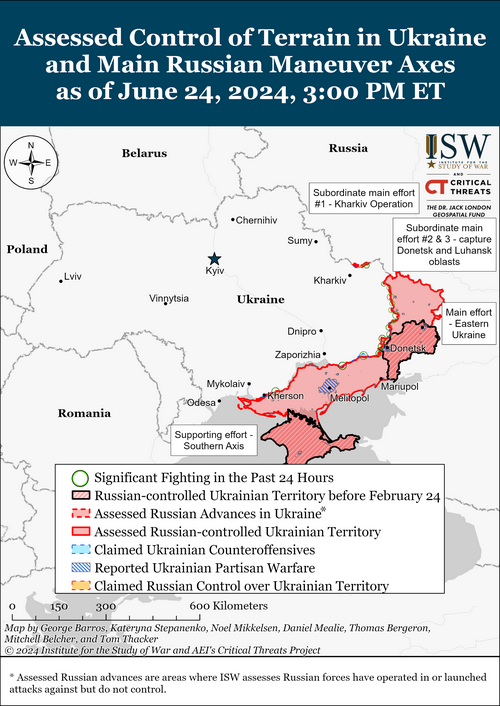
From The Institute for the Study of War:
Russian Offensive Campaign Assessment, June 24, 2024
Christina Harward, Nicole Wolkov, Grace Mappes, Kateryna Stepanenko, and Frederick W. Kagan
June 24, 2024, 10:30pm ET
Click here to see ISW’s interactive map of the Russian invasion of Ukraine. This map is updated daily alongside the static maps present in this report.
Click here to see ISW’s 3D control of terrain topographic map of Ukraine. Use of a computer (not a mobile device) is strongly recommended for using this data-heavy tool.
Click here to access ISW’s archive of interactive time-lapse maps of the Russian invasion of Ukraine. These maps complement the static control-of-terrain map that ISW produces daily by showing a dynamic frontline. ISW will update this time-lapse map archive monthly.
Note: The data cut-off for this product was 2:30pm ET on June 24. ISW will cover subsequent reports in the June 25 Russian Offensive Campaign Assessment.
Ukrainian Main Military Intelligence Directorate (GUR) Head Lieutenant General Kyrylo Budanov stated that Western military assistance is arriving in Ukraine, but that it will likely not arrive at a scale that will significantly impact the frontline situation until at least mid to late July 2024. Budanov stated in an interview with the Philadelphia Inquirer conducted on June 12 or 13 and published on June 23 that US and European weapons deliveries, including artillery ammunition, are arriving in Ukraine at a faster pace than several months ago but noted that Ukrainian forces need a high volume of weapons and “there is a question of volume.”[1] Budanov stated that “no Armageddon will emerge [on the frontline]” but that the frontline situation will remain difficult for at least one month. Ukrainian First Deputy Defense Minister Lieutenant General Ivan Havrylyuk also recently stated on June 15 that Ukrainian forces are still waiting for most of the military assistance that the US passed in late April 2024 to arrive in Ukraine, but that limited amounts of US security assistance arrivals have reduced Russia’s artillery shell advantage from seven-to-one to five-to-one.[2] ISW continues to assess that Russian forces are attempting to make tactically and operationally significant gains before US military assistance arrives to Ukrainian forces at the frontline at scale, and that the initial arrival of Western-provided weaponry will take some time to have tactical to operational effect on the frontline.[3]
Budanov stated that a sufficient quantity of US-provided long-range ATACMS missiles could allow Ukrainian forces to strike the Russian-built Kerch Strait Bridge in occupied Crimea and sever an important Russian ground line of communication (GLOC) between occupied Crimea and Russia.[4] Budanov stated that Ukraine could isolate occupied Crimea, which the Russian military uses as a rear staging area, by conducting long-range ATACMS missile strikes against the Kerch Strait Bridge. The Russian military continues to use Crimea’s GLOCs to transport military personnel, weapons, materiel, and fuel from Russia to the frontlines in Ukraine and reinforced its air defense umbrella to cover occupied southern Ukraine from Crimea.[5] Ukrainian officials have recently stated that Russian forces have reduced their military logistics transport across the Kerch Strait Bridge, presumably due to efforts to establish logistics lines connecting mainland Russia and occupied Crimea through occupied southern Donetsk, Zaporizhia, and Kherson oblasts, but the Kerch Strait Bridge likely remains essential to maintaining Russia’s occupation of Crimea.[6] Ukrainian long-range strikes against the Kerch Strait Bridge would sever an important GLOC for Russian forces based in occupied Crimea and likely complicate their ability to maintain their occupation of and basing within the peninsula. The destruction of the bridge would force Russian military to rely on the long route along northern coast of the Sea of Azov and exacerbate vulnerabilities for Ukrainian forces to exploit along the Russian main GLOC.
Current US policy regarding Ukraine’s use of Western-provided weapons allows Ukraine to strike anywhere within Russian-occupied Ukraine, which presumably includes using long-range ATACMS to strike the portion of the Kerch Strait Bridge within Ukraine’s internationally recognized land and maritime borders.[7] ISW assesses that 13 kilometers of the Kerch Strait Bridge — which Russian authorities built without Ukraine’s approval following Russia’s illegal occupation of the peninsula in 2014 — are within Ukraine’s internationally recognized territorial waters. The US policy on the Ukrainian ATACMS use, therefore, technically should allow Ukrainian forces to strike at least a section of the bridge if not the entire bridge. Pentagon Spokesperson Major Charlie Dietz also notably stated on June 24 that “Ukraine makes its own targeting decisions and conducts its own military operations.”[8] Then–US State Department Spokesperson Heather Nauert stated on May 15, 2018, that the US condemns Russia’s construction and partial opening of the Kerch Strait Bridge, that the bridge “serves as a reminder of Russia’s ongoing willingness to flout international law,” and represents Russia’s attempt to “solidify its unlawful seizure and its occupation of Crimea.”[9]
Kremlin officials absurdly attempted to link the June 23 Ukrainian strikes on legitimate military targets in occupied Sevastopol, Crimea and the likely Islamic State (IS) affiliate Wilayat Kavkaz terrorist attack in the Republic of Dagestan. Kremlin Spokesperson Dmitry Peskov stated on June 24 that Russian President Vladimir Putin sympathizes with those who lost loved ones from both the Ukrainian missile strike on Sevastopol and the terrorist attack in Dagestan.[10] Peskov also stated that the Russian investigative bodies will determine whether the strike on Crimea and the terrorist attack in Dagestan were one series of incidents or separate incidents.[11] Russian Security Council Deputy Chairperson Dmitry Medvedev and Russian Liberal Democratic Party (LDPR) Head Leonid Slutsky labeled both events as “terrorist attacks.”[12] Russian State Duma Chairperson Vyacheslav Volodin claimed that it is possible that the “customers” (or entities that ordered these attacks) of both the Crimea strikes and the Dagestan terrorist attack “will be the same.”[13] Russian opposition outlet Verstka reported on June 24 that pro-Kremlin bots left over 1,400 comments on Russian social media platform VKontakte claiming that the US and Ukraine organized the terrorist attack in Dagestan — echoing the Russian Ministry of Defense’s (MoD) claim that the US was responsible for the Ukrainian strike on occupied Sevastopol.[14]
The Kremlin information operation linking these two events is nonsensical if only because the civilian casualties in Crimea resulted from Russia’s interception of an incoming ATACMS missile rather than a deliberate Ukrainian targeting decision. The Russian MoD acknowledged that a Russian air defense interceptor caused the Ukrainian missile to deviate from its flight path and detonate in Sevastopol.[15] An unspecified US official also told Reuters in a June 24 article that Russian forces were able to intercept the ATACMS missile targeting a Russian missile launcher causing the ATACMS missile to explode and rain down shrapnel on the Sevastopol beach.[16] Russian officials have also offered no evidence for their claims of Ukrainian or American involvement in the Dagestan terrorist attack.
The Kremlin is attempting to maintain a veneer of stability and normalcy in response to the Dagestan terror attack. Peskov stated that Putin does not plan to make a special address concerning the strikes in Sevastopol or the attack in Dagestan — in contrast to Putin’s March 25 lengthy speech following the terrorist attack at Crocus City Hall in Moscow.[17] Peskov responded to a journalist asking if the Kremlin fears the return of the situation of the early 2000s (presumably referencing a series of terrorist attacks in Russia, including the 2002 Nord-Ost siege, 2004 Moscow Metro bombing, and 2004 Beslan school siege), stating that the Kremlin does not fear a return to this situation as Russia is different now and Russian society is “absolutely consolidated” in its lack of support for terrorist attacks in Dagestan or Russia in general.[18] Dagestan Head Sergei Melikov stated that the terrorist attack against Dagestan’s “brotherhood, multinational unity, and confessional indivisibility” is an attempt to divide Dagestan but “this [division] will not happen.”[19] The Russian Ministry of Foreign Affairs (MFA) claimed that the terrorists in Dagestan were attempting to create interreligious discord but that Russia will continue its fight against terrorism.[20] Chechen Akhmat Spetsnaz Commander Apty Alaudinov similarly claimed that the attack aimed to cause interreligious conflict but that other Russian regions, such as Chechnya, have already proven that Russia can effectively resist such conflicts.[21] The Kremlin has repeatedly promoted the idea that Russia is a harmonious multinational and multireligious state, despite increasing xenophobic rhetoric from Russia’s vocal ultranationalist community and growing societal tensions.[22] This Kremlin facade of normalcy and stability also ignores the October 2023 antisemitic riots in Dagestan (including in Makhachkala, one of the locations of the June 23 attack), the March 2024 Crocus City Hall terrorist attack in Moscow, and the increasingly frequent counterterrorism operations in the North Caucasus.[23]
The European Union (EU) adopted its 14th package of sanctions against Russia on June 24, including new restrictions against Russian funding to political parties and other “opinion-forming” organizations and Russian state media broadcasts within the EU. The new EU sanctions package prohibits EU actors that “form part of the public opinion forming process,” including political parties, foundations, alliances, non-governmental organizations, think tanks, and media service providers within the EU from accepting donations, financing, or other economic benefits or support “from Russia, either directly or indirectly.”[24] The EU cites Russia’s continued propaganda and disinformation campaigns to undermine Ukrainian sovereignty and independence, justify its war in Ukraine, and influence democratic processes within the EU as reasoning for this specific restriction. The EU sanctions regulation defines these Russian “direct and indirect” entities vaguely as “Russia and its proxies.”[25] The EU also implemented a decision on June 24 that it adopted on May 17 to “suspend broadcasting activities of additional media outlets in the Union, or directed at the Union,” explicitly including Kremlin news outlets and wires RIA Novosti, Izvestia, Rossiskaya Gazeta, and Voice of Europe, until “the Russian aggression in Ukraine is brought to an end” and until Russia “and its associated media outlets cease to conduct propaganda actions” in the EU.[26] The EU defines targeted outlets as “media outlets under the permanent direct or indirect control of the [Russian] leadership” and whose propaganda actions are “supporting Russia’s war of aggression against Ukraine” and “destabili[zing]” Ukraine’s neighboring countries. The EU decision noted that these regulations only apply towards affected organizations’ “broadcasting activities” and do not impede journalists’ abilities to conduct interviews and research within EU member states. The EU has suspended the “broadcasting activities and licenses” of 18 Kremlin-backed disinformation outlets since 2022.[27] The EU does not define what constitutes “broadcasting activities” within the EU, but Western media has consistently reported that the EU has blocked access to websites of affected media outlets and that search engines and social media sites have also blocked access to sanctioned media organizations under the EU broadcasting bans.[28]
The new EU sanctions package also sanctions 116 new individuals and entities and introduces other sanctions enforcement measures.[29] The new sanctions package targets specific Russian naval vessels and forbids EU entities from providing reloading services of Russian liquefied natural gas (LNG) in EU territory for transshipment operations to third countries. The new sanctions package also introduces restrictions on exporting dual-use goods and requires EU parent companies to undertake “due diligence mechanisms” to assess and identify the risk of exported goods being re-exported to Russia and mitigating these risks.
The EU approved a first tranche of up to 1.4 billion euros (about $1.5 billion) in military assistance for Ukraine from the proceeds of frozen Russian assets.[30] The EU reported that 90 percent of the first payment is dedicated to Ukraine’s defense needs and that the remaining 10 percent is dedicated to the EU’s support of the Ukraine Facility program, which supports rehabilitation, recovery, and reconstruction in Ukraine. The EU stated that it will begin distributing resources to Ukraine in July 2024 with biannual payments and will review this prioritization annually starting on January 1, 2025. EU High Commissioner Josep Borrell stated that the EU approved this tranche of assistance from frozen Russian assets through a so-called “legal loophole” bypassing Hungary’s veto because Hungary abstained from voting on an earlier agreement voting on setting aside the proceeds from Russia’s frozen assets and therefore “should not be part of the decision to use this money.”[31]
The Kremlin continued efforts to co-opt former Wagner Group personnel by introducing a new bill that would exempt much of the Wagner force from criminal responsibility for their participation in the Wagner armed rebellion on June 23 and 24, 2023. A source told Kremlin newswire TASS on the first anniversary of the Wagner armed rebellion on June 24 that the Russian Government’s Commission on Legislative Activities approved a bill that allows for exempting a participant of an armed rebellion from criminal liability if the participant “helped to prevent further damage” in Russian state interests.[32] The bill proposes changing a footnote to the “High Treason” article in the Russian Criminal Code to offer a possible exemption from criminal liability of armed rebellion if the participant voluntarily cooperated with Russian authorities and did not commit any other crimes. The bill’s explanatory note added that this exemption will motivate participants of armed rebellions to refuse to continue their “illegal actions,” presumably referring to crimes in addition to armed rebellion. The bill also proposed to add a new “Armed Rebellion” article in the Russian Criminal Code, which will differentiate between the level of involvement and severity of the consequences for organizing, leading, or participating in a rebellion. The TASS source claimed that the Russian Government’s Commission on Legislative Activities simultaneously approved a bill on toughening criminal penalties up to life imprisonment for organizing or participating in an armed rebellion if the rebellion resulted in the death of a person or unspecified “other grave consequences.”[33]
The bill clearly demonstrates three Kremlin objectives: appeasing and possibly blackmailing remaining Wagner personnel into remaining loyal to the Kremlin; erecting a facade that the Kremlin is addressing societal backlash over casualties among defending Russian military personnel during the Wagner armed rebellion; and establishing safeguards to prevent future armed rebellions. A prominent Russian milblogger observed that this bill is clearly related to the anniversary of the Wagner armed rebellion and noted that Russian authorities did not charge any of the Wagner commanders or participants for their involvement in the rebellion.[34] The milblogger noted that this bill will lead to stricter legislation regarding armed rebellions and that the Kremlin had clearly learned a painful lesson from June 2023. The Kremlin notably dropped criminal charges against Wagner commanders and personnel on June 27, 2023, despite the fact that Wagner personnel shot down several Russian military aircraft during the rebellion, killing 13 Russian pilots.[35] Several Russian milbloggers marked the anniversary of the Wagner armed rebellion by celebrating the Wagner Group’s accomplishments and noting that the rebellion revealed serious problems in the Russian military — some of which the milbloggers claimed persist a year after the rebellion.[36]
Ukrainian President Volodymyr Zelensky replaced Joint Forces Commander Lieutenant General Yuriy Sodol with Brigadier General Andriy Hnatov on June 24.[37] Zelensky did not offer a reason for Sodol’s dismissal. Hnatov served as deputy commander of the Ukrainian southern theatre since 2022, played an important role in liberating west (right) bank Kherson Oblast, and commanded the defense of Bakhmut in spring 2023.[38]
Key Takeaways:
- Ukrainian Main Military Intelligence Directorate (GUR) Head Lieutenant General Kyrylo Budanov stated that Western military assistance is arriving in Ukraine, but that it will likely not arrive at a scale that will significantly impact the frontline situation until at least mid to late July 2024.
- Budanov stated that a sufficient quantity of US-provided long-range ATACMS missiles could allow Ukrainian forces to strike the Russian-built Kerch Strait Bridge in occupied Crimea and sever an important Russian ground line of communication (GLOC) between occupied Crimea and Russia.
- Current US policy regarding Ukraine’s use of Western-provided weapons allows Ukraine to strike anywhere within Russian-occupied Ukraine, which presumably includes using long-range ATACMS to strike the portion of the Kerch Strait Bridge within Ukraine’s internationally recognized land and maritime borders.
- Kremlin officials absurdly attempted to link the June 23 Ukrainian strikes on legitimate military targets in occupied Sevastopol, Crimea and the likely Islamic State (IS) affiliate Wilayat Kavkaz terrorist attack in the Republic of Dagestan.
- The Kremlin is attempting to maintain a veneer of stability and normalcy in response to the Dagestan terror attack.
- The European Union (EU) adopted its 14th package of sanctions against Russia on June 24, including new restrictions against Russian funding to political parties and other “opinion-forming” organizations and Russian state media broadcasts within the EU.
- The EU approved a first tranche of up to 1.4 billion euros (about $1.5 billion) in military assistance for Ukraine from the proceeds of frozen Russian assets.
- The Kremlin continued efforts to coopt former Wagner Group personnel by introducing a new bill that would exempt much of the Wagner force from criminal responsibility for their participation in the Wagner armed rebellion on June 23 and 24, 2023.
- Ukrainian President Volodymyr Zelensky replaced Joint Forces Commander Lieutenant General Yuriy Sodol with Brigadier General Andriy Hnatov on June 24.
- Ukrainian forces recently regained lost positions near Vovchansk and Starysta, and Russian forces recently advanced near Siversk and Toretsk.
- The Russian Ministry of Defense (MoD) proposed depriving all Russian military districts of their status as joint headquarters.
Go here to read the rest.
From Strategy Page:
June 24, 2024: Noting the success of the Switchblade loitering munition in Ukraine, the U.S. has ordered thousands more sent to Ukrainian forces. At the same time the American army and marines are planning to issue more of these lightweight weapons to their own troops for use as a standard weapon, like existing rocket launchers and portable anti-tank weapons.
Ukrainian forces found Switchblade less effective than UAVs developed and built locally. The Ukrainians were dealing with a resourceful enemy and the Russian were already using several forms of jamming against Ukrainian UAVs. The $1,300 Switchblades needed several upgrades to be competitive with existing Ukrainian UAVs. Both Russian and Ukrainian forces are using cheap, about $500 each quadcopter UAVs controlled by soldiers a kilometer or more away, who use FPV (First Person Viewing) goggles to see what the day/night video camera on the UAV can see. Adding night vision doubles the cost for each UAV, so not all of them have that capability. Each of these UAVs carries half a kilogram of explosives, so it can instantly turn the UAV into a flying bomb that can fly into a target and detonate. This is an awesome and debilitating weapon when used in large numbers over the combat zone. If a target isn’t moving or requires more explosive power that the UAVs can supply, one of the UAV operators can call in artillery, rocket, or missile fire, or even an airstrike.
A major limitation is the need for trained UAV operators. These troops need over a hundred hours of training before they are able to start operating these UAVs, and another hundred hours of actual use before they are able to make the most out of the system. These UAVs are difficult to shoot down until they get close to the ground and the shooter is close enough, as in less than a few hundred meters, away to successfully target a UAV with a bullet or two and bring it down. Troops are rarely in position to do this, so most of these UAVs are able to complete their mission, whether it is a one-way attack or a reconnaissance and surveillance mission. The recon missions are usually survivable and enable the UAV to be reused. All these UAVs are constantly performing surveillance, which means that either side commits enough UAVs to maintain constant surveillance over a portion of the front line, to a depth, into enemy territory, of at least a few kilometers.
This massive use of FPV-armed UAVs has revolutionized warfare in Ukraine and both sides are producing as many as they can. Not having enough of these to match the number the enemy has in a portion of the front means you are at a serious disadvantage in that area. These UAVs are still evolving in terms of design and use and becoming more effective and essential. Currently most of the battlefield casualties in Ukraine are caused by armed UAVs.
One countermeasure that can work for a while is electronic jamming of the UAVs control signal. UAV guidance systems are constantly modified or upgraded to cope with this. Most UAVs have flight control software that sends UAVs with jammed control signals back to where they took off from to land and await. The jammers are on the ground and can be attacked by UAVs programmed to home in on the jamming signal and detonate their explosives on the source of the jamming signal. As a result, even countermeasures can be overcome and the side that can do this more quickly and completely has an advantage. That advantage is usually temporary because both sides are putting a lot of effort into keeping their combat UAVs effective on the battlefield. The more expensive Switchblade loitering munition has much less combat experience and, until Ukraine, none against an enemy like Russia with similar development and manufacturing capabilities.
Switchblade 600 entered service in 2020. While the original Switchblade 300 weighed 2.7 kg, Switchblade 600 was ten times heavier at 23 kg, could stay in the air for 40 minutes and be controlled up to 80 kilometers from the operator. Top speed is 180 kilometers an hour and more economical cruise speed is closer to 150 kilometers an hour at altitudes of under 100-150 meters. The heavier warhead could destroy most tanks, although some modern tank designs include protection from top attack.
Switchblade 600 was requested by the U.S. Army for longer range surveillance missions and the option to hit specific small targets, like a building or enemy position. Unlike the earlier Switchblades, the 600 uses a tablet controller with more options, including manipulating the more powerful video camera. Video transmitted back to the operator could be saved and passed on. The operator also had a wave off feature in which a quick tap on the controller screen can cause the 600 to abort an attack and be available for another try. The 600 can also be programmed to carry out a mission without operator control. This means there is no control signal for enemy electronic warning systems to detect or jam. In this case when time is up the 600 self-destructs. The 600 can be carried into a remote area and used quickly. This is what Ukrainian troops discovered and they used their Switchblade 600 very successfully and requested a lot more of them. This also persuaded the U.S. Army to issue Switchblade 600s to troops as a basic item of equipment and instruct soldiers on how to use these UAVs for reconnaissance and combat.
The marines were also early and enthusiastic users of Switchblade and found that it could be launched from the rear ramp of an MV-22 tilt-wing transport and carry out aerial reconnaissance for the marines as well as for attacking targets.
The original Switchblade was a small UAV fired, like all Switchblades, from its shipping tube container. Switchblade was sent to Afghanistan in 2009 for secret field testing. This was very successful and the troops demanded more, a lot more. Switchblade completed development later in 2009 and was initially thought useful only for special operations troops. In 2011, after a year of successful field testing, the army ordered over a hundred Switchblades for general troop use and since then has ordered thousands more.
While Switchblade was developed for the army, the marines apparently noted the success that soldiers and SOCOM (Special Operations Command) had with this system and ordered them as well. Switchblade was very popular with troops in Afghanistan and with SOCOM in all sorts of places they won’t discuss in detail. Switchblade is still used and thousands have been ordered and many of them used. There have been several upgrades
The original Switchblade was a lightweight, used only once UAV (Unmanned Aerial Vehicle) that could also be equipped with explosives. The Switchblade was launched from its shipping and storage tube, at which point wings flip out, a battery-powered propeller starts spinning and a vidcam begins broadcasting images to the controller. The Switchblade is operated using the same controller as the larger two kg Raven UAV. A complete Switchblade 300 system, with a missile, container, and controller weighed 5.5 kg.
Moving up to a kilometer a minute, the Switchblade could stay in the air for 20-40 minutes, depending on whether or not it is armed with explosives. Switchblade can operate up to ten kilometers from the operator. The armed version can be flown to a target and detonated, having about the same explosive effect as a hand grenade. Thus, Switchblade enables ground troops to get at an enemy taking cover in a hard to see location.
Go here to read the rest. Drones continue to reshape warfare. Young soldiers will have a hard time envisioning what ground warfare was like without them.





The naivete and wishfulness of the West to this conflict is truly a resurgence of Bourbon thinking. In the more than a century since the start of European conflict in 1914, the various countries have learned nothing. Even a country that has had the experience as had Hungary, has a delusional vision that conflict will pass it by. A total diplomatic and commercial isolation of Russia is the only non-military option that has a chance of achieving any sort of satisfactory result. If China and North Korea want to drain their own resources to support this neo-Soviet adventure, they can be added to the list. The developed world has clearly atrophied because of its own devotion to entitlement, ease and moral license and will pay a terrible price if it does not reawaken.