
From The Institute For The Study of War:
Russian Offensive Campaign Assessment, June 22, 2024
Angelica Evans, Karolina Hird, Grace Mappes, Nicole Wolkov, and George Barros
June 22, 2024, 7pm ET
Click here to see ISW’s interactive map of the Russian invasion of Ukraine. This map is updated daily alongside the static maps present in this report.
Click here to see ISW’s 3D control of terrain topographic map of Ukraine. Use of a computer (not a mobile device) is strongly recommended for using this data-heavy tool.
Click here to access ISW’s archive of interactive time-lapse maps of the Russian invasion of Ukraine. These maps complement the static control-of-terrain map that ISW produces daily by showing a dynamic frontline. ISW will update this time-lapse map archive monthly.
Note: The data cut-off for this product was 12:30pm ET on June 22. ISW will cover subsequent reports in the June 23 Russian Offensive Campaign Assessment.
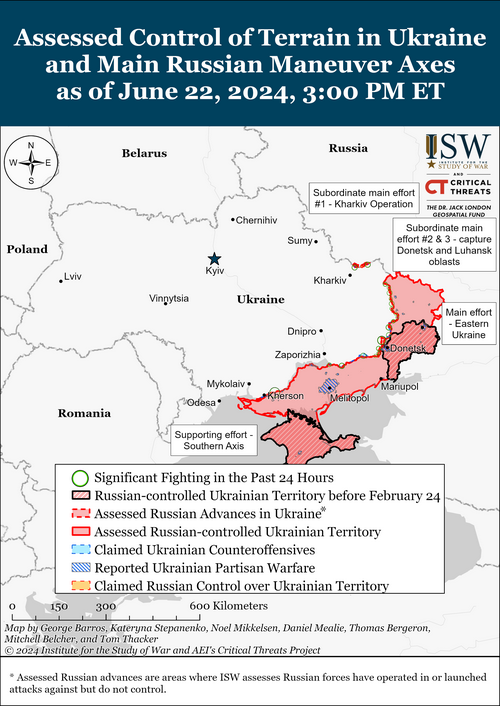
Russian forces appear to be intensifying the tempo of their offensive operations in Donetsk Oblast while decreasing the rate of attacks in northern Kharkiv Oblast — consistent with ISW’s assessment that Russian offensive operations in Kharkiv Oblast are primarily intended to fix and distract Ukrainian forces in order to allow Russian forces to intensify elsewhere in theater. Russian forces increased the intensity of assaults in the Toretsk-Horlivka direction (southwest of Chasiv Yar and northeast of Avdiivka) on the night of June 18 and maintained a relatively high rate of attacks in this area between June 19 to June 22, reportedly making several tactical gains in the area.[1] Russian forces have been generally inactive on this sector of the front throughout the course of 2024, so their activation and intensification are noteworthy. By contrast, the tempo of Russian offensive operations in northern Kharkiv Oblast has drastically decreased in recent days, particularly in comparison with the start of Russian offensive operations north and northeast of Kharkiv City in mid-May 2024.[2] ISW has long assessed that the Russian command intended its offensive operation in Kharkiv Oblast to fix Ukrainian manpower and scarce materiel along the northern border to grant Russian forces opportunities to re-intensify offensive operations in other more critical areas of the theater, particularly in Donetsk Oblast.[3] Ukrainian sources have confirmed that some Ukrainian forces have redeployed units to the Kharkiv direction from Donetsk Oblast, so Russian forces may be exploiting this perceived weakness of Ukrainian lines to intensify attacks, particularly in the Toretsk-Horlivka direction.[4] Russian forces have additionally maintained a high rate of attacks in the Chasiv Yar direction and around Avdiivka since decreasing the tempo in Kharkiv Oblast, and may soon intensify attacks in this area if the Russian command identifies the coming weeks as an advantageous time to push in these areas before Ukrainian forces re-allocate reserves back to Donetsk Oblast. Ukrainian sources have warned that Russia will conduct a summer offensive that will likely focus on Ukraine’s east after pursuing offensive operations in the north intended to stretch Ukraine’s scarce resources, and recent intensifications in Donetsk Oblast may indicate preparations for such a summer offensive, assuming it has not already begun.[5]
US policy continues to prohibit Ukrainian forces from striking legitimate military targets in Russian territory in the range of Ukrainian HIMARS. Recent reporting from the Associated Press and Washington Post indicates that US policy still prohibits Ukraine from striking Russian military targets that are not actively attacking or preparing to attack Ukraine.[6] Pentagon spokesperson Major Charlie Dietz told the Washington Post in a report published on June 21 that the US allows Ukraine to fire US-provided HIMARS equipped with GMLRS into Russia where Russian forces are attacking into Ukraine and that the rules of engagement for US-provided weapons in Russian territory are “not about geography or a certain radius.”[7] US National Security Adviser Jake Sullivan similarly stated on June 17 that “this is not about geography… If Russia is attacking or about to attack from its territory into Ukraine, it only makes sense to allow Ukraine to hit back against the forces that are hitting it from across the border.”[8] These statements indicate that the US will only allow Ukrainian forces to strike Russian military targets if Russian targets first demonstrate that they are engaged in active combat operations or preparations for imminent combat operations. US restrictions likely force Ukrainian leadership to carefully determine whether or not a given target meets the aforementioned requirements before authorizing tactical fire missions. US policy still preserves the majority of Russian sanctuary space by prohibiting Ukrainian forces from launching ATACMS missiles at any military targets in Russia.[9] No major Russian military airbases are in range of GMLRS, but many are within range of ATACMS.

Russian forces are exploiting the sanctuary that US policy still protects to support Russian combat operations in northern Kharkiv Oblast and elsewhere in Ukraine. The Russian Northern Grouping of Forces is leveraging the sanctuary to protect Russian brigade command posts and other assets outside of the range of HIMARS equipped with GMLRS north of Kharkiv Oblast. The Associated Press quoted a Ukrainian artillery commander on June 22 who stated that Ukrainian forces could target Russian brigade command points and the entire Russian Northern Grouping of Forces if the US approved Ukraine’s use of ATACMS to strike Russian territory but currently cannot because Russia has deployed such command and control elements in an area 100 to 150 kilometers away from the front line.[10] US policy still prohibits Ukraine from using ATACMS anywhere in Russia.[11]
Russian air defenses will reduce the effectiveness of Ukrainian F-16s if the US does not allow Ukrainian forces to use ATACMS to destroy Russian air defense systems in Russian territory. Ukrainian F-16 pilots will have to operate in a dangerous air space if US policy continues to provide a sanctuary in Russia that protects Russian forces from ATACMS. Russian air defenses will be able to cover up to 48 percent of Ukraine’s air space if Russia deploys S-400 air defense launchers within Russia outside of the range of HIMARS armed with GMLRS rockets. Such Russian air defense deployments would complicate Ukraine’s ability to use manned fixed-wing airpower closer to frontline areas or against areas from which Russian aircraft, drone, and missile threats emanate. ISW continues to assess that Ukrainian forces may be able to combine fixed-wing airpower in support of ground operations if the Ukrainian military receives a sufficient number of fighter jets if Western partners train enough skilled pilots, and if Ukraine succeeds in degrading Russian air defense capabilities.[12]


The partial removal of the sanctuary has already had a net positive effect, underscoring the powerful latent potential a larger policy change could achieve. The Washington Post reported that the Biden Administration’s policy change allowing Ukrainian forces to strike into limited parts of Russia in late May 2024 — despite being quite limited — has allowed Ukraine to strike “areas where [Russian] equipment is concentrated and locations from where missile strikes are launched [against Ukraine].” The Washington Post quoted a commander of a reconnaissance battalion of Ukraine’s 57th Brigade who stated that Russia has not conducted a single S-300 missile strike against Kharkiv (it is unclear whether the speaker meant Kharkiv City or Kharkiv Oblast) since the Biden Administration partially removed the sanctuary in late May 2024.[13] The Associated Press reported on June 22 that Ukrainian forces have struck Russian troops and air defense systems within 20 kilometers inside of Russian territory and quoted a Ukrainian artillery commander who stated that Ukrainian forces used HIMARS to destroy Russian columns along the international border that were awaiting orders to enter Ukraine.[14] Kharkiv City Mayor Ihor Terekhov told the Washington Post that the situation in Kharkiv City “massively changed” after the US partially removed restrictions.[15] The Washington Post report noted that Russian glide bomb strikes against Kharkiv Oblast have not decreased, highlighting the need to allow Ukraine to strike Russian air bases and to augment Ukraine’s air defense capabilities. The West maintains the ability to substantially disrupt Russian operations at scale by allowing Ukraine to use Western-provided weapons to strike Russia’s operational rear and deep rear areas in Russian territory.
Dutch Defense Minister Kajsa Ollongren announced on June 21 that the Netherlands and another unspecified country will supply Ukraine with a Patriot air defense system.[16] Ollongren stated that the Netherlands and the other unspecified country have been working for “some time” to collect the components to form a complete Patriot system. US President Joe Biden recently indicated that the US has secured commitments from five unspecified countries to provide Ukraine with additional Patriots and other air defense systems, and so far, Romania and now the Netherlands have confirmed their participation in this effort.[17]
Russian opposition outlet Vazhnye Istorii reported on a series of leadership changes within the Russian Federal Security Service’s (FSB) Fifth Service, which reportedly specializes in collecting intelligence within Russia and the former Soviet Union.[18] Vazhnye Istorii stated on June 22 that a former Russian special services employee and an acquaintance of the FSB’s Fifth Service Head Colonel General Sergei Beseda stated that Alexei Komkov replaced Beseda as the head of the FSB’s Fifth Service. Vazhnye Istorii stated that Beseda formally retired from his position of Fifth Service Head due to his age and became a personal advisor to Russian FSB Head Alexander Bortnikov. Vazhnye Istorii’s sources claimed that Komkov previously worked as Deputy Head of the FSB’s counterintelligence service and that Komkov is affiliated with FSB First Deputy Director Sergei Korolev. Russian President Vladimir Putin reportedly relied on intelligence from the Fifth Service when launching his invasion of Ukraine.[19]
Western countries have reportedly provided Ukraine with roughly 800 million euros ($855.4 million) worth of Serbian-produced ammunition despite Serbian President Aleksandar Vučić’s ongoing efforts to balance favor between Russia and the West. The Financial Times (FT) reported on June 22 that it obtained estimates from an unspecified source that said that third-party countries have sent roughly 800 million euros worth of Serbian-produced ammunition to Ukraine since February 2022 and that Vučić confirmed that this number is “in the right ballpark” during an interview with FT.[20] Vučić clarified that Serbia does not export ammunition to Ukraine or Russia and that Serbia’s clients in the US, Spain, and Czechia can allocate the ammunition as they see fit. Unnamed diplomats and analysts told FT that official Serbian government data purposely veils the flow of ammunition to Ukraine via third-party countries.
Satellite imagery confirmed that Ukrainian forces struck at least one Russian air defense training center in Krasnodar Krai during recent strikes on June 20 to 21.[21] Geolocated satellite imagery collected on June 22 shows a destroyed building and scorched fields at an air defense training center west of Yeysk, Krasnodar Krai, and footage shows fires and secondary explosions following the strike.[22] Russian opposition outlet Astra reported on June 21 that Ukrainian strikes damaged barracks and injured nine personnel at the 726th Air Defense Training Center in Vorontsovka, Krasnodar Krai (south of Rostov-on-Don).[23]
Select Russian milbloggers claimed that unnamed actors, implied to be Ukrainians, conducted a strike using ATACMS against Rostov Oblast, although ISW cannot independently confirm these reports.[24] All available media reporting and senior US government officials’ statements strongly suggest that US policy still forbids Ukrainian forces from using US-provided ATACMS missiles to strike military targets anywhere in Russia.[25] ISW continues to assess that the US should allow Ukraine to strike all military targets in Russia’s operational and deep rear areas with US-provided weapons.
Key Takeaways:
- Russian forces appear to be intensifying the tempo of their offensive operations in Donetsk Oblast while decreasing the rate of attacks in northern Kharkiv Oblast — consistent with ISW’s assessment that Russian offensive operations in Kharkiv Oblast are primarily intended to fix and distract Ukrainian forces in order to allow Russian forces to intensify elsewhere in theater.
- US policy continues to prohibit Ukrainian forces from striking legitimate military targets in Russian territory in range of Ukrainian HIMARS.
- Russian forces are exploiting the sanctuary that US policy still protects to support Russian combat operations in northern Kharkiv Oblast and elsewhere in Ukraine.
- Russian air defenses will reduce the effectiveness of Ukrainian F-16s if the US does not allow Ukrainian forces to use ATACMS to destroy Russian air defense systems in Russian territory.
- The partial removal of the Russian sanctuary has already had a net positive effect, underscoring the powerful latent potential a larger policy change could achieve.
- Dutch Defense Minister Kajsa Ollongren announced on June 21 that the Netherlands and another unspecified country will supply Ukraine with a Patriot air defense system.
- Russian opposition outlet Vazhnye Istorii reported on a series of leadership changes within the Russian Federal Security Service’s (FSB) Fifth Service, which reportedly specializes in collecting intelligence within Russia and the former Soviet Union.
- Western countries have reportedly provided Ukraine with roughly 800 million euros ($855.4 million) worth of Serbian-produced ammunition despite Serbian President Aleksandar Vučić’s ongoing efforts to balance favor between Russia and the West.
- Satellite imagery confirmed that Ukrainian forces struck at least one Russian air defense training center in Krasnodar Krai during recent strikes on June 20 to 21.
- Select Russian milbloggers claimed that unnamed actors, implied to be Ukrainians, conducted a strike using ATACMS against Rostov Oblast, although ISW cannot independently confirm these reports.
- Russian forces recently advanced near Svatove, Chasiv Yar, and Avdiivka.
- Russian law enforcement and security agencies continue working with the Russian Ministry of Defense (MoD) to recruit those accused of criminal offenses into the Russian military, likely as part of ongoing crypto-mobilization efforts.
Go here to read the rest. The air war continues and grows in fury while little is occurring on the ground.


Sounds like the intellectual descendants of those who prosecuted the Vietnam War are now giving direction to the Ukrainians. Likely with the same result.