
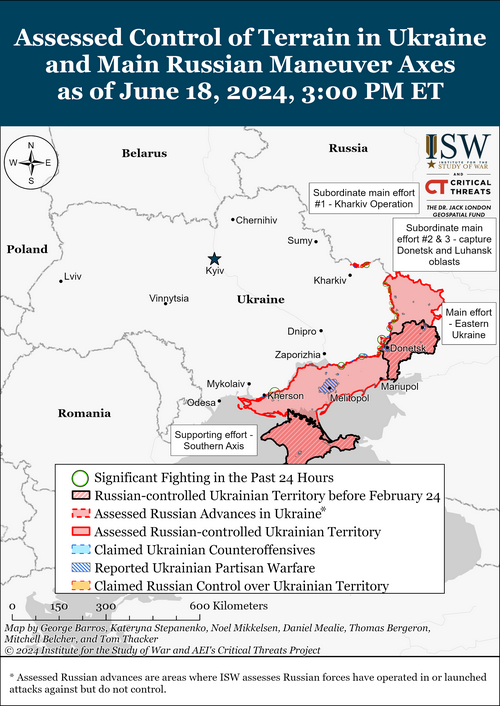
From The Institute for the Study of War:
Russian Offensive Campaign Assessment, June 18, 2024
Angelica Evans, Grace Mappes, Nicole Wolkov, Kateryna Stepanenko, and George Barros
June 18, 2024, 9:45pm ET
Click here to see ISW’s interactive map of the Russian invasion of Ukraine. This map is updated daily alongside the static maps present in this report.
Click here to see ISW’s 3D control of terrain topographic map of Ukraine. Use of a computer (not a mobile device) is strongly recommended for using this data-heavy tool.
Click here to access ISW’s archive of interactive time-lapse maps of the Russian invasion of Ukraine. These maps complement the static control-of-terrain map that ISW produces daily by showing a dynamic frontline. ISW will update this time-lapse map archive monthly.
Note: The data cut-off for this product was 2pm ET on June 18. ISW will cover subsequent reports in the June 19 Russian Offensive Campaign Assessment.
Russian President Vladimir Putin published an article in North Korean state-owned newspaper Rodong Sinmun praising Russian–North Korean cooperation on the eve of his visit to North Korea, likely to frame any future support that North Korea will lend to Russia as part of a common struggle against the West.[1] Putin invoked the history of the Soviet Union’s support for North Korea during and following the Korean War in his June 18 article and noted that the Soviet Union was the first country to establish diplomatic relations with North Korea. Putin claimed that the Soviet Union’s support helped North Korea strengthen its economy and establish a peaceful society following the Korean War and thanked North Korea for its support of Russia’s invasion of Ukraine. Putin praised Kim Jong-Un’s dedication to his father’s and grandfather’s legacies and praised Pyongyang as a “staunch like-minded” nation who is standing with Russia in opposition to the collective West. Putin reaffirmed Russia’s support for North Korea’s struggle against its enemy — the United States. Putin also implied that Western states are common adversaries of Russia and North Korea. Putin noted that Russia, like North Korea, maintains its strong economy and independence despite Western sanctions and praised North Korea’s long-term struggle against the West. Putin claimed that the West has refused peace offers from both leaders, although both leaders appear averse to serious, good-faith peace negotiations.[2] Putin stated that Russia and North Korea will cooperate to develop a security architecture for Eurasia and expressed hope that their bilateral relations will continue to deepen. Putin’s intentional appeal to known propaganda narratives about the legacies of the Kim regime, the Korean War, and North Korea’s historical struggle against the US and the West is likely setting conditions for Putin to justify his future requests or demands of the North Korean people in support of Russia’s war effort in Ukraine. Putin’s visit to North Korea is also a significant goodwill gesture towards Kim Jong-Un as the visit helps legitimize Kim’s pariah regime both domestically and abroad. Foreign heads of state rarely visit North Korea, and Putin last visited North Korea in 2000. Putin may be using this visit as flattery to assist in extracting additional aid from North Korea in the future, which may range from additional requests for weapon supplies or even manpower; for example, reports in 2022 suggested that North Korea was considering sending North Korean workers to Russian-occupied Ukraine to help with reconstruction efforts.[3]
Select Western officials warned about the dangers of greater cooperation between global authoritarian regimes on June 17 in response to Putin’s visit to North Korea. NATO Secretary General Jens Stoltenberg stated on June 17 that Russia’s growing alignment with its “authoritarian friends” is making it “even more important” for NATO countries to work with their partners in the Indo-Pacific region and condemned the People’s Republic of China’s (PRC) and North Korea’s support for Russia’s war effort.[4] US National Security Spokesperson John Kirby stated during a press conference that the US is alarmed by deepening Russian–North Korean relations due to both the consequences in Ukraine and the security of the Korean peninsula.[5] Kirby stated that the US is carefully monitoring the development of Russian–North Korea relations.
Ukrainian forces struck Russian oil depots in Rostov Oblast and Krasnodar Krai overnight on June 17 to 18, using domestically produced Neptune missiles against a ground target in Russia for the second time.[6] Sources in the Ukrainian Navy told Ukrainian media outlet Suspilne on June 18 that Ukrainian forces used Neptune anti-ship missiles, presumably modified to strike ground targets, to strike an oil terminal of the Yugneftekhimtransit LLC in the port town of Chushka, Krasnodar Krai overnight.[7] Russian opposition outlet Astra reported locals witnessed explosions near Chushka overnight and that a fire damaged the pipeline and areas with engineering or technical equipment.[8] Russian authorities did not confirm the strike, but the Russian Ministry of Defense (MoD) claimed on June 18 that Russian forces intercepted a Ukrainian Neptune missile in an unspecified area on June 17.[9] Sources in the Ukrainian Security Service (SBU) told Ukrainian media outlets that Ukrainian forces conducted drone strikes against the Azovskaya and Azovnaftoprodukt oil terminals in Azov, Rostov Oblast, and geolocated footage shows that the resulting fire burned overnight on June 17 to 18 and well into the day on June 18.[10] Rostov Oblast authorities reported that the strikes set the oil tanks on fire.[11] The SBU sources stated that these depots combined have 22 fuel tanks, and Radio Free Europe/Radio Liberty’s (RFE/RL) Crimean service reported that up to 60 tons of petroleum products pass through these depots per month and that the storage tanks can hold up to 30 thousand cubic meters of petroleum products simultaneously.[12]
Ukrainian forces have now conducted two strikes with its own Neptune missiles against areas in Russian territory that are within range of US-provided ATACMS but that are also protected by US policy that has established a vast sanctuary in Russian territory. The Ukrainian General Staff reported on May 31 that Ukrainian forces used Neptune missiles to strike an oil depot near the port of Kavkaz, Krasnodar Krai, and former Ukrainian Naval Deputy Chief of Staff Andriy Ryzhenko stated that the May 31 strike was the first Ukrainian strike using Neptunes against ground targets.[13] Chushka and Kavkaz are port towns near the Kerch Strait and are roughly 250 kilometers from the current frontlines and within the 300-kilometer range of the US-provided long-range ATACMS.[14] The US has not allowed Ukrainian forces to use existing US-provided weapons to strike legitimate targets in Russian territory for much of the full-scale invasion thus far and still prohibits Ukraine from using ATACMS anywhere in Russia.[15] Ukraine first debuted Neptune anti-ship missiles against Russian naval targets in April 2022 and has had to further develop and modify these missiles to conduct deep strikes against Russian territory — a process that took over two years during which Russian forces in Russia enjoyed protection against Western-provided weapons.[16] ISW continues to assess that the US should allow Ukraine to strike legitimate military targets within Russia’s rear with US-provided weapons, especially given that standing US prohibitions on how Ukrainian forces may use US-provided weapons will not prevent Ukraine or other Western weapons from striking Russia.
The Russian government is charging Ukrainian servicemen and military officials with crimes in absentia as part of its efforts to enforce Russian federal law outside of its jurisdiction and insinuate that Ukraine should not exist as an independent state. The Russian Ministry of Internal Affairs (MVD) placed former Ukrainian Deputy Defense Minister Pyotr Mekhed and former Deputy Chief of the Ukrainian General Staff Viktor Bokiy on Russia’s wanted list on June 18 and charged the men with unspecified war crimes in absentia.[17] The Russian Investigative Committee ruled on June 17 to detain a Ukrainian commander in absentia on charges that the commander helped down a Russian A-50 long-range radar detection aircraft in February 2024 — a legitimate act of war and a normal event for two warring states.[18] The Russian MVD previously absurdly placed multiple officials from most NATO member countries on its western flank on Russia’s wanted list for violating various Russian laws while the officials were in their respective countries where Russian law has no jurisdiction.[19] Russian officials similarly temporarily placed Ukrainian President Volodymyr Zelensky, Ukrainian Ground Forces Commander Lieutenant General Oleksandr Pavlyuk, and former Ukrainian President Petro Poroshenko on its wanted list for allegedly violating Russian law while those officials were not in Russia.[20] ISW continues to assess that Russia’s decision to place Western officials on its wanted list for violating Russian federal laws outside of Russia is part of its effort to violate the sovereignty of NATO member states and justify possible future Russian aggression against NATO.[21] The Kremlin’s prosecution of Ukrainian military personnel and political leadership who are engaged in a fully lawful, defensive war against an invasion by a foreign power in a manner akin to domestic terrorists highlights Russia’s enduring belief that the Ukrainian state does not and should not exist as a political entity separate from Russia.
Founder of the Kremlin-linked Rybar Telegram Channel, Mikhail Zvinchuk, gave his second uncharacteristically public interview within a month in which he criticized the state of Russia’s war effort in Ukraine and acknowledged that Western sanctions are negatively affecting Russia’s industry and economy. Republika Srpska (the Serbian entity within Bosnia and Herzegovina) media portal BanjaLuka.net published an interview with Zvinchuk on June 18 to promote his recently established “Rybar media school” in the Balkans.[22] Zvinchuk gave an unusually frank and critical view of the Russian military when asked to discuss the current state of Russia’s war in Ukraine. Zvinchuk stated that the war has not proceeded as the Russian military had planned, in part, because of Russia’s poor planning. Zvinchuk also claimed that Russian forces have learned to fight at the platoon, company, and battalion levels but still lack the capability to fight at any higher echelons. Zvinchuk noted that Russian forces have “learned” to seize the battlefield initiative but have only done so in select unspecified locations and that Russian forces are only able to make slow tactical gains. Zvinchuk claimed that if Russia could seize the strategic initiative that Russian forces would seize “a city per week, not a house or village per week.” Zvinchuk also assessed that Russia does not have enough materiel to take the strategic initiative but acknowledged that Russia is attempting to accelerate its defense industrial base (DIB) output. Zvinchuk acknowledged that international sanctions against Russia have hindered Russia’s ability to maintain its technological capabilities, noting that some Russian oil refineries are not working, which has resulted in a 10 percent increase in fuel prices. Zvinchuk gave an interview to Russian-language diaspora-focused outlet RTVi on May 18 — shortly after Russian President Vladimir Putin replaced Sergei Shoigu with Andrei Belousov as Russian Defense Minister – in which Zvinchuk criticized the Russian Ministry of Defense (MoD) and speculated on possible changes within the MoD.[23] ISW assessed that Zvinchuk may be trying to use his public interviews to gauge the Kremlin’s response to critical voices or that the Kremlin may have tasked Zvinchuk with criticizing the Russian MoD publicly while dictating the content and severity of his statements. Zvinchuk’s decision to give his second public interview within a month to a Republika Srpska media portal indicates Zvinchuk’s interest in publicizing his efforts to spread pro-Russian informational influence in Europe and support long-term Russian efforts to destabilize the Western-brokered Dayton Accords in Bosnia and Herzegovina.
Key Takeaways:
- Russian President Vladimir Putin published an article in North Korean state-owned newspaper Rodong Sinmun praising Russian–North Korean cooperation on the eve of his visit to North Korea, likely to frame any future support that North Korea will lend to Russia as part of a common struggle against the West.
- Ukrainian forces struck Russian oil depots in Rostov Oblast and Krasnodar Krai overnight on June 17 to 18, using domestically produced Neptune missiles against a ground target in Russia for the second time.
- Ukrainian forces have now conducted two strikes with its own Neptune missiles against areas in Russian territory that are within range of US-provided ATACMS but that are also protected by US policy that has established a vast sanctuary in Russian territory.
- The Russian government is charging Ukrainian servicemen and military officials with crimes in absentia as part of its efforts to enforce Russian federal law outside of its jurisdiction and insinuate that Ukraine should not exist as an independent state.
- Founder of the Kremlin-linked Rybar Telegram Channel, Mikhail Zvinchuk, gave his second uncharacteristically public interview within a month in which he criticized the state of Russia’s war effort in Ukraine and acknowledged that Western sanctions are negatively affecting Russia’s industry and economy.
- Russian forces recently marginally advanced near Vovchansk, Svatove, and Avdiivka
- Russian President Vladimir Putin continues efforts to groom Russian military personnel for positions in the Russian government through the Kremlin’s “Time of Heroes” program.
- Russian occupation officials continue their efforts to militarize Ukrainian youth in occupied Ukraine.
Go here to read the rest. Both Russia and Ukraine have decided not to make use of the best campaigning weather in Ukraine to launch new major offensives. Stalemate.

