
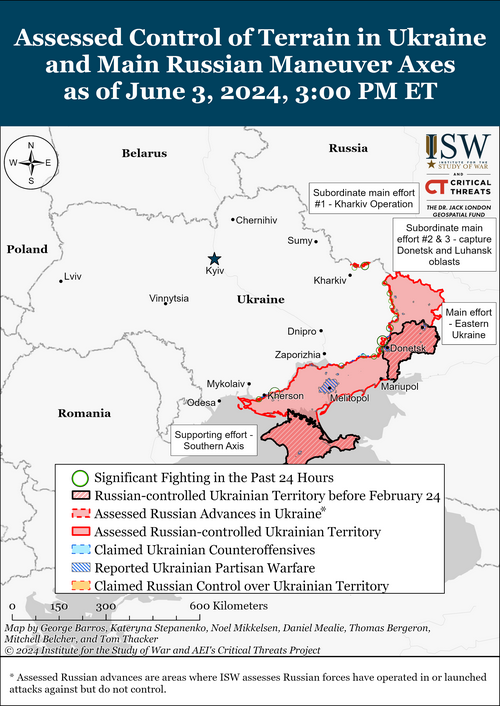
From The Institute for the Study of War:
Russian Offensive Campaign Assessment, June 3, 2024
Christina Harward, Angelica Evans, Grace Mappes, Karolina Hird, Liam Karr, and Frederick W. Kagan
June 3, 2024, 7:25pm ET
Click here to see ISW’s interactive map of the Russian invasion of Ukraine. This map is updated daily alongside the static maps present in this report.
Click here to see ISW’s 3D control of terrain topographic map of Ukraine. Use of a computer (not a mobile device) is strongly recommended for using this data-heavy tool.
Click here to access ISW’s archive of interactive time-lapse maps of the Russian invasion of Ukraine. These maps complement the static control-of-terrain map that ISW produces daily by showing a dynamic frontline. ISW will update this time-lapse map archive monthly.
Note: The data cut-off for this product was 1:30pm ET on June 3. ISW will cover subsequent reports in the June 4 Russian Offensive Campaign Assessment.
Ukrainian forces struck a Russian S-300/400 air defense battery in Belgorod Oblast likely with HIMARS on June 1 or 2. Geolocated imagery published on June 3 shows two destroyed launchers and a damaged command post of a Russian S-300/400 air defense system in a field east of Kiselyovo (just north of Belgorod City).[1] Russian sources widely speculated that Ukrainian forces used US-provided HIMARS, but Ukrainian officials have yet to comment on the strike.[2] The S-300/400 air defense system was located roughly 60 kilometers from the current frontline in northern Kharkiv Oblast and over 80 kilometers from Kharkiv City, which is within the range of HIMARS but exceeds the range of other MLRS systems that Ukrainian forces reportedly use to conduct strikes into Belgorod Oblast.[3] Russian sources have increasingly claimed that Ukrainian forces are using HIMARS to strike Belgorod Oblast since the US partially lifted its restrictions on Ukraine’s ability to use US-provided weapons to strike military targets in Russian border areas with Kharkiv Oblast.[4] Russian sources will likely continue to characterize any successful strike in Belgorod Oblast as a HIMARS strike regardless of the system used.
The People’s Republic of China (PRC) and Russia are reportedly in disagreement about economic issues such as the proposed Power of Siberia 2 (PS-2) pipeline despite publicly portraying themselves as diplomatically aligned. The Financial Times (FT) reported on June 2 that three unspecified sources familiar with the matter stated that the PRC and Russia disagree about the details of the PS–2 gas pipeline, with the PRC wanting to pay prices near Russia’s subsidized domestic gas prices and to only commit to buying a small part of the pipeline’s planned capacity.[5] Gazprom Head Alexei Miller reportedly did not accompany Russian President Vladimir Putin on his recent visit to the PRC due to these disagreements over the pipeline. FT reported that Putin asked PRC President Xi Jinping during their May 2024 meetings to come to an agreement on the pipeline, but FT reported that sources said that a pipeline agreement “remains distant.” FT noted that Russia needs the pipeline to launch as expected more than the PRC. FT reported that it gained access to an unreleased report by an unspecified major Russian bank that stated that if the PS-2 pipeline does not launch in 2029, Gazprom’s profits are forecasted to drop by almost 15 percent, which is especially significant following Gazprom’s $6.9 billion loss in 2023, its largest loss in more than 25 years. FT, citing a recent report by Columbia University’s Center on Global Energy Policy, also stated that the PRC will mostly or entirely be able to meet its projected increased demand for imported gas with existing supply contracts until 2030, but that the PRC’s demand for imported gas will exceed the capacity of its existing contracts by about 150 billion cubic meters by 2040.[6] The PRC is likely aware of Russia’s more immediate need for the pipeline and is using Beijing’s upper hand in the energy sphere to extract concessions from Russia on the issue.
Putin also reportedly asked Xi in May 2024 to “snub” the upcoming Ukrainian peace conference in Switzerland amid continued Russian efforts to discredit and otherwise undermine the peace conference.[7] Ukrainian Foreign Minister Dmytro Kuleba stated on June 3 that Russia is trying to discredit the upcoming Ukrainian peace summit by convincing other states that the summit is insignificant, that they should not participate, and that if they do they should participate at the lowest possible level.[8] Other Ukrainian officials have recently emphasized that it is imperative for both the United States and the PRC to attend the June 2024 peace summit as their participation is “decisive” in compelling Russia to participate in the process of restoring peace and security.[9] The PRC announced on May 31 that it would not be joining the peace summit, and Saudi Arabia has reportedly decided not to attend.[10]
Russian forces continue to abuse Ukrainian prisoners of war (POWs) in violation of the Geneva Convention on POWs. Ukrainian Verkhovna Rada Human Rights Commissioner Dmytro Lyubinets amplified footage on June 2 showing a group of three Russian servicemen beating, threatening, and harassing a group of four Ukrainian POWs.[11] The footage shows one Russian serviceman shooting the ground immediately next to a POW’s head and the Russian servicemen forcing the POWs to sing the Russian national anthem. Lyubinets stated the preliminary information suggests that the incident was filmed in the Kharkiv direction, where Russian forces recently began offensive operations. The Ukrainian Prosecutor General’s Office reported on June 3 that it opened an investigation into the incident.[12] Russian opposition outlet Vazhnye Istorii identified the Russian serviceman who filmed the video as Alexei Kirpin, a former soldier in the far-right “Rusich” assault formation.[13] Ukraine-based ZMINA Human Rights Center reported that Russian authorities are also mistreating and beating Ukrainian POWs in pre-trial detention centers in Russia.[14] ISW has observed evidence of widespread violations of the Geneva Convention on POWs committed by the Russian military in recent months, including Russian forces executing Ukrainian POWs and using POWs as human shields on the battlefield.[15]
Russian military and political leadership continues to pursue increased military, political, and economic cooperation with several African states. Russian Deputy Defense Minister Yunus-Bek Yevkurov traveled to Benghazi, Libya on May 31 and met with Libyan National Army (LNA) Commander-in-Chief Khalifa Haftar at the Ar Rajma military base in eastern Libya.[16] Yevkurov promised to enhance LNA capabilities in eastern Libya.[17] Russia has recently reinforced its military presence in eastern Libya and increased deployments of Russian military personnel and supplies to the area since at least March 2024.[18] The American Enterprise Institute’s Critical Threats Project (CTP) previously assessed that the intensified Russian military efforts in Libya are likely partially contributing to the wider Kremlin effort to secure a naval base in Tobruk, Libya, and that Yevkurov has been particularly involved in negotiations with LNA officials over Russian naval basing in Libya since August 2023.[19] Yevkurov also traveled to Niger on June 3 to meet with Nigerien junta head Abdirahmane Tiani, Nigerien junta defense minister Salifou Modi, and Nigerian junta interior minister Mohamed Toumba, reportedly signing a “multi-sectoral cooperation” memorandum of understanding.[20] Russia has recently increased its military presence in Niger—the Russian Ministry of Defense (MoD)’s Africa Corps deployed to Niger in April 2023 and stated its intentions to replace US forces in northern Niger, then entered a base housing US military personnel in the country in May 2024.[21] The US notably intends to remove all American troops from Niger by September 15, 2024.[22] Alongside increased Russian military presence in Niger and efforts to supplant US forces, Russia is also reportedly seeking to take over uranium assets in Niger currently held by French state-controlled company Orano SA, and the “multi-sectoral cooperation” agreement signed by Yevkurov and his Nigerien counterparts may support this Russian effort.[23]
While Yevkurov primarily pursues military cooperation with African states, Russian Foreign Minister Sergei Lavrov is also visiting Africa to discuss Russian political and economic engagement with various African partners. Lavrov met with Guinean junta officials in Conarky, Guinea, on June 3 to discuss Russian-Guinean relations.[24] The Guinean junta’s relationship with Russia is complicated, but the Kremlin maintains substantial economic and resource-based interests in Guinea. Russia depends on Guinea for a significant share of its bauxite, a refined-mineral-based material that is used in the production of spark plug insulators and other circuit and furnace related industrial goods.[25] The Kremlin may desire to maintain access to bauxite to support the Russian defense industrial base (DIB). Lavrov also met Congolese officials in Ollombo, Congo on the evening of June 3, to discuss the situation in Libya, as Congolese President Denis Sassou-Nguesso’s is the head of the African Union High-Level Committee on the Crisis in Libya.[26] Russian officials have attempted to maintain firm relations with Congo over the backdrop of the war in Ukraine, with Lavrov visiting Congo in 2022 and Russian President Vladimir Putin calling Neguesso in March 2024.[27] Lavrov is also expected to travel to Chad on June 5 and Burkina Faso sometime in the coming days as well.[28] Lavrov’s visit to Chad in particular continues Russian efforts to grow ties with the Chadian regime since Putin met with Chadian President Mahamat Déby in Moscow in January 2024, and Russia likely aims to establish itself as the primary security partner across the Sahel to advance Russia’s economic and military interests in the region.[29] CTP previously forecast that aligning with Russia and the Russia-backed Sahelian juntas could pave the way for the Chadian junta to expand its defense and economic ties with Russia to address its own regime security needs and internal pressure to distance itself from the West.[30]
The Russian military is reportedly forcibly sending Russian servicemembers who refused to fight to the front in Ukraine from Russia instead of standing trial for their refusal to participate in combat. Russian opposition outlet Verstka reported on June 3 that Russian military authorities began forcibly sending hundreds of Russian servicemembers who refused to take part in Russian combat operations to the front in Ukraine, including to northern Kharkiv Oblast and Donetsk Oblast, in May 2024.[31] Verstka stated that the Russian military holds the servicemembers at military unit basepoints in Russia as they await trial for crimes related to their refusal to fight before suddenly cancelling their trials and immediately sending them to Ukraine. Verstka reported that Russian authorities used physical abuse to coerce some soldiers into volunteering to go to Ukraine before forcing others from their holding cells at gunpoint and transporting them to the frontlines. Verstka reported that Sverdlovsk Oblast Commissioner for Human Rights Tatyana Merzlyankova claimed on May 6 that she visited a collection point for servicemembers who refused to fight but that management stated that there were no violations of the servicemembers’ civil rights. Verstka reported that Russian authorities cancelled the trials of at least 170 servicemembers who refused to fight and deployed them to Ukraine and that investigators, prosecutors, and lawyers were all unaware of this. Verstka reported that several sources, including one source from the Russian presidential administration, stated that the Russian military sends conscripts and “incompetent” reservists, who have signed contracts with the Russian Ministry of Defense (MoD), to noncombat roles in Russia’s border forces to free up experienced military personnel for the Russian offensive operation in northern Kharkiv Oblast, but that the Russian military is also sending deserters to fight. A Russian lawyer, who specializes in cases related to servicemembers refusing to fight, reportedly stated that the Russian MoD may be stopping criminal cases to send such servicemembers to the front due to a shortage of forces needed to fight in northern Kharkiv Oblast. ISW previously assessed that Russian forces likely launched the offensive operation in northern Kharkiv Oblast when the Northern Grouping of Forces was understrength, and the Russian MoD may be sending servicemembers awaiting their trials to the front in Kharkiv Oblast to strengthen the limited forces in the area.[32]
Georgian Parliament Speaker Shalva Papuashvili signed the Russian-style “foreign agents” bill into law on June 3 amid continued protests.[33] The Georgian Parliament overwhelmingly overrode Georgian President Salome Zurabishvili’s veto of the law on May 28, and Georgian Dream Secretary General Kakha Kaladze stated on June 3 that Georgian officials will fine and seize the property of any organizations that refuse to register under the law.[34]
Key Takeaways:
- Ukrainian forces struck a Russian S-300/400 air defense battery in Belgorod Oblast likely with HIMARS on June 1 or 2.
- The People’s Republic of China (PRC) and Russia are reportedly in disagreement about economic issues such as the proposed Power of Siberia 2 (PS-2) pipeline despite publicly portraying themselves as diplomatically aligned.
- Putin also reportedly asked Xi in May 2024 to “snub” the upcoming Ukrainian peace conference in Switzerland amid continued Russian efforts to discredit and otherwise undermine the peace conference.
- Russian forces continue to abuse Ukrainian prisoners of war (POWs) in violation of the Geneva Convention on POWs.
- Russian military and political leadership continues to pursue increased military, political, and economic cooperation with several African states.
- The Russian military is reportedly forcibly sending Russian servicemembers who refused to fight to the front in Ukraine from Russia instead of standing trial for their refusal to participate in combat.
- Georgian Parliament Speaker Shalva Papuashvili signed the Russian-style “foreign agents” bill into law on June 3 amid continued protests.
- Ukrainian forces recently advanced within Vovchansk and Russian forces recently advanced near Lyptsi, Avdiivka, and Velyka Novoslika and in western Zaporizhia Oblast.
- The family members of mobilized Russian personnel continue to protest for the demobilization of their relatives.
Go here to read the rest. I will believe in a China-Russia alliance when I see it. They are not friends and have never been friends. Any “alliance” would make the Nazi-Soviet pact look like an enduring true love feast in comparison.

