
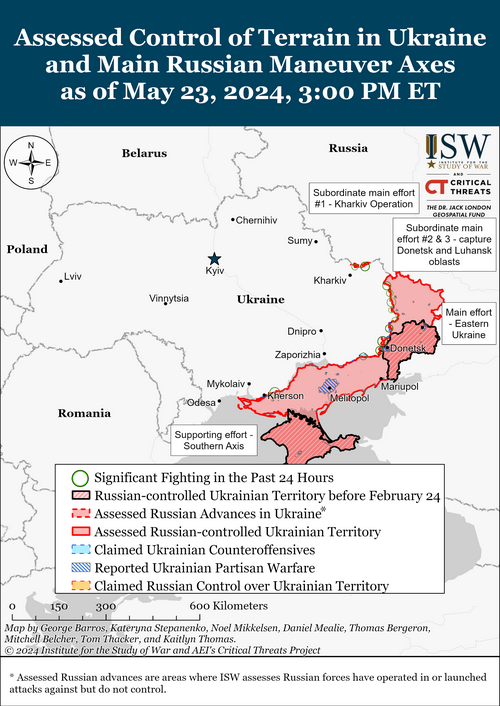
From The Institute for the Study of War:
Russian Offensive Campaign Assessment, May 23, 2024
Grace Mappes, Nicole Wolkov, Riley Bailey, Angelica Evans, and Frederick W. Kagan
May 23, 2024, 7pm ET
Click here to see ISW’s interactive map of the Russian invasion of Ukraine. This map is updated daily alongside the static maps present in this report.
Click here to see ISW’s 3D control of terrain topographic map of Ukraine. Use of a computer (not a mobile device) is strongly recommended for using this data-heavy tool.
Click here to access ISW’s archive of interactive time-lapse maps of the Russian invasion of Ukraine. These maps complement the static control-of-terrain map that ISW produces daily by showing a dynamic frontline. ISW will update this time-lapse map archive monthly.
Note: The data cut-off for this product was 1:00pm ET on May 23. ISW will cover subsequent reports in the May 24 Russian Offensive Campaign Assessment.
The Kremlin is pursuing a concerted effort to remove senior Russian defense officials and has likely expanded this effort to senior officers commanding Russian combat operations in Ukraine. The Russian Investigative Committee announced on May 23 the arrests of Russian Deputy Chief of the General Staff and Head of its Main Communications Directorate Lieutenant General Vadim Shamarin and Head of the Russian Ministry of Defense’s (MoD) Department for State Procurement, Vladimir Verteletsky.[1] Shamarin is accused of accepting a bribe of at least 36 million rubles (about $392,000), and two defendants in the Russian telecommunications industry have agreed to testify against him.[2] Verteletsky is accused of corruption and accepting a large bribe with total damages of 70 million rubles (about $763,000).[3] Five senior Russian MoD officials and former military commanders have been arrested on corruption charges since the arrest of Russian Deputy Defense Minister Timur Ivanov on April 24, and a Russian insider source previously claimed that six more MoD officials plan to resign following former Russian Defense Minister Sergei Shoigu’s removal from the MoD.[4] The Kremlin is likely using the guise of corruption charges as an excuse to hide the real reasons for ousting specific individuals from the MoD who have fallen from favor, as ISW has recently assessed.[5]
Russian ultranationalist milbloggers also claimed that the Russian MoD dismissed the commander of the 20th Combined Arms Army (Moscow Military District [MMD], formerly Western Military District [WMD]), Lieutenant General Sukhrab Akhmedov.[6] ISW is unable to confirm Akhmedov’s removal, but claims of his removal are notable as this would be the first removal of an officer actively commanding Russian forces in Ukraine as a part of the most recent round of dismissals. The 20th CAA is currently heavily committed to offensive operations in the Lyman direction and failed to achieve significant tactical gains in the area during the Winter-Spring 2024 offensive on the Kharkiv-Luhansk axis.[7] The milbloggers also directly connected Akhmedov’s arrest with significant command issues in Ukraine, referencing their prior complaints about Akhmedov by name for his role in commanding attritional Russian assaults near Vuhledar, Donetsk Oblast in winter 2022–2023 when he commanded the 155th Naval Infantry Brigade or his role in Russian forces suffering significant casualties due to a Ukrainian rear area strike in summer 2023.[8]
Official Kremlin statements and milblogger speculation about the arrests and command changes signal that more senior officers could face removal. Russian state newswire TASS cited Russian law enforcement on May 23 as saying there will be continued investigations in connection with Shamarin’s arrest.[9] Some Russian milbloggers and insider sources have alleged that some of the arrested officials have ties to Chief of the General Staff Army General Valery Gerasimov but have largely not gone so far as to claim that Gerasimov himself will be removed.[10] Peskov oddly stated on May 13 that “no changes are foreseen yet” when specifically asked about Gerasimov’s position, however, suggesting that Gerasimov’s tenure over the longer term is not assured.[11] Kremlin Spokesperson Dmitry Peskov notably denied on May 23 that there is a “campaign” against Russian MoD officials, instead asserting that the MoD arrests are part of a consistent fight against corruption.[12] Peskov has previously deflected reporters’ questions about the Russian MoD, and his decision to answer questions about the MoD’s command changes and arrests indicates that the Kremlin may want its support of these purges.[13] Peskov’s claim that the removals are part of a consistent effort are difficult to square with the sudden flurry of dismissals and arrests at an anomalous rate and with high publicity.
Russian milbloggers largely celebrated the arrests of Russian MoD officials they have claimed were inept and speculated about possible additional removals of senior commanders and officials. Russian ultranationalist milbloggers celebrated the arrests of Shamarin and Verteletsky and the alleged removal of Akhmedov and have offered criticisms of MoD officials and military officers more vocally than they had been doing before the start of the arrests in late April.[14] The milbloggers began speculating about which officials and commanders could be removed or charged next. Some named a deputy defense minister as likely next to face investigation and pointed to supposed connections between arrested or dismissed individuals and remaining MoD and military officials, presumably to indicate future possible targets.[15] Many milbloggers vaguely claimed that Russian authorities are not done with their investigations and detentions of these officials and celebrated the arrests as the start of an effort to bring corrupt officials to justice under new Defense Minister Andrei Belousov.[16] The Kremlin is likely allowing these criticisms because they are specifically directed against individuals the MoD is targeting, thereby supporting Belousov’s image as the one who will solve issues within the MoD in a way that Shoigu has not. The Kremlin also benefits from allowing the milbloggers to emphasize that no Russian defense or military official is safe from the consequences of falling from Putin’s favor. The Kremlin is likely attempting to secure the loyalty of the milbloggers who have long argued for significant changes in the Russian MoD and military command by allowing them to criticize the ousted individuals after months of active censorship and self-censorship as long as the criticism advances larger Kremlin objectives.
Russian border guards removed buoys in Estonian waters of the Narva River, which demarcates the Estonian-Russian international border, likely to set conditions to further question maritime borders and test NATO resolve. The Estonian Police and Border Guard Board reported on May 23 that on the night of May 22 to 23 Russian border guards removed 24 buoys used to mark shipping routes in Estonian waters in the Narva River, which demarcates the international border between Estonia and Russia.[17] The Estonian Eastern Prefecture Border Guard Bureau Head Eerik Purgel stated that Estonia had placed the first 50 of a planned 250 buoys on May 13 in accordance with a 2022 Estonian-Russian agreement made prior to Russia’s full-scale invasion of Ukraine.[18] Purgel reported that Russia announced that it did not agree with the locations of about half of the planned placements of the buoys earlier in 2024. The Estonian Ministry of Foreign Affairs (MFA) stated that Russia’s removal of the buoys “fits well within the broader pattern of Russia’s provocative behavior” and stated that Estonia would treat the event as a “provocative border incident.”[19] The Estonian MFA demanded an explanation from Russian border and diplomatic officials and the buoys’ immediate return. Estonian Prime Minister Kaja Kallas stated that “Russia uses border issues as a means to create fear and anxiety.”[20] The Russian Ministry of Defense (MoD) proposed on May 21 that the Russian government reassess its maritime borders in the Baltic Sea, and Kremlin Spokesperson Dmitry Peskov called the Russian MoD’s proposal “appropriate steps” to “ensure [Russian] security” in response to the escalation of tensions and the increased level of confrontation in the Baltic region.[21] Russian border guards are likely attempting to create contention along the international border between Russia and a NATO member country to gauge NATO reactions to future Russian efforts to challenge established delimitations.
Select US officials are reportedly pressing for a reconsideration of the White House’s current policy prohibiting Ukraine from using US-provided weapons to strike within Russia. The New York Times (NYT) reported on May 22 that US Secretary of State Antony Blinken is urging US President Joe Biden to lift restrictions on the Ukrainian use of American weapons for strikes within Russia but noted that the proposal is in a formative stage.[22] NYT reported that two US officials stated that it is still unclear how many people within the Biden administration support the measure and added that the proposal’s proponents have yet to formally present it to Biden.[23] ISW assesses that Western limitations on Ukraine’s ability to strike military targets in Russia have created a sanctuary in Russia’s border areas from which Russian aircraft can conduct glide bomb and missile strikes against Ukrainian positions and settlements and where Russian forces and equipment can freely assemble before entering combat.[24]
Polish Foreign Ministry Spokesperson Pawel Wronski stated on May 23 that Poland is considering using its air defense to protect Ukrainian airspace against Russian strikes.[25] Wronski stated that Poland is considering protecting unspecified airspace along the Ukrainian-Polish border and acknowledged that Ukrainian officials have submitted a request to Poland on the matter.[26] Wronski stated that Poland has yet to make any decisions on the policy and that international law and technical specialist should review it.[27] Russian forces have targeted Ukrainian energy and gas infrastructure in western Ukraine in recent months, including in Lviv Oblast, which borders Poland.[28]
Ukraine’s Main Military Intelligence Directorate (GUR) conducted a series of drone strikes against Russian defense industrial facilities in the Republic of Tatarstan on May 23. Sources in Ukrainian special services told Ukrainian outlet Suspilne that the GUR’s drones attacked Russian defense industrial facilities in Kazan and Nizhnekamsk, which is notably just south of the Shahed-136/131 drone production facility in Tatarstan’s Alabuga Special Economic Zone (SEZ).[29] Suspilne and Russian media outlets reported that Russian officials evacuated employees from the Nizhnekamsk Thermal Power Plant, Teneko oil refinery, Taif-Nk oil refinery, Nizhnekamskneftekhim petrochemical facility, and Nizhnekamskshina tire production facility in Nizhnekamsk and the Kazanorgsintez chemical plant in Kazan.[30] Yelabuga City Mayor Rustem Nuriyev stated that Russian air defenses destroyed a Ukrainian drone near the city and denied that the strikes caused any damage in the area.[31] Footage published on May 23 purportedly shows Russian air defenses destroying at least one Ukrainian drone near Nizhnekamsk.[32] Ukrainian forces conducted a long-range strike against Russian defense industrial and oil refining infrastructure in the Alabuga SEZ on April 2, and ISW assessed that the April 2 strike represented a significant inflection in Ukraine’s demonstrated ability to conduct long-range strikes far into the Russian rear.[33]
Iranian leaders have used the occasion of President Ebrahim Raisi’s funeral events to emphasize close ties with Armenia even as tensions between Yerevan and Moscow continue to increase. NOTE: A version of this text appears in ISW-CTP’s May 23 Iran Update. Mokhber met with Armenian Prime Minister Nikol Pashinyan, Egyptian Foreign Affairs Minister Sameh Shoukry, and Tajikistani President Emomali Rahmon on May 22.[34] Mokhber emphasized that Iran will continue its policy of “expanding relations and cooperation” with neighboring countries during his meeting with Pashinyan.[35] Mokhber added that Iran will continue to adhere to its “commitments and agreements” with Armenia. Pashinyan also met with Iranian Supreme Leader Ali Khamenei on May 22.[36] It is notable that Khamenei and Mokhber met with Pashinyan amid his deteriorating relations with Russia. Pashinyan’s meetings with Khamenei and Mokhber come shortly after he indirectly accused Russia of helping Azerbaijan to prepare for the 2020 Nagorno-Karabakh War.[37]
It is also notable that the Azerbaijani prime minister and foreign affairs minister, who both traveled to Iran to attend Ebrahim Raisi’s funeral, have not yet met with senior Iranian officials, such as Khamenei and Mokhber, on the sidelines of the funeral.[38] Raisi inaugurated a dam on the Iran-Azerbaijan border with Azerbaijani President Ilham Aliyev shortly before his death on May 19.[39] Iranian media highlighted on May 22 that Aliyev, along with the presidents of Russia, Syria, Turkey, and Venezuela, did not attend Raisi’s funeral.[40]
Key Takeaways:
- The Kremlin is pursuing a concerted effort to remove senior Russian defense officials and has likely expanded this effort to senior officers commanding Russian combat operations in Ukraine.
- Russian border guards removed buoys in Estonian waters of the Narva River, which demarcates the Estonian-Russian international border, likely to set conditions to further question maritime borders and test NATO resolve.
- Select US officials are reportedly pressing for a reconsideration of the White House’s current policy prohibiting Ukraine from using US-provided weapons to strike within Russia.
- Polish Foreign Ministry Spokesperson Pawel Wronski stated on May 23 that Poland is considering using its air defense to protect Ukrainian airspace against Russian strikes.
- Ukraine’s Main Military Intelligence Directorate (GUR) conducted a series of drone strikes against Russian defense industrial facilities in the Republic of Tatarstan on May 23.
- Iranian leaders have used the occasion of President Ebrahim Raisi’s funeral events to emphasize close ties with Armenia even as tensions between Yerevan and Moscow continue to increase.
- Ukrainian forces advanced near Lukyantsi and Kreminna, and Russian forces advanced near Berestove, Chasiv Yar, Avdiivka, Donetsk City, and Velyka Novosilka.
- The Russian Ministry of Defense (MoD) proposed applying regular military punishments to volunteers, likely as part of the MoD’s continued formalization efforts.
Go here to read the rest. Why is Putin doing his purge of Russian Brass. My guess is that Putin would like to mount an all out war winning offensive this year and he is getting rid of Generals and defense officials who have told him that the Russians lack the forces to do that. We shall see.

