
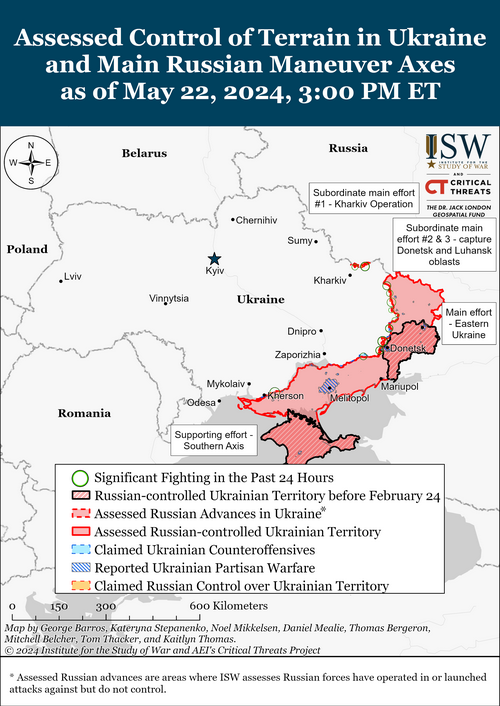
From The Institute for the Study of War:
Russian Offensive Campaign Assessment, May 22, 2024
Kateryna Stepanenko, Angelica Evans, Riley Bailey, Nicole Wolkov, and Frederick W. Kagan
May 22, 2024, 8:40pm ET
Click here to see ISW’s interactive map of the Russian invasion of Ukraine. This map is updated daily alongside the static maps present in this report.
Click here to see ISW’s 3D control of terrain topographic map of Ukraine. Use of a computer (not a mobile device) is strongly recommended for using this data-heavy tool.
Click here to access ISW’s archive of interactive time-lapse maps of the Russian invasion of Ukraine. These maps complement the static control-of-terrain map that ISW produces daily by showing a dynamic frontline. ISW will update this time-lapse map archive monthly.
Note: The data cut-off for this product was 2:00pm ET on May 22. ISW will cover subsequent reports in the May 23 Russian Offensive Campaign Assessment.
The Russian Ministry of Defense (MoD) proposed on May 21 that the Russian government reassess Russia’s maritime borders in the Baltic Sea so that these borders “correspond to the modern geographical situation.”[1] The Russian MoD produced a since-deleted document, which appeared on the Russian government’s legal portal on May 21, proposing that the Russian government should reassess the 1985 maritime borders in the Gulf of Finland because these borders were based on outdated “small-scale nautical navigation maps” developed in the mid-20th century.[2] The document proposed to partially recognize the 1985 resolution as “defunct.” The document suggested that the Russian government should adjust the maritime border coordinates in the Gulf of Finland in the zone of Jähi, Sommers, Gogland, Rodsher, Malyy Tyuters, and Vigrund islands and near the northern delta of the Narva River. The document also proposed that the Russian government revise the area of the Curonian Spit, Cape Taran, a cape south of Cape Taran, and the Vistula Spit in the Baltic Sea. Sommers, Gogland, Rodsher, Malyy Tyuters, and Vigrund island are under Russian control, while Russia and Finland split control over the Jähi island. The northern delta of the Narva River is located between Russia and Estonia, while the Curonian Spit leads to the international border between Russia and Lithuania. The Vistula Spit (also known as the Baltic Spit in Russia) is split between Kaliningrad Oblast, Russia and Poland, and Cape Taran is just northwest of Kaliningrad City. The document stated that these proposed changes would establish a system of baselines for maritime borders on the southern part of the Russian islands in the eastern part of Gulf of Finland as well as in the areas of Baltiysk and Zelenogradsk, both in Kaliningrad Oblast. The document also noted that these changes will allow Russia to use corresponding water areas as Russian internal sea waters, and that the line of the Russian state border will shift due to the changes in the position of the external border of the territorial sea.

Kremlin and Russian MoD officials denied on May 22 that Russia is planning to change the Russian maritime border, but invertedly implied that the Russian government is considering undertaking some “security” measures in the Baltic Sea. Russian state news agencies Ria Novosti and TASS published statements from unnamed military-diplomatic sources, who claimed that “Russia did not have and does not have any intentions of revising the state border line, economic zone, and continental shelf in the Baltic [region].”[3] Kremlin Spokesperson Dmitry Peskov said that the Russian MoD’s proposal is not politically motivated, despite the fact that the “political situation has changed significantly” since 1985.[4] Peskov added that the escalation of tensions and the increased level of confrontation in the Baltic region “requires appropriate steps” from relevant Russian agencies to “ensure [Russian] security.” Russian officials did not explain why the MoD proposal was removed from the government’s legal portal.
Western officials noted that Russia may be reassessing the basis for maritime borders in order to revise maritime zones in the Baltic Sea.[5] Finnish Foreign Minister Elina Valtonen stated on May 22 that the Finnish Foreign Ministry (MFA) is reviewing the reports about Russia’s reassessment and that Finland expects Russia to act according to the UN Convention of the Law of the Sea.[6] Finnish Prime Minister stated that Russia’s review of maritime borders will likely be routine and that Finland is not worried about the reassessment.[7] Lithuanian Foreign Minister Gabrielius Landsbergis announced that Lithuania summoned the Russian charge d’affaires in connection with the reassessment.[8] The Lithuanian MFA told Politico that Lithuania sees Russia’s actions as “deliberate, targeted, escalatory provocations to intimidate neighboring countries and their societies.”[9] The Lithuanian MFA added that the Russian MoD’s proposal is “further proof that Russia’s aggressive and revisionist policy is a threat to the security of neighboring countries and Europe as a whole.” Swedish Commander-in-Chief Mikael Byden expressed concern about Russian ambitions in the Baltic Sea and warned that Russian President Vladimir Putin aims to control the Baltic Sea and that Putin “has his eyes” on the island of Gotland.[10] Byden did not rule out the possibility that Russia is already using oil tankers to conduct reconnaissance and sabotage in the Baltic Sea and near Gotland.[11]
The Kremlin appears to be developing a system to legalize the status of Russia’s so-called “compatriots abroad,” likely as part of its efforts to set information conditions to justify further aggression and hybrid operations abroad as “protecting” Russia’s compatriots. Russian Federal Agency for the Commonwealth of Independent States (CIS), Compatriots Living Abroad, and International Humanitarian Cooperation (Rossotrudnichestvo) General Director Yevgeny Primakov stated during an interview with Kremlin newswire TASS published on May 22 that Rossotrudnichestvo is developing an “Electronic Card of Compatriots” program that will allow Russia’s compatriots abroad to access unspecified government services, visit and work in Russia, and even apply for Russian citizenship in the future.[12] Primakov stated that Russia is preparing to launch a pilot version of the program in several unspecified neighboring countries and may begin issuing the first cards by the end of 2024. Primakov stated that Russia’s compatriots can provide their personal identifiable information through an online application in exchange for a card and access to these various services, which will presumably be available through an unspecified online platform. Primakov noted that while some of Russia’s compatriots abroad do not have Russian citizenship and are “skeptical” of Russia’s policies, they are still compatriots in “one way or another” and that this program will help compatriots and their children maintain ties with Russia. Primakov estimated that Russia has between 20 and 40 million compatriots abroad, although it is unclear what definition of “compatriot abroad” Primakov is using. Primakov also emphasized the importance of Russia’s educational and cultural exchange programs with students from Armenia, Kazakhstan, Kyrgyzstan, and other countries and noted that the Russian government has been increasing the number of foreign students allowed to study in Russia over the past several years. Primakov stated that Russia has set a goal of having 500,000 foreign students studying in Russia every year by 2030. Primakov noted that Rossotrudnichestvo is having issues operating in the US, United Kingdom (UK), Canada, and other Western countries due to “unfriendly” Western policies and absurdly claimed that Russian Houses (Russkyi Dom) in Europe “do not engage in political propaganda or anything else” and only conduct “cultural activities.” Moldovan and Ukrainian officials have previously warned that Russian officials use Russkyi Dom to promote Russian propaganda and conduct “subversive work” abroad.[13]
Rossotrudnichestvo has been working on the “Electronic Card of Compatriots” project since at least 2021 but has yet to publicly launch the program, and Primakov stated in June 2023 that Rossotrudnichestvo plans to open “certification centers” in Russkyi Dom centers throughout the world where compatriots can verify their identity as part of the application process.[14] The Russian Orthodox Church Moscow Patriarchate (ROC MP), a Kremlin-controlled organization and a known tool within the Russian hybrid warfare toolkit, issued a series of recommendations during the World Russian People’s Council on March 27 and 28, which included a call for Russia to prioritize the mass repatriation of “compatriots” to Russia, and the “Electronic Card of Compatriots” program could be a viable pathway for Russia to pursue this recommendation.[15] Russia’s compatriots abroad — whom Russian President Vladimir Putin has previously defined as anyone with historical, cultural, or linguistic ties to Russia — are a key aspect of the Kremlin’s Russkyi Mir (Russian World) narrative, which the Kremlin intends to use to justify future Russian aggression under the guise of “protecting” Russian compatriots.[16] The Russian government previously eased language and ancestry requirements for compatriots interested in moving to Russia and may be attempting to further broaden its vague definition of a compatriot to encompass as many people as possible.[17]
United Kingdom (UK) Defense Minister Grant Shapps stated on May 22 that US and UK intelligence have evidence that the People’s Republic of China (PRC) “is now or will be” providing lethal military assistance to Russia, a statement that US National Security Advisor Jake Sullivan questioned.[18] Shapps stated that this evidence is a “significant development” as the PRC has previously presented itself as a “moderating influence” but did not provide further information about the supposed intelligence. Sullivan stated during a press conference that he has previously warned that the PRC may supply Russia with lethal military assistance but that the US has “not seen that to date.”[19] Sullivan stated that he will speak with his British counterparts to ensure that the US and UK have a “common operating picture” and to clarify Shapps’ comment.
Western officials warned that Russian intelligence services intend to increase sabotage activities and other hybrid operations against NATO member countries. Norway’s Police Security Service (PST) and the Norwegian Intelligence Service (NIS) warned on May 22 that there is an increased threat of Russian sabotage against Norwegian arms supplies and other Norwegian organizations involved in the delivery of military materiel to Ukraine.[20] PST Counterintelligence Head Inger Haugland stated that the PST has warned Norwegian arms suppliers to be on high alert and previously warned that Russian actors were planning acts of sabotage in western Norway, where Norwegian naval bases and oil and gas infrastructure are located.[21] Polish Prime Minister Donald Tusk warned on May 20 that Polish authorities have recently arrested and charged nine suspects for engaging in acts of sabotage in Poland on behalf of Russian security services.[22] Haugland stated that Russian security services have used non-Russian nationals to conduct sabotage in Poland, Germany, and the United Kingdom in order to have deniability.[23] Tusk also warned on May 21 that Russian actors plan to illegally smuggle thousands of migrants from Africa to Europe and that more than 90 percent of those recently apprehended illegally entering Poland have had Russian visas in their passports.[24] Russian officials recently attempted to create an artificial migrant crisis on the Finnish border in late 2023 in an effort to destabilize NATO and the European Union (EU).[25] Russian security services are likely intensifying sabotage operations in European countries to disrupt the arrival of resumed US security assistance to Ukraine and will likely continue hybrid operations aimed at fomenting discord in Europe ahead of European Parliament elections scheduled for early June 2024.
US Space Command reported on May 21 that Russia recently launched an anti-satellite weapon, the most recent report that Russia intends to field disruptive anti-satellite capabilities.[26] US Space Command reported that Russia launched the COSMOS 2576 satellite on May 16 and that US intelligence assesses that it is a counterspace weapon presumably capable of attacking other satellites in low Earth orbit.[27] Pentagon Spokesperson Brigadier General Patrick Ryder added that Russia deployed the COSMOS 2576 satellite into the same orbit as a US government satellite.[28] Russia reportedly launched a separate satellite as part of its program to develop a nuclear anti-satellite weapon in early February 2022.[29] Russia reportedly has yet to field nuclear components of the nuclear anti-satellite weapon and that weapon is likely not yet operational, although the most recent anti-satellite weapon likely is.[30] Russian efforts to field anti-satellite capabilities aimed at disrupting US and partner satellites likely aim to support preparations for a future confrontation with NATO.[31]
Armenian Prime Minister Nikol Pashinyan indirectly accused Russia and directly accused Belarus of helping Azerbaijan to prepare for the 2020 Nagorno-Karabakh War, against the backdrop of deteriorating Armenian-Russian relations. Belarusian President Alexander Lukashenko stated that he and Azerbaijani President Ilham Aliyev conversed before the 2020 Nagorno-Karabakh War and concluded that Azerbaijan could be victorious during Lukashenko’s May 16-17 state visit to Azerbaijan.[32] Lukashenko also visited Fizuli and Shusha, two settlements that Azerbaijani forces took control of in the 2020 Nagorno-Karabakh War. Pashinyan responded to Lukashenko’s statement at a question-and-answer session between the Armenian National Assembly and the Armenian government by stating that Lukashenko said aloud “what he has been trying to metaphorically say to Armenia for four years.”[33] Pashinyan added that he knows of at least two Collective Security Treaty Organization (CSTO) member countries that “participated in preparations for the war [in 2020]” and claimed that Azerbaijan’s objective in the war was to destroy the “independent state of Armenia.”[34] Pashinyan’s implication that Russia helped Azerbaijan prepare for the 2020 Nagorno-Karabakh War, and by extension, supported Azerbaijan’s objective of destroying Armenia, is part of Pashinyan’s continued criticisms of Russian-Armenian relations and efforts to distance Armenia from political and security relations with Russia.
Pashinyan met with Iranian Supreme Leader Ali Khamenei and Interim President Mohammad Mokhber on May 22.[35] Pashinyan’s meeting with Khamenei and Mokhber indicates that Iran may intend to pursue positive relations with Armenia amid Armenia’s souring relations with Russia.
Key Takeaways:
- The Russian Ministry of Defense (MoD) proposed on May 21 that the Russian government reassess Russia’s maritime borders in the Baltic Sea so that these borders “correspond to the modern geographical situation.”
- Kremlin and Russian MoD officials denied on May 22 that Russia is planning to change the Russian maritime border, but invertedly implied that the Russian government is considering undertaking some “security” measures in the Baltic Sea.
- Western officials noted that Russia may be reassessing the basis for maritime borders in order to revise maritime zones in the Baltic Sea.
- The Kremlin appears to be developing a system to legalize the status of Russia’s so-called “compatriots abroad,” likely as part of its efforts to set information conditions to justify further aggression and hybrid operations abroad as “protecting” Russia’s compatriots.
- United Kingdom (UK) Defense Minister Grant Shapps stated on May 22 that US and UK intelligence have evidence that the People’s Republic of China (PRC) “is now or will be” providing lethal military assistance to Russia, a statement that US National Security Advisor Jake Sullivan questioned.
- Western officials warned that Russian intelligence services intend to increase sabotage activities and other hybrid operations against NATO member countries.
- US Space Command reported on May 21 that Russia recently launched an anti-satellite weapon, the most recent report that Russia intends to field disruptive anti-satellite capabilities.
- Armenian Prime Minister Nikol Pashinyan indirectly accused Russia and directly accused Belarus of helping Azerbaijan to prepare for the 2020 Nagorno-Karabakh War, against the backdrop of deteriorating Armenian-Russian relations.
- Ukrainian forces recently recaptured territory near Vovchansk and Chasiv Yar, and Russian forces recently marginally advanced near Vovchansk, Avdiivka, Donetsk City, and Velyka Novosilka.
- Russian courts reportedly began forcibly hospitalizing Russians charged with political crimes such as spreading “fake” information about the Russian military, in psychiatric hospitals.
Placing dissidents in psych wards was a common practice in the old Soviet Union, the state that Putin wishes to revive in all but name.

