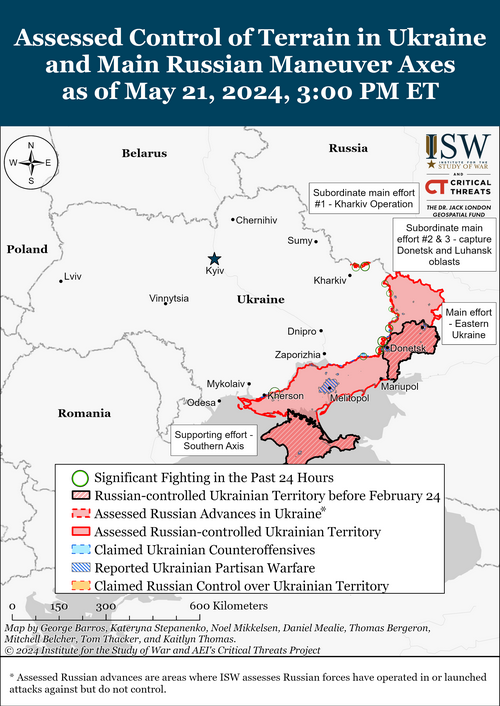
From The Institute for the Study of War:
Russian Offensive Campaign Assessment, May 21, 2024
Christina Harward, Grace Mappes, Nicole Wolkov, Kateryna Stepanenko, and Frederick W. Kagan
May 21, 2024, 9:15pm ET
Click here to see ISW’s interactive map of the Russian invasion of Ukraine. This map is updated daily alongside the static maps present in this report.
Click here to see ISW’s 3D control of terrain topographic map of Ukraine. Use of a computer (not a mobile device) is strongly recommended for using this data-heavy tool.
Click here to access ISW’s archive of interactive time-lapse maps of the Russian invasion of Ukraine. These maps complement the static control-of-terrain map that ISW produces daily by showing a dynamic frontline. ISW will update this time-lapse map archive monthly.
Note: The data cut-off for this product was 2:30pm ET on May 21. ISW will cover subsequent reports in the May 22 Russian Offensive Campaign Assessment.
The Kremlin continues to time its nuclear saber-rattling to coincide with major policy discussions in the West as part of a Kremlin reflexive control campaign to influence Western decision-makers. The Russian Ministry of Defense (MoD) claimed on May 21 that missile elements of the Southern Military District (SMD) began the first stage of non-strategic (tactical) nuclear weapons exercises.[1] The Russian MoD claimed that Russian Aerospace Forces will also exercise with Iskander ballistic missiles and Kinzhal aeroballistic missiles. The Russian MoD announced the preparations for these exercises on May 6.[2] A prominent Kremlin-awarded milblogger explicitly tied Russian tactical nuclear weapons exercises to Kremlin efforts to influence Western decision-making — particularly targeting the recent discussions about the restrictions on Ukraine’s use of Western-provided weapons to strike military targets in Russia — echoing ISW’s assessment that Russia’s tactical nuclear weapons tests are part of a Kremlin reflexive control campaign that often uses nuclear saber-rattling to influence Western decision-makers to engage in self-deterrence.[3] Reflexive control is a key element of Russia’s hybrid warfare toolkit — it is a tactic that relies on shaping an adversary with targeted rhetoric and information operations in such a way that the adversary voluntarily takes actions that are advantageous to Russia.[4] Ukrainian President Volodymyr Zelensky reiterated to the New York Times (NYT) on May 20 that Russia currently enjoys a sanctuary in Russian territory from which Russian forces can conduct missile and glide bomb strikes against Ukraine and launch offensive operations with forces amassed in the international border area, as is the case with the ongoing limited Russian offensive in northern Kharkiv Oblast.[5] ISW continues to assess that US and Western policies limiting Ukraine’s ability to strike military targets in Russia are severely compromising Ukraine’s ability to defend itself against current Russian offensive operations in northern Kharkiv Oblast or any area along the international border where Russian forces may choose to conduct offensive operations in the future.[6]
Ukrainian President Volodymyr Zelensky indicated that the limited Russian offensive in northern Ukraine is achieving its goal of drawing attention away from intense Russian offensive operations in eastern Ukraine. Zelensky stated in an interview with Reuters published on May 20 that the situation in northern Kharkiv Oblast is now stable but that “no one” is paying attention to the wave of Russian offensive operations in Donbas in the Chasiv Yar (Bakhmut), Pokrovsk (Avdiivka), and Kurakhove (west of Donetsk City) directions.[7] Zelensky stated that the situation in northern Kharkiv Oblast has been stable for about a week, which is consistent with the slowing pace of Russian advances in the Lyptsi (north of Kharkiv City) and Vovchansk directions following the initial few days of relatively rapid tactical advances.[8] Russian forces recently intensified their efforts to seize the operationally-significant town of Chasiv Yar west of Bakhmut as the tempo of operations in northern Kharkiv Oblast decreased, highlighting how the northern Kharkiv Oblast effort aims to draw and fix Ukrainian forces and create opportunities for Russian forces elsewhere in the theater.[9] As ISW has consistently reported, Russian forces’ most immediate prospect for operationally-significant gains remains the Chasiv Yar direction, as seizing Chasiv Yar would enable Russian forces to set conditions to attack part of a “fortress belt” of cities forming the backbone of Ukraine’s Donetsk Oblast defenses, and Russian forces likely seek to exploit unfavorable situations for Ukrainian forces defending near Chasiv Yar and Avdiivka before US military assistance arrives at the frontlines at scale.[10] The Ukrainian General Staff has reported for the past week that Russian forces maintain a higher tempo of offensive operations in the Avdiivka direction even as the situation in northern Kharkiv Oblast has stabilized.[11]
The Russian military command reportedly initially planned that Russian forces would quickly make significant advances in northern Kharkiv Oblast, but the limited force grouping deployed to the area suggests that the Russian military command likely changed these plans in the lead up to offensive operations in Kharkiv Oblast. The Economist reported on May 20 that it viewed Russian military plans from an unspecified date about a planned Russian offensive in the Kharkiv City and Vovchansk directions.[12] The Russian plans reportedly called for Russian forces to advance to Borshchova (about 20 kilometers northeast of Kharkiv City and about 16 kilometers from the international border) within 72 hours in order to place Russian forces within tube artillery range of Kharkiv City. The Russian plans also reportedly called for Russian forces to advance to Pechenihy (south of Vovchansk and about 50 kilometers from the international border) in an unspecified time frame. The Russian offensive was reportedly initially planned to begin May 15 to 16, and the Economist stated that it is unknown why Russian forces pushed forward their offensive operations in northern Kharkiv Oblast to May 10 instead. ISW assesses that Russian forces have advanced a maximum of about 10 kilometers deep in the Kharkiv City direction and a maximum of about seven kilometers deep in the Vovchansk direction since May 10. Ukrainian Main Military Intelligence Directorate (GUR) Deputy Chief Major General Vadym Skibitskyi reported on May 2 that Russian forces had concentrated about 35,000 personnel in the international border area and planned to concentrate a total of 50,000 to 70,000 personnel.[13] Russian forces reportedly launched offensive operations in northern Kharkiv Oblast when the Northern Grouping of Forces was understrength and have only committed a limited amount of combat power to the area thus far.[14]
The Russian military command very likely did not expect these limited and understrength forces to be able to reach these objectives, and a Ukrainian reserve officer observed that Russian forces have focused on ”creeping advances” rather than swift drives to an operational depth since their military failures in 2022.[15] The Economist did not specify when the Russian military command created these reported plans, and it is possible that the Russian military command created the plans before it became clear that the Northern Grouping of Forces would not be staffed at its desired end strength or that an earlier or more limited attack was desired. The Russian military command may have also decided to start offensive operations with an understrength grouping to take advantage of Ukrainian manpower and materiel shortages before the arrival of Western aid at scale to the frontline.
Russian authorities recently arrested the former commander of the 58th Combined Arms Army (CAA), Major General Ivan Popov, on fraud charges. Popov was largely responsible for Russian defenses against the Ukrainian Summer 2023 counteroffensive in western Zaporizhia Oblast.[16] The 235th Garrison Military Court reported that authorities arrested Popov on May 17 for large-scale fraud and will hold Popov in detention for two months.[17] Popov’s lawyer stated that authorities investigated the case for eight months before arresting Popov.[18] A prominent Russian milblogger, who alleged that they knew about Popov’s arrest before it was officially announced, claimed that authorities charged Popov with fraud worth 100 million rubles (about $1.1 million) after Popov was involved in the sale of 2,000 tons of metal products intended for the construction of fortifications in the 58th CAA’s area of responsibility in the Zaporizhia direction.[19] The milblogger claimed that an unspecified entrepreneur from Krasnodar Krai and an unspecified high-ranking Southern Military District commander are also defendants in the case. A Russian insider source claimed that the Russian military command summoned Popov to Moscow from Syria at an unspecified date and threateningly urged him to resign but Popov refused.[20] A Kremlin-awarded milblogger claimed that when they tried to clarify information last year about Popov’s removal, unspecified sources did not mention any corruption charges but only discussed Popov’s “military mistakes.”[21] Select Russian milbloggers responded to the news of Popov’s arrest by praising Popov as a competent and respected military commander and expressing hope that authorities would forgive him and allow him to return to military service.[22] Chief of the Russian General Staff Army General Valery Gerasimov fired Popov in July 2023 after Popov voiced his concerns over the need for troop rotations in western Zaporizhia Oblast amid the Ukrainian Summer 2023 counteroffensive.[23] Popov claimed in leaked audio that former Russian Defense Minister Sergei Shoigu dismissed him for expressing persistent grievances about problems in western Zaporizhia Oblast.[24]
The Kremlin is likely using the pattern of recent arrests of high-ranking officials on corruption charges in the Russian MoD to conceal the real reasons for Popov’s punishment almost 10 months after his conflict with the Russian military command and subsequent dismissal from his command position. Russian authorities likely did not want to publicly punish Popov in July 2023 out of fear of a rush of public support for the competent commander. The Kremlin also likely did not want to draw attention to issues in the Russian military command in the aftermath of the June 2023 Wagner Group’s rebellion.[25] Popov’s arrest comes after multiple recent high-profile arrests of MoD officials reportedly close to Shoigu on corruption charges.[26] The Kremlin likely hopes that arresting Popov in the middle of this alleged wide-scale anti-corruption campaign will minimize attention to Popov’s previous insubordination. Popov’s arrest, however, sends a clear signal to Russian military commanders that insubordinate senior officers will face serious punishments eventually and that Russian President Vladimir Putin values loyalty over competence.
Satellite imagery indicates that Ukrainian forces likely damaged the Russian Black Sea Fleet’s (BSF) Tsyklon small missile ship in occupied Sevastopol, Crimea on May 19. Satellite imagery dated May 20 shows a damaged building, a rescue ship, and a floating crane near the port where the Tsyklon was docked on May 17.[27] Ukrainian and Russian sources reported on May 20 that Ukrainian forces struck the Russian Tsyklon Karakhut-class (project 22800) small missile ship in Sevastopol Bay with three US-provided ATACMS missiles on May 19.[28] Ukraine’s Southern Operational Command and Navy Spokesperson Captain Third Rank Dmytro Pletenchuk stated on May 21 that that there are no more Russian Karakurt-class ships in the Black Sea following the Ukrainian strike against the Tsyklon on May 19.[29] Pletenchuk stated that the Tsyklon was the “last missile carrier” in occupied Crimea and that Russian forces have likely moved all remaining BSF missile carriers to basing in Novorossiysk.[30] Pletenchuk stated that the Tsyklon had only been in service for a year and had not yet launched a cruise missile strike. Pletenchuk stated that Russia planned to deploy five Karakurt-class ships in the Black Sea, but that Ukrainian forces previously destroyed the Askold in November 2023, that Russian forces moved the Amur and Tucha from the Black Sea to the Caspian Sea, and that the fifth unnamed ship is still under construction in Taganrog, Krasnodar Krai.[31]
Key Takeaways:
- The Kremlin continues to time its nuclear saber-rattling to coincide with major policy discussions in the West as part of a Kremlin reflexive control campaign to influence Western decision-makers.
- Ukrainian President Volodymyr Zelensky indicated that the limited Russian offensive in northern Ukraine is achieving its goal of drawing attention away from intense Russian offensive operations in eastern Ukraine.
- The Russian military command reportedly initially planned that Russian forces would quickly make significant advances in northern Kharkiv Oblast, but the limited force grouping deployed to the area suggests that the Russian military command likely changed these plans in the lead up to offensive operations in Kharkiv Oblast.
- Russian authorities recently arrested the former commander of the 58th Combined Arms Army (CAA), Major General Ivan Popov, on fraud charges.
- The Kremlin is likely using the pattern of recent arrests of high-ranking officials on corruption charges in the Russian MoD to conceal the real reasons for Popov’s punishment almost 10 months after his conflict with the Russian military command and subsequent dismissal from his command position.
- Satellite imagery indicates that Ukrainian forces likely damaged the Russian Black Sea Fleet’s (BSF) Tsyklon small missile ship in occupied Sevastopol, Crimea on May 19.
- Russian forces recently made confirmed advances near Vovchansk, Kreminna, Chasiv Yar, and Donetsk City.
- A Russian milblogger claimed that frequent Ukrainian drone strikes against Russian vehicles that lack electronic warfare (EW) systems along the frontline have created an “urgent” shortage of off-road vehicles.
- Russian authorities continue to illegally and forcibly deport Ukrainian citizens, including children, to Russia and to forcibly remove Ukrainian citizens deeper into occupied Ukraine.
Go here to read the rest. The frequent arrests of Russian brass is rather like Stalin’s purges on a very small scale by Putin. One of the occupational hazards of being a dictator is increasing paranoia.
https://www.youtube.com/watch?v=bo_gCfzt9Yc