
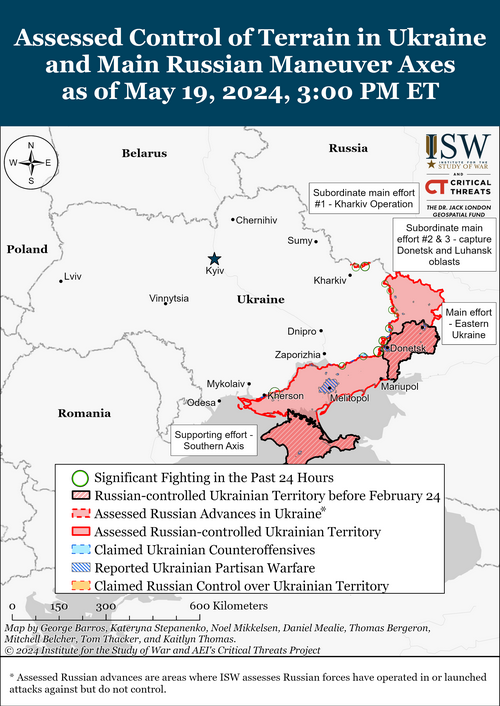
From The Institute for the Study of War:
Russian Offensive Campaign Assessment, May 19, 2024
Nicole Wolkov, Christina Harward, Angelica Evans, Riley Bailey, and Frederick W. Kagan
May 19, 2024, 5:15pm ET
Click here to see ISW’s interactive map of the Russian invasion of Ukraine. This map is updated daily alongside the static maps present in this report.
Click here to see ISW’s 3D control of terrain topographic map of Ukraine. Use of a computer (not a mobile device) is strongly recommended for using this data-heavy tool.
Click here to access ISW’s archive of interactive time-lapse maps of the Russian invasion of Ukraine. These maps complement the static control-of-terrain map that ISW produces daily by showing a dynamic frontline. ISW will update this time-lapse map archive monthly.
Note: The data cut-off for this product was 12:15pm ET on May 19. ISW will cover subsequent reports in the May 20 Russian Offensive Campaign Assessment.
Ukrainian forces reportedly conducted successful drone strikes against Russian military infrastructure and oil refineries in occupied Crimea, Krasnodar Krai, and Leningrad Oblast on the night of May 18 to 19. The Russian Ministry of Defense (MoD) claimed that Russian forces destroyed nine ATACMS missiles over occupied Crimea.[1] A prominent Kremlin-affiliated Russian milblogger claimed that Ukrainian forces launched 12 ATACMS against Sevastopol Bay — nine of which Russian forces shot down near Sevastopol and Belbek airfield, and three of which struck a vessel in Sevastopol port.[2] Footage published on May 19 purportedly shows Russian forces attempting to repel Ukrainian drones over the port in Novorossiysk, Krasnodar Krai.[3] Krasnodar Krai Governor Venyamin Kondratyev claimed that Russian air defense suppressed over 10 drones near Novorossiysk and that falling debris caused fires.[4] Sources in Ukrainian intelligence told Ukrainian outlet Suspilne that Ukraine’s Security Service (SBU) and Unmanned Systems Forces conducted successful drone strikes against the Slavyansk oil refinery in Slavyansk-on-Kuban, Krasnodar Krai and against the Kushchyovskaya airfield in Krasnodar Krai where Russian forces station Su-34, Su-25, Su-27, and MiG-29 aircraft used to conduct strikes in Ukraine.[5] The sources stated that the Ukrainian drone strikes damaged several aircraft at the Kushchyovskaya airfield and several distillation columns at the Slavyansk oil refinery. Slavyanskiy Raion Head Roman Sinyagovsky claimed that six drones fell on the Slavyansk oil refinery, and Krasnodar Krai Operational Headquarters reported that Russian air defense suppressed at least 10 drones over Slavyanskiy and Kushchyovskiy raions.[6] Ukrainian forces previously conducted successful drone strikes against the Kushchyovskaya airfield in April 2024 and the Slavyansk oil refinery in March and April 2024.[7] The Ukrainian General Staff reported that Ukrainian forces also destroyed the Russian Black Sea Fleet’s (BSF) Kovrovets Natya-class minesweeper, although it is unclear if Ukrainian forces destroyed the minesweeper near occupied Sevastopol, Crimea, or Novorossiysk, Krasnodar Krai as the BSF has redeployed the majority of its naval assets to Novorossiysk over the past year.[8] Suspilne also reported on May 19 that its sources within Ukrainian special services stated that Ukraine’s Main Military Intelligence Directorate (GUR) caused explosions at an unspecified number of vertical fuel tanks at the Vyborg oil depot in Leningrad Oblast with three explosive devices.[9] Geolocated footage published on May 18 shows a large fire at the oil depot, although Leningrad Oblast Governor Alexander Drozdenko denied reports that drone strikes caused the explosions and claimed that pyrotechnics caused the explosions near the oil depot.[10]
Russian milbloggers appear to be experimenting with different ways to express critical opinions of the Russian Ministry of Defense (MoD) following the recent appointment of Russian Defense Minister Andrei Belousov. A prominent Russian milblogger posted a photo on May 18 of an undated document allegedly from the Russian MoD’s Head of the Missile and Artillery Weapons Service responding to an appeal about the inaccuracy of Russian artillery.[11] The document claimed that any issues with artillery ammunition are due to Russian servicemen’s improper handling of the rounds and demanded that Russian servicemen follow the Russian Chief of the General Staff’s previously issued order prohibiting military personnel from disassembling and weighing artillery ammunition. The milblogger then described the alleged issues by using general terms as well various code words, such as names of other countries or places from popular science fiction films, that multiple Russian milbloggers have repeatedly used recently to cautiously discuss issues in the Russian Ministry of Defense (MoD).[12] The milblogger claimed that Russian military personnel noticed that artillery systems were performing strangely, subsequently discovered that the amount of gunpowder in the ammunition shells widely varied, and reported the issue to the Russian military command but to no avail. Another Russian milblogger responded and used some of the same code words to criticize the Russian MoD and to express hope that Belousov will make reforms that solve the larger bureaucratic issues in the MoD.[13] A third milblogger, who previously served as a “Storm-Z” unit instructor, however, was direct with his criticisms of the Russian military and claimed that he has previously heard information from Russian servicemen about the inconsistent amounts of gunpowder in some artillery shells.[14] The milblogger claimed that this issue began in Spring 2022 and that the alleged order from the Russian General Staff described in the document indicates that the Russian military leadership has been aware of the issue for some time. The milblogger criticized the Russian military command for not finding a solution and claimed that Russian artillery systems are also suffering from barrel wear (which is very likely given their extremely heavy use).
Founder of the Kremlin-linked Rybar Telegram channel, Mikhail Zvinchuk, whom the Kremlin likely co-opted as part of the Kremlin’s wider efforts to gain control over the Russia information space, gave an uncharacteristically public interview in which he criticized the Russian MoD and directly connected some of the milbloggers’ code words to the Russian MoD on May 18.[15] Although it is unclear if Zvinchuk gave this interview with Kremlin approval or not, the Kremlin’s permittance of criticisms by select prominent Russian milbloggers of the Russian MoD could increase public pressure for reforms, that would, if implemented, assist Russia’s war effort in Ukraine.[16]
Russian Security Council Deputy Chairperson Dmitry Medvedev threatened Russian internet technology and telecommunications company Yandex because its large language model failed to provide responses that cohere with ongoing Russian information operations. Medvedev criticized Yandex’s Alisa voice assistant (ostensibly similar to Amazon’s Alexa) on May 19 for being unable to answer questions about the US law approving the seizure of Russian foreign assets or supposed monuments in Ukraine to Nazi sympathizers.[17] Medvedev asserted that Yandex’s artificial intelligence (AI) is a “coward” for failing to provide his desired answers to these questions and suggested that Yandex may be concerned about offending its Western clients. Medvedev suggested that Yandex’s supposed unwillingness to provide answers to these questions greatly undermines trust in Yandex’s products and could provide grounds for the Russian government to recognize Yandex’s services as “incomplete” and even identify Yandex’s current managers as “foreign agents.” Russian news outlet RBK reported that Russian officials have previously submitted complaints against similar large language models for failing to generate sufficiently patriotic responses.[18] Russian officials will likely continue to struggle with shortcomings of large language models that are well known to others with more experience of those systems as the Kremlin continues efforts to solidify its control over the Russian information space.
A St. Petersburg court ruled that Russian authorities can seize over 700 million euros ($760 million) of assets from three large European banks on May 18 on behalf of a Gazprom subsidiary.[19] The court determined that Russian authorities could seize assets, accounts, property and shares belonging to Deutsche Bank, German Commerzbank, and Italian bank UniCredit after ruling in favor of a suit from Gazprom subsidiary RusChemAlliance.[20] The European banks were among the guarantor lenders under a contract for the construction of a gas processing plant in Russia with German-based engineering company Linde, which involved parties terminated due to Western sanctions following the start of Russia’s full-scale invasion of Ukraine.[21] The court also ruled that Deutsche Bank cannot sell its subsidiary businesses in Russia without the approval of Russian President Vladimir Putin and stated that the measure is necessary to prevent the bank from “alienating its property in Russia.”[22]
Key Takeaways:
- Ukrainian forces reportedly conducted successful drone strikes against Russian military infrastructure and oil refineries in occupied Crimea, Krasnodar Krai, and Leningrad Oblast on the night of May 18 to 19.
- Russian milbloggers appear to be experimenting with different ways to express critical opinions of the Russian Ministry of Defense (MoD) following the recent appointment of Russian Defense Minister Andrei Belousov.
- Russian Security Council Deputy Chairperson Dmitry Medvedev threatened Russian internet technology and telecommunications company Yandex because its large language model failed to provide responses that cohere with ongoing Russian information operations.
- A St. Petersburg court ruled that Russian authorities can seize over 700 million euros ($760 million) of assets from three large European banks on May 18 on behalf of a Gazprom subsidiary.
- Russian forces recently marginally advanced within Vovchansk and near Chasiv Yar and Donetsk City.
Go here to read the rest. The air war continues to heat up.

