
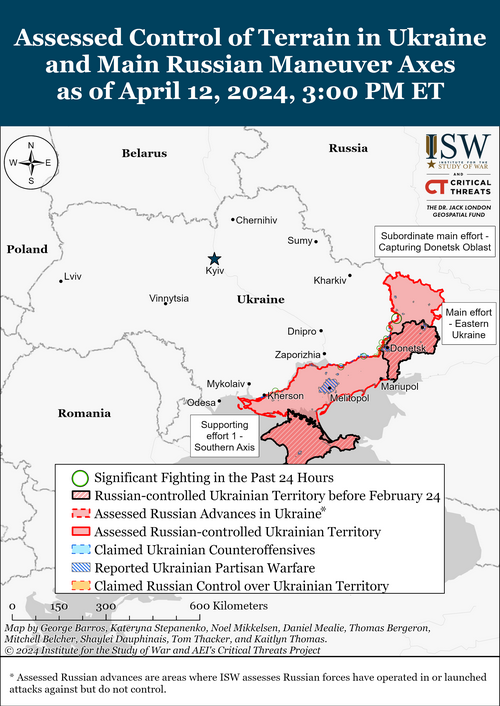
From The Institute for the Study of War:
Russian Offensive Campaign Assessment, April 12, 2024
Angelica Evans, Christina Harward, Grace Mappes, Riley Bailey, and Frederick W. Kagan
April 12, 2024, 5:55pm ET
Click here to see ISW’s interactive map of the Russian invasion of Ukraine. This map is updated daily alongside the static maps present in this report.
Click here to see ISW’s 3D control of terrain topographic map of Ukraine. Use of a computer (not a mobile device) is strongly recommended for using this data-heavy tool.
Click here to access ISW’s archive of interactive time-lapse maps of the Russian invasion of Ukraine. These maps complement the static control-of-terrain map that ISW produces daily by showing a dynamic frontline. ISW will update this time-lapse map archive monthly.
Note: The data cut-off for this product was 12:45pm ET on April 12. ISW will cover subsequent reports in the April 13 Russian Offensive Campaign Assessment.
Russian President Vladimir Putin acknowledged that Russia’s ongoing strike campaign against Ukrainian energy facilities aims in part to devastate the Ukrainian defense industry, confirming ISW’s ongoing assessment that Russian strikes against Ukrainian energy facilities aim to degrade Ukrainian defense industrial capacity. Putin stated during a meeting with Belarusian President Alexander Lukashenko on April 11 that Russian drone and missile strikes against Ukraine’s energy sector are connected to Russia’s goal of “demilitarizing” Ukraine – one of his three stated goals in Ukraine.[1] Putin characterized Russia’s ongoing strikes against Ukrainian energy infrastructure as a “forced” response to recent Ukrainian drone strikes against Russian oil and gas facilities and openly stated that Russian strikes indirectly aim to degrade Ukraine’s defense industrial capacity. The recent Russian strike campaign is degrading Ukraine’s power generation capacity while also exploiting reported Ukrainian air defense missile shortages in a renewed effort to collapse Ukraine’s power grid.[2] Putin likely hopes to prevent Ukraine’s defense industry from developing to the point of near self-sufficiency in the long term as a strong defense industry could put Ukraine in a good position to defend against future Russian aggression and significantly reduce Ukraine’s dependence on Western aid.[3] Significant delays in Western aid, due in part to successful Russian information operations and Western hesitancy, have created an opportunity for Russian offensive operations and Russia’s strike campaign.
ISW continues to assess that the development of Ukraine’s defense industrial base (DIB) over time can allow Ukraine to sustain its defense against Russia and longer-term national security needs with significantly reduced foreign military assistance.[4] Ukrainian officials have expressed their intention to expand Ukraine’s DIB domestically and abroad since the start of Russia’s full-scale invasion, and Ukrainian Defense Minister Rustem Umerov previously identified increased Ukrainian domestic production of weapons and military equipment as a priority for 2024.[5] US State Department Spokesperson Matthew Miller has stated that the short- and medium-term provision of Western air defenses to Ukraine will be a critical element of Ukraine’s ability to stand up its defense industry, which will, in turn, decrease Ukrainian dependence on Western aid and especially US aid to Ukraine in the long term.[6] Ukrainian President Volodymyr Zelensky recently emphasized that Ukraine cannot mitigate the lack of sufficient air defense systems and that only Western-provided air defense systems, namely Patriot systems, allow Ukraine to defend Ukraine against the intensified Russia strike campaign.[7] ISW continues to assess that the US will not need to send large security assistance packages to Ukraine indefinitely if Ukraine can sufficiently expand its defensive industrial capacity, but the West’s provision of air defense systems and missiles to Ukraine is crucial for Ukraine’s ability to defend its energy infrastructure and its developing defense industry against Russian strikes.[8]
Russian forces are domestically producing and fielding a new air-to-surface subsonic cruise missile against Ukraine designated the Kh-69 as part of continued efforts to improve strike packages and penetrate Ukraine’s degraded air defense. Ukrainian media reported on April 11 that Ukrainian law enforcement sources stated that Russian forces destroyed the Trypilska Thermal Power Plant (TPP) in Kyiv Oblast on April 11 with new Kh-69 missiles, which Russian forces had reportedly used in “isolated cases” in 2023 prior to the April 11 strike.[9] Ukrainian Air Force Spokesperson Major Ilya Yevlash confirmed on April 12 that Russian forces used the Kh-69s in the April 11 strike and described the Kh-69 missiles as an improved version of Kh-59 cruise missiles, which Russian forces have frequently used in strike packages against Ukraine in recent weeks.[10] ISW has not previously observed the Russian use of Kh-69 missiles in Ukraine. Russian forces have reportedly launched Kh-69 missiles from 400 kilometers away from their targets, exceeding a previous estimated range of 300 kilometers and the 200-kilometer range of the most recent Kh-59MK2 variant.[11] Russian forces can reportedly launch the missiles from more numerous Su-34 and Su-35 tactical aircraft rather than exclusively from strategic bombers.[12] Yevlash stated that Russian forces are domestically producing the Kh-69 missiles but that their ability to manufacture the missiles depends on their ability to source critical components.[13] While the Russian stockpiles and production capability of these Kh-69 missiles are unclear, Russia is unlikely to be able to produce them at a significantly greater speed or quantity than its other domestically produced missiles. Yevlash noted that Ukrainian forces are still developing methods to counter the Kh-69s but emphasized that Patriot air defense systems would likely be able to intercept them.[14]
The Russian Federal Security Service (FSB) claimed that it prevented a group of Central Asians from perpetrating a terrorist attack against a Russian military facility in occupied Ukraine with Ukraine’s help, likely as part of efforts to set information conditions to portray any future Ukrainian attack on legitimate Russian military targets in occupied Ukraine as “terrorist” attacks. The FSB claimed on April 11 that it detained six citizens of an unspecified Central Asian state for allegedly preparing a Ukrainian-orchestrated terrorist attack on a Russian military facility in occupied Donetsk Oblast.[15] The FSB claimed that the attackers were planning to go to Turkey and then back to Ukraine after carrying out the attack – a narrative that likely attempts to parallel how the Crocus City Hall attackers traveled to Turkey before the March 22 attack.[16] Russia routinely labels Ukrainian strikes against legitimate Russian military targets in occupied Ukraine and within Russia as ”terrorist” attacks.[17]
The FSB also claimed that it prevented a terrorist attack on a synagogue in Moscow on April 10 and that the FSB killed one of the alleged terrorists, a native of an unspecified Central Asian country, during a shootout.[18] The FSB claimed on March 7 that it prevented members of the Islamic State (IS) in Kaluga Oblast from conducting an attack on a Moscow synagogue.[19] The FSB may have not claimed that Ukraine was involved in the attack that the FSB allegedly stopped on April 10 due to the FSB’s prior public statements connecting the previous plans for an attack on a Moscow synagogue to IS. Russian authorities recently conducted counterterrorism operations in the Republic of Kabardino-Balkaria and the Republic of Dagestan, and ISW continues to assess that the increased frequency of counterterrorism operations in Russia is likely due to either Russian law enforcement’s actual heightened fears of another terrorist attack in Russia or is part of efforts to show the Russian public that authorities are taking competent preventative steps following the major law enforcement and intelligence failure that was the Crocus City Hall attack.[20] These counterterrorism activities are also further evidence that Russian authorities actually assess that terrorist threats emanate from Central Asian and Muslim communities instead of Ukraine.[21]
Key Takeaways:
- Russian President Vladimir Putin acknowledged that Russia’s ongoing strike campaign against Ukrainian energy facilities aims in part to devastate the Ukrainian defense industry, confirming ISW’s ongoing assessment that Russian strikes against Ukrainian energy facilities aim to degrade Ukrainian defense industrial capacity.
- ISW continues to assess that the development of Ukraine’s defense industrial base (DIB) over time can allow Ukraine to sustain its defense against Russia and longer-term national security needs with significantly reduced foreign military assistance.
- Russian forces are domestically producing and fielding a new air-to-surface subsonic cruise missile against Ukraine designated the Kh-69 as part of continued efforts to improve strike packages and penetrate Ukraine’s degraded air defense.
- The Russian Federal Security Service (FSB) claimed that it prevented a group of Central Asians from perpetrating a terrorist attack against a Russian military facility in occupied Ukraine with Ukraine’s help, likely as part of efforts to set information conditions to portray any future Ukrainian attack on legitimate Russian military targets in occupied Ukraine as “terrorist” attacks.
- Russian forces recently made confirmed advances near Avdiivka and Donetsk City.
- Russia is reportedly sending about 2,400 Eastern Military District (EMD) military personnel currently in Russia to fight in Ukraine to make up for personnel losses at the front.
- Russian occupation officials continue to expand educational programs that aim to indoctrinate Ukrainian children and erase their Ukrainian identity.
Go here to read the rest. The terrorists are not done with Mother Russia.

