
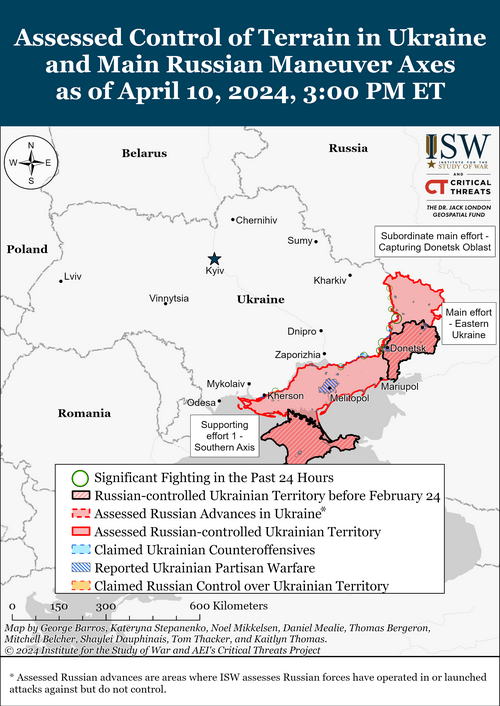
From The Institute for the Study of War:
Russian Offensive Campaign Assessment, April 10, 2024
Nicole Wolkov, Angelica Evans, Grace Mappes, Riley Bailey, and Frederick W. Kagan
April 10, 2024, 7:45pm ET
Click here to see ISW’s interactive map of the Russian invasion of Ukraine. This map is updated daily alongside the static maps present in this report.
Click here to see ISW’s 3D control of terrain topographic map of Ukraine. Use of a computer (not a mobile device) is strongly recommended for using this data-heavy tool.
Click here to access ISW’s archive of interactive time-lapse maps of the Russian invasion of Ukraine. These maps complement the static control-of-terrain map that ISW produces daily by showing a dynamic frontline. ISW will update this time-lapse map archive monthly.
Note: The data cut-off for this product was 1pm ET on April 10. ISW will cover subsequent reports in the April 11 Russian Offensive Campaign Assessment.
The Ukrainian military’s effective use of drones on the battlefield cannot fully mitigate Ukraine’s theater-wide shortage of critical munitions. Ukrainian President Volodymyr Zelensky stated in an interview with German outlet BILD published on April 10 that Ukraine is successfully domestically producing drones, but that drones cannot replace air defense systems, long-range missile systems, or artillery.[1] Ukrainian forces have partially mitigated ongoing artillery ammunition shortages by using first-person view (FPV) drones to blunt Russian infantry and armored vehicle assaults, although artillery systems can deliver much more powerful strikes than loitering munitions and drone-dropped munitions. An unnamed NATO official told Foreign Policy in an article published on April 9 that Ukrainian forces have used FPV drones to “destroy” over two-thirds of the total number of Russian tanks that the Ukrainians have “destroyed” in recent months.[2] Ukrainian FPV drone pilots reportedly target a Russian tank’s ”open hatch, the engine or ammunition stored in the turret.”[3] Ukrainian FPV drones are likely able to temporarily render armored vehicles hors de combat during a combat operation, but current FPV drones with relatively light payloads are unlikely to destroy armored vehicles rendering them irretrievable and irreparable very often. Electronic warfare systems and increased armor on armored vehicles can also make it difficult for FPV drones to strike a specific target location on the vehicle, although technological and tactical competition can create periodic windows of opportunity for offense or defense to gain an advantage.[4] Reuters reported on March 26 that Ukrainian FPV drone pilots acknowledged that they would be unable to hold the frontline without artillery and infantry.[5] Ukrainian forces have managed partially to repel an increased tempo of Russian mechanized assaults in recent weeks despite ammunition shortages.[6] Ukraine’s ability to repel mechanized assaults with FPV drones is a partial mitigation, however, and continued shortages of artillery deprive Ukrainian forces of the ability to destroy armored vehicles rapidly and in large numbers.
US European Command (EUCOM) Commander General Christopher Cavoli warned on April 10 that Russian forces currently have a five-to-one artillery advantage along the frontline – a statement consistent with Ukrainian officials’ reports – but that Russian forces could have a 10-to-1 artillery advantage “in a matter of weeks” if the United States continues to delay the provision of military aid to Ukraine.[7] Zelensky and senior Ukrainian military officials have recently warned that delays in Western military assistance have forced Ukraine to cede the battlefield initiative to Russia and that the Ukrainian military cannot plan a successful counteroffensive or defensive effort without knowing when and what kind of aid Ukraine will receive. ISW continues to assess that delays in Western military assistance have forced the Ukrainian military to husband materiel and that Ukrainian forces must make difficult decisions prioritizing certain aspects of its defense at the cost of lives and lost territory as well as at the expense of contesting the initiative to constrain Russian military capabilities or planning for future counteroffensive operations.[8]
Zelensky stated that there are no mitigations for insufficient air defense systems and indicated that Russian strikes are forcing Ukraine to reallocate already scarce air defense assets to defend Kharkiv City. Zelensky told BILD that drones cannot replace air defenses and that Ukraine needs air defenses to survive.[9] Russian forces have recently intensified their strike campaign against Ukraine, and Ukrainian officials have recently warned that if Russian forces sustain the current high tempo of this campaign, then Ukraine will likely lack the air defense missile stocks necessary to protect Ukrainian cities and critical infrastructure.[10] Zelensky discussed plans with Ukrainian Air Force Commander Lieutenant General Mykola Oleshchuk on April 10 to redeploy Ukrainian air defenses to protect Kharkiv City, against which Russian forces have recently intensified missile, drone, and glide bomb strikes.[11] The Russian strike campaign has pressured Ukraine to prioritize protecting strategic objects, population centers, and energy infrastructure in deep rear areas over the frontline and near rear areas such as Kharkiv City.[12] This further reorganization of Ukrainian air defenses to protect Kharkiv City will presumably draw from Ukraine’s existing arsenal of missiles and launchers, which will stretch Ukraine’s already limited air defense capabilities and provide Russian forces with the opportunity to further exploit weakened air defenses elsewhere. As ISW has recently assessed, degraded and thin Ukrainian air defenses would afford Russian aviation prolonged security to operate on the frontline, significantly increase devastating glide bomb strikes at scale, and possibly even permit routine large-scale Russian aviation operations against near rear Ukrainian logistics and cities.[13]
US emergency efforts to bolster Ukraine’s existing air defense capabilities remain insufficient to protect Ukraine against Russian strikes. The US Department of Defense (DoD) approved the possible sale of equipment worth $138 million on April 9 to repair and modernize Ukraine’s HAWK air defense systems due to Ukraine’s “urgent need” to defend against Russian airstrikes but acknowledged that the possible transfer would “not alter the basic military balance” in Ukraine absent additional aid.[14] Ukrainian Foreign Minister Dmytro Kuleba recently emphasized that Patriots can shoot down Russian ballistic missiles that Ukraine’s Soviet systems cannot, and Zelensky recently stated that Ukraine will need an additional 25 Patriot air defense systems, likely meaning launchers, to extend full air defense coverage to all of Ukraine’s territory.[15] NATO Supreme Allied Commander Europe and US European Command Commander General Christopher Cavoli warned on April 10 that Ukraine will run out of missiles for the launchers it already has “in fairly short order” if the United States does not continue to support Ukraine and stressed that the US failure to provide Ukraine with additional military assistance has generated battlefield effects that favor Russia.[16]
Zelensky warned about the threat of a potential future Russian ground offensive operation targeting Kharkiv City, which would force Ukraine to reallocate some of its already-strained manpower and materiel capabilities away from other currently active and critical sectors of the front. Zelensky told BILD that he cannot rule out the possibility of a major Russian offensive operation on Kharkiv City and noted that Russian President Vladimir Putin has sought to seize Kharkiv City since the beginning of the full-scale invasion because Kharkiv City is a major Ukrainian city and has symbolic meaning for both Russia and Ukraine.[17] Zelensky noted that Ukrainian forces are doing everything possible to prevent Russia from seizing Kharkiv City. Zelensky recently told CBS that Ukrainian forces are also constructing fortifications and defensive positions near Sumy City in response to a reported significant buildup of Russian forces in neighboring Bryansk Oblast.[18] A Russian ground operation against Kharkiv in the very near future is unlikely, but Russian efforts to create strategic reserves and reposition forces in the theater could allow Russian forces to launch an offensive toward the city in the summer.[19]
The threat of a Russian offensive operation targeting Kharkiv or Sumy city appears to be forcing the Ukrainian military to redistribute its limited manpower and materiel to the construction of defensive fortifications in those areas and an active Russian operation to seize these cities would only further exacerbate this dynamic. The Russian military maintains the theater-wide initiative in Ukraine, and Russia’s ability to conduct opportunistic offensive operations in almost any area of the frontline will continue to strain Ukraine’s already stretched resources, regardless of any one operation’s success in actually seizing a targeted city or settlement.[20] The Russian forces are able to allocate significant resources in hopes of achieving operationally significant breakthroughs in frontline areas of their choosing and can exploit areas of the front previously made vulnerable by Ukrainian manpower and materiel transfers. Russian forces are currently concentrating significant resources near Chasiv Yar and Avdiivka and continue to make slow, grinding advances in those areas, largely due to Ukrainian manpower challenges and delays in US and Western aid.[21] Ukrainian forces will likely not be able to contest the theater-wide initiative and more proactively allocate their resources without continuing to address their manpower issues and receiving additional Western aid.
The Ukrainian Verkhovna Rada considered and adopted provisions from Ukraine’s draft mobilization law on April 10 as part of an ongoing effort to increase the sustainability of Ukrainian mobilization over the long term. The Ukrainian Verkhovna Rada National Security and Defense Committee adopted the second reading of the draft mobilization law on April 9 and submitted it to the wider Verkhovna Rada for consideration, which began on April 10.[22] Ukrainian officials reported that the Verkhovna Rada adopted a provision from the law allowing for the mobilization of Ukrainian convicts and a provision amending Ukraine’s criminal code to increase penalties for mobilization evasion.[23] Ukrainian officials reportedly removed an existing provision from the draft law that would have stipulated the end of active military service for mobilized personnel after 36 months of service.[24] Ukrainian Ministry of Defense (MoD) Spokesperson Dmytro Lazutkin stated on April 10 that Ukrainian officials will consider issues regarding the conclusion of military service of individuals and rotations of military personnel in a separate draft law.[25] Ukrainian efforts to establish a more sustainable mobilization apparatus will support the Ukrainian military’s ability to restore and reconstitute existing units and create new units. ISW continues to assess that Western-provided materiel continues to be the greatest deciding factor for the Ukrainian military’s ability to restore and augment its combat power, however.
Russian officials continue to indicate that they are not interested in any meaningful negotiations on the war in Ukraine amid Switzerland’s announcement that it will host a global peace summit on the war on June 15 and 16.[26] Swiss officials stated that Switzerland will send invitations for the summit to representatives of over 100 countries and that the summit will include discussions of various peace proposals, including Ukraine’s Peace Formula and China’s vague 12-point peace plan.[27] The Russian Embassy in Switzerland reiterated previous Russian statements that Russia would reject any invitation to the summit and that any discussions about Ukraine without Russia are pointless.[28] Russian officials have repeatedly falsely blamed Ukraine and the West for the lack of peace negotiations, despite numerous public Russian statements suggesting or explicitly stating that Russia is not interested in good-faith negotiations with Ukraine.[29] The Kremlin continues efforts to destroy Ukrainian statehood and identity and fundamentally weaken NATO and has shown no legitimate indication that it is open to reconsidering these objectives.[30]
Kremlin Spokesperson Dmitry Peskov attempted to downplay tension in Armenian-Russian relations amid Armenia’s continued efforts to distance itself from political and security relations with Russia. Peskov claimed on April 10 that Russian President Vladimir Putin and Armenian Prime Minister Nikol Pashinyan will meet in the near future to discuss “existing questions” about Armenian-Russian relations.[31] Peskov asserted that Armenia is Russia’s ally and that Russia engages with Armenia on the assumption that Russia and Armenia can resolve all problems through dialogue.[32] Pashinyan stated on April 10 that Armenian-Russian relations are “not experiencing their best time” and that Armenia has “not made a single wrong step” in this relationship.[33] Pashinyan stated that Armenian-Russian relations are transitioning from a “historical” nature to “real” relations, likely a reference to growing dissatisfaction at Russia’s inability and unwillingness to support Armenian interests in Nagorno-Karabakh and increasing Armenian interest in deepening cooperation with the West.[34] Pashinyan stated that Armenia is still considering whether it will participate in the May 8 Eurasian Economic Union (EAEU) summit and did not mention if he would attend Putin’s presidential inauguration on May 5.[35] Armenian Foreign Minister Ararat Mirzoyan announced on April 9 that he would not attend the Council of Commonwealth of Independent States (CIS) meeting on April 12 in Minsk, although Kremlin newswire TASS claimed that Armenia would send a deputy minister.[36] Armenian Minister of High-Technology Industry Mkhitar Hayrapetyan stated that Armenia is considering terminating an agreement with Russia that allows Russia to broadcast Russian state television programs in Armenia following the March 29 announcement that Armenia blocked two of Russian propagandist Vladimir Solovyov’s shows.[37]
Russian Investigative Committee Head Alexander Bastrykin claimed that Russia has no economic reason to import foreign labor, a direct contradiction of Russian President Vladimir Putin’s recent efforts to justify Russia’s current migration laws to his xenophobic ultra-nationalist constituency. Bastrykin claimed during a speech at the St. Petersburg International Legal Forum on April 10 that Russia has no economic reason to import migrant workers, particularly workers from Central Asian countries.[38] Bastrykin stated that an Uzbek government official once asked Bastrykin why Russia takes in so many migrants and allows migrants to apply for Russian citizenship, particularly young migrants whom Bastrykin insinuated were dangerous. Bastrykin claimed that there is “no way” Russia can overcome the reported trend of increased migrant crime in Russia and claimed that migrants in Russia are unwilling to assimilate into Russian culture and society. The Russian Ministry of Internal Affairs (MVD) published a “criminogenic index” in January 2024 that detailed which migrant groups are more predisposed to criminal activity and indicated that the number of crimes committed by migrants in Russia has increased annually since 2019.[39] Bastrykin reiterated a sentiment that he claimed to see on social media – that migrants who are Russian citizens should sign military service contracts and fight in Ukraine while migrants who are unwilling to fight in Ukraine should return to their native countries.[40] Russian milbloggers and some State Duma members have previously justified Russia’s ongoing coercive crypto-mobilization effort, which disproportionally targets migrants, by claiming that migrants who receive Russian citizenship must fight in Ukraine to “earn” their Russian citizenship and that migrants who fight in Ukraine will receive Russian citizenship.[41] Putin stated on April 4 that Russia’s future labor shortage is “absolutely certain” and that Russia will either have to import labor from abroad or increase its existing labor productivity.[42] ISW continues to assess that the Kremlin is unlikely to approve anti-migrant policies that could worsen Russia’s labor shortages and degrade Russia’s crypto-mobilization efforts despite xenophobic demands from Russian ultranationalists to drastically reduce – if not eliminate – migration to Russia.[43] Bastrykin’s contradiction of Putin further illustrates that the Kremlin’s attempts to appeal to ultranationalist anti-migrant fervor may continue to generate inconsistencies and contradictions with the Kremlin’s migration policy and rhetoric.
Key Takeaways:
- The Ukrainian military’s effective use of drones on the battlefield cannot fully mitigate Ukraine’s theater-wide shortage of critical munitions.
- Zelensky stated that there are no mitigations for insufficient air defense systems and indicated that Russian strikes are forcing Ukraine to reallocate already scarce air defense assets to defend Kharkiv City.
- Zelensky warned about the threat of a potential future Russian ground offensive operation targeting Kharkiv City, which would force Ukraine to reallocate some of its already-strained manpower and materiel capabilities away from other currently active and critical sectors of the front.
- The Ukrainian Verkhovna Rada considered and adopted provisions from Ukraine’s draft mobilization law on April 10 as part of an ongoing effort to increase the sustainability of Ukrainian mobilization over the long term.
- Russian officials continue to indicate that they are not interested in any meaningful negotiations on the war in Ukraine amid Switzerland’s announcement that it will host a global peace summit on the war on June 15 and 16.
- Kremlin Spokesperson Dmitry Peskov attempted to downplay tension in Armenian-Russian relations amid Armenia’s continued efforts to distance itself from political and security relations with Russia.
- Russian Investigative Committee Head Alexander Bastrykin claimed that Russia has no economic reason to import foreign labor, a direct contradiction of Russian President Vladimir Putin’s recent efforts to justify Russia’s current migration laws to his xenophobic ultra-nationalist constituency.
- Russian forces recently captured Ivanivske, a settlement east of Chasiv Yar, and advanced near Avdiivka.
- Eight Russian senators and 16 State Duma deputies submitted a bill to the Russian State Duma that would likely allow Russian authorities to deploy Russian Federal Penitentiaries Service (FSIN) employees to Ukraine, amid reports that Russia is intensifying its crypto-mobilization efforts.
Go here to read the rest.


Russia can be defeated by Ukraine the same way the US was defeated by Vietnam; attrition. The West seems to have forgotten, and thus won’t make the effort, that counting the French, the Communists fought for nearly three decades before succeeding.
Russia won’t run out of people for Putin to throw at the Ukrainians, but Ukrainians are increasingly becoming unwilling to fight. For the Ukrainians to win, their partisans need to be better organized, coordinated and equipped. Until the Russian people demand Russia withdraw, Russia will keep lobbing artillery shells at Ukrainians. It’s hard to believe, but the Russian people are still largely unopposed to this war.
Don’t underestimate the effectiveness of Russian propaganda, they’ve been perfecting it for a long time.
The Russian bugout from Afghanistan in 89 indicates to me that the whole adventure may be given up once Putin goes to his, likely, eternal punishment. The Russians aren’t the Russians of yore.
CAG,Donald. You are both correct. My point is that persistence is the only real way of stopping people like Putin. Bush 41 and his 100 hour war “victory” accomplished nothing because the job was not finished and the problem remained and even expanded in the area. I was a DOD civilian employee at the time and most of us were quite unconvinced of the victory celebrations because too much was left undone.
When (not if) Putin is removed, his successor could either fold or double down. I’m not familiar enough with Russian politics to know which possibility is more likely, but I think the Afghanistan model Donald mentioned is the Ukrainian’s best path to success (that’s why I mentioned the partisans) … It’s a shame they don’t have any mountains to hide in.