
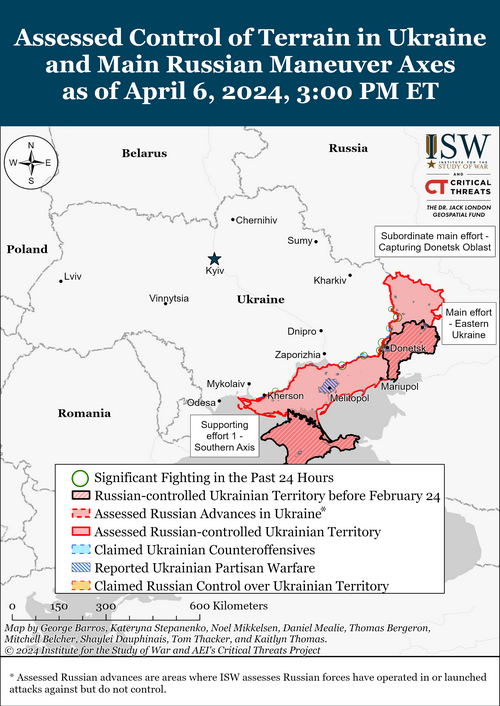
From The Institute for the Study of War:
Russian Offensive Campaign Assessment, April 6, 2024
Riley Bailey, Grace Mappes, Angelica Evans, Kateryna Stepanenko, and George Barros
Date cut-off: 10:15pm ET
Click here to see ISW’s interactive map of the Russian invasion of Ukraine. This map is updated daily alongside the static maps present in this report.
Click here to see ISW’s 3D control of terrain topographic map of Ukraine. Use of a computer (not a mobile device) is strongly recommended for using this data-heavy tool.
Click here to access ISW’s archive of interactive time-lapse maps of the Russian invasion of Ukraine. These maps complement the static control-of-terrain map that ISW produces daily by showing a dynamic frontline. ISW will update this time-lapse map archive monthly.
Note: The data cut-off for this product was 2pm ET on April 6 ISW will cover subsequent reports in the April 7 Russian Offensive Campaign Assessment.
Ukrainian President Volodymyr Zelensky indicated that Ukraine does not have enough materiel to contest the battlefield initiative. Zelensky stated during an interview aired on April 6 that Ukrainian forces currently do not have enough ammunition to initiate and sustain future counteroffensive operations and reiterated that Ukrainian forces are currently using drones to partially compensate for artillery ammunition shortages across the theater.[1] Zelensky stressed that Ukraine must conduct countermeasures to deprive Russian forces of the ability to prepare and conduct significant offensive efforts and not only rely on defensive operations. Zelensky stated that striking Russian force concentrations is one such countermeasure but that Ukrainian forces lack long-range weapons to strike Russian force concentrations and other targets necessary to undermine Russian operations. Senior Ukrainian officials have long called for timely and sustained Western military assistance that would enable Ukraine to conduct both defensive and counteroffensive operations when the timing is optimal for Ukraine to undertake such efforts, as opposed to having materiel shortages constrain Ukraine’s ability to plan and execute operations and losing opportunities to exploit Russian weaknesses.[2] Zelensky recently stated that delays in security assistance forced Ukraine to cede the battlefield initiative to Russia, and Ukrainian officials have warned that Ukraine cannot plan either a successful counteroffensive or defensive effort without knowing when and what kind of aid Ukraine will receive. ISW continues to assess that shortages in Western military assistance have forced Ukrainian forces to husband materiel, and Zelensky’s statement suggests that Ukrainian forces are now having to make difficult decisions about prioritizing certain aspects of its defense over constraining Russian military capabilities or preparing for counteroffensive operations.[3] The New York Times similarly reported on April 5 that Ukrainian forces are close to running out of some types of munitions and that Ukrainian officials have observed a five-to-one Russian artillery advantage throughout the frontline.[4] Ukrainian soldiers reportedly told the New York Times that Ukrainian forces currently have enough cluster munitions that are effective at repelling Russian infantry assaults but are low on high-explosive artillery shells needed to repel mechanized assaults.[5]
Zelensky stressed that additional Western security assistance is necessary for Ukrainian forces to effectively defend Ukraine’s airspace against the intensified Russian strike campaign and increased Russian aviation operations along the frontline. Zelensky stated that Ukraine will need an additional 25 Patriot air defense systems, likely meaning launchers, to extend full air defense coverage to all of Ukraine’s territory.[6] Zelensky warned that if Russian forces sustain the tempo of their current missile and drone strikes then Ukraine will likely lack the air defense missile stocks needed to protect Ukrainian cities and critical infrastructure.[7] Russian forces appear to be exploiting Ukraine’s already degraded air defense umbrella in an attempt to collapse Ukraine’s energy grid, likely in an effort to constrain Ukraine’s long-term defense industrial capacity.[8] Russian missile and drone strikes have consistently pressured Ukraine’s limited air defense and have forced Ukraine to make difficult decisions about providing air defense coverage between large population centers in the rear and active areas of the frontline.[9] Sparse and inconsistent air defense coverage along the front has likely facilitated Russia’s intensification of guided and unguided glide bomb strikes, which Russian forces used to tactical effect in their seizure of Avdiivka in mid-February 2024.[10] Zelensky stated that the previous downing of Russian aircraft has temporarily constrained glide bomb strikes and that Russian forces are now conducting glide bomb strikes from further away, increasing the need for long-range air defense systems.[11]
Zelensky cautioned that the arrival of all promised F-16 fighter jets from Ukraine’s Western partners in 2024 will provide Ukraine with only 10 percent of the fighter aircraft Ukraine would need to completely defeat Russian aviation and restore Ukraine’s ability to operate effectively in the air domain.[12] Zelensky stated that Ukraine will need a combination of air defense systems and fighter aircraft to combat the Russian aviation threat, namely to prevent the Russian use of KAB guided glide bombs.[13] Zelensky also added that Ukraine is currently developing new weapons to defend against Russian KAB guided glide bombs as part of this combined air defense. The further degradation of Ukraine’s air defense umbrella would not only limit Ukraine’s ability to protect critical elements of its war effort in the rear but would also likely afford Russian aviation prolonged secure operation along the frontline. Such security would allow Russian forces to significantly increase glide bomb strikes at scale and possibly even allow Russian forces to conduct routine large-scale aviation operations against near rear Ukrainian logistics and cities to devastating effect.[14] Western security assistance that allows Ukraine to establish a robust combined air defense system will enable Ukraine to protect its cities while providing air defense to potentially operationally significant defensive and counteroffensive operations.
Continued delays in US security assistance are specifically impacting the capabilities that Ukrainian forces need to respond to the increased tempo of Russian mechanized assaults in eastern Ukraine. Ukrainian Commander-in-Chief Colonel General Oleksandr Syrskyi warned on April 6 that a particularly difficult situation has emerged east of Chasiv Yar and west of Avdiivka in Donetsk Oblast, both areas where ISW has observed a recent intensification of Russian mechanized assaults ranging from platoon-sized to battalion-sized attacks.[15] Syrskyi also observed that Russian forces are conducting platoon-, company-, and sometimes battalion-sized infantry assaults in separate directions. The Press Service of the Ukrainian Airborne Forces stated that Russian forces with massed armored vehicle support are still attempting to break through Ukrainian defenses west of Avdiivka despite not yet repeating mechanized assaults as large as the ones that they conducted in the area between March 29 and March 31.[16] Geolocated footage published on April 6 indicates that elements of the Russian 90th Guards Tank Division (41st Combined Arms Army [CAA], Central Military District [CMD]) recently conducted a likely company-sized mechanized assault southeast of Umanske (west of Avdiivka), and a Ukrainian airborne assault brigade reported that its personnel destroyed 10 Russian tanks, five BMP infantry fighting vehicles (IFVs), and a MT-LB IFV during 11 mechanized assaults in the area.[17] Ukrainian forces have so far successfully repelled intensified Russian mechanized assaults throughout eastern Ukraine in the past week but have done so despite persisting materiel shortages.
The Kremlin explicitly threatened its long-term ally Armenia on April 5 over Armenian outreach to the West following Russia’s failure to prevent Armenia’s loss of Nagorno-Karabakh in September 2023. Armenian Prime Minister Nikol Pashinyan, European Commission President Ursula von der Leyen, European Union (EU) High Representative Josep Borell, US Secretary of State Antony Blinken, and US Agency for International Development (USAID) Administrator Samantha Powers met on April 5 in Brussels to discuss continued Western support of Armenian democratic and economic development.[18] The Russian Ministry of Foreign Affairs (MFA) released a statement later on April 5 responding to the meeting, in which the Russian MFA claimed that the West is attempting to “drag the South Caucasus [region] into a geopolitical confrontation” between Russia and the West.[19] The Russian MFA stated that “extra-regional interference” in the South Caucasus region is “irresponsible” and “destructive” and aims to drive a wedge between the South Caucasus countries and Russia. The Russian MFA threatened that Western interference could result in the “most negative consequences for [regional] stability, security, and economic development” and an “uncontrollable increase in tension” in the region. The Russian MFA explicitly threatened the Armenian government and warned that Armenia could “go down the wrong path,” which the MFA claimed is fraught with security and economic issues, could result in an “outflow of the population,” and is reminiscent of the issues that Russia’s invasion has caused Ukraine. The Russian MFA accused the West of attempting to “deceive” Armenia into withdrawing from the Russian-led Collective Security Treaty Organization (CSTO) and Eurasian Economic Union (EAEU) and requesting that Russia withdraw from Russia’s military base in Armenia and from the Yerevan International Airport.
The Russian MFA’s April 5 statement follows several months of Kremlin threats against Armenia in response to ongoing Armenian efforts to secure new, Western security guarantees and efforts to blame Armenia for deteriorating Russian-Armenian relations.[20] Armenian officials recently stated that Armenia is considering withdrawing from the CSTO and applying to join the EU and recently asked Russia to withdraw Russian border guards from the Yerevan International Airport.[21] The Russian MFA’s statement insinuates that the Armenian government is not independently making decisions about its security, and that Western countries are somehow guiding the Armenian government’s decisions. The Kremlin has made similar ridiculous claims that the West controls the Ukrainian government as part of Kremlin efforts to question and undermine Ukrainian sovereignty.[22] The Kremlin has previously conducted hybrid wars against former Soviet states that have sought EU accession.
The Russian MFA also continues to threaten Finland and claimed that Finland has “lost its independence in making foreign policy decisions” since its accession to NATO — a narrative that the Kremlin routinely used to falsely claim that NATO was controlling Ukraine and using Ukraine to threaten Russia. Russian Ambassador to Finland Pavel Kuznetsov stated during an interview with Kremlin newswire TASS on April 6 that Finland is on a “destructive course” in its relationship with Russia and that Finland’s accession to NATO is making the Baltic region a “zone of potential escalation.”[23] Kuznetsov threatened Finland and the NATO alliance broadly, claiming that Russia would have to respond to a buildup of NATO material and manpower or the deployment of a nuclear weapon in Finland and that Russia’s response would be “adequate but not necessarily symmetrical.” Kuznetsov claimed that Finland has joined the “party of war until victory over Russia” by joining NATO and accused perceived Finnish “Russophobia” of causing a complete breakdown of the Russian-Finnish relationship. Kuznetsov insinuated that Finland has no option but to improve its relationship with Russia, given that “we can’t escape geography,” but blamed Finland unilaterally for the poor state of Russian–Finnish relations, despite the artificial migrant crisis that Russia created on the Russian–Finnish border in fall 2023 and repeated Russian threats against Finland and the wider NATO alliance.[24] ISW continues to assess that Russian threats against NATO member states are aimed at leading the West to deter itself and that Russian claims of imagined threats originating from NATO are aimed at setting informational conditions to justify and support an envisioned long-term geopolitical confrontation with the West.[25]
Chechen Republic Head Ramzan Kadyrov announced on April 5 that 3,000 former Wagner Group personnel will join the Akhmat Spetsnaz unit following successful negotiations between Akhmat and Wagner commanders.[26] Kadyrov claimed that Commander of the Akhmat Spetsnaz (and deputy commander of the 2nd Luhansk People’s Republic’s [LNR] Army Corps [AC]) Apty Alaudinov reached an agreement with Wagner leadership that Wagner commander Alexander Kuznetsov (call sign “Ratibor”) will join Akhmat Spetsnaz along with 3,000 Wagner personnel. Kadyrov added that the Russian Ministry of Defense (MoD) already allocated a required number of vacancies within the Akhmat Spetsnaz unit to accommodate the Wagner personnel, and that Wagner personnel can start combat missions after resolving all organizational issues. Kadyrov’s mention of the Russian MoD indicates that these Wagner elements will be subordinated under the Russian MoD’s authority rather than Rosgvardia. Alaudinov also amplified a Kremlin-affiliated milblogger’s claim that the main group of Wagner commanders and 5,000 Wagner personnel are transferring to the 2nd AC under the Russian MoD.[27] The milblogger added that the Russian military is still discussing whether these 5,000 Wagner personnel will form a regiment like the unit under Kuznetsov, form a new separate brigade, or be distributed among existing brigades.
The claimed transfer of 3,000 Wagner personnel into MoD’s Akhmat Spetsnaz indicates that the Russian MoD is successfully formalizing control over some elements of the remaining Wagner Group force — an objective it has been pursuing since 2023. ISW previously assessed that the Russian MoD launched a campaign in early-to-mid-2023 which aimed to directly subordinate Wagner forces under the Russian MoD. ISW also assessed that deceased Wagner Group financier Yevgeny Prigozhin and Wagner personnel started the mutiny in June 2023 in protest of the Russian MoD’s efforts to consolidate control over Wagner forces.[28] The transfer of Wagner personnel to Akhmat Spetsnaz units sparked some criticism from Wagner-affiliated irregular formations, such as the Rusich Sabotage Assault Reconnaissance Group which accused these Wagner personnel of selling out to the Russian MoD.[29] One Russian milblogger also accused Kadyrov of exaggerating the number of transferred Wagner personnel, claiming that most Wagner personnel hate Kuznetsov and are located in Africa.[30] Kremlin-affiliated milbloggers largely celebrated the claimed transfer, claiming that Wagner personnel had two options: to either hold on to their past grudges or let them go to serve the Russian state.[31] One Kremlin-affiliated milblogger claimed that former Wagner forces previously formed the Kamerton detachment under Akhmat Spetsnaz and that the Russian MoD did not ban this detachment from using Wagner symbology, networks, and management systems.[32]
Key Takeaways:
- Ukrainian President Volodymyr Zelensky indicated that Ukraine does not have enough materiel to contest the battlefield initiative.
- Zelensky stressed that additional Western security assistance is necessary for Ukrainian forces to effectively defend Ukraine’s airspace against the intensified Russian strike campaign and increased Russian aviation operations along the frontline.
- Zelensky cautioned that the arrival of all promised F-16 fighter jets from Ukraine’s Western partners in 2024 will provide Ukraine with only 10 percent of the fighter aircraft Ukraine would need to completely defeat Russian aviation and restore Ukraine’s ability to operate effectively in the air domain.
- Continued delays in US security assistance are specifically impacting the capabilities that Ukrainian forces need to respond to the increased tempo of Russian mechanized assaults in eastern Ukraine.
- The Kremlin explicitly threatened its long-term ally Armenia on April 5 over Armenian outreach to the West following Russia’s failure to prevent Armenia’s loss of Nagorno-Karabakh in September 2023.
- The Russian MFA also continues to threaten Finland and claimed that Finland has “lost its independence in making foreign policy decisions” since its accession to NATO — a narrative that the Kremlin routinely used to falsely claim that NATO was controlling Ukraine and using Ukraine to threaten Russia.
- Chechen Republic Head Ramzan Kadyrov announced on April 5 that 3,000 former Wagner Group personnel will join the Akhmat Spetsnaz unit following successful negotiations between Akhmat and Wagner commanders.
- Russian forces recently made confirmed advances near Avdiivka and Donetsk City.
- Russian President Vladimir Putin passed two laws on April 6, offering Russian society some concession for its sacrifices to support Russia’s war in Ukraine.
Go here to read the rest. And Putin is still trying to bring back the Wagner mercenaries for his Ukraine adventure.


A Chechen Wagner unit is a bit of a gamble for the Russians. That’s a dog that won’t come to heel on command and can easily turn on its owner.