
From The Institute for the Study of War:
Russian Offensive Campaign Assessment, April 5, 2024
Angelica Evans, Riley Bailey, Christina Harward, Grace Mappes, and George Barros
April 5, 2024, 8:15pm ET
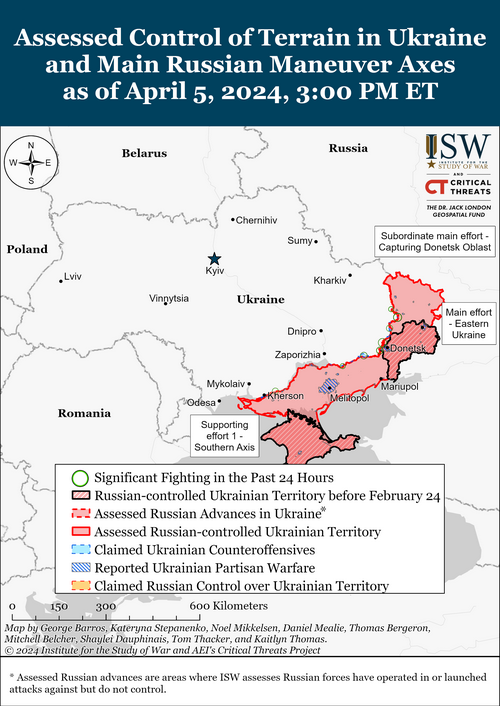
Click here to see ISW’s interactive map of the Russian invasion of Ukraine. This map is updated daily alongside the static maps present in this report.
Click here to see ISW’s 3D control of terrain topographic map of Ukraine. Use of a computer (not a mobile device) is strongly recommended for using this data-heavy tool.
Click here to access ISW’s archive of interactive time-lapse maps of the Russian invasion of Ukraine. These maps complement the static control-of-terrain map that ISW produces daily by showing a dynamic frontline. ISW will update this time-lapse map archive monthly.
Note: The data cut-off for this product was 1pm ET on April 5 ISW will cover subsequent reports in the April 6 Russian Offensive Campaign Assessment.
Ukraine’s Security Service (SBU) and Ukrainian forces reportedly conducted one of the largest series of drone strikes against military facilities within Russia, targeting at least four Russian airbases, on the night of April 4 to 5. Ukrainian media reported that sources within Ukrainian security services, including the Ukrainian Main Military Intelligence Directorate (GUR), stated that the SBU and Ukrainian forces conducted successful strikes on airfields near Kursk City and Yeysk, Krasnodar Krai; the Engels Airbase in Saratov Oblast; and the Morozovsk Airbase in Rostov Oblast.[1] These Ukrainian security sources reportedly stated that the Ukrainian drone strikes significantly damaged three Tu-95MS strategic bombers at Engels airbase, damaged two Su-25 fixed-wing aircraft at the airbase near Yeysk, and destroyed six unidentified aircraft and significantly damaged another eight unidentified aircraft at the Morozovsk Airbase.[2] The Ukrainian strikes reportedly killed four Russian military personnel at the airbase near Yeysk and seven Russian personnel at the Engels Airbase and wounded and killed up to 20 Russian personnel at the Morozovsk Airbase.[3] Geolocated footage shows explosions and Russian air defenses activating near all the airbases except for the one near Yeysk.[4] ISW has not yet observed any visual confirmation that Ukrainian forces damaged or destroyed aircraft or infrastructure at any of the airbases. Satellite imagery collected on April 4 indicates that there were three Tu-160 heavy strategic bombers, five Tu-95 strategic bombers, an Il-76 transport aircraft, and a Tu-22 bomber at Engels Airbase; ten L-39 training and combat aircraft, five An-26 transport aircraft, an An-74 transport aircraft, an An-12 transport aircraft, four Su-27 fixed-winged aircraft, four Su-25 fixed-wing aircraft, one Su-30 fixed-wing aircraft, and several Ka-52 and Mi-8 helicopters at the Yeysk Airbase; and 29 fixed-wing aircraft, primarily Su-34s, at the Morozovsk airfield.[5] The Russian Ministry of Defense (MoD) claimed that Russian forces intercepted 44 drones over Rostov Oblast, six drones over Krasnodar Krai, and a drone each in Saratov, Kursk, and Belgorod oblasts on the night of April 4 and into the morning on April 5.[6] Ukrainian drone strikes have typically only targeted individual airbases within Russia, and Ukraine’s ability to strike four separate airbases in one strike series represents a notable inflection in the capabilities that Ukrainian forces are employing in their campaign against Russian military infrastructure, critical infrastructure, and strategic industries within Russia.
ISW continues to assess that Ukrainian strikes against targets within Russia are a necessary component of Ukraine’s campaign to degrade industries that support the Russian war effort and military capabilities deployed in the Russian rear through asymmetric means. Russian forces routinely use Tu-95 strategic bombers stationed at Engels Airbase to launch Kh-101/Kh-555 cruise missiles at targets in Ukraine, and the Russian military had roughly 60 Tu-95 aircraft as of 2023.[7] If confirmed, the possible loss of roughly five percent of Russia’s strategic Tu-95 bombers in a single strike would be notable. ISW has also previously observed that the loss of fixed-wing aircraft is not negligible since Russia likely has about 300 various Sukhoi fixed-wing aircraft.[8] Russian forces are currently using Sukhoi fixed-wing aircraft to conduct guided and unguided glide bomb strikes along the entire frontline in Ukraine and have previously leveraged significantly intensified glide bomb strikes to make tactical gains.[9] Sustained Ukrainian strikes against Russian airfields within Russia will degrade the Russian Aerospace Force’s (VKS) ability to conduct missile and air strikes throughout Ukraine.
The recently intensified tempo of Russian offensive operations in Ukraine will likely result in increased manpower and materiel losses, but the Russian Ministry of Defense (MoD) appears to be successfully mitigating these losses. Russian forces have conducted several mechanized assaults roughly at the platoon, company, and battalion levels west of Bakhmut near Chasiv Yar, west of Kreminna near Terny, and west of Avdiivka near Berdychi, Semenivka, and Tonenke over the past week after primarily conducting infantry-led “meat” assaults across the theater following the start of the campaign to seize Avdiivka in October 2023.[10] The previous pattern of Russian infantry-led attacks did not employ armored vehicles at scale at the expense of greater manpower losses, and Russia appears to have successfully leveraged its ongoing crypto-mobilization efforts to make up for increased manpower losses.[11] Ukrainian Main Military Intelligence Directorate (GUR) Deputy Chief Major General Vadym Skibitskyi stated on January 15 that Russia recruits around 30,000 personnel per month, which the Russian military uses to replenish personnel losses in Ukraine and form tactical and operational-level reserves.[12] The observed new trend in which Russian forces are now employing more vehicles than was the previously observed standard for tactical assaults suggests that the Russian military may no longer be as constrained or concerned about its armored vehicle and tank losses. The British International Institute for Strategic Studies (IISS) think tank reported on February 12 that Russia is likely able to sustain its current rate of vehicle losses (over 3,000 armored fighting vehicles annually) for at least two or three years by mainly reactivating vehicles from storage.[13] Ukrainian military observer Kostyantyn Mashovets reported on February 4 that the Russian defense industry can produce 250-300 ”new and thoroughly modernized” tanks per year and can repair around 250-300 additional damaged tanks per year, suggesting that Russia can currently compensate for its vehicle losses in Ukraine by refurbishing vehicles from Soviet-era storage.[14] The Kremlin is unlikely to conduct unpopular manpower or economic mobilization efforts in the short term unless Russia’s manpower or materiel losses significantly increase past the point that Russia’s current crypto-mobilization campaign and defense production capacity can accommodate. The recent intensification of mechanized attacks in eastern Ukraine indicates that the Russian command appears to believe that Russia is capable of compensating for losses in these intensified mechanized assaults while preparing for a forecasted offensive effort in Summer 2024.
Ukrainian Prime Minister Denys Shmyhal indicated that Ukraine is starting to staff new units, but that Ukraine needs further Western military assistance to properly equip them. Shmyhal stated in an interview with Estonian outlet Estonian Public Broadcasting (ERR) published on April 4 that Ukrainian forces are staffing an unspecified number of new brigades with new personnel but are waiting for Western partners to deliver military equipment, weapons, and ammunition to equip these brigades at their full end strength.[15] Shmyhal stated that Ukraine can meet its necessary objectives with ”usual mobilization” and that Ukraine has begun rotating out frontline personnel, which is consistent with Ukrainian Commander-in-Chief Colonel General Oleksandr Syrskyi’s recent statements that Ukraine does not need to conduct a proposed effort to mobilize 500,000 new personnel.[16] Ukrainian forces have recently transferred rear area personnel in noncombat units to frontline units to enable force rotations and lowered the mobilization age from 27 to 25 to address ongoing manpower issues.[17] Shmyhal’s statement highlights Ukraine’s need for continued timely and consistent Western military assistance in the short- and medium-term to maintain its defense.
Shmyhal also reported that Russian missile and drone strikes have damaged or disrupted roughly 80 percent of electricity generation at Ukrainian thermal power plants (TPPs) in recent weeks, as Russian forces continue to exploit the degraded Ukrainian air defense umbrella in an effort to collapse Ukraine’s energy grid.[18] Russian forces intensified missile and drone strikes on March 22 and have since been primarily targeting Ukrainian critical energy infrastructure, and Shmyhal added that these strikes have damaged or disrupted more than six gigawatts of power generation at Ukrainian TPPs and hydroelectric power plants (HPPs).[19] Recent Russian drone and missile strikes have notably expanded their target sets to include Ukrainian HPPs.[20] The increasing damage and disruptions to major Ukrainian power plants threaten to accelerate the degradation of Ukraine’s energy generation capabilities and constrain Ukraine’s ability to stabilize future disruptions to its energy grind in the long term.[21] The Russian effort to collapse the Ukrainian energy grid may aim to heavily degrade the critical defense industrial capacity that Ukraine needs to support a long war effort against Russia.[22] Continued delays in US security assistance will continue to degrade Ukrainian air defense capabilities and present Russian forces with greater opportunities to severely damage Ukraine’s energy infrastructure.[23]
Ukrainian officials continue to warn that Russian forces are systematically and increasingly using chemical weapons and other likely-banned chemical substances in Ukraine. The Ukrainian Support Forces Command stated on April 5 that Ukrainian forces have recorded 371 cases of Russian forces using munitions containing chemical substances during the last month and 1,412 cases of Russian forces using chemical weapons between February 2023 and March 2024.[24] The Ukrainian Support Forces Command reported that Russian forces primarily use K-51 and RG-VO grenade launchers to launch munitions containing chemical agents. Ukrainian officials, and a Russian military unit, have previously reported on increasingly common instances of Russian forces using chemical substances in combat that are banned by the Chemical Weapons Convention (CWC), to which Russia is a signatory.[25]
An unattributed drone reportedly struck a military unit in the pro-Russian Moldovan breakaway republic of Transnistria on April 5 amidst an assessed ongoing Kremlin hybrid operation aimed at destabilizing Moldova from within. The Transnistria Ministry of State Security (MGB) claimed that unspecified actors conducted a drone strike against a Transnistrian Ministry of Defense (MoD) military unit in Ribnita on the Dniester River on the afternoon of April 5.[26] The Transnistrian MGB claimed that the drone strike targeted a radar station, which sustained minor damage. Transnistrian authorities did not report any casualties. The Transnistrian MGB did not specify the actor behind the drone strike but noted in their press release that Ribnita is six kilometers from the Transnistrian-Ukrainian border, likely to vaguely allege Ukrainian involvement. Transnistrian sources posted footage of a drone allegedly flying in the area and posted photos of where the drone allegedly hit the ground, but neither the footage nor the photos showed the drone hitting a target or any radar station.[27] Kremlin newswire TASS and other Russian outlets amplified the Transnistrian MGB’s claims.[28] Ukrainian Main Military Intelligence Directorate (GUR) Spokesperson Andriy Yusov stated that Ukraine had nothing to do with the drone strike and ”would not waste valuable drones for such minor provocations.”[29] ISW cannot independently verify the details of the reported drone strike or identify the responsible actors, but it is unlikely that Ukrainian forces conducted the strike given the limited means used in the strike. Russian authorities previously baselessly accused Ukraine of conducting a reported drone strike against a military base in Transnistria on March 17 and may similarly blame Ukraine for the reported April 5 strike as part of ongoing Kremlin hybrid operations against Moldova.[30] Yevgenia Gutsul, the governor of the other pro-Russian Moldovan region, Gagauzia, claimed on April 5 that Gagauzia would ”immediately” begin the process to secede from Moldova should Moldova unify with Romania, a NATO and European Union (EU) member state.[31] ISW continues to assess that the Kremlin is likely trying to exploit both Transnistria and Gagauzia to forward its efforts to destabilize Moldova from within and prevent Moldovan EU accession.[32]
Russia reportedly has conducted thousands of cyber-attacks against Czechia’s rail transport infrastructure and that of other European states as part of a broader effort to degrade NATO members’ transport logistics since the start of Russia’s full-scale invasion of Ukraine. Czech Transport Minister Martin Kupka reportedly told Financial Times (FT) in an article published on April 4 that Czechia suspects Russia of conducting a hacking campaign consisting of thousands of attacks against Czech national railway operator České dráhy to destabilize the EU and destroy critical infrastructure.[33] Kupka noted that Czechia is capable of defending against all the attacks. The European Union Agency for Cyber Security (ENISA) published its first threat report in March 2023 consisting of data collected between January 2021 and October 2022 and found that pro-Russian hacker groups had escalated major cyberattacks against railway companies in Latvia, Lithuania, Romania, and Estonia.[34] ENISA’s March 2023 report also found pro-Russian major cyberattacks against air and maritime transport in the EU more broadly.[35]
Key Takeaways:
- Ukraine’s Security Service (SBU) and Ukrainian forces reportedly conducted one of the largest series of drone strikes against military facilities within Russia, targeting at least four Russian airbases, on the night of April 4 to 5.
- The recently intensified tempo of Russian offensive operations in Ukraine will likely result in increased manpower and materiel losses, but the Russian Ministry of Defense (MoD) appears to be successfully mitigating these losses.
- Ukrainian Prime Minister Denys Shmyhal indicated that Ukraine is starting to staff new units, but that Ukraine needs further Western military assistance to properly equip them.
- Shmyhal also reported that Russian missile and drone strikes have damaged or disrupted roughly 80 percent of electricity generation at Ukrainian thermal power plants (TPPs) in recent weeks, as Russian forces continue to exploit the degraded Ukrainian air defense umbrella in an effort to collapse Ukraine’s energy grid.
- Ukrainian officials continue to warn that Russian forces are systematically and increasingly using chemical weapons and other likely-banned chemical substances in Ukraine.
- An unattributed drone reportedly struck a military unit in the pro-Russian Moldovan breakaway republic of Transnistria on April 5 amidst an assessed ongoing Kremlin hybrid operation aimed at destabilizing Moldova from within.
- Russia reportedly has conducted thousands of cyber-attacks against Czechia’s rail transport infrastructure and that of other European states as part of a broader effort to degrade NATO members’ transport logistics since the start of Russia’s full-scale invasion of Ukraine.
- Russian forces recently made confirmed advances near Avdiivka amidst ongoing positional fighting along the entire line of contact on April 5.
- Russia’s defense industry continues to mobilize to meet the Russian military’s needs in Ukraine.
- Russian President Vladimir Putin announced on April 4 that Russia will open two youth centers aimed at indoctrinating Ukrainian youth into Russian culture and historical narratives in occupied Zaporizhia and Kherson Oblasts in the near future.
Go here to read the rest. I wonder if the ground war is becoming a side show to the aerial drone and missile war?

