
From The Institute for the Study of War:
Russian Offensive Campaign Assessment, March 29, 2024
Riley Bailey, Christina Harward, Angelica Evans, Grace Mappes, and George Barros
March 29, 2024, 9:30pm ET
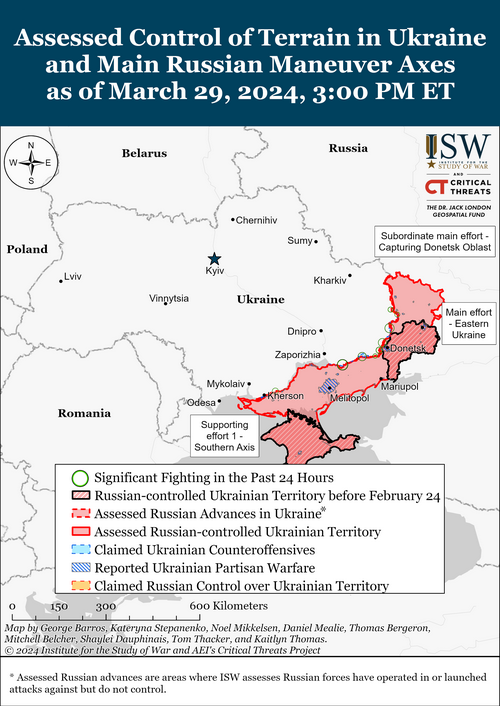
Click here to see ISW’s interactive map of the Russian invasion of Ukraine. This map is updated daily alongside the static maps present in this report.
Click here to see ISW’s 3D control of terrain topographic map of Ukraine. Use of a computer (not a mobile device) is strongly recommended for using this data-heavy tool.
Click here to access ISW’s archive of interactive time-lapse maps of the Russian invasion of Ukraine. These maps complement the static control-of-terrain map that ISW produces daily by showing a dynamic frontline. ISW will update this time-lapse map archive monthly.
Note: The data cut-off for this product was 1:15pm ET on March 29. ISW will cover subsequent reports in the March 30 Russian Offensive Campaign Assessment.
The Russian Orthodox Church Moscow Patriarchate (ROC MP), a Kremlin-controlled organization and a known tool within the Russian hybrid warfare toolkit, held the World Russian People’s Council in Moscow on March 27 and 28 and approved an ideological and policy document tying several Kremlin ideological narratives together in an apparent effort to form a wider nationalist ideology around the war in Ukraine and Russia’s expansionist future.[1] ROC MP Head Patriarch Kirill, reportedly himself a former Soviet Committee for State Security (KGB) officer and a known staunch supporter of Russian President Vladimir Putin, chaired the congress of the World Russian People’s Council that approved the document, and Kirill likely coordinated the document’s ideological narrative and policy recommendations with the Kremlin.[2] The document, “The Present and Future of the Russian World,” addresses Russian legislative and executive authorities with specific calls to amend Russian policy documents and laws. These calls are likely either attempts to socialize desired Kremlin policies among Russians before their implementation or to test public reactions to policies that Kremlin officials are currently considering. Putin and Kremlin officials have gradually attempted to elaborate on amorphous ideological narratives about the war in Ukraine and their envisioned geopolitical confrontation with the West since the start of the full-scale invasion, and the ROC MP appears to be offering a more coherent ideological framework for Russians.[3] The ROC MP released the document a week after the Crocus City Hall terrorist attack and roughly a month before the start of the Orthodox Easter Holy Week, and likely aims to seize on heightened anxieties following the terrorist attack and increased Russian Orthodoxy observance to garner support for its desired ultranationalist policies and ideological vision.
The ROC MP intensified Kremlin rhetoric about Russia’s war in Ukraine and cast it as an existential and civilizational “holy war,” a significant inflection for Russian authorities who have so far carefully avoided officially framing Russia’s invasion of Ukraine as any kind of “war.” The ROC MP called Putin’s “special military operation” a holy war (Svyashennaya Voyna) and a new stage in the Russian people’s struggle for “national liberation…in southwestern Russia,” referencing eastern and southeastern Ukraine.[4] The ROC MP claimed that the Russian people are defending their lives, freedom, and statehood; their civilizational, religious, national, and cultural identity; and their right to live within the borders of a single Russian state by waging Putin’s war of conquest in Ukraine. The ROC MP argued that the war in Ukraine is a holy war because Russia is defending “Holy Russia” and the world from the onslaught of globalism and the victory of the West, which has fallen into Satanism. The ROC MP asserted that the war in Ukraine will conclude with Russia seizing exclusive influence over the entire territory of modern Ukraine and the exclusion of any Ukrainian government that the Kremlin determines to be hostile to Russia. The ROC MP’s description of Russian goals is in line with repeated Kremlin statements indicating that Putin retains his objective to destroy Ukrainian sovereignty and statehood.[5] The ROC MP’s use and description of the holy war in Ukraine is also consistent with Kremlin efforts to frame the war as an existential national struggle against Ukraine and the collective West but notably expands the alleged threats that defeat in Ukraine poses for Russians.[6] The term “holy war” may also conjure allusions to the Great Patriotic War (the Second World War), as the Soviet Union’s unofficial war anthem shared the same name, and the Kremlin has routinely invoked the mythos of the Great Patriotic War to generate domestic support for the war in Ukraine.[7] The Kremlin has continued to stress that the war in Ukraine is a “special military operation,” however, and the ROC MP’s direct acknowledgment of the conflict as a holy war may elicit support from Russians who have found the Kremlin’s comparatively restrained rhetoric uninspiring. The ROC MP did not define the holy war as a purely Orthodox concept and instead tied it to the Kremlin’s purposefully broad conception of who is a part of the Russian nation and Russkiy Mir (Russian World).[8] Ukrainian victory does not pose these existential threats, however, as Ukraine’s struggle to restore its territorial integrity, return its people, and defend its national identity does not infringe on Russian identity, statehood, or territorial integrity.
The ROC MP called for the codification of elements of the Russkiy Mir and may be gauging public support for the formal inclusion of ethnic Ukrainians and Belarusians in the Kremlin’s concept of the Russian nation. The ROC MP stated that Russia is the “creator, support, and defender” of the Russkiy Mir and that the Russkiy Mir is a “spiritual, cultural, and civilizational phenomenon” that transcends the borders of the Russian Federation and historical Russian lands and encompasses everyone that values Russian traditions and culture.[9] The ROC MP claimed the Russkiy Mir’s mission is to destroy and prevent efforts to establish “universal hegemony in the world” and that the reunification of the “Russian nation” should be one of the priorities of Russian foreign policy. The ROC MP stated that Russia should return to the “trinity doctrine” of the Russian nation, which falsely asserts that the “Russian nation” is comprised of sub-groups of ethnic Russians, Belarusians, and Ukrainians whom Russia should reunify. The ROC MP called on Russia to codify the “trinity doctrine” in law, make it an “integral part” of the Russian legal system, include it in the “normative list” of Russian spiritual and moral values, and give the concept legal protection. Putin and other Kremlin officials have consistently invoked similar claims about the “Russian people” and Russkiy Mir since before the full-scale Russian invasion of Ukraine as a means to justify Russian aggression against Ukraine while undermining Ukraine’s sovereignty and territorial integrity and denying the existence of a Ukrainian ethnic identity.[10] The ROC MP may be gauging the response to the idea of codifying the “trinity doctrine” on the Kremlin’s orders. The Kremlin may codify this doctrine as official Russian policy.
The ROC MP heavily emphasized Russia’s need for traditional family values and an updated migration policy to counter Russia’s ongoing demographic crisis. The ROC MP labeled Russia’s demographic crisis as Russia’s main existential threat and characterized steady demographic growth as a critical national security priority. The ROC MP asserted that Russia should aim to grow its population to 600 million people (a roughly 450 million increase) in the next 100 years and laid out a series of measures that it envisions would allow Russia to achieve this monumental task. The ROC MP called for the revival of the “traditional large family” and traditional family values in Russia – echoing Russian President Vladimir Putin’s emphasis on 2024 as the “Year of the Family” in recent major national addresses.[11] The ROC MP claimed that the Russian government should recognize the family and its well-being as Russia’s ”main national development goal” and a “strategic national priority” and should amend Russia’s main strategic planning documents to reflect this.[12] The ROC MP called on Russian popular culture to create a “cult of the family” in society and suggested various economic benefits the state should enact to encourage larger families. The ROC MP claimed that a new state migration policy is also key to an “effective” demographic policy. The ROC MP complained that migrants who do not speak Russian, do not understand Russian history and culture, and cannot integrate into Russian society are “deforming” Russia’s unified legal, cultural, and linguistic space. The ROC MP alleged that the “uncontrolled” influx of migrant labor decreases the “indigenous” population’s wages and access to jobs and that “closed ethnic enclaves” are “breeding grounds” for corruption, organized crime, extremism, and terrorism. The ROC MP offered a series of policy recommendations that Russia should prioritize in a new migration policy, including “significant” restrictions on low-skilled foreign laborers, guarantees of employment and high incomes for Russian citizens, protections of the rights and interests of ethnic Russians, and other indigenous peoples of Russia, the mass repatriation of “compatriots” to Russia, and the relocation of highly-skilled foreign specialists who are loyal to Russia and ready to integrate into Russian society.
The ROC MP’s demographic and migration policy suggestions continue to highlight how the Kremlin struggles with inconsistent and contradictory policies concerning migrants and the interests of its ultranationalist population. Select Russian officials and ultranationalist voices have recently called for Russia to enact anti-migrant policies following the Crocus City Hall terrorist attack, but ISW continues to assess that Russia is unlikely to introduce any restrictions that would reduce the number of migrants in Russia given that Russia continues to heavily rely on migrants to offset domestic labor shortages and for force generation efforts.[13] Putin asserted in December 2023 that Russia’s “compatriots abroad” are those who have historical, cultural, or linguistic ties to Russia, and the ROC MP appears to suggest that the repatriation of such “compatriots” to Russia could be a large resource Russia could tap into to solve its demographic crisis.[14] Some of the ROC MP’s other policy recommendations, however, contradictorily seek to restrict some of the very migrants that would fall under Putin’s definition of “compatriots abroad.” The ROC MP’s approach to the Russkiy Mir appears to be at odds with Putin’s previous definition of Russkiy Mir which posits a diverse and inclusive Russian civic nationalism.[15]
The ROC MP appears to be combining previously parallel Kremlin narrative efforts into a relatively cohesive ideology focusing on national identity and demographic resurgence that promises Russians a period of national rejuvenation in exchange for social and civic duties. The ROC MP highlighted that “the restoration of the unity of the Russian people” through the war in Ukraine is a key condition for Russia’s survival and successful development throughout the 21st century. This call for restoration amounts to the full-scale destruction of the Ukrainian nation and its envelopment into Russia. The ROC MP aims to also envelop ethnic Belarusians into the Russian nation through its conception of the “trinity doctrine” while also massively repatriating other “compatriots” abroad. The ROC MP’s calls for Russians to assume the responsibility for steadily increasing birth rates and averting demographic catastrophe similarly promises Russians that Russian sovereignty and identity will persist in the 21st century. These efforts to expand Russia’s control over those it considers to be a part of the Russkiy Mir, whether through mass repatriation or forceful means like Russia’s war of conquest in Ukraine, serve the same purpose as the calls for Russians to increase birth rates — increasing Russia’s overall population with people that ultranationalists consider to be “Russian.” The ROC MP argued that the establishment of a stable and sovereign Russkiy Mir under the Russian state will lead to economic opportunity and Russia’s role as one of the leading centers of a multipolar world order. The ROC MP stated that the typical embodiment of the Russkiy Mir after the promised national rejuvenation would be a Russian family with three or more children and their own single-family home, offering ordinary Russians future socioeconomic benefits in exchange for sacrifices made now in backing the ROC MP’s suggested ultranationalist ideology and achieving Russia’s “unification” with Ukraine and Belarus. The ROC MP’s suggested ideology explicitly ties Russian national security to the preservation of an imagined and disputed Russian nation and Russian demographic growth, offering the Kremlin expanded justifications for acts of aggression against neighboring countries and the West in the name of protecting the overall size and growth of the imagined Russkiy Mir. The Kremlin may choose not to fully align itself publicly with the ultranationalist ideology that the ROC MP has proposed at this time but will highly likely borrow from and leverage it to generate support for the war effort in Ukraine and any future acts of aggression against Russia’s neighbors and the West.
Ukrainian Commander-in-Chief Colonel General Oleksandr Syrskyi stressed that materiel shortages from delays in Western security assistance are constraining Ukrainian forces and forcing Ukraine to conduct a strategic defense. Ukrainian outlet Ukrinform published an interview with Syrskyi on March 29, wherein Syrskyi stated that a strategic defense is logical given Ukraine’s materiel shortages and noted that Ukraine is unable to plan operations due to uncertainty around Western military aid provisions.[16] Syrskyi stated that Russian forces’ significant personnel advantage, heavy Russian airstrikes, and Ukrainian artillery shell shortages enabled Russian forces to break through Ukrainian defenses and seize Avdiivka, Donetsk Oblast, in mid-February 2024, and that Ukrainian forces could have successfully defended Avdiivka if they had sufficient artillery ammunition and air defenses in the area. Syrskyi acknowledged that Russian forces significantly increased airstrikes against Ukrainian forces in recent weeks and months and that Russian forces recently had an advantage over Ukrainian artillery ammunition at a ratio of six to one. Syrskyi stated that Ukrainian forces have been able to offset Russian forces’ artillery superiority through rear area strikes, but only in certain areas of the theater.
Ukrainian forces have proven themselves capable of significantly degrading Russian forces when well-provisioned. Ukrainian forces conducted an interdiction campaign using HIMARS to target bridges over the Dnipro River forcing Russian forces to withdraw from west (right) bank Kherson Oblast in November 2022.[17] Ukrainian forces exploited a surprise breakthrough of Russian lines in Kharkiv Oblast in September 2022.[18] Ukrainian forces are currently waging an ongoing campaign that is limiting the Russian Black Sea Fleet (BSF)’s ability to operate freely in and control the Black Sea.[19] Syrskyi’s interview, particularly his assertion that Ukrainian forces can defend their territory and defeat Russia’s invasion provided sufficient Western military assistance no matter how many soldiers Russia generates, underscores how the American failure to provide timely and consistent military equipment and weapons to Ukraine has constrained Ukraine’s ability to conduct strategic planning or wage major operations.[20] Syrskyi’s statements indicate that Ukraine is attempting to adapt to reduced assistance both on the battlefield and by mobilizing its defense industrial base (DIB), but these efforts are insufficient to fully compensate for the lack of materiel in the near term.[21]
Syrskyi also indicated that Ukraine is attempting to mitigate manpower shortages by reinforcing frontline units with existing personnel from rear areas. Syrskyi stated that Ukrainian forces have transferred thousands of personnel from rear area non-combat units to frontline combat units and begun force rotations to allow frontline forces to rest.[22] Syrskyi stated that Ukrainian forces expect to have sufficient personnel to conduct its strategic defense and that this number is well below the 500,000 personnel that Ukrainian officials had suggested mobilizing in December 2023.[23]
The Russian military likely expanded the target set for Russia’s strike campaign against Ukraine’s critical infrastructure to include hydroelectric power plants. The Ukrainian Air Force reported that Russian forces launched a series of missile and drone strikes at targets in Ukraine on the night of March 28 to 29, including 60 Shahed-136/131 drones from Primorsko-Akhtarsk, Krasnodar Krai and Kursk Oblast; three Kinzhal missiles from MiG-31 aircraft over Ryazan Oblast; nine Kh-59 cruise missiles from Su-34 aircraft over Belgorod Oblast; four Iskander-K missiles from Kursk Oblast; and 21 Kh-101/Kh-555 cruise missiles from Tu-95MS strategic bombers that took off from Engels airbase in Saratov Oblast.[24] Ukrainian air defenses downed 58 Shahed drones, five Kh-59 cruise missiles, all four Iskander-K missiles, and 17 Kh-101/Kh-555 cruise missiles. Ukrainian President Volodymyr Zelensky stated that Russian forces deliberately targeted the Kaniv and Dnister hydroelectric power plants in Cherkasy and Chernivtsi oblasts during the March 28-29 strikes.[25] Ukrainian officials reported that these Russian strikes targeted unspecified critical infrastructure in Ivano-Frankivsk and Dnipropetrovsk oblasts, and Russian milbloggers claimed that Russian forces struck the Kryvyi Rih Thermal Power Plant and the Serednodniprovska Hydroelectric Power Plant in Dnipropetrovsk Oblast.[26] Ukrainian state electricity transmission operator Ukrenergo reported that Russian strikes on March 28-29 damaged thermal and hydroelectric power plants in central and western Ukraine, causing electricity shutdowns in Dnipropetrovsk and Kharkiv oblasts.[27] Russian strikes on March 22 significantly damaged Ukraine’s Dnipro Hydroelectric Power Plant (DHPP) in Zaporizhzhia City and the facility will likely remain offline for some time.[28] ISW previously assessed that Russian strikes against Ukrainian energy facilities may aim to degrade Ukraine’s defense industrial capacity and that Russian forces are likely trying to exploit Ukrainian air defense missile shortages in a renewed attempt to collapse Ukraine’s energy grid.[29]
Russia’s newly emerging pattern of striking Ukrainian dams and hydroelectric power plans is a significant inflection and an escalation of Russia’s strike campaign against Ukraine. Russian forces did not previously conduct sustained missile strikes against Ukrainian dams and hydroelectric power plans. The US and European countries remain unwilling to provide Ukraine with materiel that could prove operationally or strategically significant and assist significant Ukrainian offensive efforts due to fears of Russian escalation or retaliation. Western states’ decisions to limit Ukraine’s defense capabilities in an effort to manage escalation have failed to prevent Russia from escalating its war against Ukraine, however. Ukraine, moreover, is conducting a strategic defense, not an offensive effort that could seriously threaten Russian positions in occupied Ukraine or Russian territory. US Chairman of the Joint Chiefs of Staff General Charles Brown Jr. stated on March 28, regarding the provision of long-range ATACMS missiles to Ukraine, that the “risk of escalation is not as high as maybe it was at the beginning [of Russia’s full-scale invasion of Ukraine].”[30] Russia has consistently proven its willingness to escalate its aggression without provocation, and concern about Russian retaliation and escalation in response to the further provision of Western weapons and systems to Ukraine should not dictate US or other Western decision-making regarding this assistance.[31]
Russia vetoed an annual United Nations Security Council (UNSC) resolution extending a monitoring panel tracking adherence to UN sanctions against North Korea on March 28.[32] China also abstained from the vote. The UN Security Council has unanimously adopted the annual renewal of the North Korean sanctions monitoring panel’s mandate since its inception in 2009.[33] Kremlin Spokesperson Dmitri Peskov vaguely commented that the veto was in Russia’s interest.[34] Russian Ministry of Foreign Affairs (MFA) Spokesperson Maria Zakharova claimed that the UN sanctions against North Korea are “old models” and have led to “severe humanitarian consequences” in North Korea.[35] Zakharova claimed that the “collective West” is responsible for Russia’s veto of the resolution and that the West did not want to accept Russia’s proposed “compromises.”[36] Voice of America (VOA) reported that Russia and China recently attempted to push the UNSC to add “sunset” clauses to some of the sanctions on North Korea in which the sanctions would expire after an unspecified period of time if the UNSC did not reach a consensus on their extension.[37] Russia recently strengthened its relationship with North Korea as part of efforts to source North Korean ballistic missiles and artillery ammunition to use in Ukraine, and Russia may be helping North Korea evade international sanctions beyond the immediate violations of sanctions involved in North Korean weapons transfers to Russia.[38] Russia’s veto of the supervisory panel is likely part of Russian efforts to prevent the detection of Russia’s own sanctions evasion schemes with North Korea. Russia may also have suspected that the UNSC would not approve the “sunset” clause proposals and instead used these proposals to set information conditions to later blame the West for the expiration of the monitoring panel’s mandate. Kremlin newswire TASS stated on March 27 that Russian Foreign Intelligence Service (SVR) Director Sergei Naryshkin met with North Korean Minister of State Security Ri Chang-dae in Pyongyang during a visit on March 25-27 and discussed deepening Russian-North Korean relations.[39]
The Kremlin appears to have succeeded in pressuring Telegram to further censor extremist content following the March 22 Crocus City Hall attack, highlighting the Kremlin’s ability to pressure significant actors within the Russian information space to act in its interests. Telegram founder and CEO Pavel Durov stated on March 28 that Telegram began measures to prevent extremist posts calling for terrorist attacks on March 24, preventing tens of thousands of alleged attempts to send messages calling for terrorist attacks and blocking thousands of users who sent such messages.[40] Durov stated that Telegram users in Russia, Ukraine, and Belarus will be able to limit who can send them private messages beginning next week and emphasized that Telegram is not a place to call for violence.[41] Kremlin Spokesperson Dmitri Peskov stated on March 28 that Russia has no plans to block Telegram but specifically called on Durov by name to pay more attention to how terrorists use the platform and that the Kremlin “expected more” from Durov.[42] The Kremlin’s ability to pressure Durov is noteworthy given that Telegram is no longer based in Russia, and Durov reportedly left Russia in 2014 after refusing to cooperate with Russian censorship measures.[43]
Key Takeaways:
- The Russian Orthodox Church Moscow Patriarchate (ROC MP), a Kremlin-controlled organization and a known tool within the Russian hybrid warfare toolkit, held the World Russian People’s Council in Moscow on March 27 and 28 and approved an ideological and policy document tying several Kremlin ideological narratives together in an apparent effort to form a wider nationalist ideology around the war in Ukraine and Russia’s expansionist future.
- The ROC MP intensified Kremlin rhetoric about Russia’s war in Ukraine and cast it as an existential and civilizational “holy war,” a significant inflection for Russian authorities who have so far carefully avoided officially framing Russia’s invasion of Ukraine as any kind of “war.”
- The ROC MP called for the codification of elements of the Russkiy Mir and may be gauging public support for the formal inclusion of ethnic Ukrainians and Belarusians in the Kremlin’s concept of the Russian nation.
- The ROC MP heavily emphasized Russia’s need for traditional family values and an updated migration policy to counter Russia’s ongoing demographic crisis.
- The ROC MP appears to be combining previously parallel Kremlin narrative efforts into a relatively cohesive ideology focusing on national identity and demographic resurgence that promises Russians a period of national rejuvenation in exchange for social and civic duties.
- Ukrainian Commander-in-Chief Colonel General Oleksandr Syrskyi stressed that materiel shortages from delays in Western security assistance are constraining Ukrainian forces and forcing Ukraine to conduct a strategic defense.
- The Russian military likely expanded the target set for Russia’s strike campaign against Ukraine’s critical infrastructure to include hydroelectric power plants.
- Russia vetoed an annual United Nations Security Council (UNSC) resolution extending a monitoring panel tracking adherence to UN sanctions against North Korea on March 28.
- The Kremlin appears to have succeeded in pressuring Telegram to further censor extremist content following the March 22 Crocus City Hall attack, highlighting the Kremlin’s ability to pressure significant actors within the Russian information space to act in its interests.
- Russian forces recently made confirmed advances near Bakhmut, Avdiivka, and Donetsk City and in the Donetsk-Zaporizhia Oblast border area amid continued positional engagements along the entire line of contact on March 29.
- The Russian Ministry of Defense (MoD) is preparing for Russia’s semi-annual spring conscription cycle, which will begin on April 1.
- Russian occupation authorities continue law enforcement crackdowns, including against the Crimean Tatar ethnic minority, to consolidate control over occupied Ukraine.
Go here to read the rest. The Russian Orthodox Church continues its long tradition of being an arm of the Russian State.

