
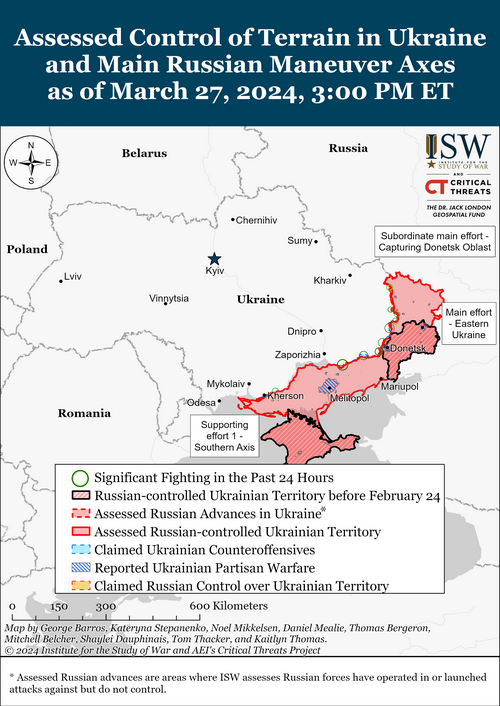
From The Institute for the Study of War:
Russian Offensive Campaign Assessment, March 27, 2024
Christina Harward, Karolina Hird, Riley Bailey, Nicole Wolkov, and Frederick W. Kagan
March 27, 2024, 5:10pm ET
Click here to see ISW’s interactive map of the Russian invasion of Ukraine. This map is updated daily alongside the static maps present in this report.
Click here to see ISW’s 3D control of terrain topographic map of Ukraine. Use of a computer (not a mobile device) is strongly recommended for using this data-heavy tool.
Click here to access ISW’s archive of interactive time-lapse maps of the Russian invasion of Ukraine. These maps complement the static control-of-terrain map that ISW produces daily by showing a dynamic frontline. ISW will update this time-lapse map archive monthly.
Note: The data cut-off for this product was 2:15pm ET on March 27. ISW will cover subsequent reports in the March 28 Russian Offensive Campaign Assessment.
The UN Human Rights Monitoring Mission in Ukraine (HRMMU) released its 38th report on the human rights situation in Ukraine on March 26, confirming several of ISW’s longstanding assessments about Russia’s systematic violations of international human rights and humanitarian law in occupied territories and towards Ukrainian prisoners of war (POWs).[1] The HRMMU report details activities between December 1, 2023 and February 29 2024, and includes new findings about Russia’s abuse of Ukrainian POWs during this timeframe, based on interviews with 60 recently released male POWs.[2] Nearly all of the POWs that HRMMU interviewed detailed how they were tortured by Russian forces with beatings and electric shocks and threatened with execution, and over half of the interviewees experienced sexual violence. HRMMU also reported that it has evidence of Russian forces executing at least 32 POWs in 12 different incidents during the reporting period and independently verified three of the executions. ISW observed open-source evidence of several POW executions during this reporting period: the execution of three Ukrainian POWs near Robotyne, Zaporizhia Oblast on December 27, 2023; the execution of one Ukrainian POW near Klishchiivka, Donetsk Oblast on February 9, 2024; the executions of three Ukrainian POWs near Robotyne, the execution of six Ukrainian POWs near Avdiivka, Donetsk Oblast, and the executions of two Ukrainian POWs near Vesele, Donetsk Oblast on or around February 18, 2024; and the execution of nine Ukrainian POWs near Ivanivske, Donetsk Oblast, on February 25.[3] The summary execution and mistreatment of POWs is a violation of Article 3 of the Geneva Convention relative to the Treatment of Prisoners of War.[4] The HRMMU report also details the forced Russification of Ukrainian populations in occupied areas, including the imposition of Russian political, legal, and administrative systems onto occupied Ukraine in violation of Russia’s international legal obligations as an occupying power.[5] ISW has reported at length on the specifics of Russia’s illegal occupation of Ukraine, consistent with the findings of the UN HRMMU report.[6]
Russian officials are tying the US and the West to a broader set of “terrorist” attacks against Russia following the Crocus City Hall attack, likely to intensify rhetoric about alleged Western and Ukrainian threats to generate greater domestic support for the war in Ukraine. The Russian Investigative Committee and Prosecutor General’s Office stated on March 27 that they will consider an appeal from the Russian State Duma to investigate American and Western financing and organization of terrorist attacks against Russia.[7] The Russian Investigative Committee, Prosecutor General’s Office, and the Duma Deputies that made the appeal did not explicitly reference the Crocus City Hall attack.[8] Kremlin officials have previously tied Ukraine and the West to the Crocus City Hall attack but have yet to make a formal accusation, and the Kremlin may refrain from issuing an official accusation as all available evidence continues to show that the Islamic State (IS) is very likely responsible for the attack.[9] Russian officials routinely describe Ukrainian military strikes against legitimate military targets in occupied Ukraine and Russia as terrorism and consistently claim that Western actors help organize these strikes.[10] The Kremlin likely aims to seize on wider Russian social fears and anger following the Crocus City Hall attack by portraying Ukraine, the US, and the West as immediate terrorist threats. The Kremlin likely hopes that perceptions of Ukrainian and Western involvement in the Crocus City Hall attack will increase domestic support for the war in Ukraine, and Russian officials will likely invoke a broader view of what they consider terrorism to further cast Ukrainians as terrorists and the West as a sponsor of terrorism.[11] The Kremlin may still formally accuse Ukraine of conducting the Crocus City Hall attack if it believes that these other informational efforts are insufficient to generate the domestic response it likely desires.[12]
Russian authorities are increasing legal pressure against migrants in Russia following recent Russian officials’ proposals for harsher measures against migrant communities in response to the March 22 Crocus City Hall attack. BBC News Russian Service stated that there has been a significant increase in the number of cases related to violations of the rules of entry for foreign citizens into Russia following the Crocus City Hall attack.[13] BBC News Russian Service reported on March 27 that 784 such cases have been registered since the morning of March 25, as compared with 1,106 during the entire previous week. A Russian lawyer who often works with Tajik citizens reportedly told BBC News Russian Service that over 100 people waited for a Moscow district court to hear their cases on March 25 alone and that Russian authorities are especially targeting migrants from Tajikistan during searches. BBC News Russian Service reported that representatives of the Tajik diaspora in Russia are expecting Russian authorities to conduct a large wave of deportations following the Crocus City Hall attack. A Russian insider source claimed on March 27 that unspecified actors gave the Moscow Ministry of Internal Affairs (MVD) an “unspoken” order to “not spare” migrants and for MVD employees to use their own judgement in the field.[14] The insider source claimed that a source suggested that Russian authorities are not preparing to conduct raids on migrant communities but will apply the “strictest measures” to migrants in “controversial situations.” Kremlin newswire TASS stated on March 27 that Russian police and Rosgvardia conducted a raid at the Wildberries warehouse in Elektrostal, Moscow Oblast to check the documents of migrant workers, and Russian opposition outlet Baza reported that Russian authorities detained 21 people during the raid.[15] Several Russian ultranationalist milbloggers complained that the way Russian-language schools in Tajikistan are teaching about Russia’s historical imperial occupation of Tajikistan is discouraging Tajik migrants from integrating into Russian society, essentially blaming migrants for the alienation that Russian society subjects them to.[16] Select Russian officials recently called for the introduction of several anti-migrant policies, which Russian authorities are unlikely to enact given Russia’s reliance on migrants for its force generation and labor needs.[17] Russian authorities may continue the practice of raiding migrant workplaces and increase crackdowns at border crossings to temporarily placate emotional cries for retribution following the March 22 attack as the Kremlin continues to develop a cogent and practical response.
Key Takeaways:
- The UN Human Rights Monitoring Mission in Ukraine (HRMMU) released its 38th report on the human rights situation in Ukraine on March 26, confirming several of ISW’s longstanding assessments about Russia’s systematic violations of international human rights and humanitarian law in occupied territories and towards Ukrainian prisoners of war (POWs).
- Russian officials are tying the US and the West to a broader set of “terrorist” attacks against Russia following the Crocus City Hall attack, likely to intensify rhetoric about alleged Western and Ukrainian threats to generate greater domestic support for the war in Ukraine.
- Russian authorities are increasing legal pressure against migrants in Russia following recent Russian officials’ proposals for harsher measures against migrant communities in response to the March 22 Crocus City Hall attack.
- Russian forces recently made confirmed advances near Avdiivka and southwest of Donetsk City on March 27.
- Russian Storm-Z personnel continue to complain about their poor treatment by the Russian Ministry of Defense (MoD) as the MoD tries to posture efficacy in its force generation and social benefit allocation system.
Go here to read the rest. Slow news day when a UN report gets top billing.

