
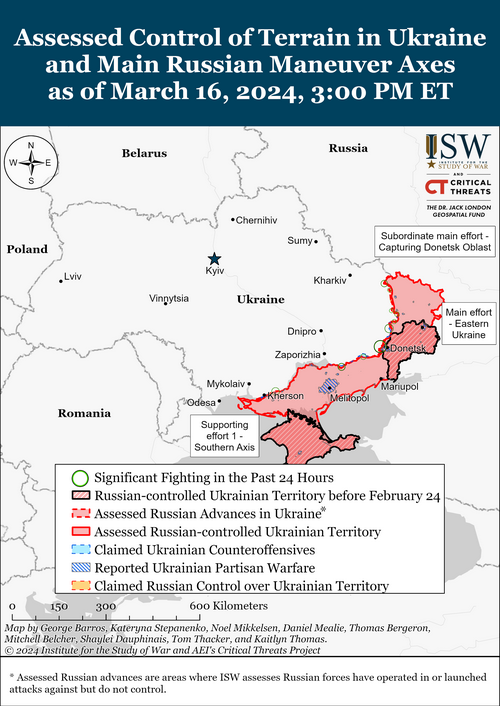
From The Institute for the Study of War:
Russian Offensive Campaign Assessment, March 16, 2024
Angelica Evans, Christina Harward, Grace Mappes, Riley Bailey, and George Barros
March 16, 2024, 5:20pm ET
Click here to see ISW’s interactive map of the Russian invasion of Ukraine. This map is updated daily alongside the static maps present in this report.
Click here to see ISW’s 3D control of terrain topographic map of Ukraine. Use of a computer (not a mobile device) is strongly recommended for using this data-heavy tool.
Click here to access ISW’s archive of interactive time-lapse maps of the Russian invasion of Ukraine. These maps complement the static control-of-terrain map that ISW produces daily by showing a dynamic frontline. ISW will update this time-lapse map archive monthly.
Note: The data cut-off for this product was 1:30 pm ET on March 16. ISW will cover subsequent reports in the March 17 Russian Offensive Campaign Assessment.
The Ukrainian State Security Service (SBU) reportedly conducted a series of successful drone strikes against three Russian oil refineries in Samara Oblast on March 16. Sources in Ukrainian special services told Ukrainian outlet RBK-Ukraine that the SBU struck the Novokuibyshevsky, Kuibyshevsky, and Syzran Rosneft oil refineries in Samara Oblast.[1] RBK-Ukraine reported that the three refineries process an estimated 25 million tons of oil per year, or 10 percent of Russia’s annual oil refinement output.[2] Geolocated footage published on March 16 shows a fire at the Syzran oil refinery following the drone strikes, and Samara Oblast Governor Dmytro Azarov stated that there was also a fire at the refinery in Novokuibyshevsky.[3] Russian outlet Kommersant reported on March 13 that Russian authorities recently strengthened anti-drone protection at the Novokuibyshevsky, Kuibyshevsky, and Syzran oil refineries following previous Ukrainian drone strikes targeting Russian oil infrastructure and reported on March 14 that Russian oil and gas and industrial enterprises are currently the main purchasers of anti-drone systems in Nizhny Novgorod Oblast.[4] Kommersant also reported that Rosneft has not restarted operations at the Tuapse oil refinery following the January 25 Ukrainian drone strike against the facility, indicating that the January 25 strike likely significantly damaged the facility.[5] Russian milbloggers deliberated whether the Russian Ministry of Defense (MoD) or Rosgvardia are to blame for not protecting Russian oil refineries and criticized general Russian bureaucracy for delaying the deployment of anti-drone countermeasures and air defense systems to defend Russian critical infrastructure operators against Ukrainian drone strikes.[6] One Russian milblogger asked why Russia has not been able to implement even an “elementary decision,” such as copying Ukraine’s mobile fire groups, to defend against drone strikes.[7]
All-Russian pro-Ukrainian volunteers continue limited cross-border raids into Belgorod and Kursk oblasts. The all-Russian pro-Ukrainian Russian Volunteer Corps (RDK) stated on March 16 that it is continuing a “limited military operation” in Belgorod and Kursk oblasts and denied previous Russian claims about the RDK, Freedom of Russia Legion (LSR), and Siberian Battalion suffering heavy losses in raids in recent days.[8] The RDK posted footage of alleged Russian prisoners of war (POW) that it recently captured and called on Belgorod Oblast Governor Vyacheslav Gladkov to meet in order to negotiate the exchange of 25 Russian POWs.[9] The Russian MoD claimed that Russian forces repelled the cross border raids near Popivka, Sumy Oblast, and in the direction of Spodaryushino and Kozinka in Belgorod Oblast.[10]
Russian authorities appointed Boris Kovalchuk, the son of Russian President Vladimir Putin’s reported “personal banker” Yuri Kovalchuk, to a position within the Russian Presidential Administration. Russian news outlet RBK, citing sources familiar with the matter, reported on March 15 that Russian authorities appointed Boris Kovalchuk the deputy head of the Presidential Control Directorate, a department of the Russian Presidential Administration that monitors how Russian federal and regional authorities implement Russian President Vladimir Putin’s orders and directives.[11] Russian outlet Kommersant reported on March 6 that Kovalchuk left Russian energy company Inter RAO, which he headed for 15 years, and that Russian authorities initially gave Kovalchuk four positions to choose from – head of Russian state-owned energy company Gazprom, head of Russian state-owned oil company Rosneft, Deputy Prime Minister for the Fuel and Energy Complex, or governor of St. Petersburg.[12] Bloomberg also reported on March 12 that Russian authorities were considering appointing Kovalchuk as Russian Minister of Energy.[13] The Kovalchuks are also longtime friends of Russian Presidential Administration Deputy Head Sergei Kiriyenko, who has gained increased influence with Putin since the start of the full-scale invasion.[14] Boris’ Kovalchuk’s new position within the Russian presidential administration suggests that both the Kovalchuk family and even Kiriyenko’s wider faction are gaining increased influence within the Kremlin and with Putin himself.
Russian authorities threatened Russian election disruptors and some Russian citizens’ continued attempts to disrupt voting in the Russian presidential election on March 16. Russian opposition outlet Sever Realii reported on March 16 that Russian authorities have opened at least 15 criminal cases across Russia for attempts to disrupt the election and sent at least two people to pre-trial detention centers.[15] Russian Central Election Commission (CEC) Chairperson Ella Pamfilova stated that “simple-minded people” tried to disrupt the voting process by committing arson or damaging ballot boxes at 29 polling stations in 20 Russian federal subjects.[16] Russian Security Council Deputy Chairperson Dmitri Medvedev claimed that Russian citizens who attempt to disrupt the election are “scoundrels” and “traitors” who can face criminal charges for obstructing the exercise of electoral rights.[17] Medvedev threatened that attempts at election disruption are a form of “direct” assistance to Ukraine and the perpetrators could face charges of high treason. Russian State Duma deputy Yana Lantratova told Russian state news outlet RIA Novosti on March 16 that Duma deputies are preparing a bill that would increase the sentencing severity for Russians who attempt to disrupt elections and are allegedly acting on instructions from a foreign state opposing Russia during wartime.[18] The bill reportedly imposes stricter sentences of five to eight years in prison for disrupting elections. Lantratova stated that Duma deputies are preparing the bill as quickly as possible so Russian lawmakers have time to adopt it before the 2026 Russian legislative elections. Isolated public protests against the Russian presidential election and Russian President Vladimir Putin are highly unlikely to impact the course or outcome of the choreographed Russian presidential election, but Kremlin officials may be quickly responding to these incidents out of concerns that continued disruptions will tarnish the Kremlin’s effort to portray the election as Russia unifying around Putin.
Group of Seven (G7) countries issued a joint statement on March 15 warning Iran against transferring ballistic missiles or related technology to Russia.[19] The G7 stated that it is prepared to respond swiftly and in a coordinated manner should Iran provide Russia with ballistic missiles or related technology, including new and “significant measures” against Iran.[20] The G7 statement did not specify what those measures may be, but a senior US official reportedly told journalists that one option under consideration is an effective ban on Iran Air flights to Europe.[21] Reuters reported in late February 2024 that Iranian sources stated that Iran had begun ballistic missile transfers to Russia and that Russia has already received 400 Iranian short-range ballistic missiles.[22] Western media reported on March 15 that the senior US official stated that the United States and its allies have not confirmed that Iran has transferred the missiles to Russia, however.[23] Russia and Iran have been reportedly negotiating transfers of the Iranian short-range ballistic missiles in recent months as Russia continues to increasingly rely on Iran for key components and weapons for its war effort in Ukraine.[24]
Key Takeaways:
- The Ukrainian State Security Service (SBU) reportedly conducted a series of successful drone strikes against three Russian oil refineries in Samara Oblast on March 16.
- All-Russian pro-Ukrainian volunteers continue limited cross-border raids into Belgorod and Kursk oblasts.
- Russian authorities appointed Boris Kovalchuk, the son of Russian President Vladimir Putin’s reported “personal banker” Yuri Kovalchuk, to a position within the Russian Presidential Administration.
- Russian authorities threatened Russian election disruptors and some Russian citizens’ continued attempts to disrupt voting in the Russian presidential election on March 16.
- Group of Seven (G7) countries issued a joint statement on March 15 warning Iran against transferring ballistic missiles or related technology to Russia.
- Russian forces made confirmed advances near Avdiivka and in the Donetsk-Zaporizhia Oblast border area.
- A Russian insider source claimed on March 16 that Rosgvardia Director Viktor Zolotov revoked a reported agreement allowing former Wagner Group units to operate independently within Rosgvardia.
Go here to read the rest. And the drone war in the air continues. Manned aircraft, as a weapon of war, may soon be a luxury for only the US.


Hence the nickname for the Air Force in the military is Chair Force.