
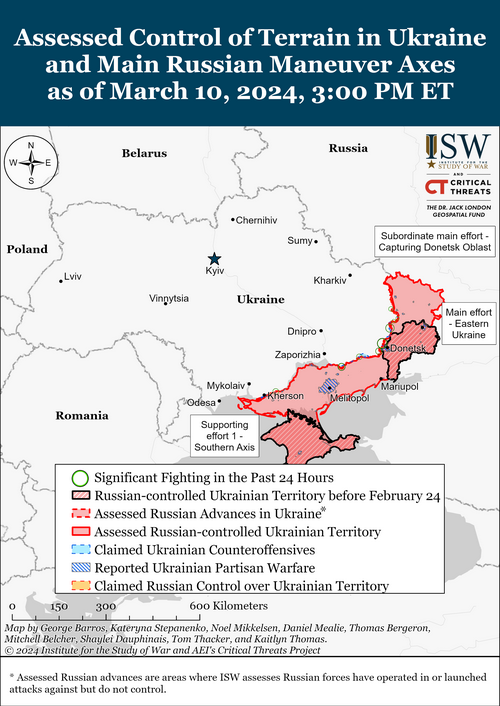
From The Institute for the Study of War:
Russian Offensive Campaign Assessment, March 10, 2024
Nicole Wolkov, Grace Mappes, Kateryna Stepanenko, Riley Bailey, and George Barros
March 10, 2024, 7:00pm ET
Click here to see ISW’s interactive map of the Russian invasion of Ukraine. This map is updated daily alongside the static maps present in this report.
Click here to see ISW’s 3D control of terrain topographic map of Ukraine. Use of a computer (not a mobile device) is strongly recommended for using this data-heavy tool.
Click here to access ISW’s archive of interactive time-lapse maps of the Russian invasion of Ukraine. These maps complement the static control-of-terrain map that ISW produces daily by showing a dynamic frontline. ISW will update this time-lapse map archive monthly.
Note: The data cut-off for this product was 1:30 pm ET on March 10. ISW will cover subsequent reports in the March 11 Russian Offensive Campaign Assessment.
A Ukrainian military official confirmed that Russian forces are conducting strikes in Ukraine with improved glide bombs. Ukrainian Tavriisk Group of Forces Spokesperson Captain Dmytro Lykhovyi reported on March 10 that Russian forces struck Myrnohrad, Donetsk Oblast, with three universal interspecific glide munition (UMPB) D-30SN guided glide bombs that Ukrainian forces initially originally assessed were S-300 missiles.[1] Lykhovyi stated that improved UMPB D-30SN guided glide bombs essentially convert Soviet-era FAB unguided gravity bombs to guided glide bombs. Russian forces had previously used unguided glide bombs as recently as January 2024.[2] ISW recently observed Russian milbloggers claim that Russian forces began conducting strikes with FAB UMPB guided glide bombs, as opposed to using unguided glide bombs with unified planning and correction modules (UMPC), in unspecified areas in Ukraine.[3] A Russian milblogger claimed that UMPB guided glide bombs have a guidance system that includes a noise-resistant GLONASS/GPS “Comet” signal receiver and folding wings similar to a Kh-101 cruise missile.[4] Russian milbloggers claimed that Russian forces can launch UMPB guided glide bombs from aircraft and ground-based multiple rocket launch systems (MLRS) such as Tornado-S and Smerch MLRS.[5] A Russian outlet claimed that Russian aviation is currently launching UMPBs without jet engines, but that Russia anticipates employing UMPBs with jet engines in the future.[6] Russian milbloggers claimed that UMPB guided glide bombs with a jet engine and fuel tank, currently absent from aerial glide bombs with UMPC, will allow Russian aviation to drop guided glide bombs from a lower altitude “similar to air-to-surface cruise missiles” and increase the maximum strike range to 80-90 kilometers.[7] Russian milbloggers claimed that the increased range of UMPB guided glide bombs will allow Russian Aerospace Forces (VKS) to increase the depth of strikes on Ukrainian positions without risk from Ukrainian air forces detecting or destroying Russian fixed-wing aircraft.[8] Russian milbloggers claimed that the Russian defense industrial base (DIB) is attempting to mass-produce UMPB guided glide bombs.[9] Russian forces will likely attempt to serialize production of UMPB guided glide bombs and increase their use across the frontline.
Russian sources reported that Northern Fleet Commander Admiral Alexander Moiseev has replaced Admiral Nikolai Yevmenov as Commander-in-Chief of the Russian Navy. St. Petersburg news outlet Fontanka reported on March 10 that Moiseev was appointed as Commander-in-Chief of the Russian Navy, and former Black Sea Fleet (BSF) Commander retired Admiral Vladimir Komoyedov later stated that Moiseev is the new Commander-in-Chief of the Russian Navy in an interview with Ural Regional State newswire URA.ru.[10] Russian milbloggers similarly claimed that Moiseev was appointed to command the Russian Navy and that recent command changes in the Russian Navy are occurring amid a “complete paralysis” of fleet leadership about new threats, likely referring to recent Ukrainian strikes against BSF assets in and near occupied Crimea.[11] Russian sources recently claimed that the Russian military officially removed BSF Commander Admiral Viktor Sokolov and replaced him with BSF Chief of Staff Vice Admiral Sergei Pinchuk.[12] ISW cannot confirm either Pinchuk’s or Moiseev’s reported appointments. The Russian Ministry of Defense (MoD) is in the process of depriving the Northern Fleet of its status as an “interservice strategic territorial organization” (a joint headquarters in Western military parlance) to restore the Moscow and Leningrad Military Districts (MMD and LMD), and Moiseev may have been appointed as Commander-in-Chief of the Russian Navy to retain a high-ranking command role.[13]
Russian occupation authorities opened early voting in occupied Ukraine for Russia’s presidential election on March 10 that will last until March 14. Kremlin newswire TASS reported on March 10 that early voting started in occupied Donetsk Oblast, but noted that early voting in areas close to the frontline has been ongoing since February 25.[14] TASS stated that stationary polling stations will open in occupied Ukraine on March 15-17. Ukrainian Luhansk Oblast Military Administration Head Artem Lysohor stated that 2,600 Luhansk People’s Republic (LNR) election commission officials have been conducting door-to-door campaigning for the past 20 days.[15] Ukrainian officials stated that Russian occupation officials intend to claim a 94 percent voter turnout in occupied Ukraine.[16] ISW continues to assess that the Kremlin and Russian occupation officials intend to falsify votes in support of Russian President Vladimir Putin and fabricate a large voter turnout in an attempt to legitimize Russia’s occupation of Ukraine to the international community.[17]
Chechen officials organized a march in Grozny, Chechnya, on March 10 in support of Russian President Vladimir Putin’s candidacy in the upcoming March presidential election. Russian state media outlet TASS reported that more than 150,000 Chechens attended the march in Grozny and that Chechen Republic Head Ramzan Kadyrov’s eldest child, Chechen Presidential Administration First Deputy Head Khadizhat Kadyrova, organized the march.[18] Russian opposition outlet SOTA amplified a claim on March 9 that the Chechen State University and Grozny State Petroleum Technical University instructed its employees and students to attend the election march on March 10.[19] Kadyrov praised the rally on March 10, emphasizing the importance of the election for the Russian state and praising Putin by name.[20] Kadyrov claimed that many prominent Chechen politicians and voices attended the march but did not mention Kadyrova by name.[21] Chechen National Policy Minister Akhmed Dudayev stated that the march “reflects that we [Chechnya] are one united team of our first President, Hero of Russia Akhmat-Khadzhi Kadyrov.”[22] This election march likely supports Kadyrov’s ongoing effort to balance appealing to his Chechen constituency while courting Putin’s favor.[23]
Over 1,000 civilian ships have transited Ukraine’s “grain corridor” in the Black Sea despite persistent Russian efforts to undermine international confidence in the corridor. US Ambassador to Ukraine Bridget Brink stated on March 9 that 1,005 civilian ships have traveled from Ukrainian ports on the Black Sea through the “grain corridor” and have delivered roughly 30 million tons of cargo, including grain, to world markets.[24] A civilian ship used the Ukrainian corridor to leave a Ukrainian port for the first time in August 2023 and to reach a Ukrainian port for the first time in September 2023.[25] Russian forces began heavily targeting Ukrainian grain and port infrastructure in summer 2023 in an effort to exact concessions on the renewal of the defunct Black Sea grain deal and have continued those strikes in part to discourage civilian maritime traffic through the corridor.[26]
The Russian Ministry of Defense (MoD) awarded a state honor to a prominent Russian ultranationalist — who is an active supporter of imprisoned former officer and ardent ultranationalist Igor Girkin — likely as part of ongoing Kremlin campaign to coopt the critical milblogger community. Russian Defense Minister Sergei Shoigu signed a decree awarding Russian military volunteer and milblogger Vladimir Grubnik with the “For Military Cooperation” medal on January 24, 2024.[27] Grubnik routinely publishes and amplifies posts in support of Girkin (also known under the alias Strelkov) – who is a prominent critic of the Russian MoD, the Russian military command, and the Kremlin.[28] Grubnik is also a member of the Russian Strelkov Movement, which advocates for Girkin‘s release from prison, and the Russian Angry Patriots Club, which Girkin founded and briefly headed in 2023.[29] Grubnik had also previously amplified posts that criticized the Russian MoD and the military command, some of which directly accused Shoigu of military failures in Ukraine.[30] Grubnik notably defended Shoigu from accusations posed by deceased Wagner Group financier Yevgeny Prigozhin during his mutiny in June 2023, however.[31] ISW had previously observed that the Kremlin began to coopt Russian milbloggers critical of the Russian war effort’s poor performance by offering them state awards or government positions starting November 2022 in an effort to regain control over the Russian information space.[32] Grubnik’s award may indicate that the Kremlin is attempting to secure control over the group of ultranationalists who support Girkin’s extremist views, are actively providing military and humanitarian help to Russian forces on the frontline, and have participated in the Russian invasion of Donbas and Crimea in 2014. Grubnik’s award, however, is different than the Order of Merit of the Fatherland Second Class medals that the Kremlin previously awarded to two other milbloggers explicitly for their milblogger activities, but the reason for Grubnik’s award is likely related to his volunteer efforts on the frontline.[33]
Key Takeaways:
- A Ukrainian military official confirmed that Russian forces are conducting strikes in Ukraine with improved guided glide bombs.
- Russian sources reported that the Russian military command has replaced Admiral Nikolai Yevmenov with Northern Fleet Commander Admiral Alexander Moiseev as Commander-in-Chief of the Russian Navy.
- Russian occupation authorities opened early voting in occupied Ukraine for Russia’s presidential election on March 10 that will last until March 14.
- Chechen officials organized a march in Grozny, Chechnya, on March 10 in support of Russian President Vladimir Putin’s candidacy in the upcoming March presidential election.
- Over 1,000 civilian ships have transited Ukraine’s “grain corridor” in the Black Sea despite persistent Russian efforts to undermine international confidence in the corridor.
- The Russian Ministry of Defense (MoD) awarded a state honor to a prominent Russian ultranationalist — who is an active supporter of imprisoned former officer and ardent ultranationalist Igor Girkin — likely as part of an ongoing Kremlin campaign to coopt the critical milblogger community.
- Russian forces recently made confirmed advances near Bakhmut and Avdiivka amid continued positional engagements along the entire frontline on March 10.
- Prominent Russian ultranationalists praised Russian volunteers and mobilized personnel on March 10, likely to assuage continued concerns among these personnel in spite of their improper and inequal treatment in the Russian military.
Go here to read the rest. The Russian Presidential election is finally upon us, the outcome certain. After it is concluded on March 14, we will see where Putin goes militarily in the Ukraine.


News this AM that Russian government is planning heavy tax increases after the war in order to pay the bills. Will please the militants but cause a loss of public support. Soviet union fell not because of the Afghan war itself but because of the effects of the war on most of the country’s average citizens.