
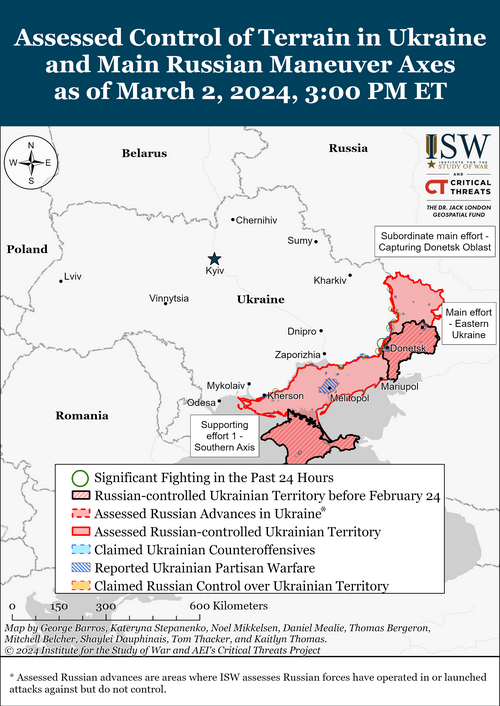
From The Institute for the Study of War:
Russian Offensive Campaign Assessment, March 2, 2024
Nicole Wolkov, Angelica Evans, Christina Harward, Riley Bailey, and Kateryna Stepanenko
March 2, 2024, 6:05pm ET
Click here to see ISW’s interactive map of the Russian invasion of Ukraine. This map is updated daily alongside the static maps present in this report.
Click here to see ISW’s 3D control of terrain topographic map of Ukraine. Use of a computer (not a mobile device) is strongly recommended for using this data-heavy tool.
Click here to access ISW’s archive of interactive time-lapse maps of the Russian invasion of Ukraine. These maps complement the static control-of-terrain map that ISW produces daily by showing a dynamic frontline. ISW will update this time-lapse map archive monthly.
Note: The data cut-off for this product was 12:30pm ET on March 2. ISW will cover subsequent reports in the March 3 Russian Offensive Campaign Assessment.
Russian forces appear to be willing to risk continued aviation losses in pursuit of tactical gains in eastern Ukraine, likely along the Avdiivka-Donetsk City line. The Ukrainian Air Force reported on March 2 that Ukrainian forces destroyed one Su-34 aircraft that was conducting glide bomb strikes against Ukrainian positions in eastern Ukraine on the morning of March 1.[1] Ukrainian Air Force Commander Lieutenant General Mykola Oleshchuk later stated that Ukrainian forces attempted to down two additional Russian Su-34 aircraft and one Su-35 and downed one of the Su-34 aircraft.[2] Ukrainian military officials reported that Ukrainian forces have shot down 15 Russian aircraft since February 17.[3] Ukrainian Air Force Spokesperson Colonel Yuriy Ihnat stated that Russian forces have not deployed A-50 long-range radar detection aircraft over the Sea of Azov for the past six days following the destruction of an A-50 aircraft on February 23 and implied that the absence of A-50 aircraft forces Russian Su-34 and Su-35 aircraft to fly closer to their targets to conduct strikes.[4] Previous Russian aircraft losses have prompted Russian forces to temporarily decrease aviation activity throughout Ukraine, but the increased rate of Russian aviation losses in Ukraine in the past weeks has yet to prompt Russian forces to significantly decrease tactical aviation activity.[5] ISW assessed that Russian forces temporarily established limited and localized air superiority during the final days of the Russian seizure of Avdiivka.[6] Russian forces are likely attempting to reestablish this limited and localized air superiority in order to support tactical Russian advances in the Avdiivka direction and have decided that continued offensive operations with air support outweigh the risk of losing more aircraft. ISW continues to assess that the reported loss of 15 aircraft and possibly some highly trained pilots in about two weeks is not negligible for the Russian military given that Russia likely has about 300 various Sukhoi fighter aircraft.[7]
Transfers of North Korean weapons to Russia by sea apparently paused as of mid-February 2024. North Korea-focused outlet NK Pro reported on February 29, citing satellite imagery, that Russian ships involved in the maritime transport of North Korean ammunition and weaponry to Russia have not docked at North Korea’s Rajin Port since February 12.[8] NK Pro reported that Russian ships have made at least 32 trips between the Rajin Port and Russia’s Dunay and Vostochny ports, Primorsky Krai since August 2023. NK Pro reported that the Russian Lady R cargo ship transported an unspecified number of shipping containers, likely containing North Korean ammunition and weapons, between North Korea and Russia from January 30 to February 8 and that the Maia-1 cargo ship arrived at Russia’s Vostochny Port from North Korea on February 12. NK Pro reported that satellite imagery has not captured another large cargo ship traveling between the two piers or new deliveries to the Rajin Port since February 12 and suggested that the pause could be due to production issues in North Korea or other logistical issues. NK Pro noted that North Korea could also be transporting weapons to Russia via air or rail. ISW previously reported that Russia uses the Baikal-Amur Railway and the East Siberian Railway to facilitate cargo transfers from and to China and North Korea, both countries that Russia is increasingly relying on for economic and military support respectively to sustain its war effort in Ukraine.[9] South Korean Defense Minister Shin Won-sik stated on February 26 that North Korea has sent an estimated 6,700 shipping containers of ammunition to Russia in recent months.[10] Shin stated that these containers could carry over three million 152mm artillery shells or roughly 500,000 122mm shells.
Russian Foreign Minister Sergei Lavrov publicly rejected Turkish President Recep Tayyip Erdogan’s recent offer to host a negotiation platform for Russia and Ukraine.[11] Lavrov attended the Antalya Diplomatic Forum in Turkey on March 1 and responded to a question about Erdogan’s offer by stating that there are no current dialogue initiatives that consider Russian interests.[12] Lavrov, Russian President Vladimir Putin, and other Kremlin officials routinely feign openness to negotiations while promoting information operations that place the onus for negotiations on the West.[13] Lavrov’s demand for a dialogue initiative that accounts for Russian interests is part of a longstanding effort to prompt preemptive Western concessions regarding Ukraine’s sovereignty and territorial integrity.[14]
Russian Foreign Minister Sergei Lavrov used the Antalya Diplomatic Forum to promote Kremlin narratives about Moldova, likely to set conditions for potential Kremlin hybrid operations that aim to destabilize Moldova and prevent Moldova’s accession to the European Union (EU). Lavrov answered a question at the Antalya Diplomatic Forum in Turkey on March 1 about the recent Congress of Deputies held in pro-Russian Moldovan breakaway region of Transnistria, which requested that Russia provide Transnistria “defense/protection.”[15] Lavrov claimed that the Moldovan government is ”moving in Kyiv’s footsteps,” reiterating his previous comparisons of Moldovan policies towards Transnistria to Ukraine before 2014.[16] Lavrov continued to claim that Moldova is discriminating against Russian speakers, applying ”economic pressure” to Transnistria, and blocking the 5+2 negotiating process for the Transnistria conflict — claims that Kremlin officials and mouthpieces have consistently repeated.[17] ISW continues to assess that the Kremlin will use the recent Transnistrian congress as a springboard to intensify hybrid operations aimed at destabilizing and further polarizing Moldova ahead of Moldova-EU accession negotiations and the Moldovan presidential election later in 2024.[18]
Senior Russian officials acknowledged Armenia’s reduced participation in the Russia-led Collective Security Treaty Organization (CSTO), marking a notable shift in Russian official rhetoric that previously sought to ignore Armenian efforts to distance itself from the CSTO. Russian Foreign Minister Sergei Lavrov stated that “it is time for Armenia to decide on its status in the CSTO,” likely in response to Armenian Prime Minister Nikol Pashinyan’s February 22 statement that Armenia “essentially” froze its participation in the CSTO because the CSTO “failed to fulfill its obligations in the field of security” to Armenia, particularly in 2021 and 2022.[19] Pashinyan stated on February 28 that Armenia has not had a permanent representative to the CSTO in the past year and that Armenian officials and forces have not participated in CSTO events and exercises in “a long time.”[20] ISW observed that Armenia effectively abstained from the CSTO by failing to send representatives to several consecutive CSTO events in mid-to-late-2023.[21] Pashinyan has increasingly publicly questioned Armenia’s security relations with Russia since mid-2023.[22] The Russian Ministry of Foreign Affairs previously responded to Pashinyan’s statements about the CSTO by rejecting his claims and emphasizing Armenia’s continued membership in the CSTO.[23] Lavrov’s acknowledgment of Armenia’s continued objection to its participation in the CSTO indicates that the Kremlin may be preparing a more concerted response to its deteriorating relations with Armenia.
The Kremlin appears to have largely permitted displays of anti-war sentiment in Moscow as Russians observed Russian opposition leader Alexei Navalny’s funeral on March 1. Russian opposition sources reported that up to 16,500 people attended Navalny’s funeral at the Borisovsky Cemetery in Moscow, and footage shows that crowds of people queueing for the funeral chanted anti-war slogans and calls for demobilization.[24] Russian civil rights group OVD-info reported that Russian authorities detained 15 people in Moscow and 89 other people in 18 other Russian cities in connection with Navalny’s funeral by the night of March 1 to 2.[25] Russians continued to lay flowers at Navalny’s grave in Moscow and at memorials elsewhere on March 2, although relatively large displays of anti-war sentiment did not continue on March 2.[26] The Moscow Times reported on March 1 that the Kremlin tasked Russian Federal Security Service (FSB) and Ministry of Internal Affairs (MVD) officials with conducting an operation to ”protect the constitutional order from threats” during Navalny’s funeral.[27] The Kremlin likely did not order large crackdowns against displays of anti-war sentiment in order to avoid prompting wider outrage while also projecting confidence in public support for Russian President Vladimir Putin and his war effort in Ukraine ahead of presidential elections on March 17.
Key Takeaways:
- Russian forces appear to be willing to risk continued aviation losses in pursuit of tactical gains in eastern Ukraine, likely along the Avdiivka-Donetsk City line.
- Transfers of North Korean weapons to Russia by sea apparently paused as of mid-February 2024.
- Russian Foreign Minister Sergei Lavrov publicly rejected Turkish President Recep Tayyip Erdogan’s recent offer to host a negotiation platform for Russia and Ukraine.
- Russian Foreign Minister Sergei Lavrov used the Antalya Diplomatic Forum to promote Kremlin narratives about Moldova, likely to set conditions for potential Kremlin hybrid operations that aim to destabilize Moldova and prevent Moldova’s accession to the European Union (EU).
- Senior Russian officials acknowledged Armenia’s reduced participation in the Russia-led Collective Security Treaty Organization (CSTO), marking a notable shift in Russian official rhetoric that previously sought to ignore Armenian efforts to distance itself from the CSTO.
- The Kremlin appears to have largely permitted displays of anti-war sentiment in Moscow as Russians observed Russian opposition leader Alexei Navalny’s funeral on March 1.
- Russian forces made confirmed advances near Kreminna, Avdiivka, and Krynky on March 2.
- Russian Deputy Defense Minister Timur Ivanov inspected a Russian shipbuilding facility and the construction site of a new military hospital in the Republic of Dagestan during a working trip to Russia’s Southern Military District on March 2.
Go here to read the rest. Russian dependence on North Korea for weaponry and ammunition details the failure of Putin to mobilize Russian to fight his Ukrainian Adventure.


N. Korea seems to be a more reliable source of munitions than does NATO