
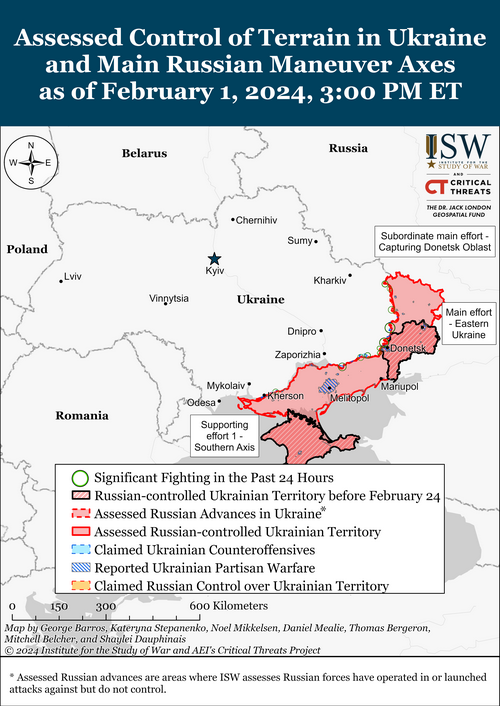
From The Institute for the Study of War:
Russian Offensive Campaign Assessment, February 1, 2024
Riley Bailey, Nicole Wolkov, Angelica Evans, Christina Harward, Grace Mappes, and George Barros
February 1, 2024, 7:40pm ET
Click here to see ISW’s interactive map of the Russian invasion of Ukraine. This map is updated daily alongside the static maps present in this report.
Click here to see ISW’s 3D control of terrain topographic map of Ukraine. Use of a computer (not a mobile device) is strongly recommended for using this data-heavy tool.
Click here to access ISW’s archive of interactive time-lapse maps of the Russian invasion of Ukraine. These maps complement the static control-of-terrain map that ISW produces daily by showing a dynamic frontline. ISW will update this time-lapse map archive monthly.
Note: The data cut-off for this product was 1pm ET on February 1. ISW will cover subsequent reports in the February 2 Russian Offensive Campaign Assessment.
Note: ISW added a new section on Russian air, missile, and drone campaign to track Russian efforts to target Ukrainian rear and frontline areas, grow its drone and missile arsenals, and adapt its strike packages.
Ukrainian Commander-in-Chief General Valerii Zaluzhnyi presented an overarching strategy to seize the theater-wide initiative in Ukraine and retain it to facilitate Ukrainian battlefield victories despite Russia’s numerical advantages in manpower and materiel. Zaluzhnyi’s strategy aims to offset Ukraine’s existing challenges and pursue advantages over the Russian military through widespread technological innovation and adaptation. The Ukrainian Armed Forces published an essay on February 1 by Zaluzhnyi titled “On the Modern Design of Military Operations in the Russo-Ukrainian War: In the Fight for the Initiative,” wherein Zaluzhnyi argued that the requirements for any given war are unique and that these requirements dictate a unique strategy for victory.[1] Zaluzhnyi identified “decisive conditions” for Ukraine to conduct successful operations, which include achieving absolute air superiority to enable effective Ukrainian fires, logistics, and reconnaissance; seizing the initiative by denying Russian forces the ability to conduct offensive or defensive operations; increasing Ukrainian mobility while limiting Russian mobility; securing safe access to unspecified key lines and important terrain; and denying Russian forces any opportunities to recapture lost positions and increase Russian operational efforts. The decisive conditions that Zaluzhnyi highlighted would effectively give Ukrainian forces the theater-wide initiative and set conditions for Ukraine to conduct operationally significant defensive and offensive operations. Zaluzhnyi argued that the rapid development of new technology changes the means by which Ukraine can achieve these “decisive conditions” and that Ukrainian forces cannot use conventional methods to achieve these conditions given Russia’s superior ability to mobilize men. Zaluzhnyi argued that new technological means, such as drones, unmanned systems, systems integration, and other advanced technological systems can allow Ukrainian forces to maximize their combat potential using fewer resources and inflict maximum damage on Russian forces.
Zaluzhnyi argued that Ukrainian limitations and geopolitical challenges are incentivizing Ukraine to pursue the development and institutionalization of these new means. Zaluzhnyi stated that an “unstable political situation around Ukraine” has led to reduced international military support for Ukraine, that Russia will likely try to provoke other conflicts to further draw the West’s attention away from Ukraine, and that Ukraine’s partners have depleted their missile and artillery ammunition stocks without the means to rapidly produce these weapons. Zaluzhnyi argued that ineffective sanctions allow the defense industrial bases (DIBs) of Russia and its partners to support a positional war of attrition that benefits Russia over Ukraine and that Russia has a significant advantage over Ukraine in the mobilization of human resources. Zaluzhnyi further highlighted imperfect Ukrainian regulatory frameworks to expand Ukraine’s DIB, although Ukrainian officials are increasingly prioritizing efforts to remedy this issue.[2] Zaluzhnyi notably concluded that the uncertain nature of the war in Ukraine makes it difficult for Ukraine’s allies to determine specific security assistance priorities for Ukraine.[3] Zaluzhnyi stated that the “main option for gaining an advantage is to master the entire arsenal of relatively cheap, new, and extremely effective and rapidly developing assets.” Zaluzhnyi specifically highlighted unmanned systems as an area where Ukraine can leverage new capabilities since they can provide continuous situational awareness, support round-the-clock fire and strikes in real-time, provide real-time intelligence, and produce accurate targeting information for strikes on the frontline and in rear areas.
Zaluzhnyi called on Ukraine to introduce a new “philosophy” for the preparation and conduct of military operations that would allow Ukrainian forces to cohesively employ these new methods in pursuit of a cohesive objective. Zaluzhnyi stated that new technological means will also expand the types of operations Ukraine can conduct in support of the war, which may include operations to reduce Russia’s economic potential, operations aimed at Russia’s complete isolation and exhaustion, robotic search and strike operations, robotic operations to control a crisis area, psychological operations, and defensive “contactless” operations. Zaluzhnyi also called on Ukrainian forces to systematically advance separate lines of effort to generate “necessary effects” in developing a coherent “digital field”; controlling the radio-electronic (the cyber-electromagnetic domain) situation along the frontline; combining attacks with unmanned and cyber assets; and improving logistics. Zaluzhnyi specifically suggested that retooling operations to integrate unmanned systems may allow Ukrainian forces to conserve personnel, weapons, and equipment while inflicting massive strikes on Russian military assets and infrastructure.
Zaluzhnyi called on Ukraine to overhaul its war effort to create “a completely new state system of technological reequipment” to master new assets and their operation. Zaluzhnyi advocated for Ukraine to retool state systems to support Ukrainian research, development, scientific support, production and maintenance, personnel training and the generalization of combat experience, the employment of forces, flexible financing, and logistics in order to prioritize the development and employment of rapidly developing technology. Zaluzhnyi added that Ukraine could create the system he envisions, with a sufficient volume of production, within five months. Zaluzhnyi concluded that this new system, alongside a new approach to military operations, can enable Ukraine to stop Russia’s current aggression and protect Ukraine in the future.
Ukrainian forces successfully struck and sunk a Russian Black Sea Fleet (BSF) vessel in the Black Sea near occupied Crimea on the night of January 31 to February 1. The Ukrainian Main Military Intelligence Directorate (GUR) published footage on February 1 showing Ukrainian maritime drones striking the Ivanovets Tarantul-class corvette (41st Missile Boat Brigade) near Lake Donuzlav in occupied Crimea.[4] The Ukrainian Navy reported that the sinking of the Ivanovets is a significant loss to the BSF since the BSF has only three ships of its project 1241.1 (Tarantul) class and noted that Ukrainian forces previously damaged a project 1239 Bora-class corvette in the 41st Missile Boat Brigade.[5] The Ukrainian Navy stated that the Ivanovets is usually staffed with 40 personnel, and the GUR stated that Russian search and rescue operations were unsuccessful.[6] ISW continues to assess that successful Ukrainian strikes on BSF vessels and infrastructure have limited the BSF’s ability to operate in the western part of the Black Sea.[7] A prominent Kremlin-affiliated Russian milblogger claimed that Ukrainian forces launched 12 Western-provided SCALP or Storm Shadow missiles against occupied Crimea on the night of January 31 to February 1.[8] The milblogger claimed that Russian forces downed five missiles near Belbek Air Base in occupied Sevastopol and six missiles over Yana Kapu, Hvardiske, and northwest of Sevastopol and that one missile struck the ground near Belbek Air Base but did not damage it.[9] Neither Ukrainian nor Russian officials confirmed these claims. Ukrainian Air Force Spokesperson Colonel Yuriy Ihnat stated that the January 31 Ukrainian strikes on Belbek Air Base damaged “several objects” but noted that Ukrainian authorities need more satellite imagery to confirm what objects Ukrainian forces struck.[10]
Russian milbloggers continued to voice frustrations about Russian forces’ continued tactical blunders during offensive operations in western Donetsk Oblast. Several Russian milbloggers criticized the Russian military command on January 31 and February 1 for failing to account for the “[drone] factor” when planning tactical assaults in response to footage posted on January 30 showing Ukrainian forces striking a column of advancing Russian vehicles and tanks near Novomykhailivka.[11] A Kremlin-affiliated milblogger noted that Ukrainian minefields are canalizing Russian routes but argued that the Russian military command still needs to stop attacking in mechanized columns due to consistently taking high equipment losses.[12] The milblogger also criticized the Russian command for failing to account for Ukrainian drone operations and to equip Russian armored vehicles with electronic warfare (EW) systems to counter Ukrainian drones.[13] Another Russian milblogger questioned how Russian commanders can fail to account for Ukrainian drones in attack plans and afford to lose so much equipment and manpower, accusing the Russian commanders of “complete stupidity and incompetence.”[14] Other Russian milbloggers seized on the discourse to advocate for continued domestic support for drone and EW production in Russia and to argue that Russian sources should not have to censor themselves if they have constructive criticism for Russian commanders.[15] The Russian military command has actively censored some Russian milbloggers in recent months for criticizing the military likely to encourage and enforce self-censorship among other Russian milbloggers.[16]
Russian milbloggers have previously argued that Russian forces need to improve their planning and coordination at the tactical and operational levels to break out of the current positional warfare in Ukraine.[17] Russian forces in Ukraine have proven capable of successfully learning lessons and adapting while conducting defensive operations and have shown limited offensive adaptation on certain sectors of the front.[18] Russian forces conducted a series of unsuccessful mechanized assaults near Avdiivka in October 2023 after analogous costly mechanized assaults along several different axes over the course of 2022 and 2023, and the recent footage of similar unsuccessful mechanized assaults near Novomykhailivka from January 30, 2024 suggests that Russian forces’ success in adapting their tactical planning and execution of assaults varies by unit-to-unit or commander-to-commander, however.[19]
The European Union (EU) unanimously approved a financial support package for Ukraine for 2024 – 2027. European Council President Charles Michel announced on February 1 that all 27 EU member states approved a support package for Ukraine worth 50 billion euros (about $54 billion), including 33 billion euros (about $35.8 billion) of loans and 17 billion euros (about $18.4 billion) in “non-repayable support” that could potentially come from frozen Russian assets.[20] Ukrainian President Volodymyr Zelensky stated that continued EU financial support will strengthen Ukraine’s long-term economic stability.[21]
EU High Representative for Foreign Affairs and Security Policy Joseph Borrell stated that the European Union (EU) will not be able to send the promised one million shells to Ukraine by March 2024, but is planning to fulfill this promise by the end of 2024. Borrell stated on February 1 that the EU delivered 330,000 rounds of artillery ammunition to Ukraine between March 2023 and January 2024 and that he expects the EU to deliver a total of 524,000 rounds by March 2024.[22] Borrell stated that the EU plans to deliver an additional 630,000 shells to Ukraine by the end of 2024. European Commission President Ursula von der Leyen stated that the European defense industrial base (DIB) has increased its production by 40 percent over an unspecified time frame and that the EU member states are working to deliver munitions to Ukraine by drawing from national stockpiles, concluding new orders, or redirecting other orders.[23] Von der Leyen stated that the European Commission will soon present a new defense and industrial strategy that will create greater coherence and coordination throughout the EU from planning to procurement. Ukrainian Main Military Intelligence Directorate (GUR) Head Lieutenant General Kyrylo Budanov stated in an interview with CNN that ammunition is “one of the most decisive factors” in the war and that the quantity of rounds is more important than quality.[24]
Chechen Republic Head Ramzan Kadyrov appointed another one of his children to a senior position in the Chechen government as of January 31. Kadyrov appointed his 24-year-old daughter Khadizhat Kadyrova as First Deputy Head of the Chechen Republic Head’s Administration from her prior post leading the Grozny City Department of Preschool Education.[25] Kadyrov previously appointed his now-26-year-old daughter Aishat Kadyrova and 17-year-old-son Adam Kadyrov to similarly senior positions.[26]
In accordance with its policy against speculating about future Ukrainian actions, ISW is not covering reported leaks concerning possible changes in the Ukrainian command structure. ISW will continue to report official statements by Ukrainian government officials and organizations as they are made.
Key Takeaways:
- Ukrainian Commander-in-Chief General Valerii Zaluzhnyi presented an overarching strategy to seize the theater-wide initiative in Ukraine and retain it to facilitate Ukrainian battlefield victories despite Russia’s numerical advantages in manpower and materiel. Zaluzhnyi’s strategy aims to offset Ukraine’s existing challenges and pursue advantages over the Russian military through widespread technological innovation and adaptation.
- Ukrainian forces successfully struck and sunk a Russian Black Sea Fleet (BSF) vessel in the Black Sea near occupied Crimea on the night of January 31 to February 1.
- Russian milbloggers continued to voice frustrations about Russian forces’ continued tactical blunders during offensive operations in western Donetsk Oblast.
- The European Union (EU) unanimously approved a financial support package for Ukraine for 2024 – 2027.
- EU High Representative for Foreign Affairs and Security Policy Joseph Borrell stated that the European Union (EU) will not be able to send the promised one million shells to Ukraine by March 2024, but is planning to fulfill this promise by the end of 2024.
- Chechen Republic Head Ramzan Kadyrov appointed another one of his children to a senior position in the Chechen government as of January 31.
- Russian forces recently made confirmed advances near Kupyansk, Avdiivka, and Donetsk City amid continued positional engagements along the entire line of contact on February 1.
- Turkish banks have reportedly started closing Russian companies’ accounts due to the threat of US secondary sanctions.
- Russian President Vladimir Putin highlighted Russian plans to integrate occupied territories of Ukraine into Russia over the next six years.
Go here to read the rest. I guess the Ukrainian Commander in Chief is worried about his job. If you really have a war winning strategy, you do not broadcast it far and wide, the enemy included in the audience. a universal contest in all wars is that most of the Brass is useless.

