
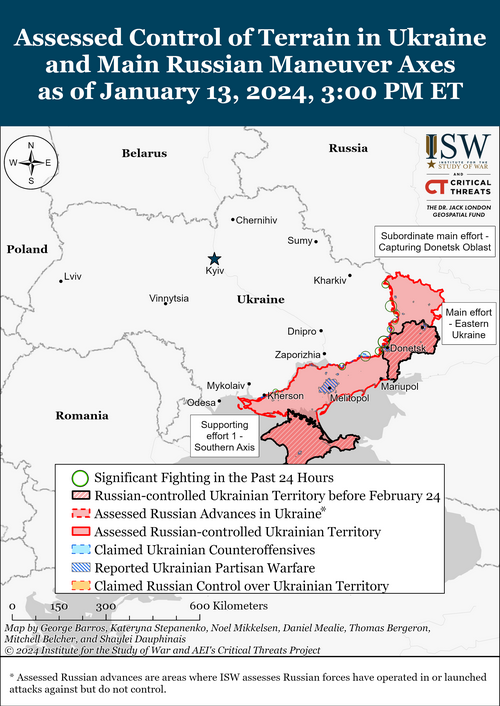
From The Institute for the Study of War:
Russian Offensive Campaign Assessment, January 13, 2024
Kateryna Stepanenko, Karolina Hird, Riley Bailey, Angelica Evans, and Frederick W. Kagan
January 13, 2024, 5:00pm ET
Click here to see ISW’s interactive map of the Russian invasion of Ukraine. This map is updated daily alongside the static maps present in this report.
Click here to see ISW’s 3D control of terrain topographic map of Ukraine. Use of a computer (not a mobile device) is strongly recommended for using this data-heavy tool.
Click here to access ISW’s archive of interactive time-lapse maps of the Russian invasion of Ukraine. These maps complement the static control-of-terrain map that ISW produces daily by showing a dynamic frontline. ISW will update this time-lapse map archive monthly.
A recent video appeal by a Serbian mercenary addressed to Russian President Vladimir Putin has unleashed discussions about an ongoing “clan war” within the Kremlin and the Russian information space against the backdrop of the Russian presidential campaign. Serbian sniper Dejan Beric (also known as “Deka”) – who has reportedly fought with Russian forces in Ukraine since Russia’s initial invasion in 2014, conducts Russian mercenary recruitment in Serbia, and became a member Putin’s election team – published a video appeal on January 8 wherein he accused military commanders of the Russian 119th Guards Airborne (VDV) Regiment (106th Guards VDV Division) of mistreating Serbian mercenaries in the “Wolves” (Volki) detachment.[1] Elements of the 119th Guards VDV Regiment are currently operating on Bakhmut’s southern flank near Klishchiivka.[2] Beric claimed that commanders of the 119th VDV Regiment forced Serbian mercenaries to conduct an assault without sufficient weapons, which prompted the entire detachment to refuse to continue attacks and demand a transfer to the nearby Chechen “Akhmat” Spetsnaz units.[3] Beric stated that Russian military officials and police declared that the Serbian mercenaries were deserters and war criminals, disarmed them, pushed them out of their trenches, and forced them to admit that they were spies.
A Russian political insider source – who routinely discusses specific details of Russian political and military command changes – claimed that Beric’s appeal is a direct indication that a “clan war” has broken out among some Russian strongmen (siloviki) within Putin’s inner circles.[4] The source claimed that Beric’s appeal is likely a part of widely discussed informational attacks against a group of Russian milbloggers who are independent and openly critical of the Russian Ministry of Defense (MoD) and that these informational attacks are part of an organized campaign against VDV commanders and their patrons. The source claimed that Beric’s appeal was part of a retaliatory attack executed on behalf of Secretary of the Russian Security Council Nikolai Patrushev’s and Defense Minister Sergei Shoigu’s respective factions within the Kremlin against the faction of Igor Sechin – Putin’s “de facto deputy” and CEO of Russian state oil company Rosneft. The source specified that Tula Oblast Governor Alexei Dyumin is an active member of Sechin’s faction and the patron of the 106th VDV Division and assessed that the Beric’s public attack against 119th VDV Regiment’s command was likely an attempt to undermine Dyumin, 106th VDV Division Commander Major General Vladimir Seliverstov, and Russian VDV and “Dnepr” Grouping of Forces Commander Colonel General Mikhail Teplinsky. Dyumin, Teplinsky, and Seliverstov have previously been involved in feuds with the Russian MoD and affiliated themselves with the Wagner Group and opposition to Shoigu.[5] The source implied that Sechin’s faction launched public attacks on Patrushev’s faction by amplifying problems with Russian egg supplies, which had been inadequately handled by Russian Minister of Agriculture Dmitry Patrushev – who is also Patrushev’s son.[6] Shoigu’s faction had also faced similar public attacks on its inability to deal with the collapse of the communal infrastructure in Moscow Oblast and problems with the Defenders of Fatherland Foundation. Putin notably recently obliquely criticized Dmitry Patrushev and Shoigu for their respective failures.[7] The source implied that factions are attempting to discredit each other in Putin’s eyes to ensure that they can secure new positions within the Kremlin following the presidential election. Another insider source claimed that First Deputy of the Main Directorate of the Russian General Staff (GRU) Lieutenant General Vladimir Alekseyev approved Beric’s appeal to bring Putin’s attention to the lack of supplies within the military amidst rumors about Alekseyev’s dismissal.[8]
In-fighting and factional dynamics within the Kremlin are not new phenomena and do not indicate the imminent collapse of Putin’s regime, particularly because power verticals are the foundation of Putin’s regime. ISW has routinely assessed that Putin deliberately creates an environment in which officials within his inner circle must compete for his favor, largely to ensure that his lieutenants remain loyal to him and his regime.[9] ISW also observed that Putin has an affinity for rotating officials and military commanders instead of outright dismissing them to prevent any single individual from amassing too much political influence and to maintain support among competing factions.[10] Putin is unlikely to change this system and eliminate these power verticals as they serve as a foundation of his rule. ISW has also observed numerous instances of Russian officials and commanders using the Russian information space to attract Putin’s attention, discredit an opposing faction, and influence changes within Putin’s inner circle.[11] Such factional feuds have notable but not dispositive battlefield effects. They can damage cohesion between Russian forces and demoralize Russian personnel but are unlikely to lead to mass conflict within the Russian ranks or wider society. A Russian “Storm-Z” assault unit instructor observed in response to Beric’s appeal that numerous Russian detachments and units are facing problems similar to those experienced by the Serbian mercenaries and implied that the Russian military has systematic issues that are prevalent outside of factional dynamics.[12] Permanent friction among the different factions that play roles in Putin’s war in Ukraine can impede Russia’s decision-making, however, and limit the Kremlin’s ability to bring coherence and efficiency to the Russian military.
Russian forces launched a medium-sized drone, missile, and air attack against Ukraine on the night of January 12-13 using a strike package similar to the recent Russian strike packages. Ukrainian military sources reported that Russian forces launched 40 long-range munitions at Ukraine from various directions—seven S-300/S-400 anti-aircraft missiles from Belgorod Oblast; three Shahed-131/131 drones from Kursk Oblast; six Kh-47 “Kinzhal” aero-ballistic (ostensibly hypersonic) missiles from six MiG-31K aircraft over Tambov Oblast; up to 12 Kh-101/555/55 cruise missiles from 11 Tu-95MS strategic bombers over the Caspian Sea; six Kh-22 cruise missiles from Tu-22M3 bombers over Bryansk Oblast; two Kh-31P anti-radar missiles from two Su-35 bombers over occupied Kherson Oblast; and four Kh-59 cruise missiles from two Su-34 bombers over Bryansk Oblast.[13] Ukraine’s Air Force Command reported that Ukrainian air defense destroyed seven Kh-101/555/55 cruise missiles and one Kh-59 cruise missile.[14] Ukrainian military officials notably stated that Ukrainian forces also disabled over 20 of the missiles using “active countermeasures by means of electronic warfare,” which may be an inflection in Ukrainian electronic warfare capabilities that are normally credited with disabling Russian drones but not missile systems.[15] ISW previously assessed that Russia’s ongoing strike campaign against Ukraine, and Ukrainian adaptations to counter new Russian strike packages, is part of a wider tactical and technological offense-defense race between long-range strike and air defense capabilities.[16] Ukrainian Air Force Spokesperson Yuriy Ihnat noted that the Russian strike package used on January 13 was similar to the strike package that Russian forces used on January 8 and in previous recent strikes—suggesting that Ukrainian forces may be able to discern patterns in recurring Russian strike packages and innovate and adapt accordingly.[17]
Russian forces are reportedly increasingly using chemical weapons in Ukraine in continued apparent violations of the Chemical Weapons Convention, to which Russia is a party. The Ukrainian General Staff reported that Russian forces have used chemical weapons 626 times since the beginning of the full-scale invasion and have used them at least 51 times so far in 2024.[18] The Ukrainian General Staff reported that Russian forces currently launch chemical weapons at Ukrainian positions up to 10 times a day and that Russian forces typically use drones to drop K-51 grenades filled with irritant CS gas (2-Chlorobenzalmalononitrile), a type of tear gas used for riot control (also known as a Riot Control Agent [RCA]), onto Ukrainian positions.[19] The Ukrainian General Staff reported that Russian forces used a new type of special gas grenade containing CS gas against Ukrainian positions on December 14, 2023.[20] The Russian 810th Naval Infantry Brigade previously acknowledged on December 22 that the brigade deliberately uses chemical weapons by dropping K-51 grenades from drones onto Ukrainian positions near Krynky in the east (left) bank of Kherson Oblast.[21] Russia is a party to the Chemical Weapons Convention (CWC), which prohibits the use of RCAs as a method of warfare.[22]
A fire destroyed a large warehouse in St. Petersburg belonging to Russia’s largest online retailer Wildberries on January 12.[23] Russian sources claimed that on the night of January 10 to 11 a mass fight broke out between migrant workers at the facility and that this prompted Russian authorities to conduct a raid on the warehouse, during which several migrants received military summonses.[24] Russian law enforcement recently detained 700 migrants at a Wildberries warehouse in Moscow Oblast and issued some military summonses in November 2023.[25] Russian authorities have consistently conducted raids on migrant communities to issue military summonses to naturalized migrants and coerce other migrants into military service.[26] Wildberries appears to be a notable target for these mobilization raids, and the company has previously admitted that such raids have interrupted their operations.[27]
Key Takeaways:
- A recent video appeal by a Serbian mercenary addressed to Russian President Vladimir Putin has unleashed discussions about an ongoing “clan war” within the Kremlin and the Russian information space against the backdrop of the Russian presidential campaign.
- In-fighting and factional dynamics within the Kremlin are not new phenomena and do not indicate the imminent collapse of Putin’s regime, particularly because power verticals are the foundation of Putin’s regime.
- Russian forces launched a medium-sized drone, missile, and air attack against Ukraine on the night of January 12-13 using a strike package similar to recent Russian strike packages.
- Russian forces are reportedly increasingly using chemical weapons in Ukraine in continued apparent violations of the Chemical Weapons Convention, to which Russia is a party.
- A fire destroyed a large warehouse in St. Petersburg belonging to Russia’s largest online retailer Wildberries on January 12.
- Russian forces made confirmed advances near Kreminna and Avdiivka amid continued positional engagements along the entire front line.
- Russian forces may be forming air assault brigades within combined arms ground formations as part of ongoing large-scale military reforms.
- Russian officials continue to fund social projects in occupied Ukraine in an effort to integrate these territories further into Russia and create the veneer of an active civil society in occupied areas.
Go here to read the rest. This blog feature will be on hiatus until January 16. My Bride and I are going up to Kenosha to assist my 92 year old mother in law in the sale of her house.

