
From The Institute For The Study of War:
Russian Offensive Campaign Assessment, January 10, 2024
Riley Bailey, Christina Harward, Angelica Evans, Nicole Wolkov, and Frederick W. Kagan
January 10, 2024, 6:55pm ET
Click here to see ISW’s interactive map of the Russian invasion of Ukraine. This map is updated daily alongside the static maps present in this report.
Click here to see ISW’s 3D control of terrain topographic map of Ukraine. Use of a computer (not a mobile device) is strongly recommended for using this data-heavy tool.
Click here to access ISW’s archive of interactive time-lapse maps of the Russian invasion of Ukraine. These maps complement the static control-of-terrain map that ISW produces daily by showing a dynamic frontline. ISW will update this time-lapse map archive monthly.
Note: The data cut-off for this product was 12:30pm ET on January 10. ISW will cover subsequent reports in the January 11 Russian Offensive Campaign Assessment.
The Kremlin’s effort to use the mythos of the Great Patriotic War (Second World War) to prepare the Russian public for a long war in Ukraine is at odds with Russia’s current level of mobilization and Russian President Vladimir Putin’s rhetorical attempts to reassure Russians that the war will not have lasting domestic impacts. St. Petersburg outlet Fontanka published an interview with Russian State Duma Defense Committee Chairman Andrei Kartapolov on January 9 wherein Kartapolov stated that even in the “victorious years of 1944 to 1945” the Soviet forces faced difficulties, prompting the interviewer to ask Kartapolov if Russia was now figuratively in 1944-1945 (i.e. nearing the end of the war in Ukraine).[1] Kartapolov attempted to expand the erroneous analogy between the Soviets’ fight against Nazi Germany and Russia’s unprovoked invasion of Ukraine by claiming that Russia is currently figuratively somewhere in December 1943 and moving into 1944.[2] The Soviet military launched a series of successful offensive operations following its defensive victory at the battle of Kursk in July 1943 and by December 1943 had reached the banks of the Dnipro River and Kyiv in Ukraine. Kartapolov explained his logic by claiming that Ukrainian forces failed in the summer 2023 counteroffensive in Zaporizhia Oblast in a way similar to Nazi Germany’s losses in battles in 1943.[3] Kartapolov’s analogy makes little sense, particularly given the fact that the Russian forces have not gained notable ground in recent months as the Soviet forces did in the months before December 1943.[4] The interviewer asked Kartapolov if his analogy suggests that Russia’s war in Ukraine will end in 2024, forcing Kartapolov to admit that Russia’s war in Ukraine and the Second World War cannot be literally compared.[5] Kartapolov nevertheless continued to use allusions to the Second World War to claim that the Russian military would continue the war in Ukraine until it installed a “banner over the Reichstag” (i.e. complete victory in Ukraine that achieves all of Putin’s maximalist objectives).[6]
Kartapolov also alluded to the Second World War in response to a question about demobilization for Russian servicemen called up during Russia’s partial mobilization by arguing that mobilized Soviet personnel did not go home in 1942 just because they had been fighting for a year.[7] Kartapolov characterized Russian calls for demobilization as part of operations by Ukrainian and Western intelligence services.[8] The interviewer pushed back against Kartapolov’s allusion and stated that the entire Soviet Union was mobilized during the Second World War whereas only one percent of the Russian population is mobilized today (likely referencing Putin’s December 1 decree alleging that the Russian military has a total of 2.039 million personnel, 1.32 million of whom are combat personnel on a population of roughly 145 million).[9] The interviewer argued that either Russian officials should mobilize the entire country or mobilized personnel unwilling to sign contracts should be able to conclude their military service.[10] Kartapolov responded by reiterating the Kremlin’s rhetorical line that there is no need for general mobilization now or in the near future.[11]
This exchange prominently highlights the disconnect between Russian force generation efforts and efforts to gradually mobilize Russia’s defense industrial base (DIB) and the Kremlin’s routine rhetorical reliance on the mythos of the Great Patriotic War. The Soviet Union mobilized roughly 34.5 million people during the Second World War, including roughly 35 percent of its male population, and committed almost the entirety of Soviet industry not destroyed by Nazi Germany to the war effort.[12] The Russian leadership continues to indicate a deep desire to avoid a wider mobilization and continues efforts to gradually mobilize Russia’s DIB in a way that is less disruptive to the Russian economy.[13] Kartapolov was likely attempting to promote a victorious portrayal of events in Ukraine while arguing that the Russian public should be prepared for a longer war effort. The Kremlin has routinely relied on allusions to the Second World War to try to achieve this effect throughout the war in Ukraine.[14]
Kremlin rhetoric casting Russia’s unprovoked invasion of Ukraine as a long total war for national survival also undermines Putin’s efforts to reassure Russians about the domestic impacts of the war and assuage discontent about the Russian state’s expectations for Russian service. Putin met with residents in Anadyr, Chukotka Autonomous Okrug, on January 10 and attempted to reassure residents that there are no issues with material or financial support for Russian servicemembers in Ukraine.[15] Putin also promised residents that Russian personnel should have a right to receive leave for a six-month period in which they received no leave as well as for the next six-month period.[16] Putin’s focus on providing promised leave is notably at odds with Kartapolov’s description of a war effort reminiscent of the Soviet Union’s in the Second World War, during which soldiers did not get regular leave. Putin and the Kremlin have routinely tried to assuage Russian concerns that the war in Ukraine will have long term economic impacts, and appeals to Russian economic anxiety appear to be a major aspect of Putin’s 2024 presidential campaign.[17] Kartapolov may be purposefully promoting longer-term Kremlin messaging that Putin and other higher-ranking Kremlin officials may want to avoid during Putin’s presidential campaign. There is no indication that erroneous Russian comparisons between the war in Ukraine and the Second World War reflect an intent within the Kremlin to bring Russia to a wartime footing remotely reminiscent of the Soviet Union’s full-scale mobilization during the Second World War. Constant Kremlin allusions to World War II are meant in part to create the entirely false impression that Russia today can sweep aside its enemies relying on mass and weight of overwhelming manpower and materiel as the Red Army supposedly did to Nazi Germany.
The Kremlin may be instructing actors in the Russian-backed breakaway republic of Transnistria to set information conditions for a possible false-flag operation in Transnistria as part of wider Kremlin efforts to destabilize Moldova. The Transnistrian Ministry of State Security (MGB) issued a press release on January 10 claiming that an “incident” occurred on January 7 during which “two Transnistrian citizens were transferred to the territory of Ukraine” but that authorities are clarifying the circumstances of the “incident.”[18] The MGB is a Russian-dominated organization that is commonly understood to be a “department of the Russian FSB (Federal Security Service)” that likely takes orders directly from Moscow.[19] Kremlin newswire TASS published an interview with Transnistrian President Vadim Krasnoselsky on January 9 wherein he claimed that Moldova’s “militarization” threatens Transnistria, blamed Moldova for halting negotiations with Transnistria, and emphasized Transnistria’s “extensive” cooperation agreements with Russia.[20] Krasnoselsky’s interview was likely part of efforts to set information conditions aimed at destabilizing Moldova and justifying any future Russian campaigns in the region.[21] The MGB’s January 10 press release is likely also part of such Kremlin efforts.
The Kremlin may attempt to use false flag operations in Transnistria as an effort to claim that Russia must protect ethnic Russians and Russian-speakers. The Russian Ministry of Foreign Affairs (MFA) stated on January 10 that it summoned the Moldovan Ambassador to Russia to protest Moldova’s “unfriendly actions,” including the “politically motivated persecution of Russian and Russian-language media” and “cases of discrimination against Russian citizens entering Moldova.”[22] The Russian MFA threateningly stated that if such actions continue, “the Russian side reserves the right to take additional retaliatory measures.” The Russian MFA also claimed that there are media reports that Moldova plans to assist NATO in training Ukrainian forces on Moldovan territory, which would amount to Moldova’s “direct involvement” in hostilities on the side of Ukraine. Kremlin officials have recently intensified references to “compatriots abroad” and the “Russian World” (Russkiy Mir), concepts that Russia often uses to justify its right to defend ethnic Russians and Russian-speakers beyond its borders.[23] Russia notably used similar justifications when it militarily intervened on behalf of separatist Transnistria in 1992.[24]
The Kremlin likely attempted to set information conditions for a possible false-flag operation in Transnistria in April 2022 and February 2023 but failed in part for economic reasons.[25] CTP previously assessed that the Kremlin was unable to draw Transnistria into its war in Ukraine at the time because Transnistrian businesses – notably those of Moldovan-Russian businessman Viktor Gushan, who effectively controls Transnistria’s government and a large part of its economy – benefited from ties with the West and Ukraine.[26] The EU’s Deep and Comprehensive Free Trade Area (DCFTA) agreement with Moldova allowed Transnistrian businesses registered in Moldova to enjoy tariff-free access to EU markets as long as they followed Moldovan custom checks.[27] Recent changes to the Moldovan Customs Code that require Transnistrian businesses to pay import customs duties to Moldova may have disrupted these benefits.[28] Moldova has also indicated in recent months its willingness to initially join the EU without Transnistria, which would further deprive Transnistrian businesses of special access to EU markets.[29]
The Kremlin may also be reviving its efforts to leverage Transnistria to create instability in Moldova in order to undermine Ukrainian grain exports along the western coast of the Black Sea. Reuters reported on January 10 that Romania’s Black Sea port of Constanta recorded 36 million metric tons of shipped grain in 2023 – a record high – and that about 40 percent of these shipments consisted of Ukrainian grain.[30] ISW previously assessed that Ukrainian strikes against Russian Black Sea Fleet (BSF) assets forced Russian naval operating patterns to change and forced the BSF to move some ships away from its main base in occupied Sevastopol in western Crimea.[31] Ukrainian strikes against BSF assets have also successfully facilitated the civilian use of Ukraine’s Black Sea grain corridor as international support for the corridor continues to increase despite Russia’s withdrawal from the Black Sea Grain Initiative and military threats against it. The Kremlin may view a false flag operation in Transnistria as an alternative way to deter countries from participating in Ukraine’s grain corridor despite Russia’s weakened presence in the western Black Sea.
Iran has reportedly developed a new Shahed drone for Russian forces to use against Ukraine and is “close” to providing Russia with surface-to-surface ballistic missiles and systems. An unspecified security source told Sky News in an article published on January 10 that Iran has developed an “explosive and reconnaissance” Shahed-107 drone and has offered “a few units” to Russia for over $2 million.[32] The source stated that the Shahed-107 has a range of up to 1,500 kilometers and has a video livestream transmitter.[33] ISW recently observed reports that Russian forces had launched a new Shahed model, the Shahed-238, which is different from the Shahed-107, against Ukraine.[34] Sky News’ source also stated that Russia is expecting to receive surface-to-surface ballistic missiles and systems from Iran ”sometime soon.”[35] US National Security Council Spokesperson John Kirby reported on January 4 that Russian officials continue efforts to buy ballistic missiles from Iran.[36] ISW assessed that Russia may be intensifying efforts to source ballistic missiles from abroad because these missiles appear more effective at striking targets in Ukraine in some circumstances.[37] Russian Foreign Minister Sergei Lavrov and Iranian Foreign Minister Hossein Amir Abdollahian discussed the development of a comprehensive strategic partnership agreement, trade cooperation, the construction of the Rasht-Astara railway in Iran, and the Israel-Hamas war among other topics in a January 9 phone call.[38]
European Union (EU) Internal Market Commissioner Thierry Breton stated that the EU will be able to supply Ukraine with one million shells by spring 2024.[39] Breton stated that the EU will need to reduce its ammunition exports to non-EU countries and ensure that EU countries pressure their defense industries to increase production.[40] Breton stated that it is “extremely important” for the EU to have the same weapons production capacity as Russia and that the EU could reach this goal within 18 months to two years.[41] CBC News reported on January 9 that Canada has yet to deliver the NASAMS air defense system that it pledged to send to Ukraine in January 2023.[42] CBC News also reported that one of the two companies building the NASAMS system claimed that it does not have a Canadian contract for the system.[43] Ukrainian military officials recently noted that Ukraine has a shortage of anti-aircraft guided missiles after several recent large Russian missile and drone strikes.[44] Ukrainian forces also reportedly face artillery ammunition shortages on the frontline.[45]
Lithuania announced a new long-term military aid package to Ukraine worth 200 million euros (about $220 million) on January 10.[46] The World Bank reported that Lithuania’s GDP in 2022 totaled $70.97 billion indicating that this long-term military aid package is equivalent to 0.3 percent of Lithuania’s total GDP.[47] The Kiel Institute for the World Economy reported that Lithuania’s total bilateral aid to Ukraine totaled 1.4 percent of its GDP as of October 31, 2023.[48] US aid to Ukraine amounted to roughly 0.3 percent of US GDP as of October 2023.[49] Ukrainian President Volodymyr Zelensky met on January 10 with Lithuanian President Gitanas Nauseda, who reaffirmed Lithuania’s support for Ukraine joining NATO and stated that Lithuania is forming a “demining coalition” to support Ukraine.[50] The Ukrainian Ministry of Strategic Industry and the Lithuanian Defense and Security Industry Association also signed a memorandum of understanding to support joint defense industry projects.[51] Ukrainian state-owned defense enterprise Ukroboronprom signed letters of intent with Lithuanian technology and defense companies RSI Europe, Brolis Semiconductors, DMEXS, and NT Service.[52]
The very characteristics that make the Russian ultranationalist milblogger community popular – its perceived independence from and willingness to criticize the Russian government – likely continue to complicate the Kremlin’s efforts to co-opt the community as Kremlin mouthpieces. A group of Russian milbloggers, led by a prominent Kremlin-affiliated milblogger, publicized efforts allegedly backed by Russian authorities to censor a smaller group of milbloggers who have criticized Russian operations in east (left) bank Kherson Oblast.[53] The milbloggers claimed that Russian authorities are attempting to censor any milbloggers and military correspondents who are critical of the Russian military and Russian operations in Ukraine.[54] The Kremlin-affiliated milblogger, whom Russian President Vladimir Putin and the Russian Ministry of Defense (MoD) have previously awarded, also claimed that unspecified Russian officials highlighted his January 9 post about command and communications issues in east bank Kherson Oblast as an example of ”discrediting” Russian Airborne Forces (VDV) Commander Colonel General Mikhail Teplinsky and the Russian Armed Forces.[55] Russian authorities have previously used the criminal charge of discreditation of the Russian Armed Forces to imprison other critical actors within the Russian information space, although it is unclear if the Kremlin is willing to use this charge against an affiliated and decorated milblogger.[56]
ISW has previously observed a concerted Kremlin campaign following the Wagner Group’s armed rebellion in June 2023 and the death of Wagner financier Yevgeny Prigozhin in August 2023 to establish more control of the Russian information space that largely achieved the intended effect of reducing public criticism of how the Russian military is conducting the war in Ukraine.[57] ISW previously assessed that prominent Russian milbloggers likely have a monetary incentive to regularly report information about the war in Ukraine that is uncritical of Russian authorities and Russian milbloggers may benefit from calling attention to censorship efforts targeting their channel, real or otherwise, to dispel the idea that they have become Kremlin mouthpieces.[58]
Russian insider sources continue to discuss the reported removal of First Deputy Head of the Main Directorate of the Russian General Staff (GRU), Lieutenant General Vladimir Alekseyev, who was reportedly in charge of the Russian “Volunteer Corps” that was intended to replace the Wagner Group in Ukraine. A Russian insider source claimed on January 10 that Alekseyev continues to fulfill his duties in an unspecified position overseeing unspecified GRU operations in Ukraine.[59] The insider source claimed that Alekseyev has accumulated a lot of control and “compromising evidence” against Russian authorities during his time in the GRU and that the Kremlin has not formally removed Alekseyev due to concerns that Alekseyev’s removal could provoke an “uncontrollable” conflict within the Russian military and GRU.[60] The insider source reiterated claims that Major General Denis Barylo “leads” the Russian “Volunteer Corps.”[61] Another Russian insider source claimed on January 8 that Russian officials forced Alekseyev to resign in fall 2023.[62]
Key Takeaways:
- The Kremlin’s effort to use the mythos of the Great Patriotic War (Second World War) to prepare the Russian public for a long war in Ukraine is at odds with Russia’s current level of mobilization and Russian President Vladimir Putin’s rhetorical attempts to reassure Russians that the war will not have lasting domestic impacts.
- The Kremlin may be instructing actors in the Russian-backed breakaway republic of Transnistria to set information conditions for a possible false-flag operation in Transnistria as part of wider Kremlin efforts to destabilize Moldova.
- The Kremlin may also be reviving its efforts to leverage Transnistria to create instability in Moldova in order to undermine Ukrainian grain exports along the western coast of the Black Sea.
- Iran has reportedly developed a new Shahed drone for Russian forces to use against Ukraine and is “close” to providing Russia with surface-to-surface ballistic missiles and systems.
- European Union (EU) Internal Market Commissioner Thierry Breton stated that the EU will be able to supply Ukraine with one million shells by spring 2024.
- Lithuania announced a new long-term military aid package to Ukraine worth 200 million euros (about $220 million) on January 10.
- The very characteristics that make the Russian ultranationalist milblogger community popular – its perceived independence from and willingness to criticize the Russian government – likely continue to complicate the Kremlin’s efforts to co-opt the community as Kremlin mouthpieces.
- Russian insider sources continue to discuss the reported removal of First Deputy Head of the Main Directorate of the Russian General Staff (GRU), Lieutenant General Vladimir Alekseyev, who was reportedly in charge of the Russian “Volunteer Corps” that was intended to replace the Wagner Group in Ukraine.
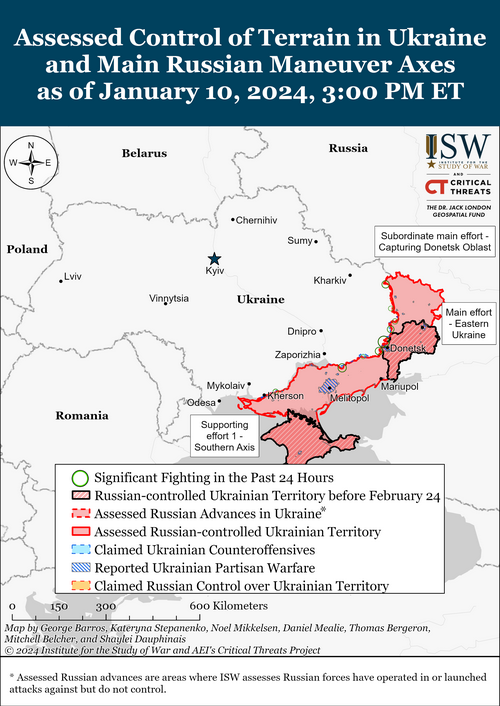
- Russian forces advanced southwest of Bakhmut and Donetsk City and in the east (left) bank of Kherson Oblast amid continued positional engagements along the entire front.
- Russian Navy Commander-in-Chief Admiral Nikolai Yevmenov stated on January 10 that the Russian military plans to reorganize the five existing naval infantry brigades of Russia’s fleets into naval infantry divisions and the Caspian Flotilla’s naval infantry regiment into a naval infantry brigade in the medium-term.
- Russian authorities continue to deport prisoners from prisons in occupied Ukraine to Russia and are likely using penal colonies as part of widespread efforts to collect data on Ukrainian citizens.
Go here to read the rest. Putin is now reaching out to the Russian Navy for cannon fodder in his ceaseless attempt to patch together combat infantry to hold the line in the Ukraine.


Latest economic intelligence on Russia indicates a drop in oil and gas income due to lower oil prices and the successful efforts of Europe to curtail purchases of Russian gas.