
From The Institute for the Study of War:
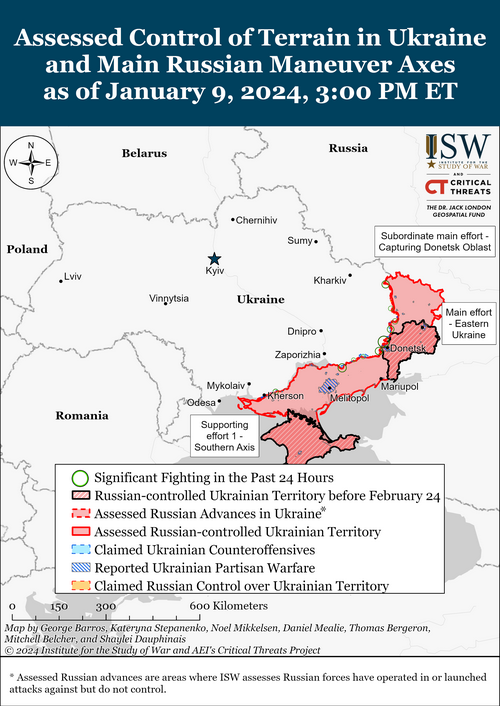
Russian Offensive Campaign Assessment, January 9, 2024
Karolina Hird, Riley Bailey, Christina Harward, Nicole Wolkov, George Barros, and Frederick W. Kagan
January 9, 2024, 7:35pm ET
Click here to see ISW’s interactive map of the Russian invasion of Ukraine. This map is updated daily alongside the static maps present in this report.
Click here to see ISW’s 3D control of terrain topographic map of Ukraine. Use of a computer (not a mobile device) is strongly recommended for using this data-heavy tool.
Click here to access ISW’s archive of interactive time-lapse maps of the Russian invasion of Ukraine. These maps complement the static control-of-terrain map that ISW produces daily by showing a dynamic frontline. ISW will update this time-lapse map archive monthly.
Note: The data cut-off for this product was 12:10pm ET on January 9. ISW will cover subsequent reports in the January 10 Russian Offensive Campaign Assessment.
A Ukrainian public opinion survey on Ukrainian attitudes towards the Ukrainian government and military indicates that Ukrainian society overwhelmingly supports Ukraine’s military and its leadership while experiencing tensions typical in a society fighting an existential defensive war. The Kyiv International Institute of Sociology (KMIS) published a survey on December 18, 2023, that it conducted between November 29 and December 9, 2023, that shows that 96 percent of respondents support the Ukrainian Armed Forces, 88 percent trust Ukrainian Commander-in-Chief General Valerii Zaluzhnyi, and 66 percent trust Ukrainian President Volodymyr Zelensky.[1] 84 percent of respondents in a previous KMIS poll conducted in December 2022 expressed trust in Zelensky, and trust in many Ukrainian institutions experienced a similar decline between December 2022 and 2023 – an unsurprising development given the protracted war.[2] The Ukrainian Armed Forces, the Ukrainian Security Service (SBU), the Ukrainian National Police, and Ukrainian volunteers did not see similar decreases in polled public trust during this time.[3]
Ukrainian sentiments in December 2022 were likely more optimistic than in November and December 2023 because Ukrainian forces had recently liberated large portions of occupied territory in Kharkiv and Kherson oblasts during successful counteroffensive operations in the fall of 2022. Ukraine’s successful counteroffensive operations in 2022 liberated the strategic regional capital city of Kherson, pushed the frontline away from several major Ukrainian population centers, and turned these cities into near rear and rear areas, which may have allowed more Ukrainians to focus on domestic issues of local governance throughout 2023 instead of the imminent existential threat of Russian military activity and occupation they faced in 2022.
The KMIS poll also shows that the majority of respondents support both Zelensky and Zaluzhnyi and that only 15 percent held polarized opinions supporting one and not the other.[4] Russian sources have widely promoted Kremlin information operations alleging a serious rift between Ukrainian military and civilian leadership and have routinely attempted to portray domestic issues in Ukraine as significantly undermining the Ukrainian will to fight.[5] These Russian information operations aim to break Ukrainians‘ trust in their leadership and weaken Ukrainian morale while also decreasing Western support for Ukraine by falsely portraying Ukrainian society as demoralized and divided. The KMIS poll suggests that these Russian information operations are far from reality and that the Russian offensive campaign in Ukraine remains highly unlikely to break Ukrainian support for Ukraine‘s military and civilian leadership and the Ukrainian will to fight.
A new independent poll from the University of Chicago’s National Opinion Research Center (NORC) found that Russian President Vladimir Putin maintains strong domestic support for his regime and his war in Ukraine, despite relatively poor economic conditions and living standards in Russia.[6] The NORC poll surveyed 1,046 Russian adults living in the Russian Federation and Russian-occupied Crimea using data from Russian mobile service providers.[7] The poll found that 67 percent of participants approve of how Putin has conducted foreign policy and 58 percent approve of his domestic policy, but that 66 percent plan to vote for Putin in the upcoming March 2024 Presidential Election.[8] Putin’s relatively high ratings appear to persevere even though the NORC poll found that Russians are unhappy with rising prices causing a general decline in living conditions.[9] The NORC poll also noted that 63 percent of participants support the war in Ukraine and that 64 percent of respondents see the war as a “civilizational struggle between Russia and the West.”[10] This result contrasts with other recent independent Russian polling that showed decreased support for Russia’s full-scale invasion of Ukraine.[11]
Russian ultranationalist vitriolic responses to gender integration in the Ukrainian military highlight Russia’s ongoing shift towards a cultural-ideological worldview that seeks to restore rigid and traditional gender roles and exposes gaps between Russia and Ukraine’s respective abilities to mobilize their societies. Ukrainian Defense Minister Rustem Umerov stated on January 8 that the Ukrainian Ministry of Defense (MoD) purchased 50,000 sets of uniforms specifically for female servicemembers for the first time.[12] Several ultranationalist Russian milbloggers inaccurately took Umerov’s statement to mean that Ukraine would be conscripting women, with one saying that the purchase of uniforms for women means “the time has come for everyone to think,” and another milblogger claiming that Ukraine is now preparing to “exterminate” 50,000 Ukrainian women.[13] Ukraine has not been conscripting women, and neither current law nor proposed bills provide for conscripting Ukrainian women.[14] Women have been volunteering to serve in the Ukrainian military, and Umerov’s statement instead reflects recent Ukrainian efforts to further increase gender integration in the Ukrainian Armed Forces by developing uniforms and body armor suited to the unique needs of female servicemembers.[15]
The negative Russian responses illuminate not only the ongoing Russian information operation designed to undermine Ukrainians’ will to fight, but also the archaic and misogynistic views shaping the worldviews of Russia’s leadership and the ultranationalist community. They also reflect the Russians’ ongoing failure to understand exactly how broadly and deeply Ukrainian society has mobilized to defend against the Russian invasion. The Ukrainian Ministry of Defense reported in October 2023 that nearly 43,000 female servicemembers are serving in the ranks of the Ukrainian Armed Forces, a 21 percent increase in female servicemembers from 2021.[16] The Ukrainian Military Media Center and Ukrainian Deputy Defense Minister Nataliia Kalmykova stated that over 5,000 female servicemembers were actively serving in frontline combat zones as of November 2023.[17]
By contrast, Russian Defense Minister Sergei Shoigu announced in March 2023 that 1,100 Russian women were serving in frontline combat positions of the 39,000 Russian women serving in the Russian Armed Forces, mostly in non-combat roles such as combat medics and cooks.[18] Russian opposition media began reporting in 2023 that Russian authorities were increasingly relying on mass forced recruitment of women from penal colonies to fill force generation requirements, suggesting that recruitment of women in Russia takes place on a much more coercive basis than the voluntarism of Ukraine’s female servicemembers.[19] Kremlin officials and Kremlin mouthpieces have recently emphasized the importance of instilling and concretizing traditional gender roles and family values as a fundamental part of Russian domestic policy, with Russian officials calling for the institution of large families with a working father and a stay-at-home mother.[20] Russian President Vladimir Putin defined 2024 as the “Year of the Family” during his New Year’s Eve address and has recently placed great weight on the role of Russian women as performing their expected role of “motherhood.”[21] The increasing Russian social reliance on traditional gender roles, as defined and encouraged by the state, is likely heavily impacting Russian social expectations for women to fight in the military, thereby impacting Russia’s ability to mobilize a significant portion of society, whereas Ukrainian society continues to be galvanized by a popular desire to defend Ukraine strong enough to bring so many Ukrainian women near and onto the battlefield of their own accord.
Ukrainian Air Force Spokesperson Colonel Yuriy Ihnat reported that Ukraine has a shortage of anti-aircraft guided missiles after several recent large Russian missile and drone strikes against Ukraine.[22] Ihnat stated that Ukraine has rationed air defense equipment and ammunition and has used a considerable amount of Ukraine’s existing air defense missile stockpile in defending against the past three large series of Russian strikes.[23] US Administration officials reported on January 8 that they met with leaders from venture capital firms and technology and defense industries to discuss providing Ukraine with US systems and equipment.[24] The meetings reportedly focused on providing Ukraine with drones, demining equipment, and means to counter Russian drones.[25]
Russian sources continue to complain about persistent command and communication problems that degrade Russian combat capability in east (left) bank Kherson Oblast. A prominent Kremlin-affiliated Russian milblogger claimed that Russian commanders have less frequently ordered units to conduct attritional assaults in the past two months since Airborne Forces (VDV) Commander Colonel General Mikhail Teplinsky replaced Colonel General Oleg Makarevich as the commander of the Russian “Dnepr” Grouping of Forces.[26] The milblogger claimed that many problems have persisted and worsened in this area, however. Russian forces operating near Krynky are reportedly unable to target Ukrainian aircraft and helicopters because the Russian command does not give them timely permission to shoot targets down.[27] Russian commanders also reportedly take several hours to approve artillery strikes and require units to send target coordinates and video or photo confirmation of targets before approving strikes.[28] The milblogger also claimed that Russian forces do not have enough electronic warfare (EW) systems to combat the number of Ukrainian drones operating in the area.[29] Another milblogger called on Russian forces to stop moving equipment to Krynky and nearby areas because Ukrainian forces destroy up to 90 percent of Russian equipment there.[30] Ukrainian military observer Kostyantyn Mashovets stated that elements of the 17th Tank Regiment (70th Motorized Rifle Division, 18th Combined Arms Army, Southern Military District), reportedly deployed southeast of Krynky, are literally “burning with desire“ to conduct heavily attritional attacks, suggesting that the command of this regiment is still relying on attritional frontal assaults as a favored attack tactic.[31] Russian forces, especially elements of the 104th Airborne (VDV) Division, have reportedly suffered significant losses in operations near Krynky.[32] ISW has consistently observed Russian complaints of inadequate command, inter- and intra-unit coordination, air defense, fire support, and EW since November 2023 but continues to assess that these reported tactical problems do not always translate into significant operational effects.[33]
Russian sources are reviving longstanding calls for a large-scale Russian offensive operation in Kharkiv Oblast to create a “buffer zone” with Belgorod Oblast despite the Russian military’s likely inability to conduct an operation to seize significant territory in Kharkiv Oblast in the near term. Kremlin spokesperson Dmitri Peskov stated on January 9 that Russian forces will do everything to prevent Ukrainian indirect fire in Belgorod Oblast.[34] Russian sources seized on Peskov’s comments to call on Russian forces to create a “buffer zone” up to 15 kilometers in depth in Kharkiv Oblast to push Ukrainian MLRS and artillery away from the international border with Belgorod Oblast.[35] Russian ultranationalists routinely called for a similar operation in summer 2023 amid widespread discontent about limited cross-border raids by pro-Ukrainian forces into Belgorod Oblast.[36] A Russian incursion 15 kilometers in depth and several hundred kilometers in width would be a massive operational undertaking that would require a grouping of forces far larger and significantly better resourced than what Russian forces currently have concentrated along the entire international border with Ukraine, least of all in Belgorod Oblast.[37] ISW has previously assessed that Russian forces may intensify efforts to capture Kupyansk, Kharkiv Oblast, in the coming weeks and that the Russian grouping in the Kupyansk direction appears more well-suited to conduct an intensified offensive effort than elsewhere in Ukraine or along the international border.[38] The Russian military is likely currently able to conduct only tactical-level actions into Kharkiv Oblast from Belgorod Oblast, which at most would serve as feints to draw and fix Ukrainian forces away from a possible Russian operational effort in the Kupyansk direction.
Recent Kremlin and Russian media rhetoric aimed at threatening Moldova likely continues to embolden pro-Russian separatist leaders in Moldova to attempt to sow political instability and division in Moldova. Vadim Krasnoselsky, the president of the Russian-backed breakaway republic of Transnistria, claimed in an interview with Kremlin newswire TASS published on January 9 that Moldova’s increased military budget, joint exercises with NATO, and military subsidies and supplies from European states are evidence of Moldova’s “militarization,” which threatens Transnistria.[39] Krasnoselsky claimed that Transnistria does not threaten Moldova and dismissed the idea that Moldova’s force generation efforts stem from a desire to defend itself, despite the fact that Russian troops have occupied Transnistria since 1992 after the Russian Federation intervened on behalf of separatist Transnistria on the pretext of protecting ethnic Russian and Russian-speaking populations.[40] Krasnoselsky also affirmed in 2018 his commitment to ensuring that Transnistria eventually becomes part of Russia.[41] Krasnoselsky claimed that Moldova “treacherously attacked [Transnistria’s] peaceful cities in the past” and has committed ”massive” human rights violations. Krasnoselsky blamed Moldova for stopping dialogue with Transnistria and abandoning previously reached agreements. Krasnoselsky claimed that Moldova is “consistently following the path of escalation” and threateningly stated that Moldova “bears the responsibility for further inevitable consequences.” ISW previously assessed that Russia is setting information conditions aimed at destabilizing Moldova and justifying any future campaigns by framing Russia as a protector of allegedly threatened Russian-language speakers in Moldova–an approach that closely parallels debunked Russian narratives used to justify the full-scale invasion of Ukraine.[42]
Krasnoselsky’s anger with a recent change to the Moldovan Customs Code likely motivated him to further the Kremlin’s efforts to set such information conditions and sow instability in Moldova. CTP has previously assessed that Krasnoselsky is closely related to Moldovan-Russian businessman Viktor Gushan, who effectively controls Transnistria’s government and a large part of its economy.[43] The Kremlin likely conducted a false flag operation in April 2022 intended to draw Transnistria into its invasion of Ukraine, but ultimately failed to win Gushan‘s support as Gushan‘s businesses benefited from ties to the West and Ukraine.[44] Moldova passed a new Customs Code in March 2023 that went into effect on January 1, 2024, and requires companies in Transnistria to pay import customs duties to Moldova.[45] Krasnoselsky claimed on January 5 that the change came as a “surprise” to Transnistria.[46] Moldovan investigative journalists reported in 2020 that two Transnistrian companies tied to Gushan’s Sheriff Enterprises imported cigarettes worth about $22 million to Transnistria without paying taxes.[47] Krasnoselsky claimed on January 9 to TASS that Moldova’s introduction of duties starting January 1, 2024, is an “unreasonable” policy that violates the trade agreement between Transnistria and the EU and that Moldova is pushing Moldovan-Transnistrian relations towards “greater confrontation.”[48] Krasnoselsky highlighted that Transnistria is striving to build direct communication with the Commonwealth of Independent States (CIS) and emphasized Transnistria’s “extensive” bilateral cooperation frameworks with Russia as means to ”help avoid risks provoked by” Moldova’s policy.[49]
Bloomberg reported that officials from Ukraine, the Group of Seven (G7) countries, India, Turkey, Saudi Arabia, and other unspecified countries held a meeting in Riyadh, Saudi Arabia on December 16 to build support for Ukrainian conditions to negotiate with Russia.[50] Unspecified individuals familiar with the meeting told Bloomberg in an article published on January 9 that officials from China, Brazil, and the United Arab Emirates (UAE) did not attend the meeting, although Brazil submitted a written statement.
Key Takeaways:
- A Ukrainian public opinion survey on Ukrainian attitudes towards the Ukrainian government and military indicates that Ukrainian society overwhelmingly supports Ukraine’s military and its leadership while experiencing tensions typical in a society fighting an existential defensive war.
- A new independent poll from the University of Chicago’s National Opinion Research Center (NORC) found that Russian President Vladimir Putin maintains strong domestic support for his regime and his war in Ukraine, despite relatively poor economic conditions and living standards in Russia.
- Russian ultranationalist vitriolic responses to gender integration in the Ukrainian military highlight Russia’s ongoing shift towards a cultural-ideological worldview that seeks to restore rigid and traditional gender roles and exposes gaps between Russia and Ukraine’s respective abilities to mobilize their own societies.
- Ukrainian Air Force Spokesperson Colonel Yuriy Ihnat reported that Ukraine has a shortage of anti-aircraft guided missiles after several recent large Russian missile and drone strikes against Ukraine.
- Russian sources continue to complain about persistent command and communication problems that degrade Russian combat capability in east (left) bank Kherson Oblast.
- Russian sources are reviving longstanding calls for a large-scale Russian offensive operation in Kharkiv Oblast to create a “buffer zone” with Belgorod Oblast despite the Russian military’s likely inability to conduct an operation to seize significant territory in Kharkiv Oblast in the near term.
- Recent Kremlin and Russian media rhetoric aimed at threatening Moldova likely continues to embolden pro-Russian separatist leaders in Moldova to attempt to sow political instability and division in Moldova.
- Bloomberg reported that officials from Ukraine, the Group of Seven (G7) countries, India, Turkey, Saudi Arabia, and other unspecified countries held a meeting in Riyadh, Saudi Arabia on December 16 to build support for Ukrainian conditions to negotiate with Russia.
- Russian forces made confirmed advances southwest of Donetsk City, and positional engagements continued along the entire frontline.
- The Russian military is reportedly abusing Serbian nationals whom Russian officials have recruited to serve in Russian formations in Ukraine.
- Russian occupation officials continue the systematic oppression of residents of occupied Crimea using law enforcement and administrative means.
Go here to read the rest.
From Strategy Page:
January 9, 2024: In 2022 Ukraine conducted a crowdfunding campaign to raise $25 million so Ukraine could build at least a hundred Unmanned Surface Vessels or USVs. These were used to carry out a series of attacks on Russian warships, ports, and other coastal targets in Black Sea. Ukraine needed to protect its coastal waters and use of the Black Sea for shipping that carried Ukrainian exports and imports. By late 2023 this effort led to the development of a new USV called Cossack Mamai. This model is a major improvement on the earlier Sea Baby USV. Cossack Mamai is faster, at about 100 kilometers an hour and armored against machine-gun bullets. To stop this USV you need a weapon that fires 20mm or larger shells accurately enough to hit and disable a USV that is only about six meters long and a hard target to hit and disable or destroy. Cossack Mamai uses a satellite link and a video camera so that it can be remotely controlled to where its target is. The USV can carry 850 kg of explosives, and this enabled several of these USVs to disable the Kerch Strait bridge between Russia and Crimea.
Ukrainian President Zelensky backed the USV program because Ukraine didn’t have any warships while the Russian Black Sea Fleet was vulnerable because Turkey has threatened to close the Dardanelles strait to additional Russian warships seeking to enter the Black Sea and reinforce the depleted Russian Black Sea Fleet. The narrow Dardanelles is the only way in or out of the Black Sea and an international treaty allows Turkey to limit warship access to the Dardanelles in wartime. Turkey is more concerned about the safety of commercial shipping in the Black Sea and the continued movement of ships carrying Ukrainian grain out and commercial cargo for Ukraine coming into the Black Sea.
Ukraine did not invent the concept of USVs but did find new ways to use them in wartime. As a country without warships, Ukraine has used UAVs, USVs and guided missile and glide bombs to attack and disable Russian naval bases in the Black Sea and gradually destroy the Russian Black Sea Fleet. This reduced Russian naval activity in the Black Sea and eliminated a major threat to commercial shipping and use of Ukrainian Black Sea ports. The Russian Black Sea Fleet had been a source of attacks on the south by launching Kalibr cruise missiles at Ukrainian cities.
Ukraine’s USV’s have also proved effective at destroying or disabling Russian warships in the Black Sea and forcing the surviving warships to move to more distant ports. This includes the primary Russian naval bases in the Black Sea, which were Sevastopol in Crimea and Novorossiysk on the east coast of the Black Sea. Novorossiysk had a small naval base facility added in 2012. Ukrainian UAVs and USVs succeeded in driving the Russian Black Sea Fleet from Sevastopol so Novorossiysk is being used to host its surviving remnants. While Novorossiysk is mainly a commercial port, exporting oil and other goods produced in the area and handling most of the imports, most of that has been halted because the Ukrainian USVs make the Black Sea a dangerous place for Russian ships of any type.
Go here to read the rest. War in this century is becoming increasingly a fight of remote controlled robots. I hope our Admirals and Generals are paying attention.

