
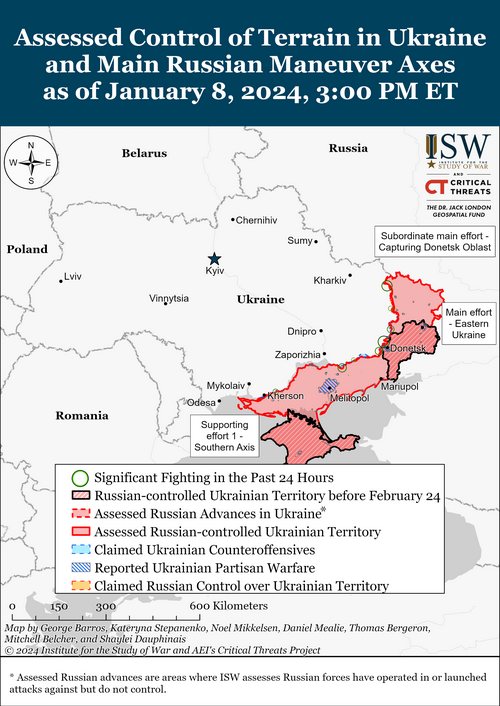
From The Institute for the Study of War:
Russian Offensive Campaign Assessment, January 8, 2024
Christina Harward, Nicole Wolkov, Grace Mappes, Angelica Evans, Kateryna Stepanenko, George Barros, and Frederick W. Kagan
January 8, 2024, 6:30pm ET
Click here to see ISW’s interactive map of the Russian invasion of Ukraine. This map is updated daily alongside the static maps present in this report.
Click here to see ISW’s 3D control of terrain topographic map of Ukraine. Use of a computer (not a mobile device) is strongly recommended for using this data-heavy tool.
Click here to access ISW’s archive of interactive time-lapse maps of the Russian invasion of Ukraine. These maps complement the static control-of-terrain map that ISW produces daily by showing a dynamic frontline. ISW will update this time-lapse map archive monthly.
Note: The data cut-off for this product was 12:30pm ET on January 8. ISW will cover subsequent reports in the January 9 Russian Offensive Campaign Assessment.
Ukrainian officials highlighted the need for more air defense systems after another large series of Russian missile and drone strikes against Ukraine on the night of January 7 to 8. Ukrainian military officials reported that Russian forces launched a total of 59 missiles and drones against Ukraine including: eight Shahed-136/-131 drones; seven S-300/400 missiles; four Kh-47M2 Kinzhal hypersonic missiles; 24 Kh-101/555/55 and eight Kh-22 cruise missiles; six Iskander-M ballistic missiles; and two Kh-31P air guided missiles.[1] Ukrainian military officials reported that the Russian strikes targeted critical and civilian infrastructure, and military facilities in Kharkiv, Dnipropetrovsk, Zaporizhia, and Khmelnytskyi oblasts and that Ukrainian forces downed all eight Shaheds and 18 Kh-101/555/55 cruise missiles.[2] Ukrainian Air Force Spokesperson Colonel Yuriy Ihnat reported that the percentage of Russian air targets that Ukrainian forces shot down on the night of January 7 to 8 did not change in comparison to previous, more intense Russian strikes, but that Ukraine needs to intercept more Russian missiles and drones given the large number of such systems that Russia regularly launches.[3] Ihnat stated that only “specific means,” such as Patriot air defense systems, can down ballistic missiles and that Ukrainian forces have yet to down a Kh-22 cruise missile.[4] Ukrainian President Volodymyr Zelensky stated in a virtual address to Sweden’s annual national Society and Defense Conference on January 8 that Ukraine needs to strengthen its air defense capabilities at the front to better protect Ukrainian positions against Russian strikes and in the rear to protect civilians.[5] Zelensky stated that Ukrainian forces have intercepted over 70 percent of the over 500 Russian missiles and drones launched over the past “several days” thanks to air defenses systems from Western partners but that this current interception rate is insufficient.[6] Zelensky stated that Russian forces will lose their power on the battlefield if Russian forces lose air superiority.[7]
Western provisions of air defense systems and missiles remains crucial for Ukraine as Russian forces attempt to adapt to current Ukrainian air defense capabilities and as Ukraine develops its defense industrial base (DIB). ISW assessed that Russian and Ukrainian forces are currently engaged in a tactical and technological offensive-defense race wherein both sides are constantly experimenting and adapting their long-range strikes and air defenses.[8] The continued and increased Western provision of air defense systems and missiles to Ukraine is crucial as Russian forces continue to experiment with new ways to penetrate Ukrainian air defenses. The inclusion of Western-provided air defense systems into Ukraine’s air defense umbrella has been essential to Ukraine’s ability to defend against Russian missiles, particularly ballistic missiles.[9] Western air defense systems and air defense missile provisions to Ukraine in the near- and medium-term are also essential to protecting Ukraine’s growing DIB as Russian forces continue to target Ukrainian industrial facilities.[10] US State Department Spokesperson Matthew Miller called the provision of US aid to Ukraine “critical” on January 4 because Ukraine is not yet able to defend itself but noted that US aid will not need to continue at previous levels because Ukraine is working to expand its DIB to “stand on its own feet.”[11]
Ukrainian forces are adapting to battlefield difficulties from equipment shortages but are struggling to completely compensate for artillery ammunition shortages and insufficient electronic warfare (EW) capabilities. The Wall Street Journal (WSJ) reported on January 8 that Ukrainian forces are struggling with artillery ammunition shortages on the frontline but that Ukrainian forces are using first person view (FPV) drones to compensate for these shortages until Ukraine receives more ammunition.[12] Ukrainian soldiers near Robotyne, western Zaporizhia Oblast told the WSJ that they are able to strike small Russian vehicles and soldiers transporting supplies with FPV drones and hinder Russian logistics, but that the FPV drones carry smaller payloads so that Ukrainian forces cannot use them to strike Russian field fortifications as they can with artillery. The New York Times (NYT) reported on January 7 that Ukrainian forces, particularly in western Zaporizhia Oblast, are struggling to overcome difficulties due to Russian ground attacks, FPV drone strikes, and EW capabilities.[13] A Ukrainian deputy battalion commander told NYT that Ukrainian morale is “all right” but that the soldiers are “physically exhausted.” The Financial Times (FT) reported on January 7 that Russian forces have an advantage in EW and are prioritizing the production of strike drones and reiterated the importance of bolstering Ukraine’s EW capabilities to counter Russian drones and missiles.[14] FT noted that Ukraine has heavily invested in its EW capabilities since the start of the full-scale invasion but that Russian forces retain the upper hand due to Russia’s pre-war EW capabilities.
Russian authorities are reportedly illegally deporting Ukrainian civilians to Russia and holding them in penal colonies and pre-trial detention centers without charges, investigations, trials, access to lawyers, or designated release dates. The BBC’s Russian Service reported on January 8 that Russian authorities have detained thousands of Ukrainian civilians in penal colonies and pre-trial detention centers in Russia and occupied Ukraine for “opposing the ‘special military operation.’”[15] BBC’s Russian Service reported that Russian authorities are holding the Ukrainian civilians without formal records of their detention, without initiating criminal or administrative cases, and without ongoing investigations, so the detainees do not “formally” exist in the Russian penitentiary system and have no access to lawyers. The BBC’s Russian Service reported that some former Ukrainian civilian detainees stated that Russian authorities treated them “like subhumans” and tortured them. The Russian Ministry of Defense (MoD) reportedly responded to a request about one of the detained civilians, stating that Russian authorities are holding the detainee in accordance with “the requirements of the Geneva Convention relative to the Treatment of Prisoners of War.” The BBC noted that the Geneva Convention prohibits the taking of civilian hostages who are non-combatants.[16] The BBC reported that there is currently no mechanism in international law for the release of civilians from captivity, and the Geneva Convention only allows for POWs to be exchanged for other POWs.[17] The BBC’s Russian Service stated that the work of third parties, such as the United Arab Emirates (UAE), that recently helped mediate a prisoner exchange that included the return of Ukrainian civilians, have proven vital for the return of the civilian detainees. The Ukrainian Ministry of Reintegration of Temporarily Occupied Territories stated that there were 4,337 Ukrainians in Russian captivity as of November 2023, including 763 civilians, but the BBC noted that these numbers rely on data from the Red Cross, which does not always have access to places where Russian authorities hold Ukrainian civilians, including detention centers and penal colonies in occupied territories.[18] Ukrainian Commissioner for Human Rights Dmitry Lubinets stated that about 25,000 Ukrainian civilians are missing and that Russian forces may have kidnapped a significant number of the missing individuals.[19] The BBC quoted the Ukrainian “Find Ours” project as estimating that there may be about 7,500 Ukrainian civilians unlawfully detained in Russia and occupied Ukraine.[20] The BBC’s Russian Service stated that Russian and Ukrainian human rights activists have identified more than 30 penal colonies and pre-trial detention centers in which Ukrainian civilians have been reportedly detained.[21]
A Russian insider source claimed that Russian officials dismissed First Deputy Head of the Main Directorate of the Russian General Staff (GRU), Lieutenant General Vladimir Alekseyev, who was reportedly in charge of the Russian “Volunteer Corps” that was intended to replace the Wagner Group. A Russian insider source, which has previously provided accurate information about Russian command changes, claimed in response to a source reportedly affiliated with Russian authorities (siloviki), that Russian officials forced Alekseyev to resign in fall 2023.[22] The siloviki-affiliated source originally claimed that Alekseyev’s irregular armed formation, the “Volunteer Corps,” was facing similar equipment and shell shortages that Wagner experienced in early 2023.[23] The siloviki-affiliated source claimed that almost all units of the “Volunteer Corps” have been experiencing an acute shortage of fuel and lubricants for the past two months, especially on the Bakhmut and Avdiivka frontlines. The siloviki-affiliated source added that the “Volunteer Corps” is struggling with these shortages even though it was integrated into the GRU organizational structure under the 462nd Special Purpose Training Center. The siloviki-affiliated source claimed that Alekseyev is assuring his subordinates that such shortages are temporary and that the Russian Ministry of Defense (MoD) is delaying weapon and supply provisions to the “Volunteer Corps” – in a similar fashion to his prior efforts to calm now-deceased Wagner financier Yevgeny Prigozhin in the spring of 2023. A Russian political blogger (who has an audience of 150,000 followers) argued that the Russian MoD likely is not intentionally failing to provide military equipment and supplies to the Russian “Volunteer Corps” since that irregular formation cannot pose the same political threat to the Kremlin as Wagner and Prigozhin’s mutiny did in June 2023.[24] The blogger argued that the reported shell shortages indicate potential systematic supply shortages across all Russian forces or more likely suggest that the Russian MoD is withholding ammunition from certain units whose functions it deems to be “less relevant.” The blogger observed that elements of the Russian “Volunteer Corps” are primarily engaged in infantry assaults and that Russia is conserving means, such as the use of aircraft, in certain directions.
ISW cannot confirm either Alekseyev’s dismissal in fall 2023 or the reports of shell shortages disproportionately affecting the Russian “Volunteer Corps.” ISW last observed reports of Alekseyev awarding servicemen of the Russian “Hispaniola” Soccer Fan Volunteer Reconnaissance and Assault Brigade on November 30, 2023.[25] BBC’s Russian Service reported that Alekseyev was present during the negotiations with Prigozhin after his mutiny, and Radio Liberty reported that Wagner channels referred to Alekseyev as “one of the founders” of Wagner.[26] Alekseyev also accompanied Prigozhin around the Russian Southern Military District (SMD) headquarters in Rostov-on-Don during the mutiny and later recorded a video of himself asking Prigozhin to stop the mutiny.[27] BBC’s Russian Service reported that Alekseyev was one of the main managers of all “volunteer” irregular formations – including the Redut private military company (PMC).
Russian authorities continue efforts to consolidate control over the Russian information space ahead of the March presidential elections. Kremlin newswire ТASS stated on January 8 that the Russian Prosecutor General’s Office, Ministry of Digital Development, and Russian federal information monitoring service Roskomnadzor prepared a bill on the rapid blocking of illegal content on the internet using a specialized information system.[28] The Prosecutor General’s Office stated that it sent 555 demands to Roskomnadzor to block “fakes” that “discredit” the Russian Armed Forces and Russian authorities in 2023 and that Russian authorities deleted or blocked over 69,000 internet resources.[29] The Prosecutor General’s Office stated that the topics of these “fakes” included the war in Ukraine, decisions made by government authorities, and violations of the electoral process during the September 2023 elections.
Russian opposition outlet Verstka reported on January 8 that recent polling shows decreased domestic support for Russia’s full-scale invasion of Ukraine ahead of the March 2024 Russian presidential elections. Verstka, citing polling data from independent Russian opposition polling organizations Chronicles and the Public Sociology Laboratory and unspecified Kremlin sources, reported that the percentage of Russians who support Russia’s withdrawal from Ukraine “without achieving the [war] goals” exceeded the percentage of Russians who support continuing the war for the first time at the end of 2023.[30] An unnamed source with reported connections to the Russian Presidential Administration told Verstka that fewer than 50 percent of respondents in a recent Kremlin-sponsored poll supported the continuation of Russia‘s war in Ukraine while more than 30 percent are in favor of peace negotiations.[31] Verstka stated that decreased support for the war has not yet led to a vocal anti-war political movement due to continued domestic political support for Russian President Vladimir Putin, however.[32] Chronicles stated on November 30, 2023, that data from its October 17–22, 2023 telephone survey indicates that respondents who are “consistent” supporters of the war – those who expressed support for the war, do not support the withdrawal of Russian troops from Ukraine unless Russia achieves its war aims, and think that Russia should prioritize military spending – decreased from 22 percent to 12 percent between February 2023 and October 2023.[33] Chronicles stated that 40 percent of respondents supported a withdrawal of Russian troops from Ukraine without Russia having achieved its war aims and that this number has remained consistent at about 39 to 40 percent throughout 2023.[34] Independent Russian polling organization Levada Center reported on October 31, 2023, that 55 percent of respondents believe that Russia should begin peace negotiations while 38 percent favor continuing to conduct the war, noting that these numbers have largely remained consistent since July 2023.[35] The Levada Center released a poll on December 5, 2023, that showed that the Russian public continues to have questions about the end and outcome of the war as well as mobilization and prospects for peace consistent with increased domestic support for a Russian withdrawal from Ukraine and peace negotiations.[36]
Russian government and media officials recently have died, possibly under mysterious circumstances. Russian authorities found the editor-in-chief of the online editorial office of the Kuban branch of the Russian State Television and Radio Broadcasting Company (VGTRK), Zoya Konovalova, and her husband dead in Krasnodar Krai on January 6, and the cause of death is reportedly poisoning.[37] Many Russian milbloggers and war correspondents are associated with VGTRK.[38] Vladimir Egorov, the deputy chairman of the Tobolsk City Duma and member of the United Russia party, died on December 27, 2023, after falling from a third-story window in his home.[39] A Russian source claimed that the most likely cause of death was a heart problem.[40] Russian news outlet RBK stated that Egorov was sentenced to correctional labor in 2016 for not collecting rent from businessmen after leasing municipal land, but the charges were dropped due to the statute of limitations.[41]
A Russian state media outlet confirmed that the Russian Federal Security Service (FSB) detained three officers of its Directorate “M” in connection with a high-profile bribery scheme. Kremlin newswire TASS cited Russian law enforcement agencies on January 8 as reporting the detention of FSB officer Alexander Ushakov and house arrests of officers Alexei Tsaryev and Sergei Manyshkin for accepting bribes totaling over five billion rubles ($55.6 million) and other unspecified crimes.[42] TASS’s report confirms part of a claim from a Russian insider source on November 28, 2023, that the FSB detained an ”Ushakov,” two unspecified Directorate “M” officers, and two unspecified Directorate “T” officers in connection with a five-billion ruble bribery case.[43] TASS reported that the FSB’s Directorate “M” is responsible for counterintelligence and combating corruption in various Russian government and law enforcement agencies, including the Russian Supreme Court, Prosecutor General’s Office, Ministry of Internal Affairs (MVD), Ministry of Justice, and Investigative Committee.[44]
Key Takeaways:
- Ukrainian officials highlighted the need for more air defense systems after another large series of Russian missile and drone strikes against Ukraine on the night of January 7 to 8.
- Western provisions of air defense systems and missiles remains crucial for Ukraine as Russian forces attempt to adapt to current Ukrainian air defense capabilities and as Ukraine develops its defense industrial base (DIB).
- Ukrainian forces are adapting to battlefield difficulties from equipment shortages but are struggling to completely compensate for artillery ammunition shortages and insufficient electronic warfare (EW) capabilities.
- Russian authorities are reportedly illegally deporting Ukrainian civilians to Russia and holding them in penal colonies and pre-trial detention centers without charges, investigations, trials, access to lawyers, or designated release dates.
- A Russian insider source claimed that Russian officials dismissed First Deputy Head of the Main Directorate of the Russian General Staff (GRU), Lieutenant General Vladimir Alekseyev, who was reportedly in charge of the Russian “Volunteer Corps” that was intended to replace the Wagner Group.
- ISW cannot confirm either Alekseyev’s dismissal in fall 2023 or the reports of shell shortages disproportionately affecting the Russian “Volunteer Corps.”
- Russian authorities continue efforts to consolidate control over the Russian information space ahead of the March presidential elections.
- Russian opposition outlet Verstka reported on January 8 that recent polling shows decreased domestic support for Russia’s full-scale invasion of Ukraine ahead of the March 2024 Russian presidential elections.
- Russian government and media officials recently have died, possibly under mysterious circumstances.
- A Russian state media outlet confirmed that the Russian Federal Security Service (FSB) detained three officers of its Directorate “M” in connection with a high-profile bribery scheme.
- Russian forces recently made confirmed advances near Donetsk City and Verbove, and positional engagements continued along the entire line of contact.
- The Ukrainian Resistance Center reported on January 8 that there are more than 450,000 Russian military personnel in Ukraine as of December 2023.
- Russia continues to forcibly deport children from occupied Ukraine under the guise of vacations.
Go here to read the rest.
From Strategy Page:
January 8, 2024: The morale and willingness to fight among Russian troops continues to plummet. One reason for this is the heavy losses, about 350,000 dead, Russia has suffered in Ukraine so far. Since late 2023 Ukrainian troops have increasingly encountered Russian troops who would surrender at the first opportunity and often do it in a dramatic fashion. This included dropping their weapons during their first encounter with Ukrainian soldiers. In other cases, Russian troops were encountered who had already dropped their weapons and were looking for someone to surrender to. While troops can be motivated or compelled to fight, they are often ineffective. That means they suffer a lot of casualties while still unable to gain much ground.
Russian commanders are aware of this and had orders to do something to prevent these surrenders and efforts to avoid combat. That proved to be an impossible order to comply with. Physical punishments did not improve morale and willingness to fight. The main problem was that troops had no confidence in their commanders (assuming they had any at all). These officers were often just as dismayed at the situations they faced on the battlefield. The government was often not supplying food, ammunition, and medical care for the troops. It is now winter in Ukraine and once more the government has not supplied enough cold weather clothing and equipment for the troops. Worse, the clothes and equipment were often almost useless cheap imitations instead of purported standard issue. This lack of support is the only thing the troops can depend on. Much of that is caused by government corruption. The government may have appropriated the funds to purchase essential items for the troops, but corrupt officials who steal the money or divert the supplies to black market dealers who will resell the goods and share the profits with their corrupt partners. This process often involves Russian criminal organizations, which do not hesitate to kill anyone who tries to disrupt their bad behavior.
Russia’s leadership, especially supreme leader Vladimir Putin, was delusional about the continuing lack of progress in Ukraine or the reasons for that. Even Russians who thought restoring independent, since 1991, Ukraine to Russian control was a good thing and worth fighting for, many began losing confidence in Putin’s ability to make that happen. Each time failure in Ukraine became obvious, Putin would come up with a new reason why Russia was winning, and each of these was soon shown to be false.
Putin now believes he can eventually prevail because of disagreements among NATO members about whether or how Ukraine can win against the Russian invaders. NATO members agree about Russia’s inability to win in Ukraine but many politicians in some of the larger, and more distant from the fighting nations like the United States, Germany, France, and Italy, openly doubt Ukraine’s ability to regain control of lost territory. Putin supports this attitude by continuing to threaten use of nuclear weapons if Russia is faced with losing all its seized territory in Ukraine. Such a move is also unpopular in Russia and one of the growing number of reasons Russians are losing faith in Putin’s promises that Russia will win in Ukraine.
A increasing number of Russians now openly oppose the war even though Putin quickly created laws to make such public dissent illegal. The failure of such laws soon became obvious in many ways. Anti-war demonstrations and physical attacks on military facilities, especially recruiting stations, are more frequent. Refusing to report when conscripted became more common. Another form of defiance is veterans of the Ukraine fighting providing details, based on personal experience, of why Russian forces are failing.
Numerous veterans are no longer in the military because they refused to renew their contracts. Many more soldiers remained in the army but refused to return to Ukraine and got away with it. Putin ordered that these soldiers be officially described, in their military records and military ID, as unreliable and unwilling to fight. In any other country a soldier who refuses to fight during wartime is subject to severe punishment, often execution. That still happens to reluctant Russian soldiers inside Ukraine where officers have the authority to shoot reluctant troops. Initially, as Russian casualties grew and progress was nonexistent, some officers did shoot troops refusing to fight. That soon changed as the troops threatened to and sometimes did shoot back or, in at least one known case, ran over an insistent officer with a tank. Not to mention troops sometimes shooting undesirable officers first. Ukrainian forces have provided additional confirmation of this violence and collapsing morale within Russian units. Many Russian troops will surrender to the Ukrainians at the first opportunity and admit it to Ukrainian, Russian, and foreign journalists. This prompted Ukraine to equip some of its quadcopters to notify and lead surrendering Russian troops safely to Ukrainian front-line forces.
Go here to read the rest. Traditionally the Russians improved morale through mass executions. During World War II the Soviets shot some 200,000 of their troops. Lesser offenders were sent to penal battalions where the men were used like so many bullets. Some 422,000 Soviets served in the penal battalions with few of them surviving the War. Putin lacks these tools. I bet he longs for the good old days.

