Donald R. McClarey
Cradle Catholic. Active in the pro-life movement since 1973. Father of three, one in Heaven, and happily married for 43 years. Small town lawyer and amateur historian. Former president of the board of directors of the local crisis pregnancy center for a decade.
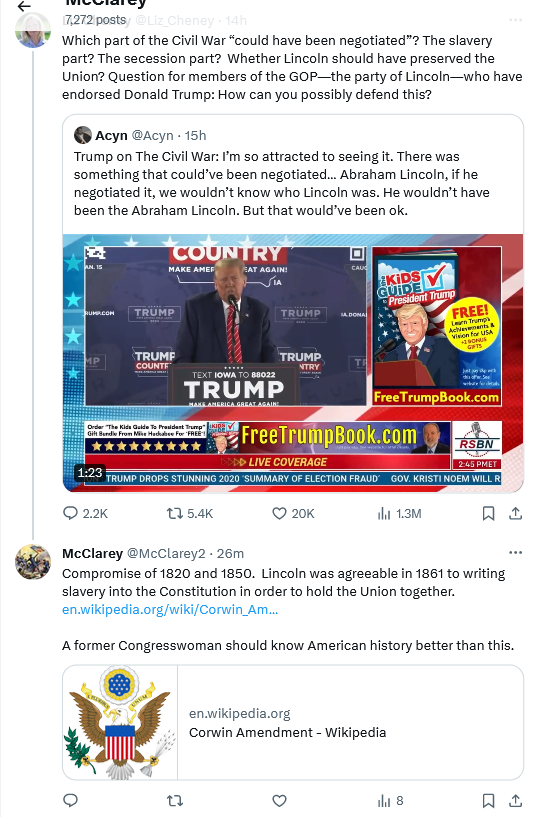



I heard a guy on a radio call in show say what Nicki Haley should have said when she was asked about slavery: “Thank God the Republicans won the Civil War.”
I notice that many of these critics who blast Trump either already despise him in general, …or have a vested interest in public perceptions of the Civil War. If they cajole everyone into believing the South fought exclusively to protect slavery–based exclusively on racist motives–they may persist with “anti-racism” efforts and profess the marvels of their “progressive” ideals and laws.
Never mind that most of them have already institutionalized their own acceptable racist attitudes. You know, I heard plenty during school and college about enslaved Africans or their descendants. ..Yet when someone during the 1990s mentioned the plight of the Irish in the North prior to the War, …oh, we can’t talk about THAT. ..Except to hate them as assumed racist filth. So we must fawn over ancestors of Africans, yet forget the struggles of our own peoples. How very charitable.
We too-often forget the degree of acrimony involved with even drafting the Constitution or ratifying it. We too-easily forget the degree of dispute over matters we rarely discuss today. We’re very well acquainted with the content of the Federalist papers; such arguments won out, after all. Yet reading the Anti-federalist papers reveals some interesting matters. There were those, especially in the South, who dreaded the Federal government becoming too powerful. Slavery was a dramatic issue, sure, yet taxes, tariffs, and who had the right to vote–and why, were also serious concerns.
Simply put, there were at least 3 concerns that helped spark the Civil War: Slavery, taxes and tariffs, ..and who would decide on either these, Federal or State government. There’s a reason why we hear about people tending to vote with their pocket-book. Slavery wound up being primarily the the last straw that finally broke the camel’s back.
It’ll be darkly humorous if we wind up having a second, shooting, Civil War…about the causes and content of the first one.
When a standing VP omits the first of the three God given rights while quoting from the Declaration of Independence it’s worse than disingenuous. It’s criminal.
Can’t say Life. (?) Nope.
Only Liberty and the Pursuit of Happiness is mentioned in her January 22nd Death to the innocent speech.
A Vice President of these United States.
Shame on her.
https://www.whitehouse.gov/briefing-room/speeches-remarks/2023/01/22/remarks-by-vice-president-harris-on-the-50th-anniversary-of-roe-v-wade/
Would also note that Lincoln chose as his Vice-President for his second term a pro-slavery, pro-union Democrat. Turned out that after Lincoln’s assassination, Johnson didn’t keep up his end of the program by promoting unity.
Johnson had been pro-slavery. By the time he was chosen as Veep he supported ending slavery.
Trump talking out of the southern end of his anatomy. What else is new?
The Corwin Amendment? So, to answer Cheney’s question, it’s slavery that Trump might’ve been willing to negotiate about?
… Not a good look.
Maybe I’m projecting onto Trump, but could it be that this is a man fully aware of the almost inevitable upheaval that this nation is barreling toward as a house divided. We can’t even have family gatherings without the real fear that our vastly different core beliefs will errupt during the meal.
Could it be that he knows bad things are coming and would prefer a workable truce instead of vast amounts of bloodshed. An 1850 Compromise instead of Antietam and Sherman’s March to the Sea.
It was Lincoln who was willing to accept the Corwin Amendment, to forestall a Civil War that devastated a quarter of the country, killed probably three quarters of million Americans out of a population of around thirty million amd maimed for life hundreds of thousands.
As late as August 1862 Lincoln stated, in his letter to Horace Greeley:
“My paramount object in this struggle is to save the Union, and is not either to save or to destroy slavery. If I could save the Union without freeing any slave I would do it, and if I could save it by freeing all the slaves I would do it; and if I could save it by freeing some and leaving others alone I would also do that. What I do about slavery, and the colored race, I do because I believe it helps to save the Union; and what I forbear, I forbear because I do not believe it would help to save the Union…. I have here stated my purpose according to my view of official duty; and I intend no modification of my oft-expressed personal wish that all men every where could be free.”
The actual text of the Corwin Amendment was as follows:
“No amendment shall be made to the Constitution which will authorize or give to Congress the power to abolish or interfere, within any State, with the domestic institutions thereof, including that of persons held to labor or service by the laws of said State.”
It states only that the federal Constitution will not “abolish or interfere, within any State” with its “domestic institutions”, including slavery. There are two important things it doesn’t say: it doesn’t forbid Congress from intervening in territories that are not yet states, and it doesn’t prevent slave states from deciding to abolish slavery on their own.* Considering that Lincoln campaigned on a platform of preventing the expansion of slavery, rather than advocating its immediate abolition regardless of the cost, it made sense for him not to oppose it as long as there was any hope of avoiding war.
As an historical footnote, 5 states — Kentucky, Ohio, Maryland, Rhode Island, and Illinois — actually ratified the Corwin Amendment; Illinois did so in 1863 — in the middle of the Civil War and after the Emancipation Proclamation had taken effect — and rescinded that action in 2022.
*Five slave states, in 1864 and early 1865, adopted state constitutions/amendments or passed laws abolishing slavery before the 13th Amendment was ratified. Granted, these were either border states that never seceded (Maryland, Missouri) or Confederate states that were mostly or entirely Union-occupied (Louisiana, Arkansas, Tennessee) and they did so only after it became obvious that the South was not going to win. But maybe they deserve a little credit for being proactive?
“There were at least 3 concerns that helped spark the Civil War: Slavery, taxes and tariffs, ..and who would decide on either these, Federal or State government. There’s a reason why we hear about people tending to vote with their pocket-book. Slavery wound up being primarily the the last straw that finally broke the camel’s back.”
This thought also occurred to me: insisting that the Civil War was only about slavery is kind of like insisting that WWII was only about Hitler. Or that, for Americans, it was only about Pearl Harbor.