
Russian Offensive Campaign Assessment, December 22, 2023
Kateryna Stepanenko, Riley Bailey, Angelica Evans, Karolina Hird, George Barros, and Frederick W. Kagan
December 22, 2023, 7:30pm ET
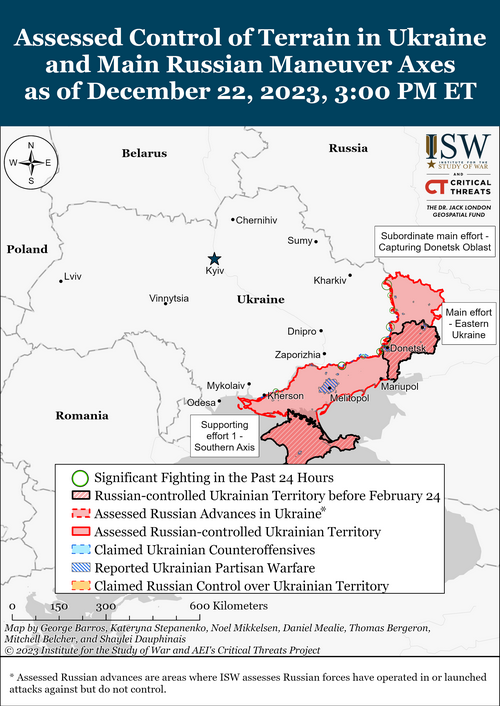
Click here to see ISW’s interactive map of the Russian invasion of Ukraine. This map is updated daily alongside the static maps present in this report.
Click here to see ISW’s 3D control of terrain topographic map of Ukraine. Use of a computer (not a mobile device) is strongly recommended for using this data-heavy tool.
Click here to access ISW’s archive of interactive time-lapse maps of the Russian invasion of Ukraine. These maps complement the static control-of-terrain map that ISW produces daily by showing a dynamic frontline. ISW will update this time-lapse map archive monthly.
Note: The data cut-off for this product was 2pm ET on December 22. ISW will cover subsequent reports in the December 23 Russian Offensive Campaign Assessment.
Ukrainian officials continue to warn that Russia maintains its maximalist objectives and additional goals for territorial conquest in Ukraine, despite recent comments made by Western officials suggesting that Russia is already defeated. NATO Secretary General Jens Stoltenberg stated on December 22 that Russian President Vladimir Putin “has lost Ukraine altogether” and can “no longer achieve its war goals,” which is a “major strategic defeat.”[1] Stoltenberg also cautioned against expectations in the West of a rapid end to the war. Stoltenberg’s comments echo comments made by US Secretary of State Antony Blinken on December 20, wherein Blinken stated that Russia has already failed to achieve its principal objective of erasing and subsuming Ukraine.[2] Deputy Chief of the Ukrainian Main Military Intelligence Directorate (GUR) Major General Vadym Skibitskyi, however, also stated on December 22 that even if Russia failed to achieve its operational-strategic objectives in 2023, Putin will simply shift Russia’s objectives to the next year, suggesting that it is premature to talk about Russia’s complete failure in the war thus far.[3] Skibitsky’s statement is consistent with ISW’s assessment that Russia continues to pursue Putin’s maximalist goals in Ukraine and that the current failure of Russian operations in Ukraine thus far is not a permanent condition.[4] A Russian source seized on Blinken’s comment and similar statements made by Western officials to propagate the narrative that these comments aim to justify reducing Western support for Ukraine.[5] Russian information space actors will likely continue to exploit Western statements regarding the failure of Russian operations in 2023 and falsely frame such statements as indicators that Western leaders intend to stop supporting Ukraine.
Ukraine will very likely receive the first batch of F-16s before the end of 2023. Dutch Prime Minister Mark Rutte confirmed on December 22 during a phone call with Ukrainian President Volodymyr Zelensky that the Dutch government will prepare an initial 18 F-16 fighter jets for delivery to Ukraine.[6] While Rutte did not confirm the timeline for F-16 delivery, a recent Estonian Ministry of Defense strategy document stated that the Netherlands, Denmark, Norway, and Belgium have already committed to donating F-16s to Ukraine “before the end of the year [2023].”[7]
The Russia Aerospace Forces (VKS) reportedly lost three Su-34 attack aircraft in southern Ukraine between December 21-22. The Ukrainian Air Force reported that Ukrainian forces downed three Su-24 aircraft on December 22 in the southern direction, and Russian milbloggers claimed that Ukrainian air defenses downed the Russian aircraft in the Kherson direction near Krynky.[8] Russian milbloggers responded to the isolated incident with great concern about Ukraine’s air defense capabilities in southern Ukraine.[9] The VKS previously lost two Mi-8 helicopters, a Su-34 bomber, and a Su-35 fighter during an incident in Bryansk Oblast on May 13, 2023, which Russian forces similarly seized on to voice anxiety over Ukrainian air defense capabilities.[10]
The Wall Street Journal (WSJ) named Russian President Vladimir Putin’s close ally and Secretary of the Russian Security Council, Nikolai Patrushev, as the individual responsible for the assassination of Wagner Group financier Yevgeny Prigozhin.[11] The WSJ, quoting Western intelligence officials and former Russian intelligence sources, reported that Patrushev, with Putin‘s permission, gave the order to ”dispose” of Prigozhin in early August 2023 by planting an explosive on the wing of Prigozhin’s jet. ISW had originally assessed on August 23 that Russian forces might have shot down Prigozhin’s jet on Putin’s orders, but evidence for that assessment was circumstantial, and ISW has no reason to doubt that the sources of the WSJ report are more reliable. Kremlin Spokesperson Dmitry Peskov accused the WSJ of putting forward a ”pulp fiction” conspiracy theory about Prigozhin’s death, however.[12]
The WSJ reported that Patrushev and other Kremlin officials warned Putin against using parallel armies, but that Putin committed Wagner forces shortly after Russian regular forces failed to accomplish the Kremlin’s invasion plan in February 2022. Patrushev reportedly began to warn Putin about Prigozhin‘s intentions in summer 2022, but Putin reportedly disregarded those concerns as Wagner forces were achieving battlefield successes. ISW previously assessed on March 12, 2023, that Putin allowed Prigozhin to expand the Wagner Group in spring and summer 2022 to avoid ordering an unpopular mobilization after Russian regular forces failed to capture Kyiv and culminated in western Luhansk Oblast.[13] Prigozhin became bolder throughout the summer and early fall of 2022 and started openly criticizing the Russian Ministry of Defense (MoD) and the General Staff in hopes of installing pro-Wagner commanders and officials within the Kremlin establishment.[14] ISW has previously observed that Putin encourages competition among different factions within the Kremlin and likely permitted the continuation of conditions in which Prigozhin could attack the Russian MoD to balance Kremlin officials and ensure that different factions competed to please him by accomplishing his stated objectives.[15] Kremlin sources similarly told the WSJ that Putin stood by his long-term practice of allowing the feud between Prigozhin and the Russian MoD to continue despite Patrushev’s concerns.
A former Russian intelligence officer reported that Putin’s relationship with Prigozhin changed after Prigozhin scolded Putin over the Wagner Group’s shortage of supplies over a phone call, which Patrushev and other Kremlin officials overheard in October 2022. ISW reported in late October about the Putin-Prigozhin discussion of battlefield realities and observed Putin issuing an oblique warning to Prigozhin on October 5, 2022, in an odd allusion to the Pugachev Rebellion that challenged Catherine the Great’s authority in the mid-1770s.[16] Patrushev reportedly seized on the phone call to convince Putin to distance himself from Prigozhin as Prigozhin showed disrespect to Putin’s authority – and Patrushev was ultimately successful in influencing Putin to cut communication with Prigozhin by December 2022. Putin’s trust in and affinity for Prigozhin may have also declined as Prigozhin failed to capture Bakhmut before the start of 2023 as he had likely previously promised to do. ISW assessed on March 12, 2023, that Putin likely allowed the Russian MoD to replace Wagner in Bakhmut in early January because Wagner had failed to capture Bakhmut by late December 2022. In March 2023, ISW observed Prigozhin publicly entertaining a claim that Patrushev and Putin were planning to ”neutralize” Wagner and Prigozhin given that there would be nothing remaining of Wagner in April or May 2023.[17] The claim that Prigozhin amplified also included Patrushev’s observation that Prigozhin would try to “unite the former and remaining active Wagner fighters under a far-fetched pretext,” arm them, and “send them to the territory of Russia in order to seize power in the regions bordering Ukraine with a possible advance inland” if Russian officials destroyed Wagner in Ukraine.[18] Prigozhin denied knowing about such claims at the time, and it appeared that the claim was falsely attributed to a Russian outlet.[19] Prigozhin’s engagement with the claim was likely deliberate, as he may have been attempting to obliquely signal to the public about Patrushev’s efforts to eliminate Wagner,
The WSJ’s sources revealed that the Kremlin then announced plans to dismantle Wagner as a fighting force by forcing all fighters to register with the Russian MoD by July 1 – leading to Prigozhin’s armed rebellion on June 23 and June 24. Prigozhin reportedly wanted to confront Chief of the Russian General Staff Valery Gerasimov and Defense Minister Sergei Shoigu in Rostov-on-Don. Both of them were reportedly at the Southern Military District (SMD) headquarters on the day of the mutiny before escaping as Wagner forces surrounded and seized the headquarters building. Patrushev reportedly took charge of the crisis and began arranging calls with Prigozhin, Belarusian President Alexander Lukashenko, and Kazakhstan’s President Kassym-Jomart Tokayev – who refused to assist Putin in quelling Prigozhin’s rebellion. Lukashenko reportedly presented Prigozhin with Patrushev’s proposal to allow Wagner to move to Belarus and to let Prigozhin operate abroad. Following the mutiny, the Kremlin let Prigozhin continue a seemingly normal life without punishment, and a US official noted that Kremlin officials were likely collecting information on Prigozhin and his allies prior to Patrushev’s assassination plan in August 2023.
Russian forces conducted a series of drone strikes against Ukraine on the night of December 21 to 22. The Ukrainian General Staff reported that Ukrainian air defenses destroyed 24 of 28 Russian-launched Shahed-131/136 drones.[20] Ukraine’s Southern Operational Command reported that Russian drones struck port infrastructure in Mykolaiv Oblast and targeted port infrastructure in Odesa Oblast.[21] Kyiv City Administration stated that Russian forces conducted a third series of drone strikes against Kyiv City in the last six days on the night of December 21 to 22, striking a multi-story residential building.[22] Russian sources claimed that Russian drones also struck targets in Dnipropetrovsk and Odesa oblasts.[23]
The Kremlin continues to position itself as a neutral arbitrator in the Israel-Hamas war despite its recent increasing anti-Israel rhetoric. Russian President Vladimir Putin held a telephone conversation with Palestinian Authority President Mahmoud Abbas on December 22 to discuss issues related to the “unprecedented” escalation of the Palestinian-Israeli conflict, primarily in the Gaza Strip.[24] Putin reportedly informed Abbas about Russian efforts to deliver humanitarian aid, including medicines and medical equipment, to Gaza.[25] Putin and Abbas reportedly called for an end to fighting and the resumption of a political settlement between Israel and Palestine.[26] Russian officials proposed on December 22 that the United Nations Security Council (UNSC) amend a humanitarian aid resolution to call for an ”urgent and sustainable cessation of hostilities.”[27] The Kremlin has routinely postured itself as a neutral actor ready to alleviate human suffering and de-escalate the conflict since the start of the Israel-Hamas war.[28] The Kremlin has expressed a much more anti-Israel position in recent weeks, however, and this increasingly non-neutral framing signals potential increased support for Iranian interests in the region and a Russian willingness to antagonize Israel.[29]
US President Joe Biden signed an executive order on December 22 granting the US Treasury Department the authority to impose sanctions on banks and other financial institutions that facilitate Russian sanctions evasion. The executive order allows the US Treasury Department to prohibit financial institutions facilitating Russian sanctions evasion from opening accounts in the US and to block all of a financial institution’s current and future property and interests in the US.[30] The order stipulates that any bank or financial institution may face these measures if it conducts or facilitates transactions on behalf of a person or entity that the Treasury Department’s Office of Foreign Assets Control (OFAC) has sanctioned for their involvement in the Russian defense industrial base (DIB) or in sectors that support Russia’s DIB.[31] US Treasury Secretary Jannet Yellen stated on December 22 that ”no one should doubt the resolve of the US and [its] partners when weighing the real risks” associated with support for Russian sanctions evasion.[32] The executive order also places sanctions on imports of Russian non-industrial diamonds, alcoholic beverages, and seafood.[33]
Russian officials continue to downplay deteriorating Russian-Armenian relations, possibly as part of a concerted campaign to improve the bilateral relationship amid concerns about Russia’s waning influence in the South Caucasus. Russian Ambassador to Armenia Sergei Kopyrkin stated during an interview with Kremlin newswire TASS on December 22 that Russia and Armenia remain “partners and strategic allies” united by common interests and history, despite “certain differences” in their bilateral and multilateral agendas.[34] Kopyrkin noted that the Armenian government maintains that it is not considering withdrawing from the Collective Security Treaty Organization (CSTO) or the Eurasian Economic Union (EAEU), the latter of which Armenia is scheduled to chair in 2024.[35] Kopyrkin stated that Russian and Armenian officials are negotiating new military-technical agreements and recently met to discuss the creation of ”operational communication channels” to resolve any disagreements in the bilateral relationship, specifically disagreements between Russian and Armenian media outlets.[36] Armenian TV and Radio Commission recently revoked the license of the Radio Tospa station, which is affiliated with Russian propaganda outlet Radio Sputnik, for 30 days due to derogatory comments made by Russian propagandists about Armenian Prime Minister Nikol Pashinyan and the Armenian people.[37] ISW has observed Russian officials, including Russian President Vladimir Putin, similarly downplay the deterioration of Russian-Armenia relations as Armenia has distanced itself from Russia following Russia’s failure to support Armenia during the Nagorno-Karabakh crisis in fall 2023.[38]
Key Takeaways:
- Ukrainian officials continue to warn that Russia maintains its maximalist objectives and additional goals for territorial conquest in Ukraine, despite recent comments made by Western officials suggesting that Russia is already defeated.
- Ukraine will very likely receive the first batch of F-16s before the end of 2023.
- The Russia Aerospace Forces (VKS) reportedly lost three Su-34 attack aircraft in southern Ukraine between December 21-22.
- The Wall Street Journal (WSJ) named Russian President Vladimir Putin’s close ally and Secretary of the Russian Security Council, Nikolai Patrushev, as the individual responsible for the assassination of Wagner Group financier Yevgeny Prigozhin.
- The Kremlin continues to position itself as a neutral arbitrator in the Israel-Hamas war despite its recent increasing anti-Israel rhetoric.
- US President Joe Biden signed an executive order on December 22 granting the US Treasury Department the authority to impose sanctions on banks and other financial institutions that facilitate Russian sanctions evasion.
- Russian officials continue to downplay deteriorating Russian-Armenian relations, possibly as part of a concerted campaign to improve the bilateral relationship amid concerns about Russia’s waning influence in the South Caucasus.
- Russian forces made confirmed advances northeast and southwest of Bakhmut and southwest of Avdiivka and continued positional engagements along the entire line of contact.
- A Ukrainian intelligence official reported that Russian forces are intensifying force generation efforts to keep pace with the rate of Russian losses in Ukraine so that they can sustain ongoing offensive operations along the front.
- Kremlin-appointment Commissioner on Children’s Rights Maria Lvova-Belova outlined new social support measures meant to further integrate occupied Zaporizhia Oblast into Russia during a working visit to the occupied oblast on December 22.
Go here to read the rest. Interesting Wall Street Journal article above on the assassination of Prigozhin, the head of the Wagner mercenaries. I assume that almost everyone in Russia assumes that Putin did it, but having confirmation of a suspicion is always more powerful than the mere suspicion. Putin has excellent personal security to survive as long as he has as the Russian strong man. I would imagine that there are elements of Wagner who would gladly kill Putin if they had the opportunity. Anyone within the Russian government who wishes to alter the disastrous Russian course might decide, eventually, to grant them the opportunity.


The Russians must think the Ukrainian presence on the east bank of the Dnipro River is a significant threat for them to put their air force in harm’s way.
If we had given Ukraine a proper supply of Stinger missiles as we did in Afghanistan in 1988-89, the Russians would have had a much greater incentive to real negotiations.
Don:
Praetorian Guards give great protection to emperors – until they don’t. I wonder if “don’t” is getting closer in Moscow.
Especially some dangerous person whose relative or friend got killed in Ukraine.