
Under the policy of “benign neglect” the 13 colonies from their foundation to the end of the French and Indian War had usually been left to their own devices by the British Crown and Parliament. Royal governors appointed by the King found themselves confronted by elected legislatures which effectively governed the colonies. Unpopular laws, at least unpopular in the colonies, passed by Parliament were dead letters in the colonies where attempts to enforce them were rare and local juries, in any case, would not convict those who ran afoul of such laws. Under these conditions the colonies throve, and the English government usually wisely looked the other way.
All of this changed at the end of the French and Indian War, and the cause of the change was money. England had won a smashing victory over France, annexing Canada and various other French colonies, but it had been an expensive victory and the new imperial responsibilities were not cheap. The English government, realizing that the Americans were the most lightly taxed people on Earth, decided that the 13 colonies should share in the financial burden. This was a radical break with tradition as Parliament had never directly taxed the colonies before.
The first of the taxes was the Sugar Act, a tax on sugar in 1764. This was followed swiftly by the Stamp Act tax of 1765, which required stamps showing payment of a tax on most printed materials, except for books. The reaction of the Americans was immediate, and actually predated the passage of the Act when rumors of it had reached America in 1764. The position of the Americans was well set out in the Virginia Resolves, authored by Patrick Henry and passed by the Virginia House of Burgesses on May 30, 1765:
“Resolved, That the first Adventurers and Settlers of this his majesty’s colony and Dominion of Virginia brought with them, and transmitted to their Posterity, and all other his Majesty’s subjects since inhabiting in this his Majesty’s said Colony, all the Liberties, privileges, Franchises, and Immunities that have at any Time been held, enjoyed, and possessed, by the People of Great Britain.
Resolved, That by the two royal Charters, granted by King James the First, the Colonists aforesaid are declared entitled to all Liberties, Privileges, and Immunities of Denizens and natural Subjects, to all Intents and Purposes, as if they had been abiding and born within the Realm of England.
Resolved, That the Taxation of the People by themselves, or by Persons chosen by themselves to represent them, who could only know what Taxes the People are able to bear, or the easiest method of raising them, and must themselves be affected by every Tax laid on the People, is the only Security against a burdensome Taxation, and the distinguishing characteristick of British Freedom, without which the ancient Constitution cannot exist.
Resolved, That his majesty’s liege people of this his most ancient and loyal Colony have without interruption enjoyed the inestimable Right of being governed by such Laws, respecting their internal Polity and Taxation, as are derived from their own Consent, with the Approbation of their Sovereign, or his Substitute; and that the same hath never been forfeited or yielded up, but hath been constantly recognized by the King and People of Great Britain.”
There we have it in a nutshell: Americans are not to be taxed except by taxes passed by their legislatures, and that their legislatures have the sole authority to make the laws governing their internal affairs. Ominously for British rule in the colonies, a Stamp Act Congress assembled in New York in October 1765. It produced a Declaration of Rights and Grievances, which reaffirmed the central point of the Americans that they could only be taxed by the action of their legislatures. Eventually all the colonies endorsed this Declaration of the Stamp Act Congress, and the value of concerted effort was hammered home to the Americans.
The uproar was so intense from the Americans that Parliament repealed the Stamp Act in February of 1766. William Pitt, the English Secretary of State who had led England to victory in the French and Indian War, now in opposition to the government, stated in Parliament: “I rejoice that America has resisted. Three millions of people, so dead to all the feelings of liberty as voluntarily to submit to be slaves, would have been fit instruments to make slaves of the rest.” Parliament also passed, Pitt and a handful of members voting against it, a Declaratory Act which stated:
“AN ACT FOR THE BETTER SECURING THE DEPENDENCY OF HIS MAJESTY’S DOMINIONS IN AMERICA UPON THE CROWN AND PARLIAMENT OF GREAT BRITAIN
Whereas several of the houses of representatives in His Majesty’s colonies and plantations in America have of late, against law, claimed to themselves, or to the general assemblies of the same, the sole and exclusive right of imposing duties and taxes upon His Majesty’s subjects in the said colonies and plantations; and have, in pursuance of such claim, passed certain votes, resolutions, and orders derogatory to the legislative authority of Parliament, and inconsistent with the dependency of the said colonies and plantations upon the crown of Great Britain: may it therefore please Your Most Excellent Majesty that it may be declared, and be it declared by the king’s Most Excellent Majesty, by and with the advice and consent of the Lords Spiritual and Temporal, and Commons, in this present Parliament assembled, and by the authority of the same, That the said colonies and plantations in America have been, are, and of right ought to be, subordinate unto, and dependent upon the imperial crown and Parliament of Great Britain; and that the king’s Majesty, by and with the advice and consent of the Lords Spiritual and Temporal, and Commons, of Great Britain, in Parliament assembled, had, hath, and of right ought to have, full power and authority to make laws and statutes of sufficient force and validity to bind the colonies and people of America, subjects of the crown of Great Britain, in all cases whatsoever.
II. And be it further declared and enacted by the authority aforesaid, That all resolutions, votes, orders, and proceedings, in any of the said colonies or plantations, whereby the power and authority of the Parliament of Great Britain to make laws and statutes as aforesaid is denied, or drawn into question, are, and are hereby declared to be, utterly null and void to all intents and purposes whatsoever.”
In short Parliament had complete control over the colonies, any actions of the colonial legislatures notwithstanding. In America the repeal of the Stamp Act was met with wild rejoicing and the Declaratory Act was ignored, most Americans assuming that it was a mere face saving device.
It was not. In 1767 Parliament passed the so-called Townshend Acts, named for Charles Townshend, Chancellor of the Exchequer (Treasury). Under the Revenue Act, duties were imposed on paper, paint, glass and tea imported into the colonies. The theory in Parliament was that since this was not an internal tax but rather an external duty, the colonists would not object. The Revenue Act also affirmed the use of writs of assistance, broad search warrants, as part of an effort of the British government to stamp out smuggling in the colonies. The Commissioners of Customs Act established the American Board of Custom Commissioners to enforce the trade restrictions preventing the colonies from freely trading with foreign countries and their colonies. The Vice Admiralty Court Act of 1768 established admiralty courts to prosecute trade and custom violations in the American colonies. No trial by jury was allowed in these courts, which was the whole point since colonial juries were quite reluctant to prosecute smugglers, who brought them cheap goods from foreign lands. The New York Restraining Act suspended the New York legislature for its failure to allocate funds for the quartering of British troops under the Quartering Act of 1765. The legislature avoided suspension by allocating the funds, but also passed a resolution stating that Parliament lacked the power to suspend an elected legislature.
The reaction in the colonies was explosive. Boycotts were organized against British goods throughout the colonies with George Washington taking the lead in Virginia. Petitions against the Acts were submitted to Parliament by the legislatures of Virginia and Pennsylvania. Parliament refused to receive the petitions. Colonial assemblies were threatened with dissolution if they followed the lead of the Massachusetts legislature in its circular letter protesting the Acts. When the Massachusetts legislature refused to rescind the circular letter it was dissolved. Prosecutions of smugglers, most notably John Hancock, made them popular heroes and inflamed popular opinion. British troops were brought into Boston in 1768 and evidence was sought of treason under the Treason Act of 1543, with the trials to be conducted in England. No treason prosecutions were undertaken due to difficulties with gathering evidence, but the threat of Americans being shipped to England to be tried for treason had a huge impact on American public opinion and increased the anger growing against King and Parliament. Growing tensions between troops and townspeople in Boston, culminated in the Boston “Massacre” on March 5, 1770, brought on by a mob of Bostonians attacking a small detail of British troops. John Adams successfully defended the troops against charges of murder and added lustre to American justice by demonstrating that even in those inflamed times an American jury was willing to acquit British troops based on evidence. Ironically, on the same day as the “Massacre”, the British Parliament, partially yielding to the unending American protests, repealed the imposts on paint, glass and paper, but kept the tax on tea.
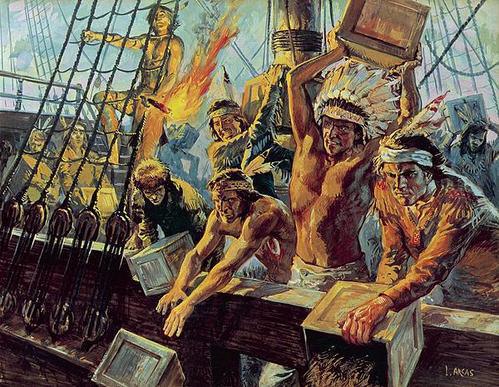
A brief period of relative peace ensued. The Tea Act of 1773 ended this period of peace. Parliament, seemingly unable to leave this issue alone, now allowed the nearly bankrupt East India Company to export tea directly to the colonies rather than through London. This actually cheapened the cost of the tea for the colonists, but the fatal flaw was the tax on the tea. As any man with any sense could have predicted in Parliament, the American reaction was intensely negative. Protests ensued throughout the colonies with the ships of the East India Company being refused the right to dock in several colonies, and in all the colonies but one, the tea that was landed was ultimately shipped back to England. In Massachusetts, Royal Governor Thomas Hutchinson refused to allow the East India ships to leave until the tea was unloaded. On December 16, 1773 the Boston Tea Party occurred and the crisis between Great Britain and America entered a new and more dangerous phase.
Initially many American leaders, including George Washington and Benjamin Franklin, disapproved of the Boston tea party. Parliament responded with the Restraining Acts in June of 1774.
The Boston Port Act closed the port of Boston until the East India Company had been recompensed for the tea dumped in Boston Harbor and until the King was satisfied that order had been restored.
The Massachusetts Government Act transformed the government of Massachusetts by making it in effect a department of the British Crown. Under the terms of the Government Act, almost all positions in the colonial government were to be appointed by the governor or the king. The act also greatly restrained the activities of town meetings in Massachusetts. Americans were especially aghast at this act. If this could be done to Massachusetts, what was to prevent the King and Parliament from altering in such a manner the government of any of the colonies?
The Administration of Justice Act allowed the governor of Massachusetts to move trials of accused royal officials to another colony or even to Great Britain if he believed the official could not get a fair trial in Massachusetts. This Act was commonly called the Murder Act in America since it appeared to many colonists to ensure that representatives of Great Britain would never again be brought to trial in America for any crimes they might commit, and thus could literally get away with murder.
The Quartering Act allowed the British to use unoccupied buildings for the quartering of troops in the colonies. Since the presence of the British troops was detested already by the colonists, one can imagine how hated was the commandeering of private buildings for the housing of these same troops.
There were wise men in Parliament who understood that these acts might well provoke the Americans into rebellion. William Pitt, now Earl of Chatham, spoke out against these acts as did Edmund Burke. In April of 1774 Burke pleaded with Parliament to reverse course and to simply revert to the policy of Great Britain prior to 1765 and allow the Americans to tax themselves:
“Again, and again, revert to your own principles—Seek Peace, and ensue it—leave America, if she has taxable matter in her, to tax herself. I am not here going into the distinctions of rights, not attempting to mark their boundaries. I do not enter into these metaphysical distinctions; I hate the very sound of them. Leave the Americans as they antiently stood, and these distinctions, born of our unhappy contest, will die along with it. They and we, and their and our ancestors, have been happy under that system. Let the memory of all actions, in contradiction to that good old mode, on both sides, be extinguished for ever. Be content to bind America by laws of trade; you have always done it. Let this be your reason for binding their trade. Do not burthen them by taxes; you were not used to do so from the beginning. Let this be your reason for not taxing. These are the arguments of states and kingdoms. Leave the rest to the schools; for there only they may be discussed with safety. But, if intemperately, unwisely, fatally, you sophisticate and poison the very source of government, by urging subtle deductions, and consequences odious to those you govern, from the unlimited and illimitable nature of supreme sovereignty, you will teach them by these means to call that sovereignty itself in question. When you drive him hard, the boar will surely turn upon the hunters. If that sovereignty and their freedom cannot be reconciled, which will they take? They will cast your sovereignty in your face. No-body will be argued into slavery. Sir, let the gentlemen on the other side call forth all their ability; let the best of them get up, and tell me, what one character of liberty the Americans have, and what one brand of slavery they are free from, if they are bound in their property and industry, by all the restraints you can imagine on commerce, and at the same time are made pack-horses of every tax you choose to impose, without the least share in granting them. When they bear the burthens of unlimited monopoly, will you bring them to bear the burthens of unlimited revenue too? The Englishman in America will feel that this is slavery—that it is legal slavery, will be no compensation, either to his feelings or his understanding.”
The voices of reason were ignored. In America the Restraining Acts quickly became known as the Coercive Acts and the Intolerable Acts. Americans were aghast, and many moderate Americans were moved to join those advocating resistance to Great Britain. Out of this furor came the First Continental Congress which met on September 5, 1774. The Congress called for a colony wide boycott of British goods commencing on December 1, 1774 and a Petition to the King, listing the grievances of the colonists and asking for redress of these grievances. The Congress also provided for a meeting of a Second Continental Congress on May 10, 1775. Rather than crushing American resistance, the Restraining Acts provoked a reaction which laid the basis for an embryonic federal government for the colonies.
The British overreaction to the Boston Tea Party provided the conditions that would burst into the flames of war in less than a year and a half.


We are there now with abortion, transgenderism, penalizing the poor who cannot afford health insurance with a fine for not buying health insurance. We are there now at the Boston Tea Party.