

America has fought many wars for land. See: the entire 19th century.
There is nothing shameful about that. But many modern "conservatives" are as clueless about the realities of the world and our own history as the leftists they pretend to oppose. https://t.co/VJkwcrFShp
— Matt Walsh (@MattWalshBlog) November 27, 2023
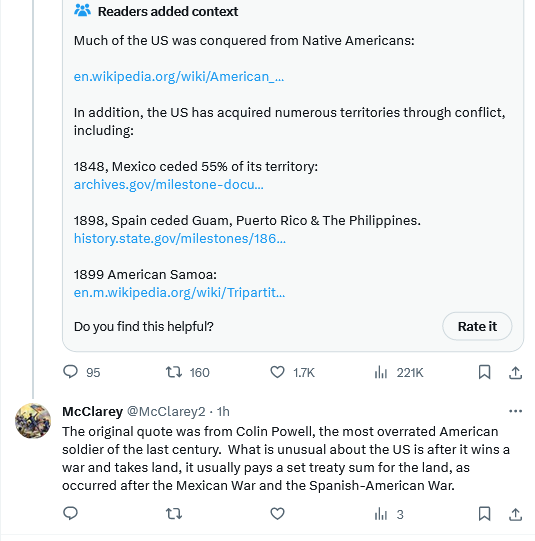 Powell probably stole the quote from General Mark Clark who was specifically referring to World War II. The “American Eagle” as Churchill ironically referred to Clark, was not the brightest of American generals and he probably stole it from someone else. McCarthy was a pretty decent Speaker, but what this demonstrates is how little most contemporary politicians know about the history of the nation they wish to have a part in leading. This will get worse as generation Wikipedia eventually comes into their own.


Just wait for Generation TikTok . . .
I see this as current-map bias, a form of presentism. We…grew, then once we were America-shaped, we didn’t conquer anything.
Seems to me there are distinctive problems with point of view.
That first quote refers to the Louisiana Purchase. Various tribes will certainly dispute rightful ownership, yet we bought that from France, not from Indians.
The others assume we took ownership of lands after having fought a war for them. Such is inaccurate. We fought Mexico for Texas, not the West; we fought Spain for Cuban independence and trade, not for the various islands we acquired afterward.
Then too, if we must ascribe ownership of lands as spoils of war, …that could accurately describe all of the Western Hemisphere. No Euro-derived peoples owned anything in North or South America before Columbus arrived. (Yes, I know, Leif Ericson found Canada before then, yet the Vikings didn’t do much with the discovery.)
As for Wikipedia, I haven’t found anything terribly inaccurate in general. They don’t present Catholic teaching or history accurately, yet I don’t often expect secular sites to be concerned with accuracy about events related to faith.
I don’t think McCarthy was all that good at his job.
In regard to the period since 1848, that’s pretty much true. The territories forcibly acquired since (Puerto Rico, Guam, American Samoa, Micronesia, and the Philippines) did not acquire that many settlers from the mainland in proportion to their local population, nor was their extensive agricultural colonization. As for the acquisitions from Mexico, they were largely populated with aboriginals who had no particular affinity for Americans or Mexicans. The population of Peninsulares, criollos, mestizos, and mission Indians was under 20,000 in California and perhaps 50,000 in New Mexico in 1850. The like population in Texas in 1835 was around 3,000. The county I grew up in in New York had a non-aboriginal population of 65,000 in 1840.
In my humble opinion and, yes, I used to teach U.S. History, the Mexican War of 1846-48, which may have been started on a tenuous thread at best, did result in our defeating the Mexican army. Why we didn’t take the entire country then, in my opinion, was due to the widespread anti-Catholic bias in the U.S. at the time. The part of Mexico that was taken/purchased as a result of the American victory had very few people (save for Texas), much less Catholics, compared to the area that comprises what stayed as Mexico (including what became the Gadsden Purchase of 1853). I’m in agreement with Art Deco’s stats regarding the other wars of the 19th century.
Little known in history is the Philippine Insurrection. “fought between the First Philippine Republic and the United States from February 4, 1899, until July 2, 1902. Tensions arose after the United States annexed the Philippines under the Treaty of Paris at the conclusion of the Spanish–American War rather than acknowledging the Philippines’ declaration of independence,developing into the eruption of open battle. The war can be seen as a continuation of the Philippine struggle for independence that began in 1896 with the Philippine Revolution against Spanish rule.” – Wikipedia
The war resulted in at least 200,000 Filipino civilian deaths, mostly due to diseases such as cholera and to famine. That number may be an underestimate. It was a brutal guerilla war.
The United States eventually granted full Philippine independence in 1946 through the Treaty of Manila.