
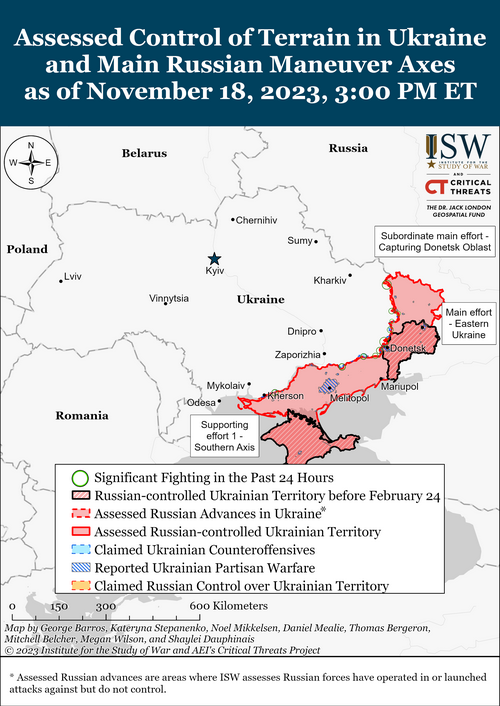
From The Institute For The Study of War:
Russian Offensive Campaign Assessment, November 18, 2023
Riley Bailey, Christina Harward, Angelica Evans, Kateryna Stepanenko, and Frederick W. Kagan
November 18, 2023, 5pm ET
Click here to see ISW’s interactive map of the Russian invasion of Ukraine. This map is updated daily alongside the static maps present in this report.
Click here to see ISW’s 3D control of terrain topographic map of Ukraine. Use of a computer (not a mobile device) is strongly recommended for using this data-heavy tool.
Click here to access ISW’s archive of interactive time-lapse maps of the Russian invasion of Ukraine. These maps complement the static control-of-terrain map that ISW produces daily by showing a dynamic frontline. ISW will update this time-lapse map archive monthly.
Note: The data cut-off for this product was 12:45pm ET on November 18. ISW will cover subsequent reports in the November 19 Russian Offensive Campaign Assessment.
Russian forces conducted a series of drone strikes against Ukraine on the night of November 17 to 18. Ukrainian military sources reported on November 18 that Ukrainian air defenses downed 29 of 38 Russian-launched Shahed-131/136 drones over multiple unspecified oblasts.[1] The Ukrainian Southern Operational Command reported that Russian Shaheds struck an energy infrastructure facility and administrative building in Odesa Oblast.[2] The Ukrainian Northern Operational Command reported that Russian Shaheds also damaged infrastructure facilities in Chernihiv Oblast.[3] Russian milbloggers claimed that Russian forces struck an oil depot in Altestove, Odesa Oblast, the Starokostyantyniv airfield in Khmelnytskyi Oblast, and Kyiv City, Kyiv Oblast.[4]
A Kyrgyzstan government official called on the Russian government to help Kyrgyz migrants in Russia against the backdrop of recent proposals from Russian government officials to decrease migrant work opportunities in Russia. Deputy Prime Minister of Kyrgyzstan Edil Baisalov met with Russian Deputy Prime Minister for Social Policy, Labor, Health, and Pension Provision Tatyana Golikova on November 17 and reiterated the importance of Russia providing families of Kyrgyz citizens working in Russia with compulsory health insurance in accordance with Eurasian Economic Union standards.[5] Baisalov stated that this would help create favorable conditions for Kyrgyz citizens in Russia. Prominent voices in the Russian ultranationalist information space responded to Baisalov’s statements by complaining that the Russian government’s migrant policy is too lenient and that Russian government officials either are not aware of the problem or do not want to fix it.[6]
Russian federal subjects and government officials have been increasingly introducing and proposing bills restricting migrants’ rights in the fall of 2023. Deputy Chairperson of the Russian State Duma Pyotr Tolstoy proposed a measure on November 14 that would restrict work opportunities for migrants from countries that have not designated Russian as a state language.[7] Russian political party A Just Russia-For Truth introduced three bills to the Duma on November 15 that would abolish work certificates for foreign workers, require Russian organizations to obtain permission from the Russian government to hire foreign workers, and require foreign workers to acquire a separate Russian work permit.[8] A Just Russia head Sergei Mironov stated that these measures will create order and ensure that the government “clearly understand[s] who is on the territory of the Russian Federation and why they are there.”[9] Several Russian federal subjects have banned migrants from driving minibuses and taxis, offering catering services, and selling alcohol and tobacco in Russia.[10]
Courts in the Republic of Dagestan reportedly continue to charge participants of the October 29 antisemitic riots with minor administrative crimes, while select Russian ultranationalists call for increased government control in order to curb the alleged spread of Islamic extremism in Dagestan. Russian authorities have reportedly charged 412 people for violating various articles of the Russian Administrative Code, including 394 people charged with violating procedures on holding assemblies and 18 people charged with organizing a mass gathering in public places.[11] A prominent Russian milblogger claimed on November 17 that a radical Salafi preacher spoke about the unrest in Dagestan and alleged that there are over 100,000 supporters of Salafism in Dagestan – an allegation that the milblogger rejected.[12] The milblogger also claimed that radical ideologues have become more active on the internet following the riots in Dagestan and that extremists are attempting to take advantage of the confusion caused by the spontaneity of the unrest.[13] Another Russian milblogger added that the Russian government needs to establish strict control over Dagestan in order to curb future unrest.[14] ISW previously assessed that the Russian leadership is likely avoiding more serious punishments for antisemitism in the North Caucasus out of concerns that they will inflame discontent towards the Kremlin.[15] Russian authorities also recently detained a Dagestani government official on corruption charges, likely in an effort to placate those calling for an increased federal government response to the unrest.[16]
The Russian government continues efforts to restrict citizens’ access to the internet and to strengthen its control over the Russian information space. Russian Prime Minister Mikhail Mishustin signed a decree on November 17 allowing the Russian Federal Service for Supervision of Communications, Information Technology, and Mass Media (Roskomnadzor) to block sites that publish information about methods to bypass sites blocked by the Russian government.[17] The Russian State Duma previously adopted a bill on October 17 that stipulates that presidential election campaign materials cannot be shown on sites restricted by Roskomnadzor, and the November 17 decree is likely in part related to controlling the Russian information space before the 2024 presidential elections.[18]
The European Commission will reportedly include sanctions on the sale of petroleum tankers to Russia in an upcoming sanctions package in an effort to curb Russian schemes to skirt the G7 price cap on Russian crude oil and petroleum products. Reuters reported on November 17 that the European Union’s upcoming sanctions package against Russia will ban the sale to Russia of tankers for crude oil and other petroleum products and will stipulate contractual clauses in the sale of tankers to third countries prohibiting the re-sale of tankers to Russia and the transfer of Russian crude oil and petroleum products that violate the G7’s price cap.[19] The Financial Times reported on November 14 that Western officials stated that Russia is likely currently selling almost all of its crude oil at or above the G7’s $60 per barrel price cap.[20] The Financial Times added that Russian export data for crude oil suggests that Russia sold crude oil at an average of roughly $80 a barrel in October.[21] Only 37 of the 134 vessels that reportedly ship Russian oil held insurance from Western countries, and Russia has reportedly increasingly relied on aging oil tankers with obscure ownership to build a ”shadow fleet” to sell crude oil and petroleum products above the G7 price cap.[22] European economic think tank Bruegel reported on October 11 that by July 2023 over 60 percent of tankers carrying Russian crude oil were covered by insurance from an unknown country of origin, whereas less than 20 percent of the tankers carrying Russian crude oil had been covered by unknown insurance at the start of Russia’s full-scale invasion of Ukraine.[23]
Key Takeaways:
- Russian forces conducted a series of drone strikes against Ukraine on the night of November 17 to 18.
- A Kyrgyzstan government official called on the Russian government to help Kyrgyz migrants in Russia against the backdrop of recent proposals from Russian government officials to decrease migrant work opportunities in Russia.
- Courts in the Republic of Dagestan reportedly continue to charge participants of the October 29 antisemitic riots with minor administrative crimes, while select Russian ultranationalists call for increased government control in order to curb the alleged spread of Islamic extremism in Dagestan.
- The Russian government continues efforts to restrict citizens’ access to the internet and to strengthen its control over the Russian information space.
- The European Commission will reportedly include sanctions on the sale of petroleum tankers to Russia in an upcoming sanctions package in an effort to curb Russian schemes to skirt the G7 price cap on Russian crude oil and petroleum products.
- Russian forces continued offensive operations along the Kupyansk-Svatove-Kreminna line, near Bakhmut, near Avdiivka, west and southwest of Donetsk City, in the Donetsk-Zaporizhia Oblast border area, and in western Zaporizhia Oblast and advanced near Avdiivka and Donetsk City.
- Russia has reportedly frozen prisoner of war (POW) exchanges with Ukraine since the summer of 2023.
Go here to read the rest. More of the recent same.

